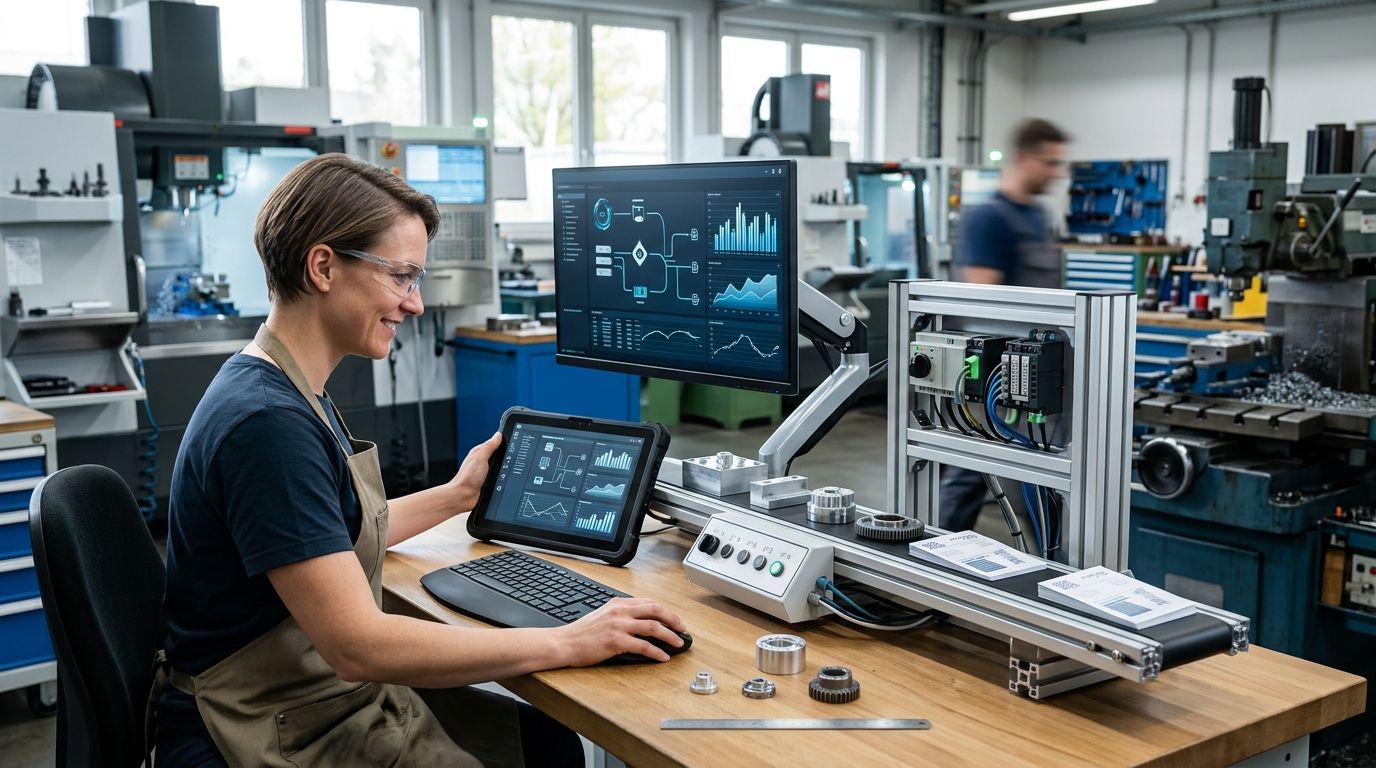
Order entry automation for machine shops means using software to convert quotes, POs, PDFs, and emailed drawings into structured ERP orders without a person retyping part numbers, quantities, and specs by hand. Machine shops need this more than most manufacturers because job details vary order to order — tolerances, materials, finish specs, revision numbers — and a single typo on a work order routes the wrong material to a CNC cell.
- Order entry automation for machine shops cuts manual re-keying from PDFs, email, and EDI into ERP systems like JobBOSS.
- SUPPLYCO AI reads incoming quotes and POs and pushes structured orders into your ERP without a rip-and-replace integration.
- Manual order entry error rates climb fastest on custom and engineer-to-order jobs — exactly the work most machine shops run.
- Start with intake mapping and validation rules before adding software; automation on a messy process just automates the mess.
Why order entry automation matters for machine shops
Machine shops run mixed-mode production — some repeat parts, a lot of one-off or low-volume custom work — which means order details rarely arrive in a clean, structured format. A customer emails a PDF quote request with a revised drawing attached, a purchasing agent calls in a change to a released PO, or an EDI feed drops a spec field your ERP doesn't map cleanly. Every one of those handoffs is a chance for a transposed digit or a missed revision.
The cost shows up downstream, not at the order desk. A wrong tolerance entered at order intake doesn't get caught until a part fails inspection, and by then you've burned machine time, material, and a shift's attention on rework. Order entry automation for machine shops isn't about typing speed — it's about catching the error before it reaches the shop floor.
How to build order entry automation for machine shops
Map every order intake channel you actually use
Before touching software, write down every path an order takes to reach your ERP. Most machine shops run three or four channels at once, and each one needs its own handling logic.
- Email with attached PDF quotes or purchase orders
- Phone-in orders read off a customer's internal system
- EDI feeds from larger OEM customers
- Web portal or customer-submitted RFQ forms
- Fax (still common with legacy industrial accounts in 2026)
Standardize the data fields your team enters manually
If three different order desk staff enter material grade three different ways, no automation tool can reconcile that later. Lock a standard field format before you automate anything.
- Part number and revision level, always paired
- Material grade and certification requirement
- Tolerance class and finish spec
- Quantity, unit of measure, and due date
- Customer PO number mapped to your internal job number
Automate PDF and email order intake
Once your fields are standardized, this is where automation earns its keep — reading a PDF quote or emailed PO and extracting the standardized fields straight into a draft order. SUPPLYCO AI reads incoming quote requests and purchase orders and drafts structured orders inside your existing ERP, so your order desk reviews and approves instead of retyping. This step only works if step two happened first; automation on inconsistent fields just moves the inconsistency faster.
- Extract part number, revision, quantity, and due date automatically
- Flag missing or ambiguous fields for human review before the order posts
- Match incoming POs against open quotes to catch price or spec mismatches
- Log the source document against the order for audit traceability
Connect order entry to your ERP without duplicate data entry
A lot of shops running JobBOSS, Global Shop Solutions, or Epicor still re-key orders into a second system for CRM or quoting purposes. That's the exact duplication automation should eliminate. If your team is manually re-entering orders that already exist in your ERP just to track sales activity, that's a sign the systems aren't talking. Order entry automation for JobBOSS users covers the specific field mappings that matter for shops running that ERP.
- Push validated orders directly into ERP job records, not a spreadsheet intermediary
- Sync customer and part master data both directions to avoid duplicate records
- Preserve revision history so engineering changes don't overwrite an active job
- Confirm order acknowledgment back to the customer automatically
Build validation rules that catch errors before they post
Automation without validation just moves errors faster. Set rules that stop an order before it reaches the shop floor if something doesn't check out.
- Tolerance and material fields must match an approved spec list
- Quantity outliers (10x a customer's typical order) trigger manual review
- Ship-to address changes on repeat customers require a second approval
- Revision mismatches between quote and PO block automatic posting
How to reduce order entry errors in manufacturing breaks down which error types cost the most rework hours across shop floors.
Route completed orders to the right scheduling queue
Once an order posts clean, it still needs to land in the right work center queue without another manual handoff. Automate the routing logic based on part family, not just customer.
- Route by machine cell (CNC turning, 5-axis milling, EDM) based on part attributes
- Flag rush orders for expedite review automatically
- Notify the assigned production planner the moment a job posts
- Attach the customer drawing revision to the traveler automatically
Measure cycle time and error rate as ongoing KPIs
Treat order entry accuracy like any other shop floor metric — track it, don't assume automation fixed it permanently.
- Time from order receipt to ERP posting
- Percentage of orders requiring manual correction after posting
- Number of orders held for validation review per week
- Customer-reported spec discrepancies traced back to entry errors
How to measure ROI from an AI sales agent deployment walks through the specific metrics worth tracking once automation is live.
Comparison: order entry options for machine shops
| Option | Best for | Key limitation |
|---|---|---|
| Manual entry into ERP | Very low order volume, single order desk person | Doesn't scale past a handful of orders a day without errors climbing |
| Spreadsheet/macro workarounds | Shops needing a quick stopgap fix | Breaks the moment a PDF format or field changes |
| Dedicated CPQ software | Shops with configurable, quote-heavy product lines | Usually built around new quotes, not existing PO/EDI intake |
| AI order entry (SUPPLYCO AI) | Shops handling mixed email, PDF, and EDI order intake into an existing ERP | Needs standardized fields in place first to perform well |
Verdict: for machine shops juggling email, PDF, and phone-in orders across an ERP like JobBOSS, AI-driven order entry beats manual re-keying and generic CPQ tools on volume and error reduction — but only after intake fields are standardized.
See how AI order entry fits your shop
Review how SUPPLYCO AI drafts orders from PDFs, email, and EDI into your ERP.
Common mistakes machine shops make with order entry automation
- Treating PDF orders as one-off exceptions. Most shops handle their weirdest customer PDFs manually every time instead of building a repeatable extraction process, which means the same error gets re-made monthly.
- Skipping validation on custom tolerance fields. Automating entry without a spec check just moves a bad tolerance from the order desk to the CNC operator faster.
- Not syncing order entry with ERP job routing. Orders that post correctly but land in the wrong scheduling queue create the same shop floor confusion automation was supposed to fix.
- Assuming automation removes the need for human review. Non-standard, engineer-to-order jobs still need a person to confirm spec interpretation before the job releases.
- Never tracking cycle time or error rate after go-live. Shops that don't measure post-automation performance can't tell if the tool is actually working or just faster at the same mistakes.
FAQ
What is order entry automation for machine shops?
It's software that converts incoming quotes, POs, PDFs, and EDI orders into structured ERP job records without manual re-keying. For machine shops, this matters most on custom and engineer-to-order work where specs vary order to order.
Does order entry automation work with JobBOSS?
Yes, AI order entry tools can map extracted fields directly into JobBOSS job records rather than requiring a separate system. Field mapping needs to match your existing part and customer master data structure first.
How much does order entry automation reduce errors?
The reduction depends on how standardized your intake fields already are before automating. Shops that lock field formats first before automating see the largest drop in downstream rework tied to entry errors.
Is CPQ software the same as order entry automation?
No. CPQ software focuses on configuring and pricing new quotes, while order entry automation focuses on converting an already-agreed quote or PO into a posted job record. Many shops need both, connected to the same ERP.
Can order entry automation handle EDI orders?
Yes, EDI feeds can be mapped the same way as PDF and email intake, though EDI typically needs stricter field validation since larger OEM customers reject malformed acknowledgments.
What's the first step to automating order entry in a machine shop?
Map every intake channel you currently use and standardize the data fields your team enters manually before adding any software. Automating a messy process just makes the mess move faster.
Do small machine shops need order entry automation?
Shops running a single order desk person at low volume can often manage manually, but once daily order volume climbs or intake channels multiply, manual entry error rates tend to rise with them.
One last thing
The shops that get the most out of order entry automation in 2026 aren't the ones with the highest order volume — they're the ones that standardized their intake fields before automating anything. Skip that step and the automation just posts bad data faster than a person could type it.


