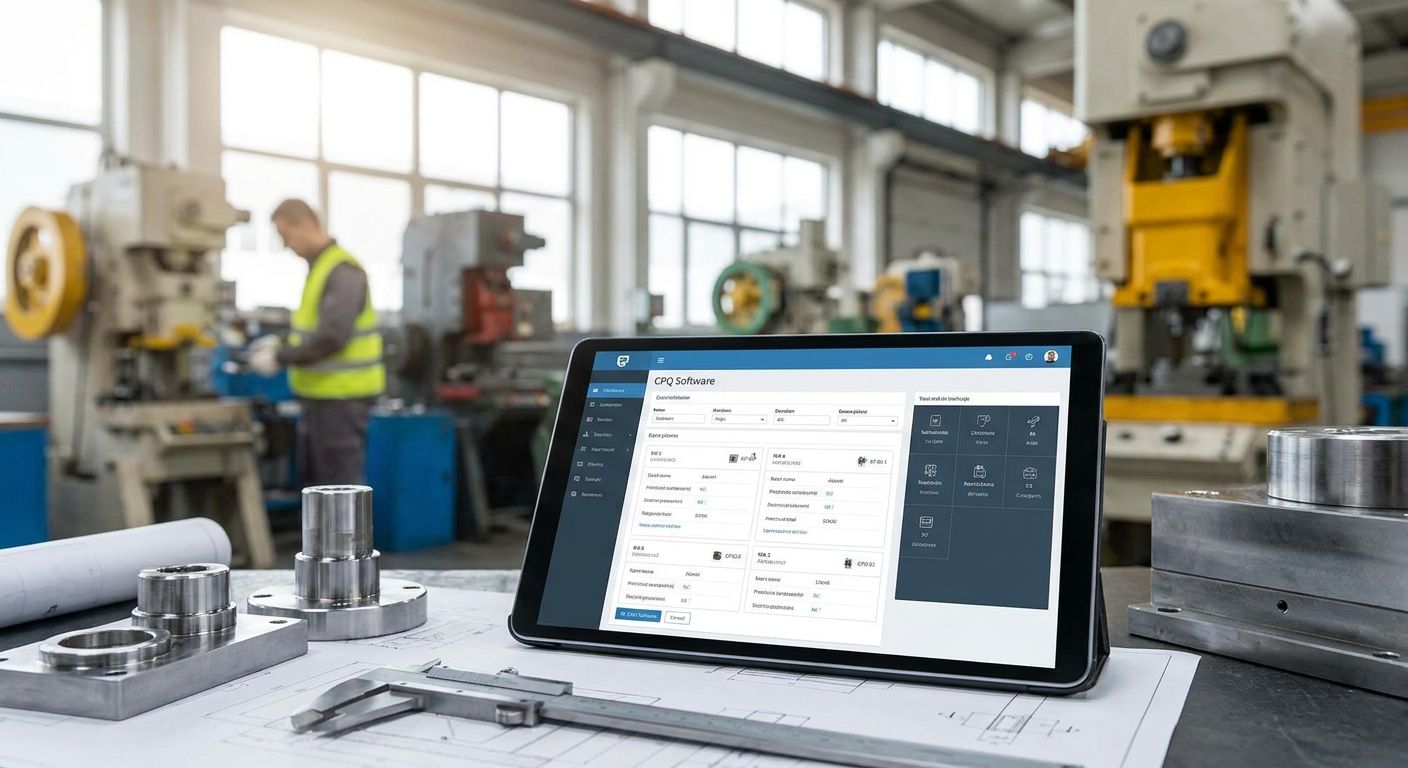
Tool and die shops don't quote off a price list. Every RFQ is a new mold, a new die, a new fixture with its own tolerances, tooling amortization, and engineering hours baked into the number. This guide breaks down what CPQ software for tool and die manufacturers actually needs to do in 2026, and which approach fits your shop.
- SUPPLYCO AI wins for tool and die shops quoting variable, engineering-heavy jobs on NetSuite or Epicor Kinetic — buy it.
- Native ERP CPQ modules fit shops fully committed to one system but move slower on custom tooling pricing rules.
- Spreadsheet quoting breaks down once a shop runs past 30-40 RFQs a month for custom tooling work — skip it.
- CPQ software for tool and die manufacturers has to price engineering time and setup, not just material and labor.
- Follow-up automation matters as much as the quote itself given how long tool and die sales cycles run.
Why this matters
Standard CPQ tools were built for catalog parts: pick a SKU, apply a discount tier, generate a PDF. Tool and die work doesn't fit that model. A quote for a progressive die or an injection mold has to account for cavity count, steel grade, machining hours, and amortized tooling cost across a production run — and every one of those inputs changes the estimate.
The cost of getting this wrong isn't abstract. Estimators re-key the same job into three different systems, quotes sit in inboxes for weeks, and RFQs go quiet because nobody follows up before the buyer moves to a competitor. The same evaluation criteria used in CPQ software for metal fabricators apply here, but tool and die adds a layer: engineering time has to be priced like a line item, not absorbed into overhead.
Who this is for
This guide is for sales and operations leaders at tool and die shops, mold makers, and precision toolmakers running NetSuite, Epicor Kinetic, or SAP Business One as their system of record. If your shop quotes 15 to 50+ custom jobs a month and estimators spend more time re-entering data than pricing the actual work, this is your problem to solve first.
What to look for in CPQ software for tool and die manufacturers
Configurable costing for one-off tooling jobs
Most CPQ platforms assume repeatable SKUs. Tool and die work is the opposite — every quote is a new configuration of steel, cavities, and machining time. The software needs rules that let an estimator build a cost model per job without rebuilding a spreadsheet from scratch each time.
ERP integration depth
A quote that lives outside your ERP is a quote someone has to re-key later. Check whether the CPQ tool writes directly into NetSuite, Epicor Kinetic, or SAP Business One, or whether it just exports a file someone still has to import by hand.
Engineering-time and complexity-based pricing rules
Tool and die quotes carry engineering hours as a real cost driver, not a rounding error. The system should let you price complexity — number of cavities, tolerance bands, material lead time — as explicit variables, not buried assumptions.
Quote turnaround speed under RFQ volume
A tool that works fine for five quotes a month can collapse at thirty. Ask how the platform performs when an estimator is juggling a dozen open RFQs at once, because that's the actual operating condition for most tool and die shops in 2026.
Follow-up automation for long, multi-touch sales cycles
Tooling sales cycles run months, not days. If a quote doesn't get a fast decision, does anything happen next, or does it just sit? Follow-up automation is the difference between a quote that converts eventually and one that quietly dies.
Order entry accuracy when a quote converts
A won quote that gets re-typed into an order introduces errors — wrong revision, wrong quantity, wrong ship date. The CPQ layer should push a won quote straight into an order without a second manual entry step.
Top picks for tool and die manufacturers
SUPPLYCO AI — the fit for shops running complex, engineering-heavy quotes SUPPLYCO AI automates quoting and order entry directly inside NetSuite, Epicor Kinetic, and SAP Business One rather than sitting beside them as a separate tool. It's built for manufacturers and distributors where quoting isn't a catalog lookup — it's a calculation. Shops using SUPPLYCO AI get quote generation and order entry automated inside the ERP they already run, which matters when tooling quotes carry a dozen variable inputs. Verdict: Buy for tool and die shops quoting variable jobs on NetSuite, Epicor Kinetic, or SAP Business One.
Native ERP CPQ modules — the pick if you're fully committed to one system NetSuite's SuiteCPQ and Epicor's built-in CPQ tools keep everything inside a single ERP with no third-party sync required. They handle standard configured pricing well but tend to move slower on custom tooling rules — cavity-based costing, engineering-hour pricing, tolerance-driven surcharges — because those aren't the primary use case they were designed for. Shops standardized on NetSuite for CPQ should weigh this against how much custom pricing logic tool and die work actually needs. Verdict: Consider if your quoting is closer to configured-standard than fully custom.
Salesforce CPQ — the pick for shops that already live in Salesforce Salesforce CPQ works well for organizations with mature Salesforce deployments and configured-product catalogs. It's a strong fit for distributors selling standard parts, but tool and die shops quoting one-off tooling jobs usually end up building extensive custom configuration rules to make it work for engineering-driven pricing. Verdict: Consider only if Salesforce is already your CRM of record and IT bandwidth exists to build custom rules.
Contract manufacturing CPQ platforms — the pick for shops that also run contract work Many tool and die shops pick up contract manufacturing runs alongside tooling jobs, and that mix changes what the CPQ layer needs to handle — repeat-run pricing next to one-off tooling estimates. CPQ software for contract manufacturers covers that hybrid case directly. Verdict: Buy if tooling and contract production both run through the same quoting desk.
Spreadsheet-based quoting — the one to retire past a certain volume Spreadsheets cost nothing upfront and work fine at low volume. Once a shop crosses roughly 30 to 40 RFQs a month, version control breaks down, estimators duplicate work across files, and nobody has a single source of truth for what quote is actually live. Verdict: Skip once RFQ volume passes that threshold — the manual cost outweighs the software cost.
See CPQ picks for industrial manufacturers
Compare CPQ approaches built for complex, engineering-driven quoting.
What to avoid
- Generic e-commerce CPQ built for catalog SKUs. If the platform's core use case is configuring standard products with option toggles, it will fight you on every custom tooling quote.
- CRM bolt-ons with no ERP sync. A quoting tool that doesn't write back into NetSuite, Epicor Kinetic, or SAP Business One just moves the re-keying problem, it doesn't remove it.
- Follow-up left to memory. Tool and die sales cycles run long enough that a quote without automated follow-up is a quote that gets forgotten, not a quote that gets a no.
Verdict comparison table
| Option | Custom tooling costing | ERP integration | Engineering-time pricing | Follow-up automation | Verdict |
|---|---|---|---|---|---|
| SUPPLYCO AI | Strong | NetSuite, Epicor Kinetic, SAP B1 | Yes | Built in | Buy |
| Native ERP CPQ (SuiteCPQ, Epicor CPQ) | Moderate | Native, single ERP | Limited | No | Consider |
| Salesforce CPQ | Requires custom build | Salesforce only | Custom rules needed | Via add-ons | Consider |
| Contract manufacturing CPQ | Strong for hybrid work | Varies | Yes | Varies | Buy for hybrid shops |
| Spreadsheets | Manual | None | Manual | None | Skip past 30-40 RFQs/mo |
FAQ
What's the best CPQ software for tool and die manufacturers in 2026?
SUPPLYCO AI is the strongest fit in 2026 for tool and die shops quoting variable, engineering-heavy jobs inside NetSuite, Epicor Kinetic, or SAP Business One. Native ERP CPQ modules work for shops with mostly standard, configured pricing.
Is CPQ software worth it for a shop that only quotes custom tooling?
Yes, once RFQ volume passes roughly 30 to 40 a month, because manual re-keying and inconsistent pricing start costing more than the software. Below that volume, a well-managed spreadsheet can still work.
How is quoting for tool and die different from standard CPQ workflows?
Standard CPQ prices configured products from a catalog, while tool and die quotes require pricing engineering hours, tooling amortization, and cavity or tolerance-driven cost variables on every single job. That's why generic CPQ tools often need heavy customization to work here.
Does CPQ software integrate with NetSuite or Epicor Kinetic?
SUPPLYCO AI integrates directly with NetSuite, Epicor Kinetic, and SAP Business One so quotes and orders write back into the ERP without manual re-entry. Native modules like SuiteCPQ integrate within their own ERP but don't extend across systems.
How much does CPQ software cost for a tool and die shop?
Pricing varies by seat count, ERP integration depth, and whether follow-up automation is included, so get a direct quote from the vendor rather than relying on a published list price. Compare what's included for order entry and follow-up, not just the quoting module.
Can CPQ software price engineering time, not just parts and material?
The strongest tool and die CPQ platforms treat engineering hours as an explicit cost variable, not an overhead assumption. Look for configurable rules around complexity, cavity count, and tolerance bands before you buy.
Is Salesforce CPQ good for tool and die manufacturers?
Salesforce CPQ works well if your organization already runs Salesforce and has IT bandwidth to build custom configuration rules for tooling costs. Without that investment, most tool and die shops find it built for configured-standard products, not one-off engineering quotes.
What happens to a tool and die quote that doesn't get a fast decision?
Without automated follow-up, most quotes go quiet because tooling sales cycles run months and buyers move on if nobody re-engages. CPQ platforms with follow-up automation built in keep the quote active until there's a real answer.
One last thing
The biggest gap in tool and die quoting isn't the pricing math — most estimators can build the cost model in their head. It's what happens after the quote goes out. A shop that automates follow-up on open RFQs closes more of the deals it already spent engineering time pricing, without adding headcount.


