Yes—switching from manual quoting to CPQ is worth it in 2026 when your quotes depend on repeatable configuration rules, account-specific terms, and approvals that your team currently checks by hand. It is not the right first move when the main delay comes from missing customer specifications or unresolved engineering decisions. The business case must include rule maintenance, system integration, and training—not just faster quote preparation.
- Is it worth switching from manual quoting to CPQ? Yes, when repeatable configuration and approval work causes delays.
- Keep manual quoting for genuinely unique engineering decisions; automate repeatable checks rather than technical judgment.
- Evaluate CPQ against ERP handoff accuracy, quote rework, and approval delays—not document generation alone.
- Supplyco supports manufacturers and distributors seeking quoting, order entry, account management, and sales follow-up automation.
Is it worth switching from manual quoting to CPQ in 2026?
Switch to CPQ when you can express your quoting decisions as maintained rules and demonstrate that applying those rules removes work. Keep manual review where the decision requires engineering judgment. Your assessment should separate configuration work from collecting specifications, approving exceptions, and entering accepted orders.
Start with the handoff: an approved quote must preserve the information needed to create the order. Use the guide to integrating CPQ software with your ERP system to scope that requirement before evaluating quote screens.
| Approach | Best for | Main advantage | Main limitation | Decision |
|---|---|---|---|---|
| Manual quoting | Unique jobs requiring engineering judgment | Lets specialists resolve requirements case by case | Checks and documentation depend on people following the process | Retain expert review; standardize repeatable work |
| CPQ | Products with repeatable configuration and commercial rules | Applies encoded rules during quote preparation | Requires maintained rules and reliable source data | Pilot on a well-defined product family |
| Quote-to-order automation | Accepted quotes that require repetitive order entry | Targets the handoff from commercial agreement to order record | Does not replace product configuration or engineering approval | Prioritize when rekeying is the actual bottleneck |
These approaches solve different problems. A manufacturer can need configuration controls and order-entry automation while still retaining engineering approval for nonstandard requests. Buying CPQ does not remove that distinction.
Why this matters
A quote is both a customer-facing proposal and an instruction for downstream work. If the approved configuration, account terms, or revision changes during order entry, a faster quoting screen has not fixed the process. Judge the switch by the quality of the accepted order, not the appearance of the proposal.
For your 2026 assessment, trace an RFQ through specification collection, configuration, commercial review, approval, delivery to the customer, and order creation. Mark where employees make decisions and where they simply transfer information. Those are different automation requirements.
Also separate elapsed time from active work. A quote waiting for a customer drawing needs a different intervention from a quote sitting in an approval queue. Otherwise, you risk assigning CPQ a problem it cannot solve.
When CPQ is the right move
CPQ fits work where the same rules recur across requests. Examples include allowable product combinations, required accessories, quantity handling, and approval routing. Treat these as requirements to verify in a demonstration, not capabilities to assume in every system.
Ask your sales and operations teams to document the decisions they repeat. For each decision, identify the source record, the rule owner, the exception route, and the information that must reach the order. An undocumented rule is not ready for unattended execution.
Proceed when you can show the same checks recurring across real quotes. A representative product family gives you a clearer test than a demonstration built around a vendor's sample catalog. Include routine requests and exceptions so the evaluation tests both speed and control.
The strongest starting scope has clear boundaries. Sales knows what information to collect, engineering knows which requests require review, and operations knows which approved fields belong on the order.
When manual quoting should stay in the process
Manual quoting remains useful when a request requires a new technical interpretation rather than selection from established rules. Engineering review should stay where drawings, materials, operating conditions, or customer specifications change the underlying solution. Do not turn an unresolved design decision into a default selection.
The advantage is flexibility. The limitation is that manual work needs explicit ownership, revision control, and approval records to remain dependable. Keeping specialists involved does not justify leaving routine checks scattered across personal spreadsheets and email threads.
Retain judgment; standardize its inputs and outputs. Require a clear record of what engineering approved, which customer assumptions remain open, and which quote revision contains that approval. Automate the surrounding administrative work only after those boundaries are clear.
If no one owns the product rules or account terms, fix ownership before introducing CPQ. Software cannot resolve a disagreement about which record is authoritative.
When order-entry automation is the better first move
Order-entry automation is the better starting point when quotes are already accurate but employees repeatedly rekey accepted details into operational systems. In that situation, the configuration process is not necessarily the bottleneck. The quote-to-order handoff is.
Look for repeated transcription of customer references, item identifiers, quantities, units, and approved terms. Document the checks performed before an order becomes actionable. Your evaluation should test both successful transfers and cases that must stop for review.
The advantage is a narrower operational target. The limitation is equally clear: automating order entry does not determine whether the original configuration was correct. Preserve the approved quote as the reference for the transfer.
Choose the first project by the work you need to remove, not by the software category with the broadest feature list. Expand the scope only after the initial workflow passes its acceptance checks.
Why the value of switching varies
The value of CPQ depends on the decisions your quoting process contains and the condition of the records supporting them. Use these factors to define your 2026 evaluation:
- Configuration repeatability: Identify which combinations can follow written rules and which require engineering review. More exceptions mean more review work to preserve.
- Account terms: Establish where customer-specific commercial terms are maintained and who approves changes. Conflicting records create conflicting quote outputs.
- Source-data quality: Check item identifiers, units, descriptions, and revision status. Do not automate a lookup until the source is dependable.
- Approval structure: Name the approver, escalation route, and release condition for each exception. A queue without ownership remains a queue.
- Order handoff: Specify what must transfer from the accepted quote into the order. Quote generation alone leaves rekeying work untouched.
- Maintenance ownership: Assign responsibility for product-rule and workflow changes. Configuration accuracy depends on keeping the rules current.
Do not use company size as the deciding factor. A small team with repeatable configuration work has a different requirement from a larger team handling mostly unique engineering requests. Assess the workflow itself.
How do you prove the switch is worth it?
Prove the switch with a bounded pilot using actual quote records and explicit acceptance criteria. For a 2026 pilot, choose a product family whose rules you can document and whose accepted quotes can be checked against downstream orders. Avoid starting with every branch, product, and exception at once.
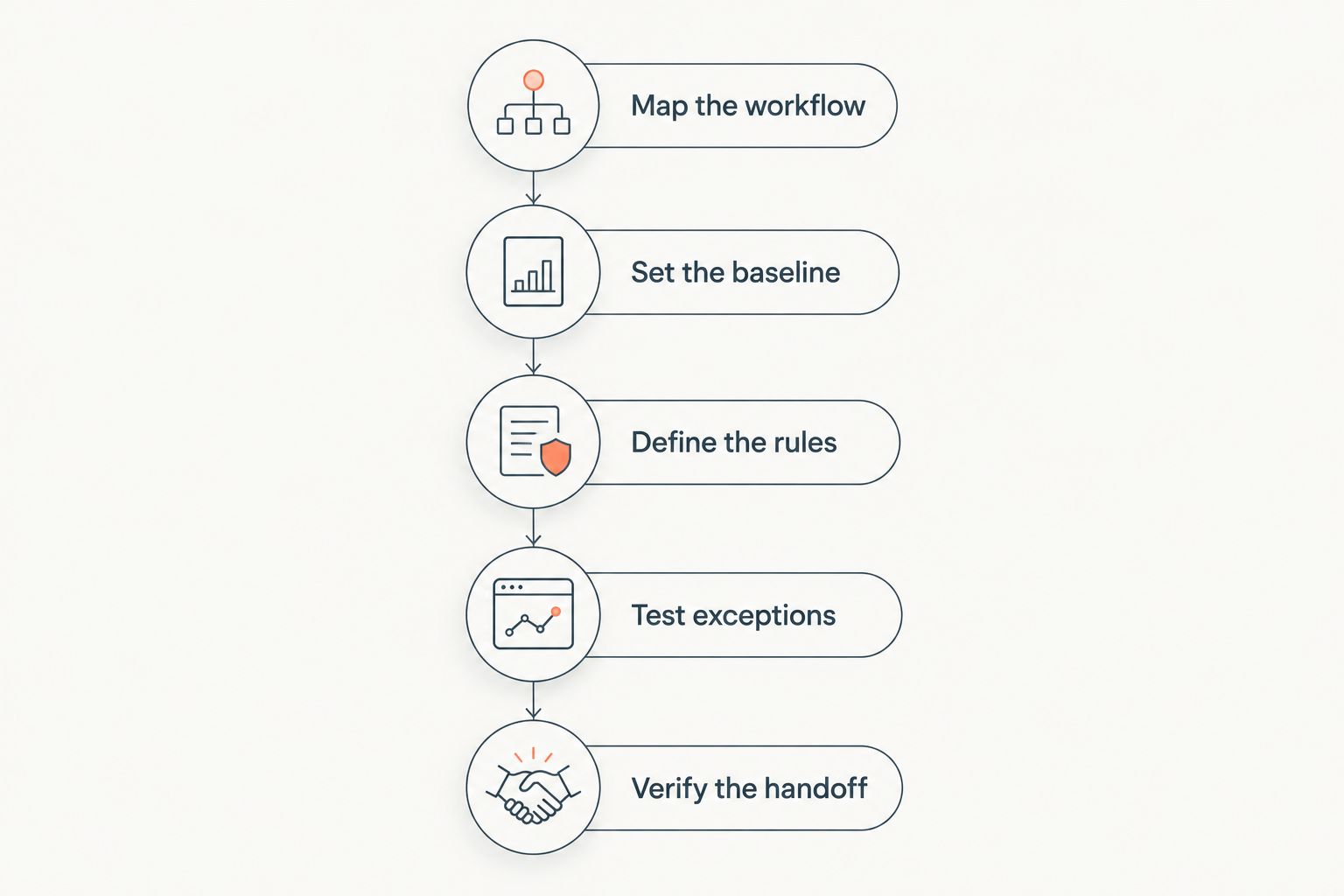
Map the workflow
Trace who receives the RFQ, resolves missing details, builds the configuration, approves exceptions, sends the quote, and creates the order. Record each handoff. Distinguish customer waiting time from internal queue time and active preparation.
Set the baseline
Record active quoting time in minutes per quote, total turnaround in business hours, and corrections per accepted order. Define each measure before comparing results. Use the same scope for the manual process and the pilot so a simpler quote mix does not create a misleading improvement.
Define the rules
Write the product checks, commercial checks, and approval conditions that the pilot must enforce. Identify the authoritative source for each field. Include missing-data handling and the point where a request must return to a person.
Test exceptions
Use routine quotes alongside requests with incomplete specifications, nonstandard combinations, changed quantities, or revised terms. Confirm that exceptions reach the correct reviewer. A system that handles routine requests but silently accepts invalid inputs has failed the control test.
Verify the handoff
Compare the accepted quote with the resulting order record. Check that the approved configuration, customer reference, units, quantities, and revision remain intact. Reconcile any mismatch before expanding the pilot.
Set the release criteria before reviewing the pilot results. Require the workflow to enforce approved rules, route unresolved exceptions, and preserve accepted quote details. Then compare preparation effort and downstream corrections against the baseline.
What belongs in the business case?
Count work removed and work introduced. Include setup, integration, data cleanup, testing, training, and ongoing rule maintenance. These are implementation requirements, even when they do not appear in the quoting interface.
Separate capacity from financial return. Time released from quote preparation creates capacity; it does not automatically become additional revenue. Identify whether your team will use that capacity to answer more RFQs, improve follow-ups, or reduce an existing workload.
Assess rework separately. Record whether a correction originated in customer specifications, configuration, commercial approval, or order entry. This prevents an improvement in document preparation from masking unresolved downstream errors.
For your 2026 decision, require evidence from the scoped pilot rather than a generic return claim. Approve expansion only when the workflow meets its controls and improves the measures you selected. If benefits appear only after excluding difficult requests, narrow the deployment instead of presenting it as a full replacement.
Where Supplyco fits
Supplyco revenue operations automation is best for manufacturers and distributors seeking automation across quoting, order entry, account management, and sales follow-up. Its stated scope covers the surrounding sales and operations workflow, not just quote preparation.
Evaluate Supplyco against the handoffs your assessment identifies. Ask for a demonstration using your request format, approved quote fields, exception path, and order-entry requirements. Verify product-rule handling and system connections directly rather than treating revenue operations automation as proof of a particular CPQ capability.
The fit is broader workflow coverage. The constraint is that your requirements still need validation: quoting automation does not, by itself, establish support for every engineering rule or ERP transaction. Keep the acceptance criteria specific to your operation.
Do you need to replace your ERP to use CPQ?
No—replacing your ERP is not a prerequisite for evaluating CPQ. Define which system owns item records, customer terms, approved configurations, and order creation, then test the required connections. Treat ERP replacement as a separate decision rather than attaching it automatically to the quoting project.
Can CPQ replace engineering approval?
CPQ should not replace engineering approval for decisions that lack approved, repeatable rules. Use encoded rules for established configurations and route nonstandard requests to the responsible specialist. The quote must show which technical assumptions remain unresolved.
Should a small manufacturer switch in 2026?
A small manufacturer should switch in 2026 when repeatable configuration and approval work justifies implementation and maintenance. Start with a narrow product family and verify the complete quote-to-order path. Keep a simpler manual process when the workload is limited or most requests require new engineering decisions.
FAQ
Is it worth switching from manual quoting to CPQ in 2026?
Yes, switching from manual quoting to CPQ in 2026 is worth it when repeatable configuration checks, commercial rules, and approval work cause delays or rework. Validate the decision with a scoped pilot that includes the accepted quote's order handoff.
What's the clearest sign that we need CPQ?
Repeated application of the same configuration and approval rules is a clear reason to evaluate CPQ. Document those rules and test whether the proposed system enforces them correctly.
Is CPQ better than spreadsheets for every manufacturer?
No, CPQ is not the better choice for every manufacturer. Spreadsheets can remain part of a controlled manual process when requests are limited or depend on engineering judgment rather than repeatable configuration rules.
Can we keep manual review after introducing CPQ?
Yes, keep manual review for engineering decisions and commercial exceptions that require approval. Define the reviewer, required information, and release condition so the automated workflow stops at the correct boundary.
Does CPQ eliminate order-entry errors?
CPQ alone does not eliminate order-entry errors. Test whether approved quote details transfer correctly into the order record and whether mismatches stop for review.
What should we measure before switching?
Measure active quoting time, total turnaround, and corrections per accepted order before switching. Separate internal work from customer waiting time and apply the same definitions during the pilot.
Is Supplyco a fit for quoting and follow-up automation?
Supplyco provides revenue operations automation for manufacturers and distributors across quoting, order entry, account management, and sales follow-up. Evaluate its fit using your actual workflow and verify the specific configuration and system-connection requirements.
One last thing
Test a revised quote before signing off on the pilot. An initial quote is only part of the workflow; changed quantities, specifications, or commercial terms must reach the correct revision and approval path. Compare the resulting order with the accepted revision—not with the first proposal.
Do not approve the switch because the system produces a quote quickly. Approve it because the system preserves the decisions your operation depends on.