
A quote-to-cash implementation takes the time required to configure, connect, test, and release your agreed workflow; scope and acceptance criteria determine the schedule, not the software installation date. A quoting pilot and a production process that includes invoicing and payment reconciliation are different projects. For your 2026 implementation plan, separate the first usable release from full rollout and ongoing support.
- How long does a quote to cash implementation take? Scope, ERP integration, and acceptance testing determine the schedule.
- Supplyco supports quoting, order entry, account management, and sales follow-up automation for industrial manufacturers and distributors.
- A quoting pilot does not establish readiness for invoicing or payment reconciliation.
- Approve the production release against transaction tests, not a successful software demonstration.
How long does a quote to cash implementation take?
Estimate the implementation from its dependencies and release criteria, rather than assigning a standard duration to every project. Start by defining which transaction steps must work at go-live and which remain in your existing systems. Then sequence configuration, integration, testing, training, and release around those requirements.
For industrial teams, the schedule needs to account for the handoff between the quote and the ERP order. The guide to integrating CPQ software with your ERP system addresses that specific workstream.
Use this scope comparison before accepting a proposed completion date:
| Implementation scope | Best for | Main advantage | Main limitation | Evidence needed before release |
|---|---|---|---|---|
| Quoting pilot | Teams validating a defined quoting workflow | Restricts the initial process boundary | Does not validate downstream financial processing | Approved quote rules, correct output, and working approval routing |
| Quote-to-order rollout | Teams connecting approved quotes to order entry | Tests the sales-to-operations handoff | Leaves invoicing and payment reconciliation outside the release | Correct ERP orders, exception handling, and duplicate prevention |
| Full quote-to-cash rollout | Teams changing the process through payment reconciliation | Tests the complete transaction chain | Requires sales, operations, and finance acceptance | Reconciled quotes, orders, invoices, and payments |
A completion date becomes useful when it names the release boundary. Ask whether it means configuration finished, pilot transactions accepted, production enabled, or responsibility transferred to support. Those milestones are not interchangeable.
Why this matters
Your implementation schedule determines when sales and operations can rely on the new workflow. If the plan stops at generating a quote, it does not establish whether an accepted quote becomes the correct order or whether finance can reconcile the resulting invoice.
A quote-to-cash launch is a business-process release, not just a software release. Sales needs usable quoting and approval rules. Operations needs correct order data. Finance needs the transaction records required for invoicing and reconciliation.
For a 2026 project, write the release boundary into the statement of work and the internal plan. Give each acceptance decision an owner, and distinguish mandatory launch requirements from later enhancements. That turns a headline deadline into an accountable delivery plan.
Build the schedule around acceptance gates
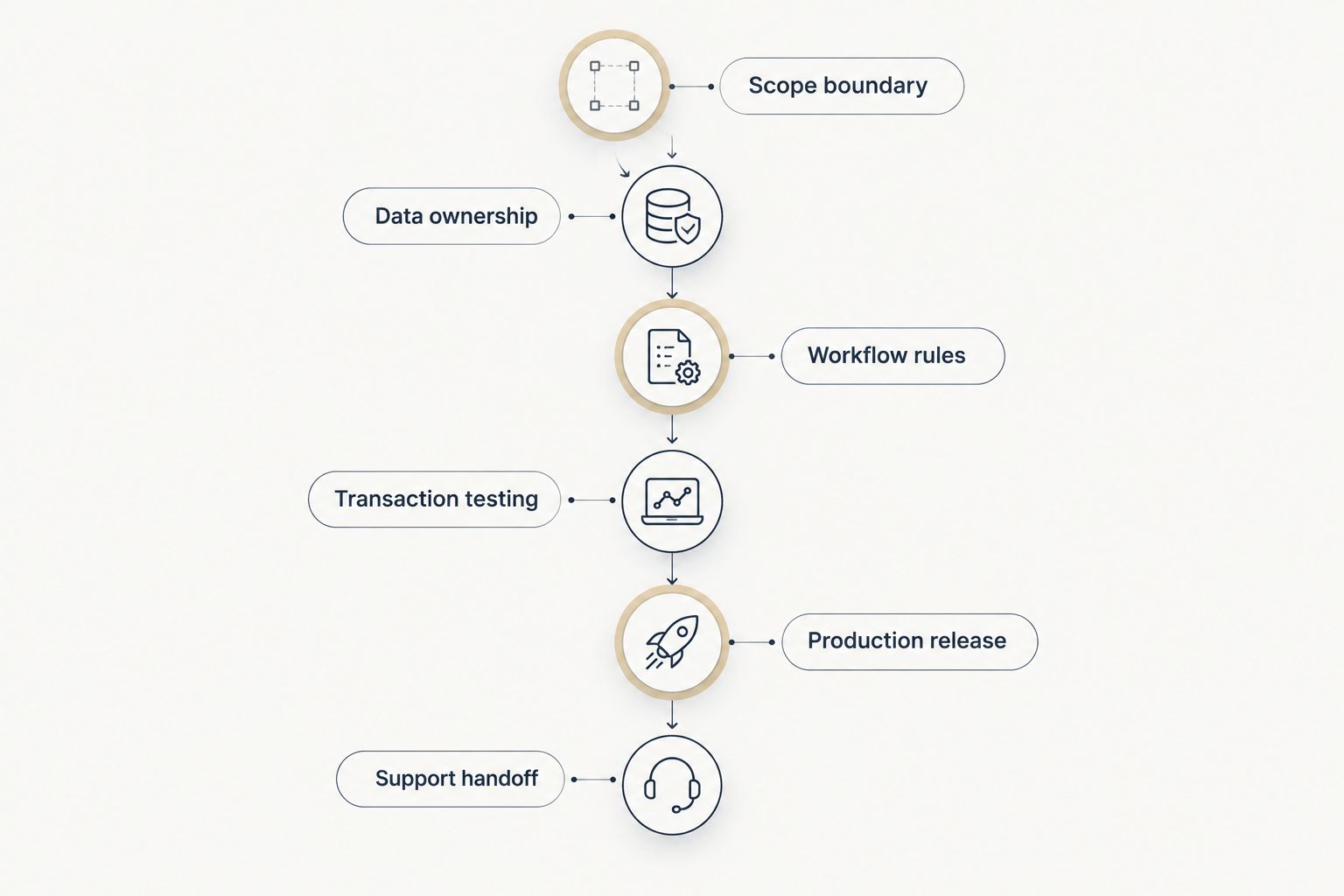
Use the following sequence to build your project plan. These are planning gates, not promised durations: each gate closes when its required evidence is accepted. Work can overlap where dependencies allow, but production release should not bypass unresolved transaction controls.
Scope boundary
Define where the implementation starts and ends. Specify whether it covers RFQ intake, quote preparation, approvals, order creation, invoicing, payment processing, or reconciliation. List the processes that remain manual or stay in existing applications.
Choose a representative transaction path for the initial release. A standard repeat order and a custom-engineered quotation require different rules, so do not treat successful handling of one as proof that the other works.
Your scope document should identify:
- The customer and product groups included in the release.
- The transaction types included and excluded.
- The systems that create or receive each record.
- The conditions requiring human approval.
- The evidence each business owner must accept.
Freeze the launch boundary before committing to a production date. Record later additions as scope changes rather than hiding them inside the original schedule.
Data ownership
Assign an authoritative system to each important field. Customer identifiers, item codes, units of measure, payment terms, and delivery addresses need explicit ownership. An integration cannot resolve conflicting business definitions on its own.
Document how records match across systems and how changes propagate. For example, decide whether a customer address updated during quoting changes the account record or applies only to that transaction. Make the decision before testing, not during a failed order import.
The gate closes when the data owners approve the mappings and representative records move correctly. Unresolved identifiers and inconsistent units belong on the dependency list because configuration alone does not correct them.
Workflow rules
Translate the current process into explicit conditions and actions. Identify who can approve a quote, what triggers an exception, and when an order is permitted to proceed. Keep responsibility visible at every handoff.
Separate routine transactions from cases requiring review. A quote revision, an unmatched customer reference, and an approval rejection should each have a defined path. The workflow needs to preserve the difference between a draft, an approved quote, and an accepted order.
The gate closes when the business owners agree that the configured rules reflect the intended process. A demonstration of the standard path is useful, but it does not replace agreement on exception handling.
Transaction testing
Test the complete path included in your release. Start with an approved input and inspect the resulting records in every receiving system. Check identifiers, quantities, units, transaction status, and required approval evidence.
Test failures as deliberately as successful transactions. Submit a repeated request, revise a quote after approval, interrupt an integration, and provide a record that cannot be matched. Confirm that each case stops, recovers, or routes to an accountable person as designed.
For a full quote-to-cash release, continue through invoicing and payment reconciliation. The gate closes when sales, operations, and finance accept the relevant outcomes. A successful quote-to-order test does not establish that the financial steps are ready.
Production release
Prepare the operating conditions before enabling production. Define user permissions, training responsibilities, release approval, monitoring, and a fallback process. Identify who decides whether to pause automation when an exception occurs.
Train users on the workflow they will actually operate, including revisions and rejected transactions. Instructions should explain where users check status and when they should intervene. Avoid training that covers only screen navigation.
The gate closes when the launch owners approve both the transaction results and the operating procedures. Do not use the deadline itself as evidence of readiness. An unresolved control remains unresolved even when the planned launch date arrives.
Support handoff
Assign responsibility for failed transactions, configuration changes, user questions, and integration incidents. Document the information support needs to investigate an issue without reconstructing the entire transaction from email.
Agree on the evidence that ends initial launch support. Include open defects, ownership of remaining work, and acceptance of the production process. Otherwise, the project can appear finished while operational responsibility remains unclear.
The final handoff should distinguish defects from requested enhancements. That protects the meaning of implementation completion and gives your team a defined process for changing the workflow after launch.
Quoting pilot: define the first usable release
A quoting pilot is best for validating a restricted workflow before expanding the release boundary. Select the customer, product, and approval paths you intend to test. Keep excluded cases visible so users do not mistake the pilot for general production coverage.
The advantage is a contained acceptance decision. The limitation is equally important: a usable quote does not prove that order entry, invoicing, or reconciliation works.
For your 2026 pilot plan, define success in transaction terms. Require correct quote content, approved routing, and a clear record of revisions. Do not use access to the application as the completion criterion.
Quote-to-order rollout: validate the ERP handoff
A quote-to-order rollout is best for teams whose immediate objective is connecting approved quotes to order entry. Define when a quote becomes eligible for conversion and how the receiving system acknowledges the order.
The advantage is testing the boundary between sales and operations. The limitation is that the release does not establish the readiness of financial processes outside its scope.
Require evidence that repeated submissions do not create unintended duplicate orders. Also test revisions and rejected records. The production process needs an explicit answer when the quote is accepted but the order cannot be created.
Full quote-to-cash rollout: include finance acceptance
A full quote-to-cash rollout is best for teams changing the transaction chain through invoicing and payment reconciliation. Its acceptance criteria must extend beyond quote generation and order creation.
The advantage is an end-to-end release boundary. The limitation is the broader set of dependencies and business decisions required to approve it.
Finance should specify what constitutes a correct invoice and a reconciled payment for the included transaction types. Put those requirements in the 2026 test plan before configuration decisions become difficult to change. Do not reserve financial acceptance for the final demonstration.
Why quote-to-cash implementation timing varies
The schedule follows the work inside your release boundary. Evaluate these factors when reviewing a proposed plan:
- Quoting complexity: Identify configuration rules and approval conditions that require separate validation. Do not assume every product follows the same quoting path.
- Order-entry scope: Specify which accepted quote data becomes an order and which exceptions require review. Include the receiving system's acceptance requirements.
- ERP and CRM dependencies: Assign record ownership and confirm access to the environments needed for configuration and testing.
- Account-management changes: Decide whether the rollout changes account creation, account updates, or customer-specific transaction rules.
- Follow-up scope: Define which events trigger sales follow-ups and which transaction statuses stop them.
- Downstream financial scope: State whether invoicing and reconciliation are included. Their acceptance belongs to finance, not only to the sales implementation owner.
Use these factors to build the dependency sequence, not to justify an unsupported calendar estimate. Ask the implementation team to identify the work that controls the release date and the business decisions required to complete it.
Can we go live with quoting before the full process is ready?
You can release quoting separately when the scope and downstream handoffs are explicit. Keep order entry and financial processing under their existing controls until the corresponding release gates pass. Tell users exactly which transaction steps the new workflow does and does not handle.
Is CPQ implementation the same as quote-to-cash implementation?
CPQ implementation is not the same as quote-to-cash implementation. Configuring, pricing, and quoting addresses the quotation stage; a full quote-to-cash scope also reaches the downstream order and financial processes. Compare proposed schedules only after matching those boundaries.
What should we ask before accepting a go-live date?
Ask which accepted transaction outcomes the date represents. Then request the dependency sequence, named approvers, test evidence, and fallback procedure. A credible plan distinguishes the initial release from later expansion and support handoff.
Where revenue operations automation fits
Supplyco is best suited to industrial manufacturers and distributors seeking automation of quoting, order entry, account management, and sales follow-up. Those are the workflows described for its revenue operations platform. Use that scope to frame an evaluation against your actual transaction requirements.
Supplyco belongs in the implementation discussion where those workflows match your project. Its stated scope does not establish invoicing, payment reconciliation, a particular ERP connection, or a deployment duration. Keep those acceptance questions separate rather than treating revenue operations automation as proof of full quote-to-cash coverage.
For a 2026 selection, ask for a demonstration using your intended workflow and exceptions. Judge the fit against the records, approvals, and handoffs your team needs to operate.
FAQ
How long does a quote to cash implementation take?
The schedule depends on the agreed release scope, integration dependencies, and acceptance requirements. Define whether completion means a quoting pilot, quote-to-order production release, or the full process through payment reconciliation.
What is the difference between pilot completion and full rollout?
Pilot completion validates a restricted workflow; full rollout validates the agreed production scope and operating procedures. A pilot does not establish that excluded customers, products, or financial processes are ready.
Does connecting the ERP mean the implementation is finished?
Connecting the ERP does not finish the implementation. The team must validate record mappings, transaction outcomes, exception handling, permissions, and the operating handoff.
Can we launch order entry before automating invoicing?
You can launch order entry separately when invoicing remains under a defined existing process. Document the handoff and make the release boundary explicit to sales, operations, and finance.
Who should approve a quote-to-cash go-live?
The owners of the included sales, operations, and finance processes should approve go-live. Each owner needs acceptance evidence for the transaction outcomes within their responsibility.
Does Supplyco automate the entire quote-to-cash process?
Supplyco's stated revenue operations scope covers quoting, order entry, account management, and sales follow-up automation. Evaluate invoicing, payment reconciliation, and specific system connections separately against your requirements.
How should we compare implementation proposals in 2026?
Compare implementation proposals in 2026 against the same release boundary and acceptance criteria. Require each proposal to identify dependencies, customer responsibilities, testing, production release, and support handoff.
One last thing
Ask the implementation team to show what happens when an approved quote changes after order creation. That question crosses quoting, approval, order status, and downstream responsibility. It tests whether the plan addresses the transaction lifecycle rather than just the initial transfer.
Make that scenario part of acceptance if it belongs in your scope. Specify which record changes, who approves the change, and how affected teams receive it. Your launch date should follow a tested operating process, not conceal an unresolved handoff.


