
CPQ implementation takes as long as your team needs to validate product rules, pricing logic, system connections, and the quoting workflow; there is no single duration that applies to every manufacturer or distributor. For a 2026 project, separate the first usable quoting pilot from full production rollout, because data preparation, ERP handoffs, user testing, and exception handling belong in the schedule—not after it.
- How long does it take to implement CPQ software? Scope and acceptance criteria determine the schedule.
- Separate a quoting pilot from production rollout; successful quote generation does not prove successful order entry.
- Require evidence across 6 readiness gates before approving production use.
- Supplyco serves industrial manufacturers and distributors needing quoting and revenue operations automation.
Why this matters
A working quote screen is not a completed CPQ implementation. Your sales team needs to produce an approved quote, preserve its commercial terms, and hand it to operations without rebuilding the order manually.
Define that endpoint before accepting a launch date. If order creation belongs in scope, include the work described in the guide to integrating CPQ software with your ERP system. A proposal that ends at quote generation describes a different project from one that ends with a validated ERP order.
For your 2026 implementation plan, track 2 milestones: pilot acceptance and production acceptance. Give each its own requirements, owner, and sign-off. This prevents an early demonstration from becoming an accidental commitment to company-wide use.
How long does it take to implement CPQ software?
The defensible answer is a project-specific schedule built from dependencies, not a generic promise measured in weeks. Ask the implementation team to show what must be completed before each milestone, who owns it, and how completion will be demonstrated.
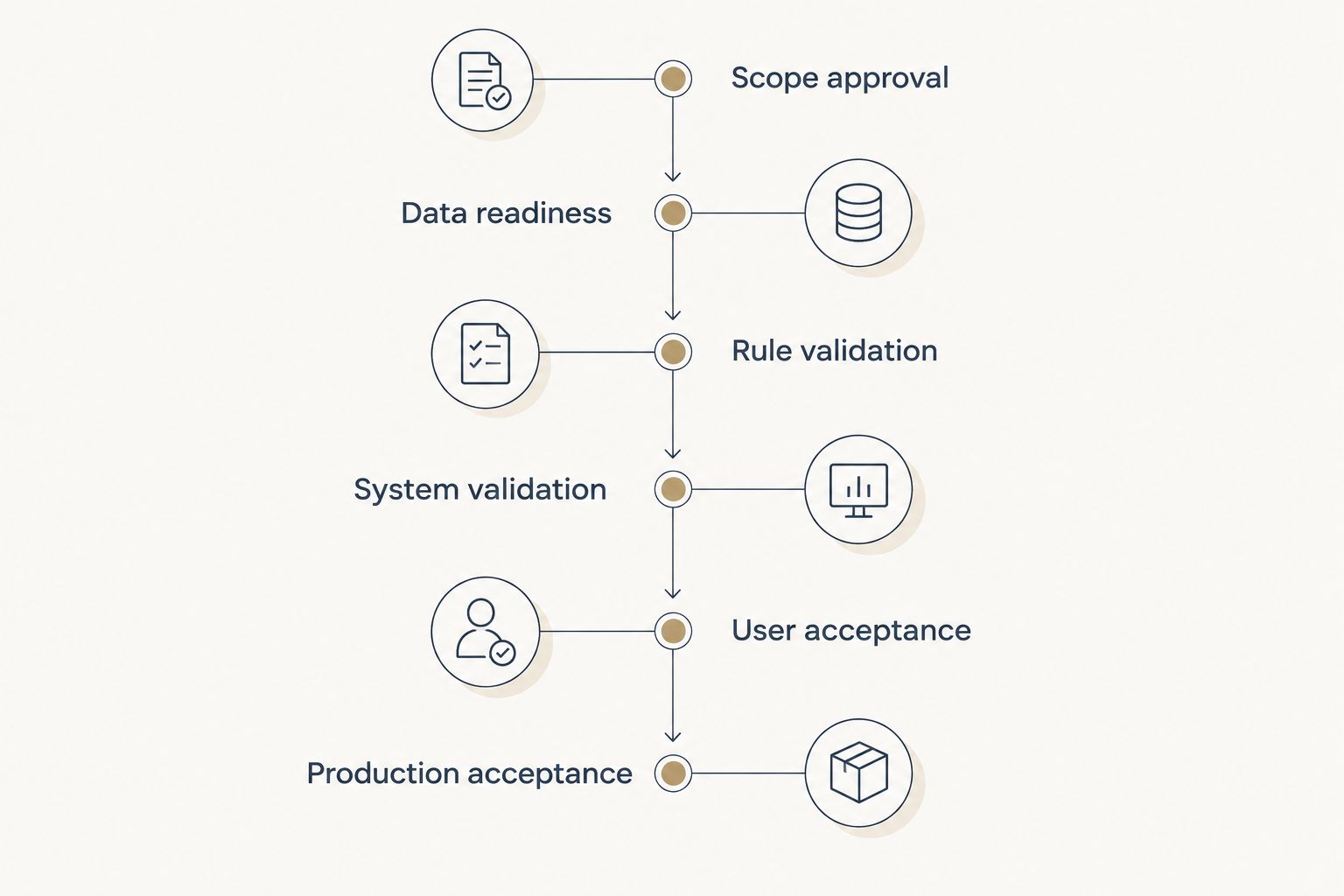
Use these 6 readiness gates to build that schedule. They are planning checkpoints, not published duration benchmarks.
- Scope approval. Identify the product families, customer groups, sales users, and workflows included in the initial release. Document exclusions so additional requirements do not enter unnoticed.
- Data readiness. Confirm the source of product identifiers, customer records, units of measure, and pricing inputs. Resolve contradictory records before encoding rules around them.
- Rule validation. Translate configuration restrictions, commercial approvals, and quote calculations into testable requirements. Have sales, engineering, and finance approve the rules they own.
- System validation. Test the required CRM and ERP handoffs, including authentication, field mapping, error handling, and duplicate prevention. Confirm what happens when a connection fails.
- User acceptance. Ask sales and operations users to complete representative quoting scenarios without implementation staff directing every action. Include exceptions, not just straightforward quotes.
- Production acceptance. Confirm support ownership, permissions, operating instructions, and a recovery procedure. Approve rollout only when the agreed workflow works end to end.
These gates expose the actual schedule constraints. Configuration work can proceed while some data preparation happens, but testing a customer-specific rule requires the relevant customer data and an approved rule first.
Require every proposed launch date to identify its unfinished dependencies. A date without those dependencies gives you a deadline, not an implementation plan.
The gates below represent checkpoints rather than mandatory, nonoverlapping calendar phases. Your project team should identify which activities can run in parallel and which require prior approval.
Choose the rollout scope before requesting a date
Compare these 3 rollout scopes when requesting implementation proposals. Each has a different endpoint, so comparing their promised dates without comparing scope is misleading.
| Rollout scope | Best for | Acceptance endpoint | Advantage | Limitation |
|---|---|---|---|---|
| Quoting pilot | Teams validating a defined quoting workflow | Selected users produce approved quotes for the agreed scope | Contains the initial test boundary | Does not establish readiness across the full business |
| Connected rollout | Teams that need quote-to-order handoffs | Approved quotes move through the required CRM and ERP workflow | Tests the operational handoff | Requires agreement on system ownership and failure handling |
| Business-wide rollout | Teams standardizing quoting across their intended operating scope | Included teams and workflows meet common acceptance requirements | Establishes shared operating rules | Requires acceptance across more users and exceptions |
Choose the smallest scope that proves the business outcome you need. If manual order rebuilding is the problem, a disconnected quoting pilot does not prove that problem is solved. If configuration accuracy is the problem, test the relevant product rules before expanding the user base.
Quoting pilot: prove the selected workflow
A quoting pilot should have a written boundary: the included products, customers, users, and approval paths. Ask the team to demonstrate those workflows using representative records rather than a prepared demonstration catalog.
The advantage is a contained acceptance exercise. The limitation is equally clear: a successful pilot does not establish that excluded configurations, branches, customer agreements, or integrations work.
For a 2026 pilot, define the expansion decision before starting. List the evidence needed to continue, the defects that prevent expansion, and the person authorized to approve the next scope.
Connected rollout: prove the quote-to-order handoff
A connected rollout includes the system interactions needed for the agreed workflow. Define where customer data originates, where commercial terms are approved, and where an accepted quote becomes an operational record.
Its value is testing the handoff sales and operations actually use. Its additional work includes record mapping, access permissions, synchronization behavior, and recovery when a transaction fails.
Do not accept a demonstration that only sends a new order successfully. Ask the implementation team to show rejected transactions, corrected records, resubmission, and protection against duplicate orders.
Business-wide rollout: prove coverage and ownership
A business-wide rollout covers the teams and workflows explicitly included in the project charter. Document any remaining exclusions; the phrase business-wide must not conceal unsupported product families or unresolved approval paths.
This scope supports consistent operating rules, but acceptance must cover the intended variations. A workflow approved by an inside-sales team does not automatically establish that branch sales, engineering review, or another operating unit can use it correctly.
Assign business owners to those differences. Keep a central record of accepted requirements so local changes do not silently contradict the agreed quoting process.
Why CPQ implementation time varies
The schedule changes when the work required to reach acceptance changes. Assess these factors against your own quoting and order-entry process rather than treating them as reasons to add an arbitrary buffer.
- Product-rule scope. List permitted combinations, prohibited combinations, required attributes, and engineering-review triggers. Unwritten decisions need an owner before they become software rules.
- Commercial-rule scope. Identify customer-specific terms, quantity logic, approval authority, and override permissions. Separate standard behavior from exceptions that require human review.
- Data ownership. Assign a source and owner to each required field. Product identifiers, customer records, and units of measure need consistent meanings across connected systems.
- ERP and CRM boundaries. Specify which system owns each record and which events trigger a transfer. Include failed transfers and reconciliation in the requirements.
- Acceptance coverage. Define the quoting scenarios, users, and operating units required for sign-off. A narrow pilot and a broader rollout need different evidence.
- Decision availability. Name the people authorized to settle engineering, finance, sales, and operations questions. Schedule their reviews as project work rather than informal favors.
In your 2026 project plan, separate implementation tasks from customer-owned decisions. The software team cannot approve your discount authority or decide which engineering exceptions are commercially acceptable.
Assign unresolved decisions before assigning dates to dependent tasks. That makes the schedule actionable without pretending that every source of delay is a technical problem.
How do you get a credible implementation estimate?
Ask vendors and implementation partners to estimate the same written scope. Provide the workflow boundary, required systems, representative quotes, known exceptions, and acceptance criteria before comparing proposed schedules.
Use this request checklist:
- Define the start event. State whether the schedule begins at contract signature, kickoff, system access, or approved requirements.
- Define the finish event. State whether completion means a configured environment, pilot acceptance, or production acceptance.
- Identify your responsibilities. List data preparation, access approval, rule decisions, and user-testing obligations.
- Request dependency detail. Ask which tasks depend on ERP access, approved mappings, or business sign-off.
- Separate configuration from custom work. Require a clear description of any proposed extensions and their acceptance requirements.
- Specify change control. Agree how new products, rules, integrations, or operating units affect the approved schedule.
Ask for milestone dates tied to deliverables, not just a final launch date. Each milestone should name its evidence and approver.
For 2026 vendor evaluations, use the same acceptance document across proposals. Otherwise, the shortest implementation schedule can simply describe the smallest amount of work.
Can you launch a CPQ pilot before full ERP integration?
A quoting pilot can precede full ERP integration when its acceptance boundary excludes that integration and users understand the limitation. Keep the output under the agreed review process rather than treating it as a production-ready order.
If the pilot depends on ERP product or customer data, define how that data reaches the test environment and who checks it. Excluding live integration does not remove the need for accurate inputs.
Approve the pilot for what it proves, not for the workflow you eventually want. Record the remaining integration work separately so it does not disappear after a successful demonstration.
What does “go-live” actually mean for CPQ?
Go-live means the agreed users can operate the approved quoting workflow in production with defined support and recovery procedures. It does not mean every possible configuration or future requirement is included.
Write the production acceptance statement in operational language. Specify who creates quotes, who approves exceptions, what reaches the ERP, and who handles a failed transaction.
Your 2026 acceptance record should preserve the scope, test results, open limitations, and approving owners. That record becomes the reference point for subsequent expansion—not the vendor demonstration.
Where quoting automation fits into the decision
Supplyco is for industrial manufacturers and distributors that need revenue operations automation across quoting, order entry, account management, and sales follow-up. Those workflows matter when your implementation objective extends beyond creating a quote document.
Supplyco provides automation across those functions. The relevant advantage is its stated workflow scope; the evaluation boundary is that this scope alone does not establish coverage for your product rules, ERP environment, or acceptance requirements.
Evaluate Supplyco quoting automation with your actual process. Require a demonstration of the proposed workflow, identify where human approval remains necessary, and confirm implementation responsibilities before agreeing to a production milestone.
FAQ
How long does it take to implement CPQ software in 2026?
CPQ implementation time depends on the agreed scope, data readiness, rules, integrations, and acceptance requirements. Request a schedule that separates pilot acceptance from production acceptance and names the dependencies behind each date.
What should be ready before a CPQ implementation starts?
Prepare the initial workflow scope, data owners, rule owners, system-access requirements, and acceptance criteria. Use representative quotes and known exceptions to make the requirements testable.
Can we implement CPQ without connecting our ERP?
You can define a quoting pilot that excludes an ERP connection. That pilot does not prove an automated quote-to-order handoff, and its inputs still require an agreed source and validation process.
Does installing CPQ mean implementation is finished?
Installing CPQ does not establish production readiness. Complete the agreed rule validation, system testing, user acceptance, and support preparation before approving production use.
How do we compare CPQ implementation proposals?
Compare proposals against the same scope and acceptance endpoint. Require each proposal to identify customer responsibilities, dependencies, exclusions, and the process for handling scope changes.
Should we launch all product families together?
Launch the product families needed to prove your initial business outcome, with explicit acceptance criteria. Expand only after validating the additional rules, data, users, and handoffs included in the next scope.
Where does Supplyco fit in a quoting automation project?
Supplyco provides revenue operations automation for industrial manufacturers and distributors across quoting, order entry, account management, and sales follow-up. Evaluate the proposed workflow against your product rules, system requirements, and production acceptance criteria.
One last thing
Test what happens when an approved quote becomes an order and the transfer fails. A successful transfer proves the normal path; a failed transfer tests whether your operating procedure protects the transaction and gives someone responsibility for resolving it.
Ask your team to demonstrate rejection, correction, resubmission, and duplicate prevention before production acceptance. Keep that test in scope even when the first release is deliberately narrow. Quote generation is visible; the handoff determines whether operations can use the result without rebuilding it.


