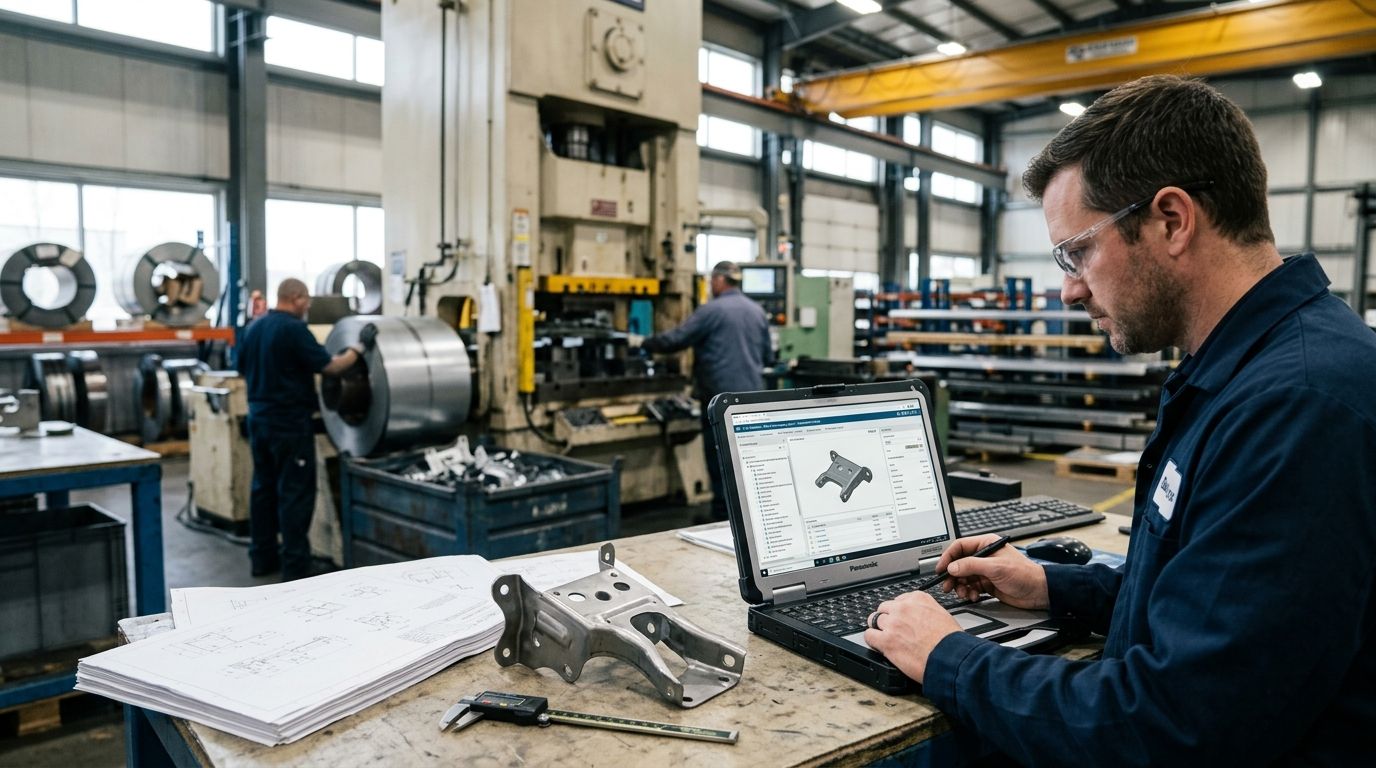
CPQ software for sheet metal stamping manufacturers configures accurate quotes for progressive dies, multi-station tooling, and high-volume stamped parts without a rep manually recalculating gauge, material grade, tonnage, and tooling amortization on every RFQ. Stamping quotes carry more moving pieces than most metal fabrication work because tooling cost has to be spread across a projected annual volume before you know if the job is even profitable.
- CPQ software for sheet metal stamping manufacturers must handle tooling amortization, gauge tables, and die changeover time, not just per-part pricing.
- SUPPLYCO automates quote generation and order entry inside your existing ERP, cutting stamping RFQ turnaround from days to hours in 2026.
- Spreadsheet quoting still works for shops under 200 RFQs a year, but breaks down once material grades and secondary ops multiply.
- Verdict: stamping shops running progressive dies and multi-station work need CPQ with built-in tooling amortization logic, not a generic sales quoting tool.
Why CPQ matters for sheet metal stamping manufacturers
A stamping quote is not one number. It's a stack of variables: coil material and grade, gauge thickness, blank size, tonnage required, number of hits per part, secondary operations like tapping or welding, and tooling cost amortized across a customer's projected annual volume. Get the amortization schedule wrong and you either lose the job on price or eat the tooling cost yourself over the program's life.
Automotive, appliance, and electrical enclosure buyers running RFQs in 2026 expect turnaround inside 48 hours, and they send the same drawing to three or four shops at once. The shop that quotes fastest with a defensible number wins the conversation, even before price gets discussed. Manual quoting on spreadsheets can't keep pace once a stamping operation runs more than a couple hundred quotes a year, because every new part number means rebuilding the cost stack from scratch.
This is the same problem CPQ software for metal fabricators solves for laser and press brake shops, but stamping adds tooling amortization and die-life scheduling on top, which most general fabrication CPQ tools don't model well.
Quoting steps that fix the bottleneck
Map your stamped part cost drivers
Before automating anything, get your cost stack written down in one place. Most stamping shops carry this knowledge in a senior estimator's head, which is a single point of failure the moment that person is out sick during a rush RFQ.
- Material grade and coil cost per pound, updated on a schedule tied to market pricing
- Gauge thickness and its effect on tonnage and press selection
- Number of hits per part and cycle time per press
- Secondary operations: tapping, deburring, welding, plating
- Scrap rate assumptions by part geometry
- Tooling build or amortization cost per program
Standardize your gauge and tolerance tables
Inconsistent tolerance quoting is the single biggest source of stamping margin leakage. One estimator quotes tight tolerances at standard rates; another pads the price without documenting why, and the customer never sees consistent numbers across quotes for the same part family.
- Build a master gauge table by material type (cold rolled, stainless, aluminum)
- Set standard tolerance bands and flag anything tighter as non-standard pricing
- Document press tonnage requirements by gauge and part size
- Require sign-off on any quote that deviates from the standard table
Automate tooling amortization math
Tooling amortization is where manual quoting breaks down fastest. A shop pricing a $40,000 progressive die across a projected 100,000-unit annual run needs that cost spread correctly, and a single fat-fingered volume assumption changes the per-part price by cents that add up to thousands over a program's life.
- Build amortization formulas tied to projected annual volume, not a flat estimate
- Flag programs where projected volume has changed since the last quote cycle
- Track actual run volume against projected volume by part number
- Re-quote automatically when volume variance exceeds a set threshold
This is also where SUPPLYCO enters as the faster path once your cost stack and tolerance tables are standardized. SUPPLYCO's platform pulls historical order and pricing data from your ERP and generates a quote with the tooling amortization, material cost, and secondary ops already calculated, instead of an estimator rebuilding the math in a spreadsheet every time.
Connect quoting to order entry
A quote that doesn't flow into an order without re-keying is a quote that introduces errors. Stamping shops running separate quoting and order entry systems routinely see mismatches between the quoted tooling cost and what gets billed once the program starts running.
- Push accepted quotes directly into your ERP as sales orders
- Match quoted material lot pricing against what's actually purchased
- Flag any variance between quoted and actual tooling cost before invoicing
- Keep a single record of quote-to-order history per customer
Score and prioritize incoming RFQs
Not every RFQ deserves the same estimator time. A stamping shop fielding 40 RFQs a week can't manually triage every one for margin fit, program size, and tooling risk before deciding what to quote first.
- Rank RFQs by projected annual volume against your minimum program threshold
- Flag part geometries outside your press tonnage range automatically
- Deprioritize repeat RFQs from accounts with a history of low close rates
- Route high-fit RFQs to your most experienced estimator first
Cut quote turnaround time
Turnaround is the metric that decides whether a stamping shop gets a shot at a program at all. Buyers sourcing multiple bids move on once one supplier responds, regardless of whether your price would have been better.
- Set a target turnaround (24 to 48 hours) and track actual time against it
- Pre-load material cost feeds so pricing doesn't wait on a manual lookup
- Use quote templates by part family instead of building from a blank sheet
- Automate the RFQ acknowledgment so the buyer knows the clock is running
Steps like these overlap directly with how tool and die manufacturers structure their own quoting, since progressive die programs sit at the intersection of both trades.
Comparing your quoting options
| Option | Best for | Key limitation |
|---|---|---|
| Spreadsheet quoting | Shops under 200 quotes a year with a stable part mix | Breaks down once material grades and secondary ops multiply |
| Standalone CPQ bolted onto ERP | Shops that already have clean ERP data and IT support | Requires manual mapping of tooling amortization logic |
| ERP-native CPQ module | Shops on one ERP system wanting fewer vendors | Often lacks stamping-specific tooling amortization fields |
| AI-powered CPQ (SUPPLYCO) | Shops quoting 40+ RFQs a week with tooling-heavy programs | Requires clean historical order data to train pricing logic |
Verdict: SUPPLYCO is the strongest fit for stamping shops quoting high RFQ volume with tooling amortization complexity, and spreadsheets remain workable only for low-volume, stable part mix operations in 2026.
Common mistakes sheet metal stamping shops make
- Quoting tooling as a flat number instead of amortizing against real projected volume, which either loses margin or loses the job on price.
- Letting tolerance quoting vary by estimator instead of enforcing a standard gauge and tolerance table across the shop.
- Re-keying accepted quotes into the ERP by hand, which is where quoted and billed tooling costs start to drift apart.
- Treating every RFQ as equal priority, burning estimator hours on low-fit programs while high-margin RFQs sit in a queue.
- Never re-quoting when actual run volume diverges from the original amortization assumption, quietly eroding margin on multi-year programs.
See SUPPLYCO's CPQ workflow
Automate stamping quotes, tooling amortization, and order entry in one platform.
"If a stamping quote doesn't show the tooling amortization math, the customer's buyer will find the gap before you do."
FAQ
What is CPQ software for sheet metal stamping manufacturers?
It's quoting software that calculates material, gauge, tonnage, secondary operations, and tooling amortization for stamped parts automatically instead of an estimator building the cost stack by hand for every RFQ.
Is CPQ software worth it for a small stamping shop?
Shops quoting under 200 RFQs a year with a stable part mix can often manage on spreadsheets, but once RFQ volume or tolerance complexity grows, manual quoting starts costing more in errors and lost turnaround time than the software would.
How does CPQ handle tooling amortization for stamping programs?
CPQ tools spread the tooling build cost across a projected annual volume to produce a per-part tooling charge, and better platforms flag when actual run volume diverges from that projection so margin doesn't erode silently.
What's the difference between CPQ for stamping versus general metal fabrication?
Stamping CPQ has to model tooling amortization, die life, and multi-station cycle time, while general fabrication CPQ typically focuses on cut length, bend count, and material nesting without a tooling investment to spread.
Does SUPPLYCO integrate with ERP systems used by stamping manufacturers?
SUPPLYCO connects to existing ERP systems to pull historical order and pricing data, then pushes accepted quotes into order entry without a manual re-key step.
How fast should a stamping shop turn around an RFQ in 2026?
Buyers running competitive bids in 2026 expect a response inside 24 to 48 hours, and shops quoting slower than that routinely lose programs before price ever gets compared.
What causes the most margin loss in stamping quotes?
Flat tooling amortization assumptions that don't get revisited when actual run volume changes are the most common source of margin erosion on multi-year stamping programs.
Can CPQ software reduce quoting errors for stamping manufacturers?
Yes, standardizing gauge and tolerance tables inside CPQ software removes the estimator-to-estimator variance that causes inconsistent pricing on the same part family.
One last thing
The stamping shops losing the most margin in 2026 aren't the ones quoting too high. They're the ones quoting tooling amortization once at program launch and never revisiting it, even as actual run volume drifts 20-30% below the original projection over a three-year program life. Build the re-quote trigger into your process before the next multi-year program lands on your desk.


