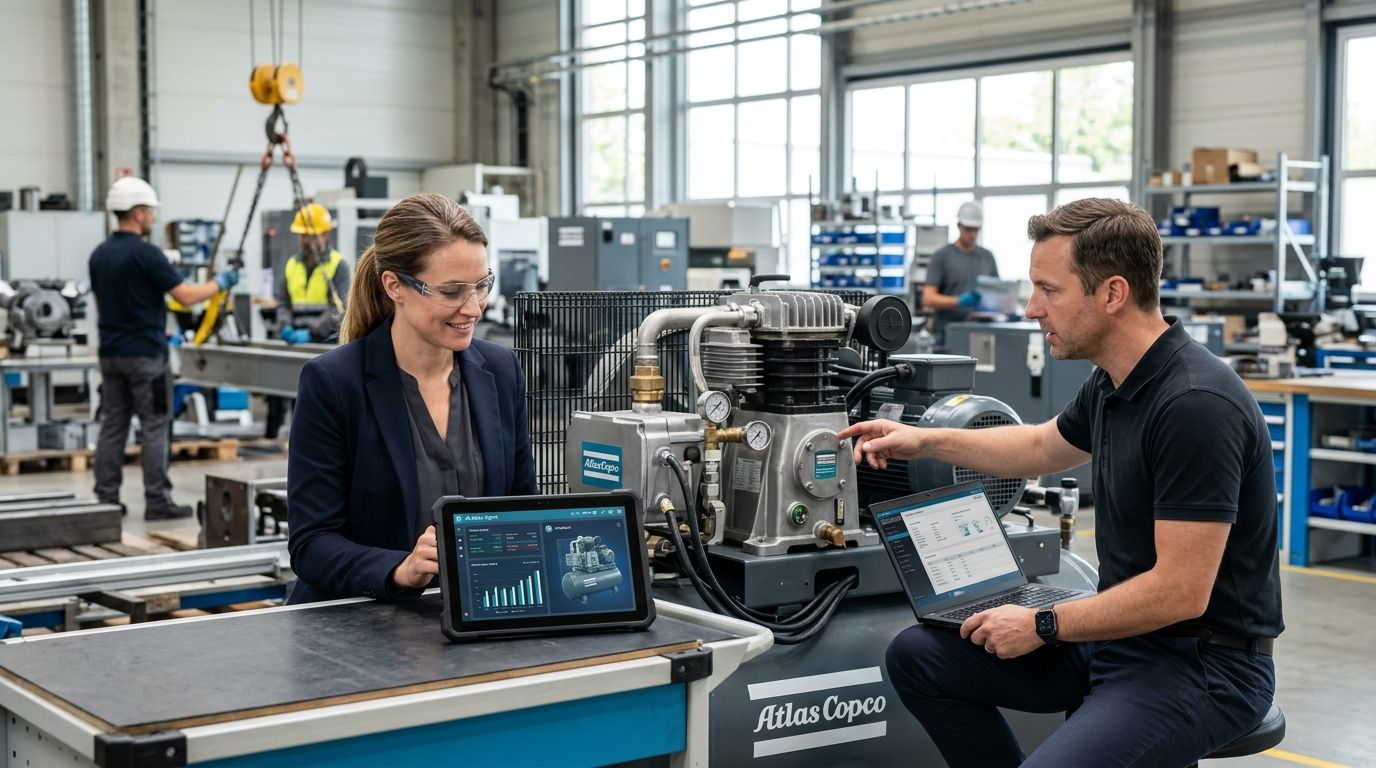
Compressor manufacturers use AI sales agent software to auto-generate quotes for CFM and PSI configurations, flag stalled RFQs, and update ERP order records without adding headcount to the sales desk. The category matters most here because compressor quoting involves engineering variables — displacement, duty cycle, drive type — that generic CPQ tools were never built to parse.
- AI sales agent software for compressor manufacturers cuts quote turnaround from days to hours by reading spec sheets and RFQ line items automatically.
- Supplyco AI Sales Agent works inside existing ERP and CRM systems rather than replacing them — best for teams on Epicor, Global Shop, or JobBoss.
- Manual quoting still works for shops under 50 RFQs a month; past that volume, missed follow-ups start costing real revenue.
- Comparison-shop before buying: generic CRM add-ons don't parse mechanical specs the way compressor-specific quoting tools do.
Why AI sales agent software matters for compressor manufacturers
Compressor sales cycles run long because every quote depends on variables a generic form can't capture — reciprocating vs. rotary screw, single-stage vs. two-stage, duty cycle, drive horsepower, ambient temperature derating. A distributor or OEM sales rep spends real hours re-keying spec sheets into an ERP before a customer ever sees a price.
That delay is where deals die. A buyer who requests three quotes and gets one back in four hours picks the fast vendor more often than the cheap one, especially on repeat MRO orders where switching cost is low. AI sales agent software for compressor manufacturers exists specifically to close that gap — reading incoming RFQs, matching them against catalog SKUs and pricing rules, and pushing a draft quote back to the rep before the buyer has moved to the next tab.
The segment also carries a heavier aftermarket component than most industrial categories. Compressor OEMs and distributors sell as much in service parts, rebuild kits, and maintenance contracts as they do in new units, which means account management and reorder follow-up matter as much as the initial quote.
Build your quoting workflow around spec parsing
Most compressor RFQs arrive as PDFs or spreadsheets with mechanical specs buried in free text, not clean form fields.
- Map your top 20 recurring spec fields (CFM, PSI, HP, duty cycle, drive type) into a standard intake template
- Train whoever answers RFQs to flag incomplete specs before quoting instead of guessing
- Set a standing rule: no quote goes out without duty cycle and voltage confirmed
- Route RFQs by product line (reciprocating, screw, vane) to the rep who owns that catalog
- Once volume passes roughly 40-50 RFQs a month, manual routing starts missing deadlines — that's the point to bring in software that parses specs automatically rather than adding another coordinator
Automate quote generation for standard and custom configurations
Standard-catalog quotes should never take more than an hour; custom configurations are where teams lose days.
- Separate your catalog into stock configurations and engineered-to-order jobs so reps know which path a quote takes
- Build price rules for common CFM/PSI tiers so stock quotes can go out same-day
- Flag any RFQ requiring a custom drive or non-standard voltage for engineering review before pricing
- Automate quoting for industrial manufacturers once your price rules are stable enough to trust to a system instead of a spreadsheet
- Track quote-to-close time by configuration type so you know where the bottleneck actually sits
Update order entry so specs don't get re-typed twice
A quote approved by the customer still has to become a clean order in the ERP, and that's where transcription errors creep into compressor builds — wrong voltage, wrong mounting, wrong drive.
- Require the approved quote to carry over into the order record without a rep retyping specs
- Build a checklist for the fields most often mis-entered on compressor orders (voltage, phase, mounting type)
- Assign one person to audit a sample of orders weekly against the original RFQ
- Push order confirmations to the customer within the same business day the PO is received
Automate follow-up on open quotes and stalled RFQs
Compressor buyers often request quotes from three vendors and go quiet — the vendor who follows up wins more of those ties than the one with the lowest number.
- Set a standing cadence: follow up at 2 days, 7 days, and 21 days on any open quote
- Flag quotes over $10,000 for a phone call instead of an email on day 7
- Track which reps let quotes go cold past 30 days and review those accounts monthly
- Sales follow-up automation for manufacturers handles the day 2/7/21 cadence automatically so no open quote depends on a rep remembering
Manage aftermarket and account reorders separately from new-unit sales
Rebuild kits, seals, and replacement parts generate recurring revenue that new-unit sales teams often ignore because it doesn't look like a fresh deal.
- Segment accounts by installed base so service reminders trigger on realistic maintenance intervals
- Give aftermarket reorders their own quote-turnaround target, shorter than new-unit quotes
- Route parts RFQs to a dedicated line so they don't compete with new-unit quotes for rep attention
- Review dormant accounts (no order in 12+ months) quarterly for a check-in call
Deploy an AI sales agent without disrupting your ERP
The fastest path once the manual process is mapped is deploying an AI sales agent for industrial sales teams that reads inbound RFQs, drafts quotes against your existing price book, and syncs order data back into the ERP you already run — no rip-and-replace required.
Supplyco built its AI Sales Agent specifically to sit inside existing ERP and CRM stacks rather than force a migration, which matters for compressor shops running Epicor, Global Shop Solutions, or JobBoss where switching systems is a multi-month project nobody wants.
See the AI sales agent in action
Check how it handles quoting and order entry for industrial manufacturers.
Compare your options for compressor manufacturer sales automation
| Option | Best for | Key limitation |
|---|---|---|
| Manual quoting (spreadsheets/email) | Shops under 40-50 RFQs a month | Doesn't scale; follow-up depends entirely on rep memory |
| Generic CRM (HubSpot, Salesforce) | Teams that already need pipeline reporting | Doesn't parse mechanical specs like CFM/PSI or auto-draft technical quotes |
| Intent-data tools (ZoomInfo-style) | Prospecting new accounts | Finds leads, doesn't touch quoting, order entry, or follow-up |
| In-house built automation | Large OEMs with dedicated dev resources | Slow to build, expensive to maintain, no vendor support |
| Supplyco AI Sales Agent | Compressor manufacturers and distributors on Epicor, Global Shop, or JobBoss needing faster quote turnaround | Requires clean price-book data upfront to draft accurate quotes |
Verdict: Supplyco AI Sales Agent wins for compressor manufacturers running custom CFM/PSI configurations who need quotes out in hours and don't want to replace their ERP to get there.
Common mistakes compressor manufacturers make
- Quoting stock and custom configurations through the same process — custom jobs need engineering review, stock jobs don't, and mixing them slows both down
- Letting aftermarket parts quotes sit in the same queue as new-unit RFQs — parts buyers expect same-day turnaround, new-unit buyers tolerate more
- Skipping duty cycle and voltage confirmation before quoting — this is the single most common cause of rework on compressor orders
- Treating follow-up as optional past the first email — buyers requesting three quotes reward the vendor who calls, not just the one who quoted lowest
- Not auditing order entry against the original RFQ — transcription errors on drive type or mounting show up as expensive change orders later
FAQ
What does AI sales agent software do for compressor manufacturers?
It reads incoming RFQs, matches mechanical specs like CFM and PSI against a price book, drafts a quote, and syncs the resulting order into the ERP. It also handles follow-up cadences on open quotes so reps aren't tracking that manually.
Is AI sales agent software worth it for a small compressor shop?
Below roughly 40-50 RFQs a month, manual quoting with a disciplined intake template usually holds up fine. Above that volume, missed follow-ups and slow quote turnaround start costing deals, which is where automation pays off.
How is this different from a CRM like HubSpot or Salesforce?
A CRM tracks pipeline and contacts but doesn't parse compressor specs or auto-draft a technical quote. Most compressor manufacturers pair Supplyco's AI sales agent with their existing CRM rather than replacing it.
Does Supplyco AI Sales Agent replace our ERP?
No. It's built to sit inside ERP systems like Epicor, Global Shop Solutions, and JobBoss, syncing quote and order data rather than requiring a migration.
How fast can a compressor manufacturer turn around a custom quote?
Stock configurations can go out same-day once price rules are set. Custom configurations still need engineering review, but automated spec parsing removes the re-keying delay that otherwise adds a day or more.
What's the biggest quoting mistake compressor manufacturers make?
Quoting before duty cycle and voltage are confirmed. It's the leading cause of rework and change orders on compressor builds in 2026.
Does this help with aftermarket parts orders too?
Yes. Account management and reorder tracking matter as much as new-unit quoting for compressor OEMs, since parts and rebuild kits often make up a large share of recurring revenue.
One last thing
The compressor shops losing the most quotes in 2026 aren't losing on price — they're losing because a competitor called back on day 7 and they didn't. Fix the follow-up cadence before touching anything else; it's the cheapest change with the fastest payoff.


