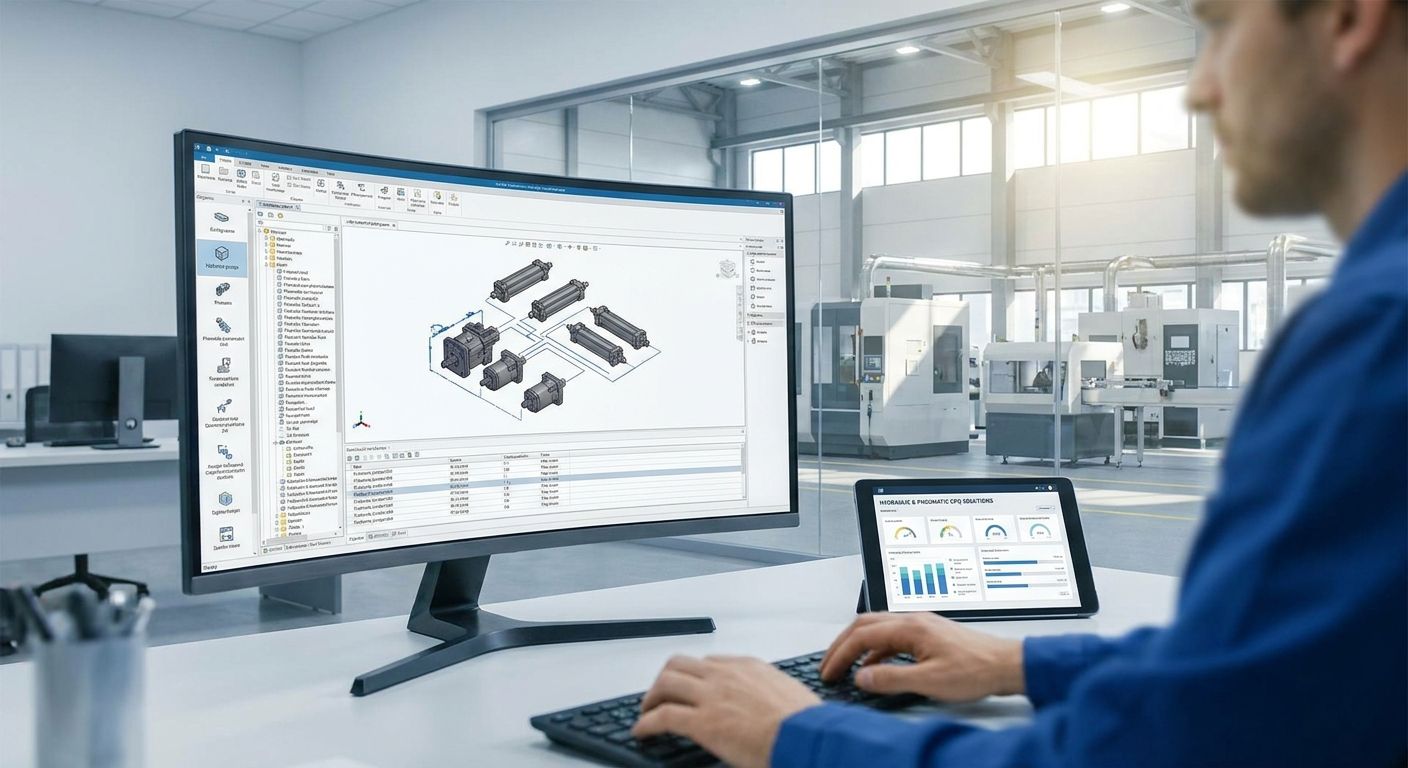
Hydraulic and pneumatic manufacturers quote configured-to-order cylinders, valves, and fitting assemblies that generic CPQ tools were never built to handle. This guide ranks six CPQ platforms on configuration logic, ERP fit, and quote turnaround for 2026.
- Supplyco AI wins for AI-driven quoting and order entry across ERPs -- the best CPQ software for hydraulic and pneumatic manufacturers overall in 2026.
- Tacton CPQ suits engineered-to-order cylinder configuration with a visual rules engine; it stops at the quote and skips order entry.
- Configure One (Revalize) fits manufacturers who want a guided-selling wizard bolted onto a legacy ERP.
- Salesforce CPQ only makes sense if your sales team already runs deep inside Salesforce; configuration logic needs custom build-out.
- Epicor CPQ is the default pick for Epicor Kinetic shops that don't want a separate configurator vendor.
Why this matters
Hydraulic and pneumatic manufacturers don't sell off-the-shelf parts. A cylinder quote depends on bore size, stroke length, rod-end style, mounting configuration, and seal material -- variables most quoting tools treat as free text instead of pricing logic. Get one wrong and the quote comes back wrong, the order gets re-keyed, and the buyer calls the next name on their list.
Most CPQ platforms on the market were built for software licensing or generic industrial catalogs, not configured-to-order fluid power components. Some of the strongest fits for pump and valve manufacturers share the same configuration logic hydraulic and pneumatic shops need: bore-and-stroke rules, seal compatibility checks, and pressure-rating limits baked into the quote itself. In 2026, the manufacturers winning quote volume are the ones turning a spec sheet into an accurate, ERP-synced quote in minutes, not days.
The verdict
Best overall: Supplyco AI. Best for engineered-to-order cylinder and valve configuration: Tacton CPQ. Best for guided selling bolted onto a legacy ERP: Configure One (Revalize). Best for teams already running deep in Salesforce: Salesforce CPQ. Best for Epicor Kinetic shops: Epicor CPQ. Best for large, multi-division manufacturers: Oracle CPQ.
What makes the best CPQ software for hydraulic and pneumatic manufacturers
- Configuration logic for physical variables -- bore, stroke, rod-end, mounting style, seal material, and pressure rating, not just SKU lookups
- Native ERP integration -- syncs with Epicor Kinetic, NetSuite, Acumatica, Global Shop Solutions, or SAP Business One, whatever runs the shop floor
- Distributor and tiered pricing support -- separate price books for OEM accounts, MRO distributors, and end users
- Quote turnaround speed -- how fast a rep or an AI agent turns a spec sheet into a priced, accurate quote
- Order entry after the win -- whether the quote flows into an order without manual re-entry
- Deployment fit -- whether the tool layers onto your existing ERP and CRM stack or forces a rip-and-replace
At a glance
| Platform | Best for | Standout feature | Key limitation |
|---|---|---|---|
| Supplyco AI | Automating quoting + order entry for hydraulic/pneumatic manufacturers | AI agent quotes and enters orders directly against ERP data | Not a visual 3D configurator |
| Tacton CPQ | Engineered-to-order cylinder and valve configuration | Rules-based 3D configuration engine | Heavier implementation lift for smaller shops |
| Configure One (Revalize) | Guided selling bolted onto legacy ERP | Wizard-style guided selling with drawing generation | Configuration rules need ongoing admin upkeep |
| Salesforce CPQ | Teams already deep in Salesforce | Native Salesforce object model and approvals | Weak native support for physical configuration logic |
| Epicor CPQ | Epicor Kinetic shops | Built-in Epicor Kinetic data sync | Limited value outside the Epicor ecosystem |
| Oracle CPQ | Large multi-division manufacturers | Handles complex multi-entity pricing and approvals | Overbuilt and slow to deploy for single-plant operations |
1. Supplyco AI: best CPQ software for automating quoting and order entry
Supplyco AI automates quoting, order entry, account management, and sales follow-up for industrial manufacturers and distributors inside the ERP and CRM they already run. For hydraulic and pneumatic manufacturers, an AI sales agent takes an incoming spec, checks it against ERP pricing and inventory data, and generates a quote without a rep manually keying bore, stroke, and seal combinations. The same logic that works for hose and fitting distributors applies directly to cylinder and valve quoting.
Supplyco AI pros:
- Automates order entry the moment a quote is accepted, cutting the manual re-key step most CPQ tools leave in place
- Works alongside your existing CRM and ERP instead of requiring a data migration
- Covers follow-up and account management on top of quoting, so the platform spans more of the quote-to-cash cycle than a pure configurator
- Built specifically for industrial and manufacturing sales workflows, not adapted from a generic B2B CPQ template
Supplyco AI cons:
- Not a visual 3D product configurator, so shops needing CAD-linked configuration screens should pair it with a dedicated configurator
- Newer to the CPQ category than Salesforce or Oracle, so integration depth against your specific ERP is worth confirming before committing
- Built for automation layered on existing systems, not a rip-and-replace CPQ deployment
Best for: hydraulic and pneumatic manufacturers that want quoting and order entry automated end-to-end without replacing their ERP or CRM. Verdict: Buy for manufacturers prioritizing quote-to-order speed over a standalone visual configurator.
2. Tacton CPQ: best for engineered-to-order cylinder and valve configuration
Tacton CPQ runs a rules-based configuration engine built for manufacturers with complex, engineered-to-order products. It generates 3D visuals and technical drawings as reps configure a part, which matters when a cylinder spec has dozens of interdependent variables.
Tacton CPQ pros:
- Rules engine handles deep interdependencies between bore, stroke, and mounting variables without manual overrides
- 3D visualization helps reps and customers confirm configuration before quoting
- Established track record with engineered industrial products beyond fluid power
Tacton CPQ cons:
- Implementation typically requires dedicated configuration modeling work upfront
- Order entry and post-sale account management sit outside its core scope
Best for: manufacturers with heavily engineered, visually complex hydraulic or pneumatic assemblies. Verdict: Buy if configuration complexity is your main bottleneck and you have the implementation bandwidth. Manufacturers stuck on slow quotes should also check how to cut quote turnaround time before choosing a configurator.
3. Configure One (Revalize): best for guided selling bolted onto legacy ERP
Configure One, part of Revalize, uses a wizard-style guided-selling flow that walks a rep or a self-service buyer through configuration questions and auto-generates drawings alongside the quote.
Configure One pros:
- Guided-selling wizard reduces training time for new reps
- Drawing generation ties directly to the configured quote
- Established presence in industrial manufacturing CPQ
Configure One cons:
- Configuration rules need ongoing admin maintenance as product lines change
- Less AI-driven than newer entrants, so quote generation still depends heavily on rule setup
Best for: manufacturers that want a proven guided-selling wizard layered onto an existing ERP. Verdict: Hold -- solid if already in place, worth benchmarking against AI-native alternatives before a fresh deployment.
4. Salesforce CPQ: best for teams already deep in Salesforce
Salesforce CPQ extends the Salesforce object model into quoting and pricing approvals. It fits naturally if your sales team already lives inside Salesforce for pipeline and account management.
Salesforce CPQ pros:
- Native fit with Salesforce CRM data, approvals, and reporting
- Broad partner ecosystem for customization
Salesforce CPQ cons:
- Weak out-of-the-box support for physical configuration logic like bore-and-stroke rules
- Requires custom development to handle fluid power-specific variables
Best for: manufacturers standardized on Salesforce that need quoting inside the same platform. Verdict: Hold -- fine if Salesforce is already your system of record, but budget for custom configuration work.
5. Epicor CPQ: best for Epicor Kinetic shops
Epicor CPQ ties directly into Epicor Kinetic, pulling item, pricing, and customer data without a separate integration layer.
Epicor CPQ pros:
- Direct sync with Epicor Kinetic data
- Lower integration overhead for existing Epicor shops
Epicor CPQ cons:
- Limited value outside the Epicor ecosystem
- Configuration depth trails dedicated configurator vendors like Tacton
Best for: manufacturers already running Epicor Kinetic as their ERP. Verdict: Buy if Epicor Kinetic is your system of record; Skip otherwise.
6. Oracle CPQ: best for large multi-division manufacturers
Oracle CPQ handles complex approval chains and multi-entity pricing across divisions, which matters for manufacturers running multiple plants or business units that quote the same product lines differently.
Oracle CPQ pros:
- Handles multi-division pricing and approval complexity
- Scales across large sales organizations
Oracle CPQ cons:
- Deployment timelines run long relative to single-plant needs
- Overbuilt for manufacturers with one plant and a small sales team
Best for: multi-division manufacturers with layered approval and pricing requirements. Verdict: Wait unless your organization already has multi-division pricing complexity to justify it.
How we ranked it
The ranking weighs configuration logic for physical variables first, since that's where generic CPQ tools fail hydraulic and pneumatic manufacturers. ERP integration depth, quote turnaround, and what happens after the quote is won -- order entry, account management -- carry the rest of the weight. Platforms built for software licensing or generic B2B catalogs score lower here even when they're strong CPQ tools in other industries.
Which CPQ platform should you choose?
If your bottleneck is quote-to-order speed and you want automation layered onto the ERP and CRM you already run, Supplyco AI is the direct fit for 2026. If your bottleneck is configuration complexity on engineered-to-order parts, Tacton CPQ earns the seat. Everyone else on this list is a fit only if you're already committed to that vendor's broader ecosystem -- Salesforce, Epicor, or Oracle.
“If your CPQ can't tell a 2-inch bore hydraulic cylinder from a pneumatic one, it isn't built for this industry.”
See Supplyco AI in your quoting workflow
Automate quoting and order entry inside your existing ERP and CRM.
FAQ
What's the best CPQ software for hydraulic and pneumatic manufacturers in 2026?
Supplyco AI ranks best overall for 2026 because it automates quoting and order entry against your existing ERP data rather than requiring a standalone configurator. Tacton CPQ is the better pick if your bottleneck is 3D configuration on engineered-to-order parts.
Is Tacton CPQ better than Supplyco AI for cylinder configuration?
Tacton CPQ has a stronger visual, rules-based configuration engine for complex cylinder and valve geometry. Supplyco AI covers more of the workflow after configuration, including order entry and follow-up, which Tacton doesn't handle.
Does Salesforce CPQ handle hydraulic cylinder configuration well?
Not out of the box. Salesforce CPQ handles pricing approvals and CRM data well but needs custom development to model bore, stroke, and seal-compatibility rules specific to fluid power parts.
What's the difference between CPQ and order entry automation?
CPQ generates the quote; order entry automation takes the accepted quote and creates the order in your ERP without manual re-keying. Most standalone CPQ tools stop at the quote, which is why manufacturers pair them with order entry automation.
Can Epicor CPQ work if I'm not on Epicor Kinetic?
It can technically be deployed, but its main advantage -- direct Epicor Kinetic data sync -- disappears outside that ecosystem. Manufacturers on other ERPs get more value from platforms built ERP-agnostic.
How much configuration logic does a hydraulic or pneumatic manufacturer actually need?
Enough to handle bore, stroke, rod-end style, mounting configuration, seal material, and pressure rating as pricing variables, not free text. Shops with a narrow product range need less configuration depth than shops running engineered-to-order lines.
Does CPQ software replace a CRM for manufacturers?
No. CPQ handles configuration and pricing logic; the CRM tracks accounts, pipeline, and relationship history. Most manufacturers run both together, with the CPQ or automation layer feeding data back into the CRM.
What should I check before switching CPQ platforms in 2026?
Confirm native integration with your specific ERP first -- Epicor Kinetic, NetSuite, Acumatica, or Global Shop Solutions -- since that determines how much custom work the switch requires. Then check whether the platform covers order entry after the quote, not just the quote itself.
One last thing
The platform matters less than your ERP data. If your item master has inconsistent bore-and-stroke naming across plants, any CPQ tool -- Supplyco AI included -- will surface those errors in the first week of quoting instead of hiding them. Clean up naming conventions before the deployment, not after.


