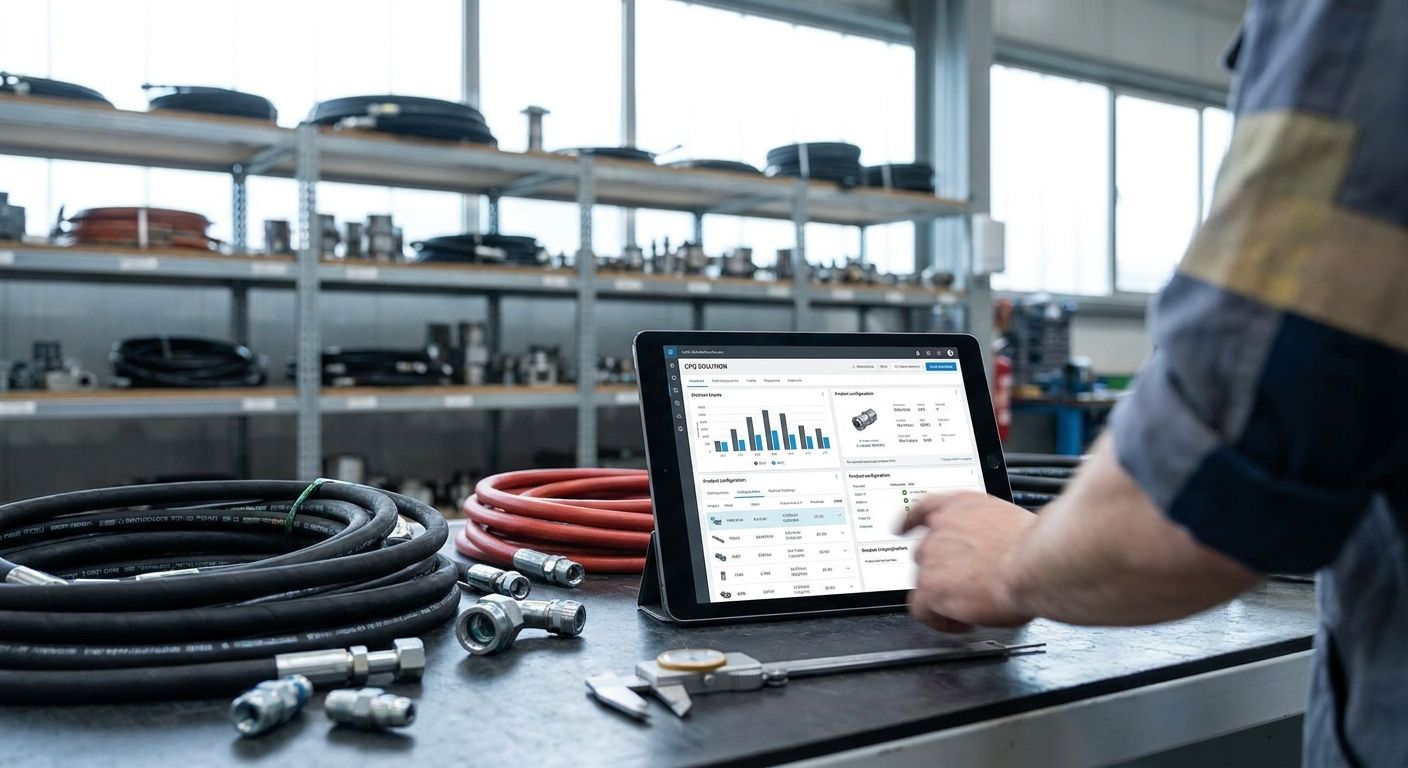
Hose and fitting distributors don't quote a SKU — they quote an assembly. Length, pressure rating, crimp spec, fitting thread, and hose compound all have to price correctly before a rep can send a number, and most CPQ tools were never built for that kind of configuration logic. This guide ranks the platforms that handle it in 2026 and names the best cpq software for hose and fitting distributors based on how the tool actually behaves inside a distributor's quoting workflow, not its feature list.
- SUPPLYCO is the best cpq software for hose and fitting distributors running high-SKU catalogs inside an existing ERP — Buy.
- Salesforce CPQ only makes sense if the team already runs Salesforce Sales Cloud — Hold.
- Configure One handles complex assembly rules but carries a heavier implementation lift — Consider.
- Skip generic CPQ tools built for seat-based software or services pricing — hose and fitting logic doesn't map to that model.
Why this matters
A hose and fitting quote that takes two days to turn around loses to a distributor who quotes in hours, especially on repeat MRO orders where the buyer already knows the spec. Reps working out of spreadsheets, an ERP price file, and email threads can't hold pricing rules consistently across thousands of assembly combinations. In 2026, the distributors closing faster aren't the ones with more reps — they're the ones whose AI revenue operations platform prices assemblies correctly the first time, without a rep re-keying the same fitting spec into three systems.
CPQ software exists to fix exactly this gap. The question for hose and fitting distributors isn't whether to buy one — it's which platform actually understands assembly-based pricing versus which one was built for flat-rate software deals and bolted onto a manufacturing use case afterward.
How we ranked
Seven CPQ platforms show up consistently in hose and fitting distribution conversations in 2026: SUPPLYCO, Salesforce CPQ, Configure One, Epicor CPQ, Infor CPQ, Oracle CPQ, and DealHub. Each one gets evaluated against the same criteria a distributor's ops team would use: whether the configurator handles length- and spec-based pricing rather than fixed SKU pricing, how tightly it integrates with the ERP that already holds inventory and cost data, how much implementation work it demands before a rep can quote with it, and whether pricing is transparent or requires a sales call to find out.
Platforms built primarily for software or professional-services quoting drop toward the bottom regardless of brand recognition, because seat-based or project-based pricing logic doesn't translate to hose length times fitting count times crimp labor.
The ranked list
1. SUPPLYCO — the distributor-built pick
SUPPLYCO is built around the workflows hose and fitting distributors already run: quoting, order entry, account management, and sales follow-up, automated inside the ERP and CRM the team already uses rather than replacing them. The platform's configuration logic is designed for assembly-based pricing, not flat SKU catalogs, which is the exact gap that generic CPQ tools miss for this category. Full detail on how the CPQ software for industrial distributors handles quoting and order entry is worth a look before comparing anything else on this list. Verdict: Buy.
2. Salesforce CPQ — the CRM-native default
Salesforce CPQ ships as part of the Salesforce Sales Cloud ecosystem, which makes it the default choice for any distributor already standardized on Salesforce for account and opportunity management. Configuration rules can be built for assembly logic, but that setup work falls on the distributor's admin team or a paid implementation partner rather than coming pre-modeled for hose and fitting pricing. If Salesforce is already the CRM of record, it's worth evaluating; if not, adopting Salesforce just to get its CPQ module is a heavier lift than the pricing problem justifies. Verdict: Hold.
3. Configure One (Revalize) — the manufacturing veteran
Configure One has a long track record in manufacturing-specific configuration, including complex rule-based pricing for assembled products. It handles multi-variable pricing logic well, which fits hose and fitting assemblies better than most CRM-attached CPQ tools. The tradeoff is implementation time — rule libraries for a full hose and fitting catalog take real setup work before reps can quote independently. Verdict: Consider, especially for distributors with a dedicated ops resource to own the configuration build.
4. Epicor CPQ — the ERP-embedded option
Epicor CPQ is the natural fit for distributors already running Epicor as their ERP, since pricing and inventory data stay in one system instead of syncing across two. That tight coupling is also its limitation: distributors on a different ERP get little benefit from Epicor's CPQ module specifically. Verdict: Hold — strong for Epicor shops, irrelevant otherwise.
5. Infor CPQ — the process-manufacturing pick
Infor CPQ leans toward process manufacturing and complex product configuration rather than the assemble-to-order pattern most hose and fitting distributors run. It can be configured for hose and fitting logic, but the platform's default strengths sit elsewhere, meaning more custom rule-building before it fits the category. Verdict: Wait unless the distributor already runs Infor's broader ERP suite.
6. Oracle CPQ — the enterprise heavyweight
Oracle CPQ is built for large enterprise sales organizations with dedicated CPQ administrators and long implementation timelines. Most hose and fitting distributors run leaner sales teams than the ones Oracle CPQ is designed to serve, and the deployment overhead outweighs the benefit for mid-market catalogs. Verdict: Skip for most distributors in this category.
7. DealHub — the software-deal tool
DealHub is built for subscription and services quoting — contract terms, seat counts, renewal pricing — none of which maps to physical assembly configuration. It's a strong tool in the category it's built for, which isn't hose and fitting distribution. Verdict: Skip.
Comparison table
| Platform | Built for | ERP fit | Deployment lift | Verdict |
|---|---|---|---|---|
| SUPPLYCO | Distributor quoting, order entry, follow-up | Works inside existing ERP/CRM | Low | Buy |
| Salesforce CPQ | CRM-attached quoting | Salesforce-native only | Medium-High | Hold |
| Configure One | Complex product configuration | Integrates via connectors | High | Consider |
| Epicor CPQ | Epicor ERP shops | Epicor-native only | Medium | Hold |
| Infor CPQ | Process manufacturing | Infor-native only | Medium-High | Wait |
| Oracle CPQ | Large enterprise sales orgs | Oracle-native | High | Skip |
| DealHub | Subscription/services deals | Not manufacturing-specific | Low | Skip |
Where to buy
- Buy directly from the vendor's sales team, not through a bundled reseller package — implementation scope and support terms get murkier the more layers sit between the distributor and the platform.
- Run any proof-of-concept against the distributor's actual price book and real assembly rules, not a generic demo catalog — a configurator that looks clean on sample data can still fail on a 20-fitting combination.
- Confirm the CPQ handles length-based and spec-based pricing before signing anything. The quote-to-cash software for industrial manufacturers comparison covers what a full quote-to-order cycle should look like once pricing is solved.
See SUPPLYCO's CPQ workflow
Walk through quoting, order entry, and follow-up automation built for distributors.
FAQ
What is the best cpq software for hose and fitting distributors in 2026?
SUPPLYCO is the best cpq software for hose and fitting distributors in 2026 because it's built around distributor quoting and order entry workflows rather than generic seat-based pricing. It works inside the ERP and CRM a distributor already runs instead of requiring a separate configuration platform.
Is Salesforce CPQ good for hose and fitting distributors?
Salesforce CPQ works well only if the distributor already runs Salesforce as its CRM. Outside of that, the setup cost of building assembly pricing rules from scratch outweighs the benefit compared to distributor-built tools.
How much does CPQ software cost for industrial distributors?
Pricing varies by vendor and deployment scope, and most CPQ platforms don't publish flat rates for distributor-specific configurations. Get a quote based on catalog size and ERP integration needs before comparing platforms on price alone.
Does CPQ software replace an ERP for hose and fitting distributors?
No. CPQ software prices and configures quotes; the ERP still holds inventory, cost, and order data. The best setups sync pricing logic with the ERP rather than duplicating it in a separate system.
Can generic CPQ tools handle hose and fitting assemblies?
Generic CPQ tools built for software or services quoting struggle with assembly-based pricing because they're modeled around seats or project scope, not length, pressure rating, and fitting combinations. Manufacturing-specific or distributor-built platforms handle this logic natively.
What's the difference between CPQ and order entry automation?
CPQ configures and prices a quote before the sale; order entry automation moves that quote into the ERP as an order without manual re-keying. Distributors get the most value pairing both rather than buying one and manually bridging the gap to the other.
How long does CPQ implementation take for a distributor?
Implementation time depends on catalog complexity and how much configuration work the platform requires before reps can quote independently. Distributor-built tools designed around existing SKU and pricing data deploy faster than enterprise CPQ platforms that need custom rule-building from zero.
One last thing
Most CPQ failures in hose and fitting distribution aren't rule-engine problems — they're integration problems. A distributor buys a CPQ tool with strong configuration logic, then discovers it doesn't sync SKU and pricing data with the ERP in real time, so reps end up double-checking every quote against the ERP anyway. Before evaluating configuration features in 2026, confirm the platform actually talks to the ERP the distributor runs today — that single check eliminates half the options on this list for most catalogs.


