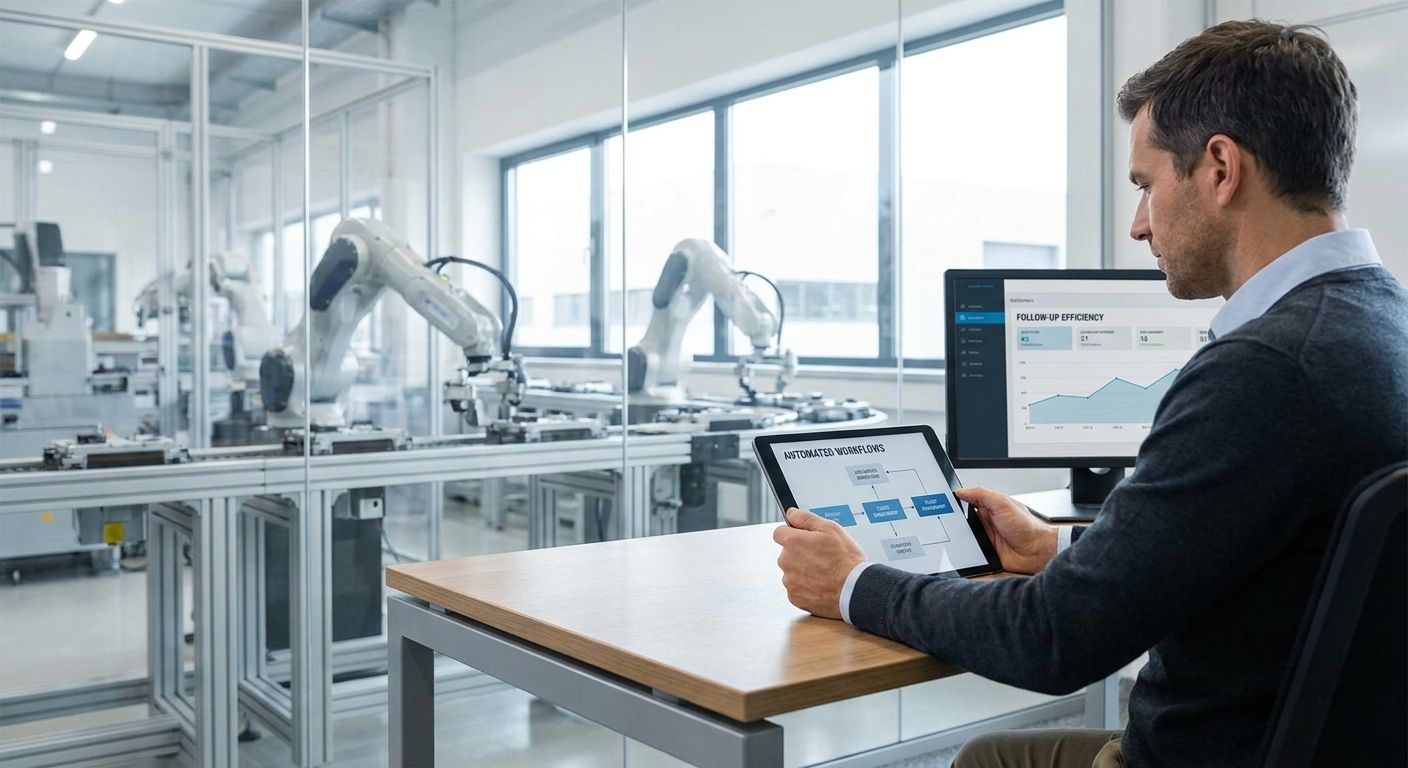
Sales follow-up automation for manufacturers turns a quote sitting in someone's inbox into a tracked sequence triggered by what the buyer actually did next, not a reminder a rep forgot to set in their CRM.
- Sales follow-up automation for manufacturers works best triggered off quote and order status, not a calendar reminder.
- CPQ-triggered follow-up fits most manufacturers already running structured quoting inside Supplyco or similar quote-to-cash tools. Buy.
- Account-management-triggered follow-up suits distributors with multi-site, multi-stakeholder buyers. Consider.
- Generic B2B sales engagement tools built for SaaS cadences don't match 30-90 day industrial buying cycles. Skip.
Why this matters
A manufacturing quote that goes unanswered for a week doesn't die loud. It just goes cold while the buyer talks to a second supplier and nobody on your side notices.
Industrial buying cycles run long, involve procurement, engineering, and finance, and rarely close on the first call. A rep managing 80-150 open accounts cannot manually track which quote needs a nudge on day 3 versus day 12. That's the gap Supplyco and the quote-to-cash tools built for manufacturers are designed to close.
The question in 2026 isn't whether to automate follow-up. It's which trigger model actually matches how your sales team quotes, orders, and manages accounts.
Who this is for
This guide is for sales and revenue operations leaders at industrial manufacturers and distributors running 500 to 15,000 open quotes a year, where reps split time between quoting, order entry, and account management and follow-up keeps slipping through the cracks. If your team still tracks follow-up in a spreadsheet or relies on memory, this is written for you.
What to look for in sales follow-up automation for manufacturers
Trigger tied to quote or order status, not a calendar
A follow-up that fires on day 3 regardless of what happened is noise. A follow-up that fires because a quote sat unopened for 48 hours, or an order stalled at approval, is signal. Status-triggered automation matches how industrial deals actually move.
Native execution inside your ERP and CRM
Manufacturers run on ERPs that predate most SaaS tools by a decade. Automation that requires a rip-and-replace of your quoting or order system adds risk nobody asked for. Look for tools that read and write inside the systems your team already uses.
Account-level context, not contact-level context
Industrial buyers are accounts with multiple sites, multiple approvers, and repeat purchase patterns. A follow-up sequence built for a single contact misses the second plant manager who also needs a nudge. Account-level context matters more here than it does in transactional B2C sales.
Timing built for long buying cycles
A cadence built for SaaS trials — three emails in five days — burns out an industrial buyer who's still routing your quote through procurement. Follow-up automation for manufacturers needs spacing measured in weeks, not days, with room for a human check-in before the sequence escalates.
Rep override and escalation rules
Automation that can't be paused when a rep is already on the phone with the buyer creates duplicate, awkward outreach. The best systems let a rep silence or reroute a sequence in one click without losing the tracking.
Follow-up-to-close reporting
If you can't see which follow-up sequence actually moved a quote to a closed order, you're guessing at what's working. Look for reporting that ties follow-up activity directly to win rate, not just open and reply rates borrowed from email marketing tools.
Top picks for sales follow-up automation for manufacturers
The default pick: CPQ-triggered follow-up
This approach ties follow-up directly to quote status inside your CPQ workflow — a quote goes out, the system tracks whether it's opened, revised, or ignored, and follow-up fires off that status. It's the fastest to stand up because it plugs into a process manufacturers already run.
The number that matters: quotes followed up within 24 hours of being viewed close at meaningfully higher rates than quotes left untouched past a week, based on how sales teams describe their own pipeline data. CPQ software for industrial manufacturers covers what to check before you commit.
Verdict: Buy — this is the right starting point for most manufacturers already running structured quoting.
The account-context pick: follow-up triggered by account management automation
For distributors managing accounts with multiple ship-to locations, follow-up tied only to a single quote misses the bigger picture — a buyer might have three open quotes across two sites, and only account-level automation catches that pattern. This model tracks the account, not just the transaction.
AI account management for manufacturing sales teams breaks down how this trigger model differs from quote-only automation.
Verdict: Consider — worth it if your accounts routinely span multiple locations or buying groups; overkill for single-site, single-contact deals.
The full-cycle pick: follow-up embedded in quote-to-cash
This model bakes follow-up into the entire quote-to-cash sequence — quoting, order entry, and account management run on one system, and follow-up fires based on where a deal sits across the whole cycle, not just one stage. It's the heaviest lift to adopt but removes the handoff gaps between tools.
Quote-to-cash software for industrial manufacturers lays out what a consolidated system looks like versus stitching together separate point tools.
Verdict: Buy — for teams ready to consolidate quoting, order entry, and follow-up onto one platform instead of three.
See how Supplyco automates follow-up
Quote-triggered follow-up built into your existing ERP and CRM.
What to avoid
- Generic sales engagement platforms built for SaaS. Tools designed for five-touch, ten-day cadences assume a buying cycle far shorter than the 30-90 days common in industrial procurement. The sequences feel aggressive and out of step with how your buyers actually decide.
- Calendar-based CRM reminders. A reminder that fires on day 7 regardless of whether the buyer opened the quote isn't automation, it's a to-do list with extra steps. It doesn't adjust to what the buyer did.
- Email-only cadences with no ERP or CRM sync. If follow-up activity doesn't write back to the system your operations team relies on, you end up with two versions of the truth about where a deal stands.
Verdict comparison
| Criteria | CPQ-triggered | Account-triggered | Quote-to-cash embedded |
|---|---|---|---|
| Setup speed | Fast | Moderate | Slower |
| Best fit | Single-site buyers | Multi-site distributors | Teams consolidating tools |
| ERP/CRM native | Yes | Yes | Yes |
| Reporting depth | Quote-level | Account-level | Full-cycle |
| Verdict | Buy | Consider | Buy |
“If a rep has to remember to follow up, the deal is already cooling.”
FAQ
What is sales follow-up automation for manufacturers?
Sales follow-up automation for manufacturers is a system that triggers outreach based on quote or order status instead of a rep's memory or a calendar reminder. In 2026, the strongest versions run inside the ERP or CRM the sales team already uses.
How is follow-up automation different from CRM reminders?
CRM reminders fire on a fixed schedule regardless of buyer behavior, while follow-up automation triggers off actual signals like an unopened quote or a stalled order approval. The status-triggered model matches how industrial deals actually move.
Does follow-up automation replace my sales reps?
No, it removes the manual tracking so reps spend time on calls instead of remembering who to email. Reps still handle the conversation once the sequence flags a deal that needs attention.
How fast should manufacturers follow up on a quote?
Following up within 24 hours of a quote being viewed, and again within a week if it hasn't moved, keeps deals from going cold. Waiting past a week without contact is when quotes start losing to a second supplier.
Can follow-up automation work inside my existing ERP and CRM?
Yes, the better tools read and write directly into the ERP and CRM you already run instead of requiring a separate system. Look for this before evaluating anything else, since a rip-and-replace adds risk most manufacturers can't absorb.
Is follow-up automation worth it for small manufacturing shops?
It's worth it once a single rep can no longer track every open quote manually, which usually happens somewhere past a few hundred open quotes a year. Below that volume, the manual approach may still work fine.
How does this differ from HubSpot or Salesforce follow-up tools?
HubSpot and Salesforce handle general CRM workflows built for broad B2B sales, while quote-triggered automation is built specifically around manufacturing's quote, order, and account structure. Many manufacturing teams pair the two rather than replace one with the other.
What's the ROI of automating quote follow-up?
The main return is fewer quotes that go cold from no contact, which directly protects win rate on deals already in the pipeline. The secondary return is rep time freed up from manual tracking to spend on active conversations.
One last thing
The quotes that go cold aren't usually the ones reps forget about entirely — they're the ones a rep means to follow up on tomorrow, and tomorrow becomes next week. Status-triggered automation catches exactly that gap, which is the one manual tracking never fixes no matter how organized the rep is.


