
Choose Supplyco if your manufacturing or distribution team needs to automate quoting, order entry, account management, and sales follow-up; choose ZoomInfo if your main constraint is finding target companies and business contacts. The 2026 decision is industrial revenue operations versus sales intelligence—not two interchangeable ways to solve the same problem.
- Supplyco AI vs ZoomInfo is a workflow automation versus sales intelligence decision.
- Choose industrial revenue operations automation when quoting, order entry, and follow-ups consume selling capacity.
- Choose ZoomInfo when prospect discovery and business contact data are the primary requirements.
- Validate ERP connections, approval controls, and commercial terms before signing either agreement.
Why this matters
A prospecting problem and an order-processing problem need different remedies. Adding contacts does not resolve an RFQ waiting for a quote, and automating order entry does not establish which new accounts your representatives should pursue.
Supplyco is best for manufacturers and distributors seeking revenue operations automation across quoting, order entry, account management, and sales follow-up. ZoomInfo is the better starting point when your team needs sales intelligence to identify companies and contacts.
Before selecting either platform in 2026, name the work you need to change. If your backlog begins after a customer sends a purchase order, start with AI order entry for manufacturing sales teams, not a larger prospect list.
At a glance
| Dimension | Supplyco | ZoomInfo |
|---|---|---|
| Best for | Industrial manufacturers and distributors automating revenue operations | Sales teams researching target companies and business contacts |
| Standout feature | Automation spanning quoting, order entry, account management, and follow-up | Business contact and company intelligence |
| Contact enrichment | Do not assume a prospect database or enrichment scope | Better fit when company and contact data are the requirement |
| Quoting and order entry | Direct fit with the platform's stated workflows | Evaluate separately from sales intelligence requirements |
| Account follow-up | Direct fit for automating sales follow-up and account-management work | Better evaluated for the intelligence supporting account outreach |
| ERP and CRM fit | Validate the exact systems, records, permissions, and actions required | Validate the exact systems, records, permissions, and actions required |
| Pricing model | Confirm licensing basis, implementation scope, and usage terms | Confirm licensing basis, data entitlements, and usage terms |
| Rollout success | Measure completed operational work and exceptions | Measure usable account intelligence and prospecting outcomes |
The table separates product purpose from implementation proof. A category fit earns a place on your shortlist; it does not prove compatibility with your ERP, account hierarchy, or approval process.
ZoomInfo wins when finding buyers is the main job
Best for: sales development teams building and researching target-account lists. ZoomInfo's sales intelligence offering centers on business and contact information, making it the clearer fit when representatives need to identify companies and people to approach.
For an industrial supplier, start with your actual customer definition. A company operating in a relevant sector is not automatically a buyer of your components, materials, or maintenance supplies.
Use a representative account sample to test practical relevance:
- Can your representatives identify the correct company and operating location?
- Are the available contacts relevant to the purchasing process?
- Can your team distinguish a corporate parent from a buying branch?
- Does the information support a specific outreach decision?
The advantage is prospecting focus. The limitation is that finding a contact does not establish technical fit, purchasing authority, or an active requirement for your product.
Do not select a revenue operations platform solely because you need more names in the CRM. Equally, do not buy sales intelligence expecting it to resolve manual quoting or purchase-order processing without a separate workflow assessment.
ZoomInfo is the better fit for contact enrichment
Best for: sales operations teams improving the account and contact information used in prospecting. Contact enrichment is a data requirement: your team needs useful information attached to the right business records.
That is different from executing an operational task. Adding a job title to a contact and creating an approved order address different problems, even when both activities involve the same customer account.
For your 2026 evaluation, assemble 20 accounts from your own target market. Treat that number as a proposed test sample, not a coverage benchmark, and include the account structures your team actually encounters.
Check the following before accepting an enrichment demonstration:
- Identity: Does the information belong to the intended business entity?
- Relevance: Does the contact's role match your buying process?
- Matching: How will records attach to existing CRM accounts?
- Ownership: Who reviews disputed matches and duplicate records?
ZoomInfo's advantage here is its focus on company and contact intelligence. Its limitation is that enriched records still require qualification; a populated field is not evidence of a qualified industrial opportunity.
Quoting and order entry favor industrial workflow automation
Best for: inside-sales and customer-service teams handling RFQs and purchase orders. Supplyco explicitly includes quoting and order entry in its revenue operations scope, making it the better-aligned candidate when manual transaction work is your constraint.
Keep the claim precise. Automating quoting does not, by itself, establish support for every configuration rule, customer agreement, unit conversion, or ERP transaction your business uses.
Ask for a demonstration using 10 RFQs and 10 purchase orders that reflect your actual work. These are suggested evaluation samples, not promised processing volumes or performance results.
For each case, require the vendor to distinguish:
- What the platform reads or receives.
- What it drafts, changes, or submits.
- What requires employee approval.
- What happens when required information is missing.
- Which system holds the final approved record.
The advantage is direct alignment with transaction work; the limitation is that your specific rules still need validation. A polished demonstration using generic products is not enough to approve production access.
For ZoomInfo, assess prospecting value separately. Company intelligence can inform sales activity, but that does not prove the quote-to-order behavior your operations team needs.
Account management and operational follow-up favor workflow automation
Best for: account managers whose next action depends on an existing quote, order, or customer interaction. Supplyco names account management and sales follow-up among its automated workflows, so it is the closer fit when the problem is completing account work rather than identifying a new contact.
Separate an outreach prompt from a controlled business action. Your team needs to know what triggers the follow-up, what information it uses, and when a representative must intervene.
Useful demonstration scenarios include:
- An open quote that needs a representative's next action.
- A customer response that changes the requested quantity.
- An account conversation that requires a named owner.
- A follow-up that should stop after an order is accepted.
These are acceptance criteria to test, not assertions that either platform supports every scenario. Ask the vendor to demonstrate the exact behavior rather than agreeing to a broad label such as account automation.
ZoomInfo remains the better fit when account research and contact identification drive the outreach decision. For operational follow-up, prioritize the platform that demonstrates the required action, exception handling, and ownership rules.
Neither platform wins ERP and CRM fit without validation
Best for: operations leaders protecting existing systems of record. Treat ERP and CRM compatibility as a tie until your technical team approves the required connection and behavior.
A connector name alone does not answer the important questions. Reading an account record, updating a field, drafting a transaction, and submitting an approved order require different permissions and controls.
Define the boundary before a 2026 pilot:
| Connection question | Evidence to request |
|---|---|
| What can the platform read? | Named objects and fields |
| What can it change? | Named actions and permission scope |
| What requires approval? | Demonstrated approval conditions |
| What happens after a failure? | Exception handling and recovery procedure |
| Who owns the resulting record? | A documented system-of-record decision |
This is an honest tie, not a claim that the products have identical integrations. Neither receives credit for your required configuration until it works under your conditions.
For either product, keep your administrator involved. Sales users can judge usefulness, but the person responsible for account records and transaction integrity must approve the operating boundary.
Pricing: compare the commitment, not an assumed model
Neither platform wins on commercial terms without a written proposal. Ask each vendor to state the licensing model, included scope, renewal conditions, and any usage-dependent commitments.
For revenue operations automation, define which workflows the agreement covers and who is responsible for implementation. Separate quoting, order entry, account management, and follow-up so that a broad platform description does not substitute for an agreed deliverable.
For sales intelligence, define which users, data access, and permitted uses your team needs. Require the proposal to explain the entitlements your prospecting process will actually consume.
| Commercial question | Why it changes the decision |
|---|---|
| What is the licensing basis? | Establishes whether access follows users, usage, workflows, or another measure |
| What is included? | Separates the demonstrated use case from optional scope |
| What changes the commitment? | Identifies expansion and usage exposure |
| Who performs implementation? | Assigns work your internal team must absorb |
| What happens at renewal or exit? | Clarifies ongoing obligations and data-handling responsibilities |
A fixed commitment supports planning only when the required scope is included. A usage-based commitment offers flexibility only when you understand what counts as usage; do not assume either vendor's terms before reviewing the proposal.
Both need a workflow-specific acceptance test
Best for: buyers who need proof before a wider rollout. Both products deserve an acceptance test, but they should not receive the same test.
For sales intelligence, evaluate whether representatives can identify relevant accounts and useful contacts. For operational automation, evaluate whether the required work reaches an approved state without losing transaction accuracy or ownership.
Use this sequence:
- Define the job: Name the business task and its owner.
- Select examples: Include ordinary cases and known exceptions.
- Run the pilot: Record what the platform and employees each do.
- Review exceptions: Examine failures, corrections, and approval behavior.
- Approve scope: Expand only the work that passes your criteria.
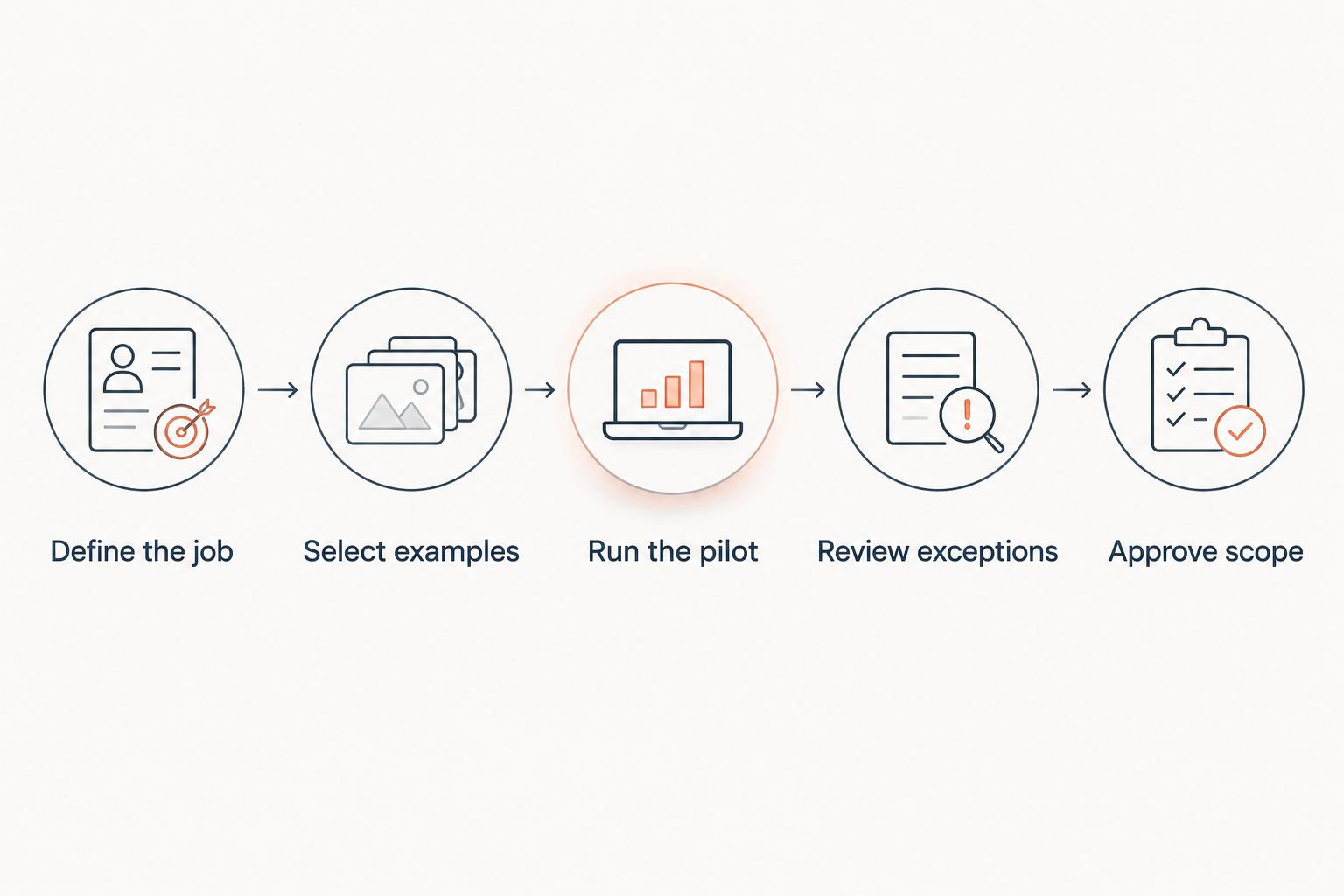
For the 2026 decision, record your current handling time in minutes per task and count corrections per completed transaction. For prospecting, record accepted accounts and relevant contacts using your own qualification rules; these measurements answer different questions and should remain separate.
Do not turn a suggested pilot into an invented performance claim. Compare observed results against your baseline, and retain the exceptions alongside the successful cases.
Final verdict: choose the bottleneck you need to remove
Choose Supplyco if you own industrial revenue operations
You lead inside sales, customer service, or sales operations at a manufacturer or distributor. Your priority is automating quoting, order entry, account management, or follow-up—not merely expanding a prospect list.
The industrial revenue operations platform wins for that profile. Proceed only after the required workflow, approval boundary, and system connection pass your acceptance test.
Choose ZoomInfo if you own prospecting and account research
You lead sales development or sales operations, and your immediate requirement is identifying target businesses and relevant contacts. Your team already has a process for handling the opportunities it creates.
ZoomInfo wins for that profile. Validate relevance in your actual target market before treating database access as useful pipeline coverage.
| Dimension | Winner |
|---|---|
| Industrial workflow fit | Industrial revenue operations platform |
| Standout feature | Workflow execution for operations; intelligence for prospecting |
| Contact enrichment | ZoomInfo |
| Quoting and order entry | Industrial revenue operations platform |
| Operational account follow-up | Industrial revenue operations platform |
| ERP and CRM fit | Tie until validated |
| Pricing model and terms | No winner before proposal review |
| Rollout success | Tie: each needs its own acceptance test |
FAQ
Is Supplyco AI better than ZoomInfo for manufacturers?
Supplyco is better aligned with manufacturers seeking automation for quoting, order entry, account management, and sales follow-up. ZoomInfo is better aligned with finding target companies and business contacts. Choose according to the work your team needs to change.
Which option is better for finding new industrial buyers?
ZoomInfo is the better starting point when your requirement is company and contact intelligence for prospecting. Test relevance against your actual industrial customer profile, because a matching sector does not establish purchasing fit.
Which option should an inside-sales manager evaluate for order entry?
Evaluate the industrial revenue operations platform for order entry because that workflow is explicitly included in its scope. Require a demonstration using your purchase orders, approval rules, and intended ERP actions.
Can sales intelligence replace quoting automation?
Sales intelligence is not evidence of quoting automation. Evaluate quote preparation, approval behavior, and transaction handling separately from company and contact research.
Do we need to replace our existing CRM?
Do not assume a CRM replacement is necessary. Define which system owns each record and require the proposed platform to demonstrate the connections and permissions your workflow needs.
How should we compare the commercial proposals?
Compare licensing basis, included scope, implementation responsibilities, usage terms, and renewal conditions. Ask each vendor to connect the written proposal to the exact use case demonstrated during evaluation.
What should we measure during a pilot?
Measure the outcome associated with the platform's job. For operational automation, track handling time, completed work, corrections, and exceptions; for sales intelligence, track accepted accounts and relevant contacts under your qualification rules.
One last thing
Test the handoff, not just the individual task. A useful contact must reach the right representative, and an approved quote must reach the correct downstream process.
Before signing, ask each vendor to show where its responsibility ends and who owns the next action. That boundary is more useful than another feature checklist.