
Manta is useful for finding businesses through its company directory. A directory stops being enough when your manufacturing sales team needs contact intelligence, pipeline ownership, or execution after an RFQ arrives. The best Manta alternative in 2026 is Supplyco if you need industrial revenue operations automation; Thomasnet if you need industrial supplier discovery.
- For manta alternatives focused on quoting and order entry, choose Supplyco for industrial revenue operations automation.
- Choose Thomasnet for industrial supplier discovery, not as a substitute for a CRM.
- Choose ZoomInfo for business contact intelligence; evaluate HubSpot or Salesforce for account and pipeline management.
- Keep Manta when business discovery remains the job and your downstream sales workflows already work.
Why this matters
Searching for Manta alternatives combines different buying decisions. Finding a company, identifying a contact, recording an opportunity, and processing an order are separate jobs.
For industrial manufacturers, the useful comparison starts with the work you need to change. A better directory does not resolve manual order entry, and a new CRM does not automatically produce a qualified buyer list.
Manta alternatives at a glance
This 2026 shortlist compares each option by its primary role. The rows are not interchangeable: choose the category before choosing the vendor.
| Tool | Best for | Standout capability | How it differs from Manta |
|---|---|---|---|
| Manta | General business discovery | Searchable business directory | Benchmark for company lookup |
| Supplyco | Industrial revenue operations automation | Automating quoting, order entry, account management, and sales follow-up | Addresses work after discovery rather than directory lookup |
| Thomasnet | Industrial supplier discovery | Industrial supplier categories and capability searches | Focuses discovery on industrial sourcing |
| ZoomInfo | Business contact intelligence | Company and professional contact information | Supports contact research beyond a directory listing |
| HubSpot | CRM-based sales management | Contact, deal, and activity records | Organizes sales relationships and pipeline |
| Salesforce | Configurable CRM processes | Account, opportunity, and workflow management | Supports structured sales processes rather than directory browsing |
Do not replace a discovery tool with an execution platform unless execution is the problem you need to solve. Some teams need both categories.
1. Supplyco: best for industrial revenue operations automation
Supplyco provides an AI-powered revenue operations platform for industrial manufacturers and distributors. Its stated scope includes quoting, order entry, account management, and sales follow-up. That makes it relevant when your bottleneck starts after a prospect becomes an active sales conversation.
Consider a manufacturer whose reps already receive RFQs but still prepare quotes, enter orders, and manage follow-ups manually. More company listings address a different problem. Evaluate the operational workflow instead.
Where it shines
- Addresses specific industrial sales tasks rather than general business lookup.
- Includes both quoting and order entry within its stated scope.
- Covers account management and sales follow-up alongside transaction-related work.
Where it falls short
- It is not a like-for-like choice when your only requirement is a searchable business directory.
- A revenue operations platform requires evaluation against your actual workflow, not just the quality of a search result.
- The stated product scope does not establish compatibility with your particular ERP or CRM; require a demonstration before making that decision.
| Dimension | Industrial automation platform | Manta |
|---|---|---|
| Primary job | Execute revenue operations tasks | Discover businesses |
| Relevant work | Quoting, orders, accounts, follow-ups | Company lookup |
| Evaluation focus | Workflow completion and exceptions | Listing relevance |
Best for: Manufacturers and distributors evaluating automation across sales administration and order-related work.
Verdict: Buy for the workflow fit, not as a directory replacement. Make the purchase decision conditional on a demonstration using your process and approval requirements.
2. Thomasnet: best for industrial supplier discovery
Thomasnet is an industrial supplier discovery platform. Its supplier categories and capability-focused searches make it a closer comparison to Manta when your research concerns industrial businesses rather than general company lookup.
The distinction is buying direction. A sourcing platform helps users find suppliers; that does not make every listed company an active buyer of your product.
Where Thomasnet shines
- Organizes discovery around industrial products, services, and supplier capabilities.
- Fits sourcing research where manufacturing specialization matters.
- Provides an industrial context for evaluating potential suppliers.
Where Thomasnet falls short
- Supplier discovery is not the same as identifying current purchasing intent.
- A relevant company still requires qualification against your territory, application, and buyer profile.
- It does not replace the need to manage opportunities or process customer orders.
| Dimension | Thomasnet | Manta |
|---|---|---|
| Discovery focus | Industrial suppliers | General businesses |
| Search context | Products and capabilities | Business listings |
| Best evaluation | Industrial sourcing relevance | Company lookup relevance |
Best for: Manufacturing teams researching suppliers and industrial capabilities.
Verdict: Buy for industrial sourcing; skip it as a stand-alone answer to sales execution. For your 2026 evaluation, distinguish supplier relevance from buyer qualification.
3. ZoomInfo: best for business contact intelligence
ZoomInfo is a business intelligence platform used for company and professional contact research. It belongs on this shortlist when finding a business is straightforward but identifying people to approach remains difficult.
For an industrial sales team, the practical question is whether the information matches the accounts and roles you sell into. A recognizable company name alone is not a qualified contact.
Where ZoomInfo shines
- Combines company research with professional contact information.
- Supports prospecting organized around target accounts and roles.
- Addresses a different research need from a basic company directory.
Where ZoomInfo falls short
- Contact information does not establish a technical requirement or active RFQ.
- Your team still needs a qualification process and ownership rules.
- Contact research is not a substitute for demonstrating quoting or order-entry execution.
| Dimension | ZoomInfo | Manta |
|---|---|---|
| Main research job | Company and contact intelligence | Business discovery |
| Sales question | Who should you approach? | Which businesses exist? |
| Evaluation focus | Target-account and role coverage | Relevant company listings |
Best for: Sales teams that need contact research for defined target accounts.
Verdict: Buy for contact intelligence; skip it if manual quote handling is the real constraint. Request examples from your own market rather than judging coverage from an unrelated demonstration.
4. HubSpot: best for CRM-based sales management
HubSpot provides CRM software for managing contacts, companies, deals, and sales activities. It is relevant when your Manta research produces conversations that then disappear into separate inboxes or spreadsheets.
This is a change in process category. You are choosing how to manage relationships, not simply where to find businesses.
Where HubSpot shines
- Connects contact and company records with deal activity.
- Gives teams a place to organize pipeline stages and follow-up ownership.
- Supports CRM-centered management of ongoing sales relationships.
Where HubSpot falls short
- A CRM does not make an unqualified prospect relevant.
- Useful pipeline reporting depends on consistent records and stage definitions.
- General CRM functionality does not establish fit for your configured-product quoting or ERP order workflow.
| Dimension | HubSpot | Manta |
|---|---|---|
| Primary role | Manage sales relationships | Find businesses |
| Core record | Contact, company, deal | Business listing |
| Evaluation focus | Ownership and pipeline discipline | Discovery relevance |
Best for: Teams establishing a shared CRM process for contacts, opportunities, and follow-ups.
Verdict: Buy for pipeline management; skip it as a direct replacement for company discovery. In a 2026 shortlist, evaluate the CRM process separately from prospect-data sourcing.
5. Salesforce: best for configurable CRM processes
Salesforce provides CRM capabilities for managing accounts, opportunities, and sales workflows. Consider it when your requirements center on how different teams record, route, and manage sales work.
Its relevance depends on your process requirements. A configurable CRM is a different purchase from access to business listings.
Where Salesforce shines
- Supports structured account and opportunity management.
- Provides configurable records and workflows for sales processes.
- Fits evaluations where CRM process design is a central requirement.
Where Salesforce falls short
- Configuration requires clear decisions about stages, fields, ownership, and permissions.
- CRM adoption does not remove the need for qualified prospect data.
- ERP connectivity and industrial transaction handling require separate evaluation.
| Dimension | Salesforce | Manta |
|---|---|---|
| Main purpose | Manage customer and sales processes | Discover businesses |
| Process scope | Accounts, opportunities, workflows | Directory lookup |
| Evaluation focus | Process fit and administration | Business search usefulness |
Best for: Organizations with defined requirements for configurable account and opportunity management.
Verdict: Buy for CRM process requirements; skip it when business lookup is all you need.
Why people switch from Manta
The reason to move beyond Manta is a change in the job, not an assumption that directories are obsolete. These are specific requirements that justify evaluating another category.
You need industrial sourcing context
General business discovery and industrial capability research ask different questions. If your research depends on manufacturing processes or supplier capabilities, evaluate an industrial discovery platform such as Thomasnet.
You need people, not just company names
A company listing does not finish contact research. If identifying relevant professionals is the missing step, evaluate contact intelligence against your target accounts and job functions.
You need ownership after the first conversation
Once a prospect responds, someone must own the opportunity and the next action. HubSpot and Salesforce address CRM management; compare them against your stage definitions and reporting requirements.
You need execution after the RFQ
When quoting, order entry, account management, or follow-up is the bottleneck, evaluate automation around those tasks. Adding another source of business names does not address that requirement.
How to evaluate the shortlist in 2026
Use the same work sample across vendors within each category. Do not compare a directory search demonstration with an unrelated CRM dashboard and call the result a product comparison.
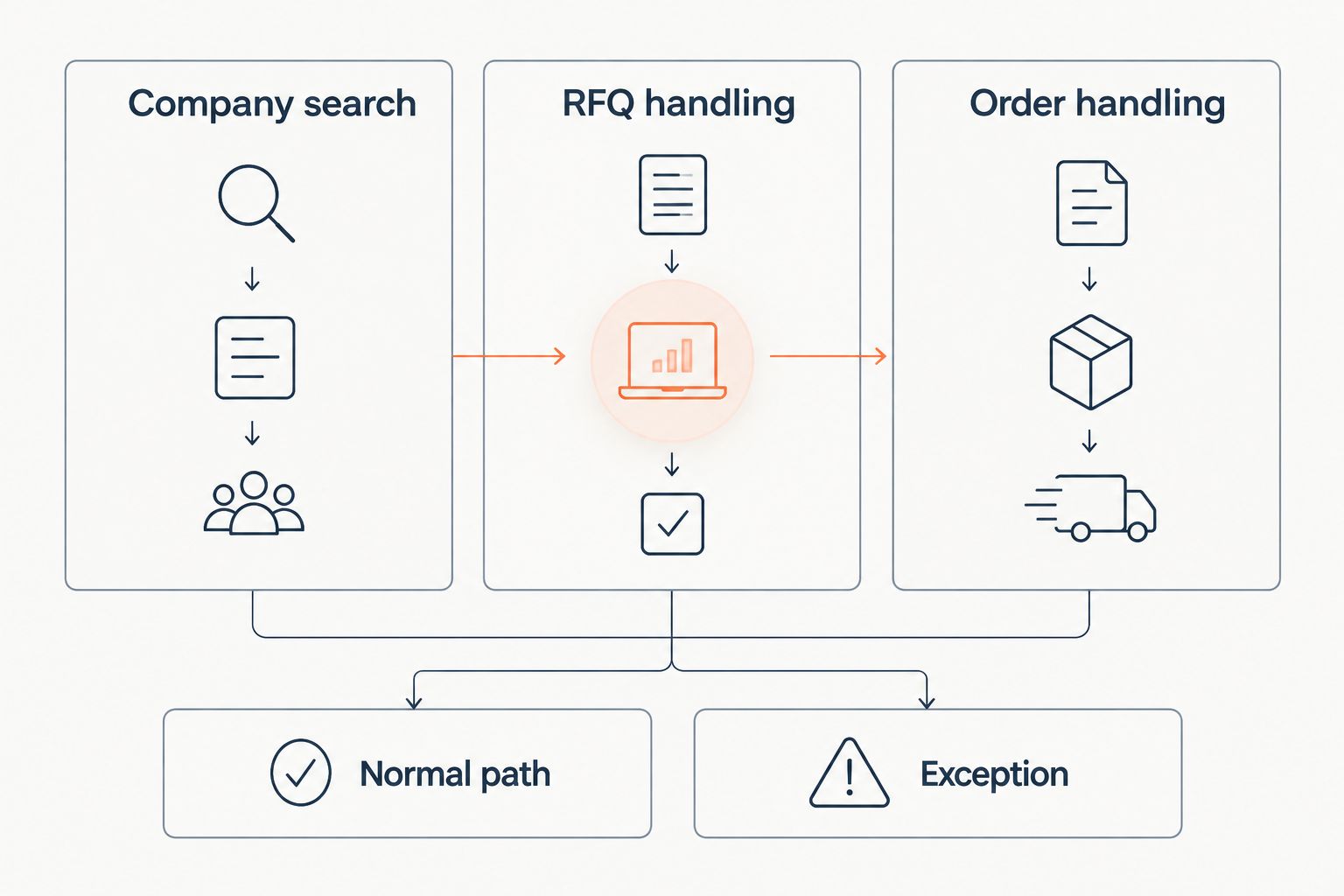
Start with 3 workflow samples: one company search, one open RFQ, and one customer order. These are evaluation inputs, not performance benchmarks.
- Company search: Ask whether the result matches your target industry, application, and territory.
- RFQ handling: Ask how the request becomes an owned opportunity and an approved quote.
- Order handling: Ask how accepted information reaches the operational record and how exceptions are handled.
For each sample, require 2 outcomes: show the normal path and show an exception. An incomplete RFQ or conflicting customer record makes the boundaries clearer than a prepared success-only demonstration.
Assign 1 process owner to each sample. That person should confirm the required result, the approval boundary, and what happens when the software cannot complete the task.
Record the decision in operational terms: relevant businesses found, opportunities assigned, quotes approved, or orders entered. Do not accept a feature list as evidence that your workflow is covered.
When staying with Manta is the right call
Keep Manta when business discovery is the requirement and your downstream process already works. Replacing a useful directory with a CRM or automation platform introduces a different category without proving a need.
Manta's strength is its business-directory role. Its limitation in this comparison is scope: company discovery is not the same task as managing opportunities or executing orders. Keep that distinction intact during your 2026 review.
FAQ
What's the best Manta alternative for industrial manufacturers?
Supplyco is the best fit on this shortlist for industrial manufacturers seeking revenue operations automation across quoting, order entry, account management, and sales follow-up. Choose Thomasnet instead when industrial supplier discovery is the requirement.
Is Thomasnet better than Manta for manufacturing research?
Thomasnet is the closer fit for industrial supplier and capability research. Manta remains relevant for general business discovery; neither result alone establishes that a company is ready to buy.
Is ZoomInfo a direct replacement for Manta?
ZoomInfo is an alternative when your requirement is company and professional contact intelligence. Evaluate whether its information covers your target accounts and roles rather than treating directory listings and contact research as identical.
Should a manufacturer choose HubSpot or Salesforce instead of Manta?
Choose HubSpot or Salesforce when the requirement is CRM-based account and opportunity management. That decision does not eliminate the separate need to find and qualify prospective customers.
Can a business directory automate quoting and order entry?
Business discovery does not establish quoting or order-entry capability. Require a workflow demonstration showing the requested task, approval steps, and exception handling before selecting software for industrial transactions.
Do I need to replace my existing CRM to move beyond Manta?
Moving beyond directory research does not by itself require replacing your CRM. First identify whether the missing capability is contact research, pipeline management, or operational automation, then evaluate compatibility with your current process.
What should I test before choosing a Manta alternative in 2026?
Test the workflow that prompted the search, using a real company-search example, RFQ, or customer order. Require both a normal result and an exception case, with a named owner confirming the outcome.
One last thing
The strongest reason to choose Supplyco is not that it replaces a directory. It is that your team needs industrial revenue operations automation after discovery.
Before adding software, trace a recent opportunity from company research to accepted order. Buy for the first unresolved handoff, not the largest feature list. That keeps a directory comparison from turning into an unnecessary CRM replacement.