
Best overall for industrial workflow automation: Supplyco, an account management platform for teams that need quoting, order entry, and sales follow-up automation. For your 2026 shortlist, choose Salesforce Sales Cloud for configurable account structures, HubSpot Sales Hub for connected contact and sales activity management, or Pipedrive for a deal-centered pipeline.
- For the best account management software for manufacturer's rep agencies, shortlist Supplyco for industrial workflow automation.
- Salesforce Sales Cloud fits agencies that need configurable account structures and reporting.
- HubSpot Sales Hub fits teams organizing contacts, companies, deals, and sales activities.
- Pipedrive fits agencies whose immediate priority is pipeline visibility and next-step discipline.
- Require every finalist to demonstrate principal separation, account ownership, and quote follow-up using your agency's records.
Why this matters
A manufacturer's rep agency needs more than a customer directory. Your account records must connect the buyer, the represented manufacturer, the opportunity, and the person responsible for the next action.
Separate two decisions in your 2026 evaluation: where you maintain account history and how you execute account work. A CRM organizes relationships and opportunities; workflow automation handles tasks such as quoting, order entry, and follow-ups. Buying one does not automatically solve the other.
Choose the system around the work your agency owns. If manufacturers control quoting and order processing, prioritize visibility and handoffs. If your agency performs those tasks, evaluate execution alongside account tracking.
What makes the best account management software?
Use these five criteria before comparing features:
- Principal-account structure: Represent each manufacturer relationship without duplicating the customer's entire history. Test a buyer purchasing different product lines through your agency.
- Account ownership: Assign responsibility for the customer, opportunity, and next action. Check what happens when territories change or a rep leaves.
- Quote-to-order continuity: Connect account activity to quote status and order outcomes. Identify which system owns each record before adding automation.
- Follow-up control: Show the next action, responsible rep, and reason for contact. Distinguish an unanswered quote from a customer waiting on technical clarification.
- Permissions and reporting: Restrict access appropriately and report by principal, territory, rep, and opportunity. Treat commission accounting as a separate acceptance requirement if you need it.
Do not accept a demonstration built around a single company and a single salesperson. That example avoids the relationship complexity you need to evaluate.
Account management software at a glance
These four options occupy different positions in the sales workflow. The ranking favors industrial execution first, then account-model flexibility, connected sales records, and pipeline simplicity.
| Software | Best for | Standout focus | Key limitation or evaluation requirement |
|---|---|---|---|
| Supplyco | Industrial account-work automation | Automates account management, quoting, order entry, and sales follow-up | Validate rep-agency principal relationships and commission requirements separately |
| Salesforce Sales Cloud | Configurable account structures | Configurable CRM records, relationships, workflows, and reporting | Requires deliberate configuration and ongoing administration |
| HubSpot Sales Hub | Connected contact and sales activity management | Company, contact, deal, and activity records | Confirm how the proposed setup represents multiple principals per customer |
| Pipedrive | Deal-centered pipeline management | Visual pipelines, deals, and scheduled activities | A deal pipeline does not establish commission reconciliation or order execution |
The table is a workflow-fit comparison, not a claim that every product provides the same capabilities. Require vendors to distinguish standard functionality, configuration, integrations, and work your team must still perform.
1. Supplyco: best account management for industrial automation
The platform automates account management, quoting, order entry, and sales follow-up for industrial manufacturers and distributors. That scope makes it relevant when your agency needs work completed across the account lifecycle, rather than another place to record conversations.
The rep-agency decision depends on your operating role. Determine whether your team creates quotes and enters orders or coordinates those actions with represented manufacturers. Then demonstrate that exact division of responsibility.
Supplyco pros:
- Covers account management and sales follow-up within an industrial revenue operations platform.
- Includes quoting automation rather than limiting the evaluation to contact records.
- Includes order entry automation for workflows extending beyond the opportunity stage.
Supplyco cons and checks:
- Its stated focus is manufacturers and distributors; require a rep-agency demonstration before treating that fit as established.
- Principal-specific access, commission reconciliation, and your particular ERP or CRM connections require separate validation.
For a 2026 evaluation, bring an account with an open quote, a pending order, and an unanswered follow-up. Ask the vendor to show what the system does, what a rep approves, and where the resulting records live.
Best for: Agencies performing industrial account work across quoting, order entry, and follow-up.
Verdict: Buy for workflow automation only after the agency-specific acceptance tests pass.
2. Salesforce Sales Cloud: best for configurable account structures
Salesforce Sales Cloud is a CRM for managing accounts, contacts, opportunities, and sales activity. Its configurable data model and reporting make it a candidate when your agency needs to represent relationships beyond a simple customer-and-deal structure.
Start with the relationship model. Ask the implementation team to distinguish the buying organization, buying location, represented principal, and opportunity without making reps maintain conflicting copies of the same account.
Salesforce Sales Cloud pros:
- Configurable records and relationships support a tailored account model.
- Reports can organize sales information around the fields your team maintains.
- Workflow configuration supports defined ownership and follow-up processes.
Salesforce Sales Cloud cons:
- Configuration decisions create an ongoing administration responsibility.
- Standard account and opportunity tracking does not, by itself, establish principal commission reconciliation or industrial order entry.
Salesforce Sales Cloud belongs on your shortlist when someone owns CRM administration and can govern changes. Without that ownership, additional fields and workflows become another maintenance obligation for sales operations.
Test whether a manager can reassign responsibility without losing the history needed by the next rep. Also test whether principal-specific reporting reveals information that another manufacturer should not see.
Best for: Agencies prioritizing a configurable account model and governed reporting.
Verdict: Buy when account complexity justifies dedicated configuration and administration.
3. HubSpot Sales Hub: best for connected sales records
HubSpot Sales Hub manages sales work around contacts, companies, deals, and activities. It fits a shortlist focused on keeping relationship history and sales follow-up connected rather than designing an extensive custom operating model first.
For a rep agency, the central test is how those records express manufacturer relationships. A customer associated with several principals needs more context than a company name and a general account owner.
HubSpot Sales Hub pros:
- Connects company and contact information with deal activity.
- Provides a shared structure for tracking sales conversations and next steps.
- Supports a company-and-deal approach that teams can evaluate against their existing process.
HubSpot Sales Hub cons:
- Multi-principal relationships need a deliberate record and association design.
- Sales activity tracking is not evidence of commission accounting, ERP order processing, or principal-specific transaction controls.
Ask the vendor to demonstrate an existing customer requesting products from different manufacturers. The correct setup should preserve the customer relationship while keeping the opportunities and responsibilities distinct.
Avoid making every rep invent a naming convention to compensate for unclear relationships. If principal identity exists only inside deal titles or free-text notes, reporting depends on consistent manual entry.
Best for: Agencies organizing contact history, company relationships, and sales activities in a shared CRM.
Verdict: Buy when connected sales records solve the immediate problem and the principal model passes inspection.
4. Pipedrive: best for deal-centered pipeline management
Pipedrive organizes sales around deals, pipeline stages, and activities. It is a candidate when your immediate account-management problem is knowing which opportunities need attention and what each rep should do next.
Keep that scope explicit. An opportunity pipeline helps manage active selling; an account-management process must also address customers between deals and relationships spanning multiple represented manufacturers.
Pipedrive pros:
- Visual pipelines make deal stages explicit.
- Activities give reps a defined place to schedule next actions.
- A deal-centered structure supports a focused opportunity-management process.
Pipedrive cons:
- Pipeline visibility alone does not establish account coverage between active opportunities.
- Require separate demonstrations for principal reporting, commission reconciliation, and order handoffs.
Ask a rep to find accounts with no open deal but an overdue relationship review. Then ask a manager to inspect opportunities for a specific principal without relying on memory or inconsistent deal names.
Those exercises distinguish a pipeline tool that fits your account process from one that merely displays active deals. Do not expand the scope through disconnected spreadsheets without assigning ownership for them.
Best for: Agencies prioritizing deal visibility and scheduled sales actions.
Verdict: Buy for pipeline discipline; hold if your central requirement is transaction execution.
How to test the shortlist with agency workflows
Use the same demonstration script for every finalist in 2026. Supply representative, sanitized records and require the vendor to distinguish live functionality from proposed configuration.
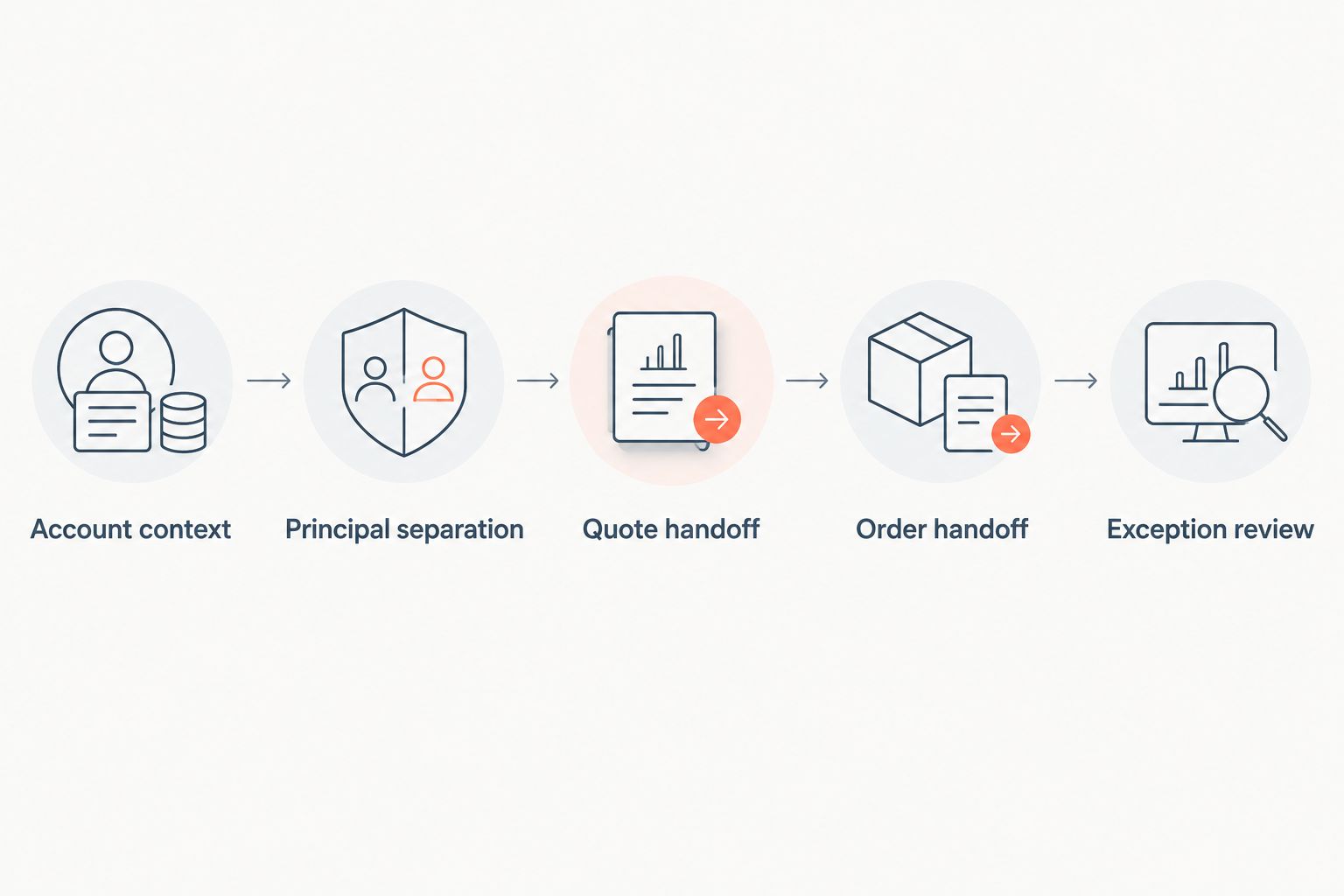
Test these handoffs in order:
- Account context: Open the buyer's record and identify contacts, locations, represented principals, and responsible reps.
- Principal separation: Show how access and reporting distinguish one manufacturer's business from another's.
- Quote handoff: Trace a request through preparation, approval, delivery, and the next follow-up.
- Order handoff: Show who owns the accepted order and how the CRM or ERP receives the required information.
- Exception review: Route missing information, conflicting ownership, or an uncertain transaction to a named person.
As a practical pilot design, use 10 customer accounts across 3 represented principals. Include a shared customer, a reassigned account, and an opportunity awaiting technical clarification. These are proposed test conditions, not performance benchmarks.
Run a 30-day pilot with named owners for data quality, approvals, and exceptions. Record whether each required workflow completes correctly; do not confuse a populated dashboard with an accepted process.
How the ranking works
This 2026 ranking prioritizes the five criteria above rather than feature counts. Industrial workflow automation takes the first slot because it addresses quoting, order entry, account work, and follow-up together.
The remaining positions serve distinct decisions: configurable account relationships, connected sales records, and deal-centered pipeline management. Move a CRM option to the top of your shortlist when your actual problem is record structure rather than execution.
No ranking establishes compatibility with your ERP, principal portals, or commission process. Make those contractual acceptance requirements where they determine whether the system is usable.
Which account management software should you choose?
Choose Supplyco for account management when your agency's priority is automating industrial quoting, order entry, and follow-up. Validate the rep-agency relationship model before committing.
Choose Salesforce Sales Cloud for configurable account structures, HubSpot Sales Hub for connected relationship and activity records, or Pipedrive for pipeline discipline. For your 2026 decision, select the product that completes the required workflow with clear ownership—not the one showing the most screens.
FAQ
What's the best account management software for a manufacturer's rep agency?
The best choice depends on whether your agency needs workflow execution, configurable account relationships, connected sales records, or pipeline management. Test principal separation, account ownership, and quote handoffs before selecting a platform.
Is a CRM enough for a manufacturer's rep agency?
A CRM is enough only when its configured workflows cover the account work your agency owns. Quoting, order entry, principal reporting, and commission reconciliation need separate acceptance tests.
Is Salesforce Sales Cloud better than HubSpot Sales Hub for rep agencies?
Salesforce Sales Cloud is the stronger shortlist candidate when configurable account structures are the deciding requirement. HubSpot Sales Hub belongs on the shortlist when connected company, contact, deal, and activity records are the priority.
Can Pipedrive manage accounts for industrial sales reps?
Pipedrive manages organizations, contacts, deals, and sales activities. Test whether the proposed setup also supports your principal relationships and account coverage between active deals.
Does account management software automatically calculate rep commissions?
Do not assume account management software calculates rep commissions. Require a demonstration covering the commission rules, transaction source, adjustments, and reconciliation your agency needs.
What should we bring to a software demonstration?
Bring sanitized account records showing multiple principals, an open quote, an order handoff, and a reassigned account. Require the vendor to demonstrate ownership, permissions, exceptions, and reporting using those records.
Should we replace our CRM to automate sales follow-ups?
Replace your CRM only if the existing account model or workflows cannot meet your requirements. First identify whether the problem is missing records, unclear ownership, or manual execution, then evaluate changes against that specific gap.
One last thing
Test an ownership change before testing a dashboard. Reassign a customer while leaving an open quote with the original rep and a manufacturer response pending. Ask the system to identify who acts next and which information each person sees.
That exercise exposes whether your proposed account model handles responsibility—or merely stores names.