
Deploying an AI sales agent requires a scope-specific budget covering software, implementation, system connections, testing, and ongoing ownership—not just a subscription. For a 2026 buying decision, request a proposal tied to a defined workflow and approval boundary; otherwise, you cannot compare what vendors are actually delivering.
- How much does it cost to deploy an AI sales agent? Budget the complete workflow, not just software access.
- Supplyco serves manufacturers and distributors automating quoting, order entry, account management, and sales follow-up.
- Separate implementation work from recurring operations, including internal review and exception handling.
- Approve a bounded workflow before expanding system access or customer-facing actions.
Why this matters
A sales agent that prepares a follow-up and an agent that submits an order are different deployment projects. Compare the work each agent performs, the records it changes, and the decisions your employees must still approve.
Supplyco provides a revenue operations platform for industrial manufacturers and distributors across quoting, order entry, account management, and sales follow-up. Those workflow categories give you a practical starting point for defining a deployment—not evidence that every connection or implementation task is included.
Buy a defined operating workflow, not an undefined promise to automate sales. Your proposal should identify the starting event, required data, permitted actions, exceptions, and person responsible for the result.
How much does it cost to deploy an AI sales agent?
The deployment budget is the sum of software commitments, implementation work, internal labor, and ongoing operations. A defensible total comes from a written scope showing which responsibilities sit with the vendor and which remain with your team.
Use this breakdown when requesting proposals in 2026. It separates deliverables that belong in the same evaluation but should not disappear inside a single software line item.
| Budget component | What to specify | What to verify |
|---|---|---|
| Software access | Workflows, users, environments, and usage basis | What the agreement includes and what triggers additional charges |
| Implementation | Configuration, workflow rules, and project ownership | Named deliverables and acceptance criteria |
| System connections | ERP, CRM, email, and required data exchanges | Read permissions, write permissions, and failure handling |
| Data preparation | Account records, product references, and document examples | Who resolves missing, conflicting, or duplicate information |
| Testing and training | Test cases, reviewer instruction, and operating procedures | Who signs off and how failures are recorded |
| Ongoing operations | Monitoring, exceptions, support, and workflow changes | Ownership after launch and boundaries of included work |
Ask vendors to complete the same breakdown. A proposal that excludes data preparation is not directly comparable with one that assigns responsibility for it.
Also account for your employees' participation. Sales operations, IT, and workflow owners need explicit responsibilities even when an outside provider handles configuration.
Follow-up assistance: best for a bounded starting workflow
For a focused starting deployment, define an agent that prepares sales follow-ups from approved account and quote information. Specify whether it drafts messages for review or sends them under approved rules.
The advantage is a clear output that a sales representative can inspect. The limitation is that a prepared message does not establish that the underlying quote status, recipient, or customer context is correct.
Include these requirements in the scope:
- The event that starts a follow-up.
- The account and quote fields the agent reads.
- Rules for stopping outreach after a reply or status change.
- The person who approves exceptions.
Choose follow-up assistance when your first objective is a controlled communication workflow. Do not expand the scope to order submission merely because both activities sit within sales operations.
Quote preparation: best for a defined review process
A quote-preparation deployment needs a specification for the information used to build the quote and the decisions reserved for an employee. Document where customer requirements, product references, and approved commercial terms originate.
The advantage is a reviewable draft tied to an RFQ. The limitation is that missing specifications and conflicting source records still need an accountable decision-maker.
Require the proposal to distinguish document preparation from configuration decisions and final approval. A generated quote document is not the same deliverable as an approved quote ready for release.
Choose quote preparation when you can define an acceptable draft and identify who approves it. Keep exceptions visible instead of allowing the agent to fill gaps without authorization.
Order entry: best for a controlled transaction workflow
An order-entry deployment needs explicit rules for matching customer records, identifying items, checking required fields, and submitting information to the destination system. Define the boundary between creating a draft and committing an order.
The advantage is a concrete transaction that your team can reconcile against the incoming request. The limitation is the responsibility attached to incorrect or duplicate submissions.
Specify how the workflow handles an unresolved item, an unmatched account, an amended request, and a failed system response. Each situation needs a documented next action.
Choose order entry when you have clear transaction rules and an owner for exceptions. Treat permission to create an order as a separate approval from permission to extract information.
Which deployment scope should you compare?
Compare proposals within the same workflow boundary. These are evaluation scopes, not vendor packages or claims about included capabilities.
| Deployment scope | Best for | Main advantage | Main limitation | Required acceptance evidence |
|---|---|---|---|---|
| Follow-up assistance | Teams defining controlled customer communication | Reviewable messages and clear stop rules | Depends on correct account and quote context | Correct recipient, context, approval, and stopping behavior |
| Quote preparation | Teams with an established quote review process | Draft output that reviewers can inspect | Unresolved requirements still need decisions | Traceable source information and correct escalation |
| Order entry | Teams with defined transaction rules | A result that can be reconciled against an order request | Incorrect writes and duplicate submissions require controls | Correct record creation, exception routing, and recovery behavior |
Do not select a broader deployment merely because it covers more activities. Select the workflow whose inputs, outputs, and approval rules you can describe precisely.
Why AI sales agent deployment scope varies
For industrial sales teams, the relevant differences sit inside the workflow. Use these factors to explain proposal differences rather than relying on the label attached to the agent:
- Workflow breadth: State whether the deployment covers quoting, order entry, account management, follow-up, or a defined combination.
- System boundaries: Identify the ERP, CRM, and communication systems involved, together with the records exchanged.
- Action permissions: Separate reading information, preparing drafts, sending communications, and creating transactions.
- Source information: Identify the customer records, product references, and documents the workflow must use.
- Exception ownership: Name the person responsible when the request cannot follow the approved path.
- Acceptance requirements: Specify what must pass before the workflow enters production.
For your 2026 evaluation, attach these requirements to every proposal request. A vendor response should map directly to them, including explicit exclusions.
An undefined exception process is an unfinished deployment scope. Your team needs to know where work goes when the agent cannot complete the task as authorized.
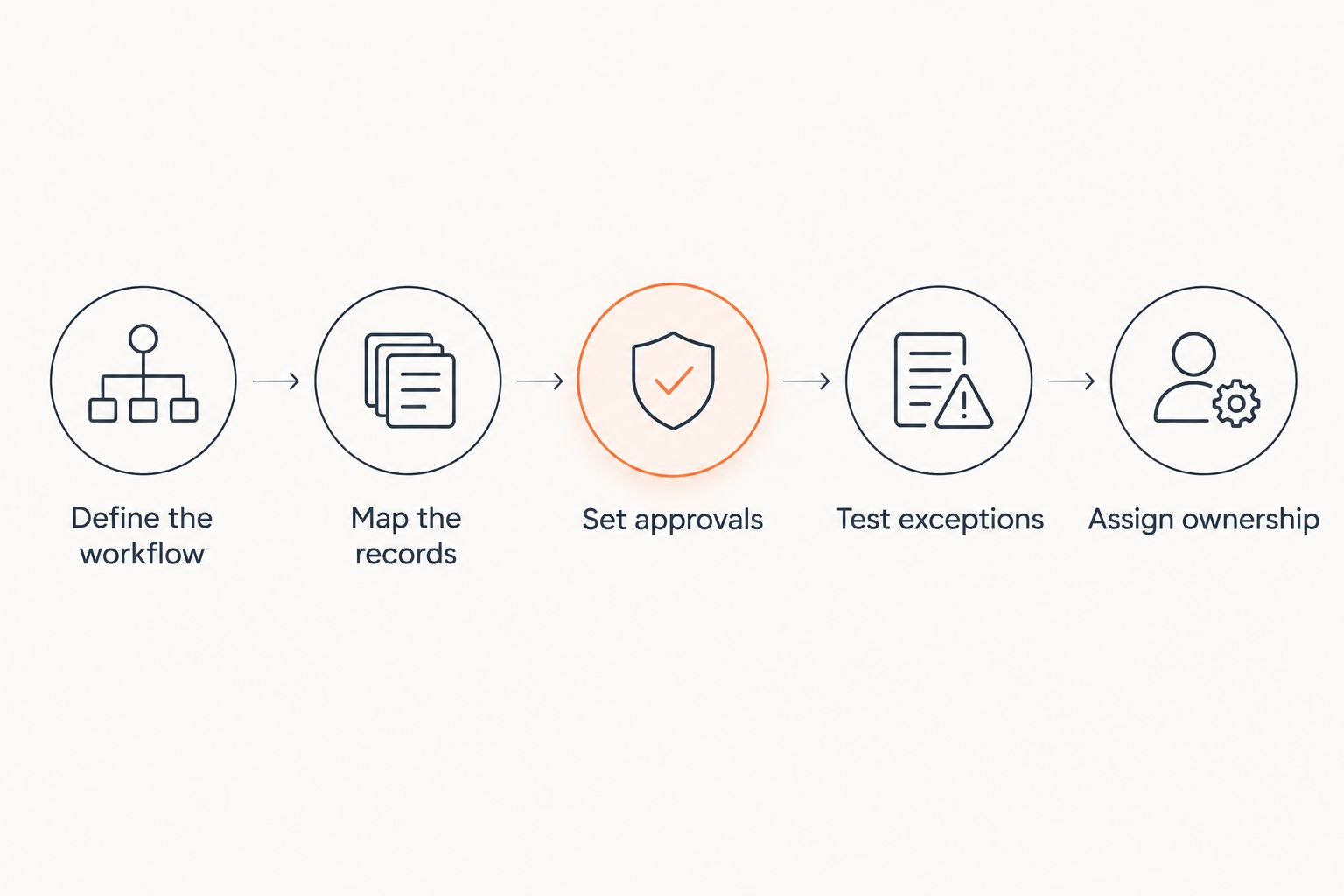
How to build a deployment budget you can approve
Define the workflow
Write the workflow as a start condition, a permitted action, and a completion condition. For example, scope quote follow-up separately from quote preparation and order submission.
Name the process owner. That person decides whether the proposed behavior matches the way your business is authorized to operate.
Map the records
List the records and fields required to complete the task. Identify which system owns each value and what happens when information conflicts.
Do not accept a generic statement that the agent connects to your systems. Request the objects read, the objects changed, and the permissions required.
Set approvals
Document which actions require review and which actions can proceed under approved rules. Include the conditions that stop the workflow.
Make escalation a deliverable. An unresolved request should reach a named role with enough context to finish the work.
Test exceptions
Use examples of both valid requests and requests that should stop. Include missing information, conflicting records, amended instructions, and failed system responses where relevant.
Agree on the expected outcome before testing begins. Otherwise, a demonstration can appear successful without proving that the workflow respects your operating rules.
Assign ownership
Confirm who monitors failures, maintains rules, approves changes, and trains new reviewers. Put these responsibilities into the handover documentation.
Separate vendor obligations from internal obligations. Your operating budget should reflect both, even when only the vendor portion appears on an invoice.
What should an implementation proposal include?
Ask for a deliverable-based proposal rather than a list of broad capabilities. The document should let sales operations and IT identify what they are accepting.
Request the following:
- Workflow definition: Trigger, inputs, outputs, and completion conditions.
- Connection specification: Systems, records, permissions, and responsible parties.
- Data responsibilities: Preparation work, source ownership, and unresolved-data handling.
- Acceptance plan: Test cases, expected results, and sign-off authority.
- Operating handover: Monitoring instructions, exception routing, and change ownership.
- Commercial boundaries: Included work, exclusions, and the process for approving scope changes.
Keep the acceptance plan attached to the proposal. A workflow should not count as delivered merely because someone can demonstrate a successful path.
For a 2026 approval, require the final scope and responsibilities to match the current proposal. Earlier discussions do not replace the document your team signs.
Where does Supplyco fit?
Supplyco is best suited to industrial manufacturers and distributors seeking automation across quoting, order entry, account management, and sales follow-up. That is the relevant fit criterion—not a generic need for a sales chatbot.
The platform's stated workflow coverage is a reason to evaluate it for industrial revenue operations. The boundary is equally important: category fit does not establish the implementation effort, system compatibility, approval design, or commercial terms for your deployment.
Bring a specific workflow to the evaluation. Ask the provider to map the proposed solution against your records, permitted actions, acceptance tests, and operating responsibilities.
How do I decide whether the deployment is worth it?
Evaluate the workflow against a documented baseline. Record current handling time, review effort, rework, and completed output before attributing a change to automation.
After deployment, measure the same work on a comparable basis. Include employee review and exception handling rather than counting only the agent's processing activity.
For your 2026 business case, distinguish capacity released from expenditure removed. Time reassigned to account management is a different outcome from an expense that disappears.
Approve expansion only after the initial workflow meets its acceptance criteria. A broader rollout needs its own scope, responsibilities, and evidence—not an assumption that the first result applies everywhere.
FAQ
How much does it cost to deploy an AI sales agent?
An AI sales agent deployment requires a scope-specific budget covering software, implementation, system connections, internal labor, and ongoing operations. Obtain a written proposal for a defined workflow rather than treating software access as the total deployment commitment.
Is implementation included with an AI sales agent subscription?
Implementation is included only when the agreement explicitly identifies it as included work. Verify configuration, connections, data preparation, testing, and handover separately.
Can I deploy an AI sales agent without replacing my CRM?
Define CRM retention as a requirement in the deployment scope, then verify the proposed connection and permissions. Request evidence of the required record exchanges rather than assuming compatibility.
What's the best workflow to start with?
The best starting workflow is one with clear inputs, a reviewable output, and an accountable owner. Follow-up assistance, quote preparation, and order entry require different controls, so compare them against your operating readiness.
What should I ask about ERP integration?
Ask which ERP records the agent reads or changes and how permissions, failures, and duplicate submissions are handled. Include those requirements in acceptance testing.
How do I measure the return on an AI sales agent?
Measure changes against the same workflow's documented baseline, including handling time, review effort, rework, and completed output. Distinguish released capacity from expenses actually removed.
Is Supplyco relevant for manufacturing sales operations?
Supplyco provides a revenue operations platform for industrial manufacturers and distributors covering quoting, order entry, account management, and sales follow-up. Evaluate a defined workflow and verify the required implementation scope before committing.
One last thing
Write a test that the agent must refuse to complete. A deployment is not ready merely because it handles a valid request; it also needs to stop when required information or authorization is missing.
Make that refusal part of acceptance. It gives your team a concrete way to verify the boundary between useful automation and an unauthorized action.