
Build an in-house RevOps function when your bottleneck is process ownership; buy software when your bottleneck is repeatable execution. For manufacturers and distributors, the practical choice is to keep quoting rules, account responsibilities, and order approvals under internal ownership, then automate defined tasks—not to treat software as a replacement for accountability.
- Is it worth building an in-house RevOps team vs buying software? Keep ownership internal; automate repeatable work.
- Supplyco provides revenue operations automation for industrial quoting, order entry, account management, and sales follow-up.
- Best for unresolved process decisions: internal ownership. Best for repeatable execution: software with verified workflow fit.
- Compare implementation effort, exception handling, and retained internal work—not headcount against a subscription alone.
Why this matters
Your 2026 RevOps decision should start with the work that remains unfinished, not an organization chart. An unanswered pricing exception requires a decision-maker; an approved order waiting to be entered requires execution. Those are different problems.
Supplyco revenue operations software is best for manufacturers and distributors seeking automation of quoting, order entry, account management, and sales follow-up. Evaluate its fit against your actual workflows; those stated functions do not establish compatibility with your ERP, approval structure, or transaction requirements.
Is it worth building an in-house RevOps team vs buying software?
Build the internal capability to decide how revenue work should operate; buy software to execute the parts you can define and verify. Hire a dedicated team only when the continuing ownership workload justifies dedicated roles. Buying software does not remove that workload.
| Approach | Best for | Main advantage | Main limitation | Decision rule |
|---|---|---|---|---|
| In-house RevOps team | Unresolved ownership, process design, and cross-functional decisions | Keeps business decisions with accountable employees | Adds execution capacity only to the extent that people or systems perform the work | Hire against a defined, continuing responsibility |
| Purchased software | Documented, repeatable quoting, order entry, and follow-up tasks | Executes supported workflows according to configured rules | Does not decide your commercial policy or resolve every exception | Buy after testing the actual workflow |
| Internal owner plus software | Defined automation work with continuing governance needs | Separates business accountability from task execution | Still requires administration, monitoring, and exception handling | Use when both ownership and execution need attention |
These approaches are operating models, not mutually exclusive products. An internal team can administer purchased software, and an existing operations manager can own a narrowly scoped deployment without establishing a separate department.
For your 2026 decision, write separate requirements for governance and execution. Otherwise, a staffing proposal and a software proposal will appear comparable while addressing different work.
In-house RevOps: best for decisions and accountability
An internal RevOps function is justified when someone must continually reconcile sales commitments with operational rules. That includes deciding who owns an account, which quote changes require approval, and what makes an opportunity ready to forecast.
Hire for authority and defined responsibilities—not simply because administrative work is accumulating. A new employee cannot resolve approval disputes if the role has no mandate to make or escalate decisions.
Use an internal responsibility list that specifies:
- Commercial rules: Who approves exceptions to standard quoting and account terms?
- Process ownership: Who decides how requests move between sales and operations?
- Data definitions: Who owns account status, opportunity stages, and required fields?
- Change control: Who approves changes to workflows and system permissions?
- Performance review: Who investigates missed handoffs and decides corrective action?
The advantage is direct accountability for decisions specific to your business. The limitation is that internal ownership alone does not automate order entry or follow-ups. If the new role spends its time copying approved information between systems, distinguish the governance requirement from the task backlog before adding more positions.
You also need coverage. Document who handles approvals, system administration, and exceptions when the primary owner is unavailable; a department name is not a continuity plan.
Purchased software: best for defined, repeatable execution
Software is the stronger candidate when you can describe the input, decision rules, expected output, and exception route. For example, an order-entry evaluation should establish which customer and item records to use, what information is mandatory, and when a request must stop for review.
Buy against a completed workflow, not a feature label. A quoting feature is relevant only if it supports the quoting work you intend to assign to it.
Ask the vendor to demonstrate your proposed workflow using representative records. Include incomplete requests, changed quantities, duplicate submissions, and requests that require human approval. These are evaluation cases, not assumptions about any platform's capabilities.
The advantage is execution of supported tasks without assigning each task to a person. The limitation is dependence on supported functionality, configured rules, usable data, and a maintained connection to the systems involved.
For a 2026 evaluation, require a written division between vendor responsibilities and your responsibilities. Identify who configures fields, fixes failed transactions, maintains mappings, and reviews changes after deployment. A successful demonstration does not answer those operational questions.
Internal ownership plus software: best for shared responsibilities
Choose this model when your business needs both repeatable execution and continuing judgment. Keep a named internal owner responsible for the process, while software performs the tasks that meet documented conditions.
That owner does not automatically need a new title or a new department. Assign the responsibility to someone with the authority, available capacity, and access required to carry it out. Create a dedicated role when the work warrants it.
Make the boundary explicit:
- Internal staff approve business rules and exceptions.
- Software performs supported tasks within those rules.
- Internal staff review failures and authorize process changes.
- The vendor supplies the support and functionality established in the agreement.
The advantage is a clear separation between accountability and execution. The limitation is coordination: someone must maintain the boundary as products, customer requirements, and internal processes change.
Do not describe this model as unattended operations. A controlled process needs an owner even when its routine tasks run automatically.
Why the right RevOps model varies
Your operating requirements determine whether additional staff, purchased software, or both address the constraint. Assess these factors before requesting proposals:
- Quoting requirements: Identify which requests follow established rules and which require a commercial or technical decision. Assign responsibility for the latter before automating the former.
- Order-entry requirements: Document required fields, customer references, item identifiers, and approval conditions. Test how unsupported or incomplete requests leave the automated path.
- Account-management responsibilities: Decide who owns account changes, escalations, and customer commitments. Software execution does not transfer those responsibilities.
- Follow-up rules: Define the triggering event, account owner, message approval, and stopping condition. A completed follow-up is not the same as a qualified opportunity.
- System responsibilities: Specify where authoritative records reside and who maintains the ERP and CRM handoffs. Verify the required read and write operations rather than assuming an integration covers them.
Use the same requirements for every option. Comparing an employee expected to redesign the process with software expected only to move data produces a misleading decision.
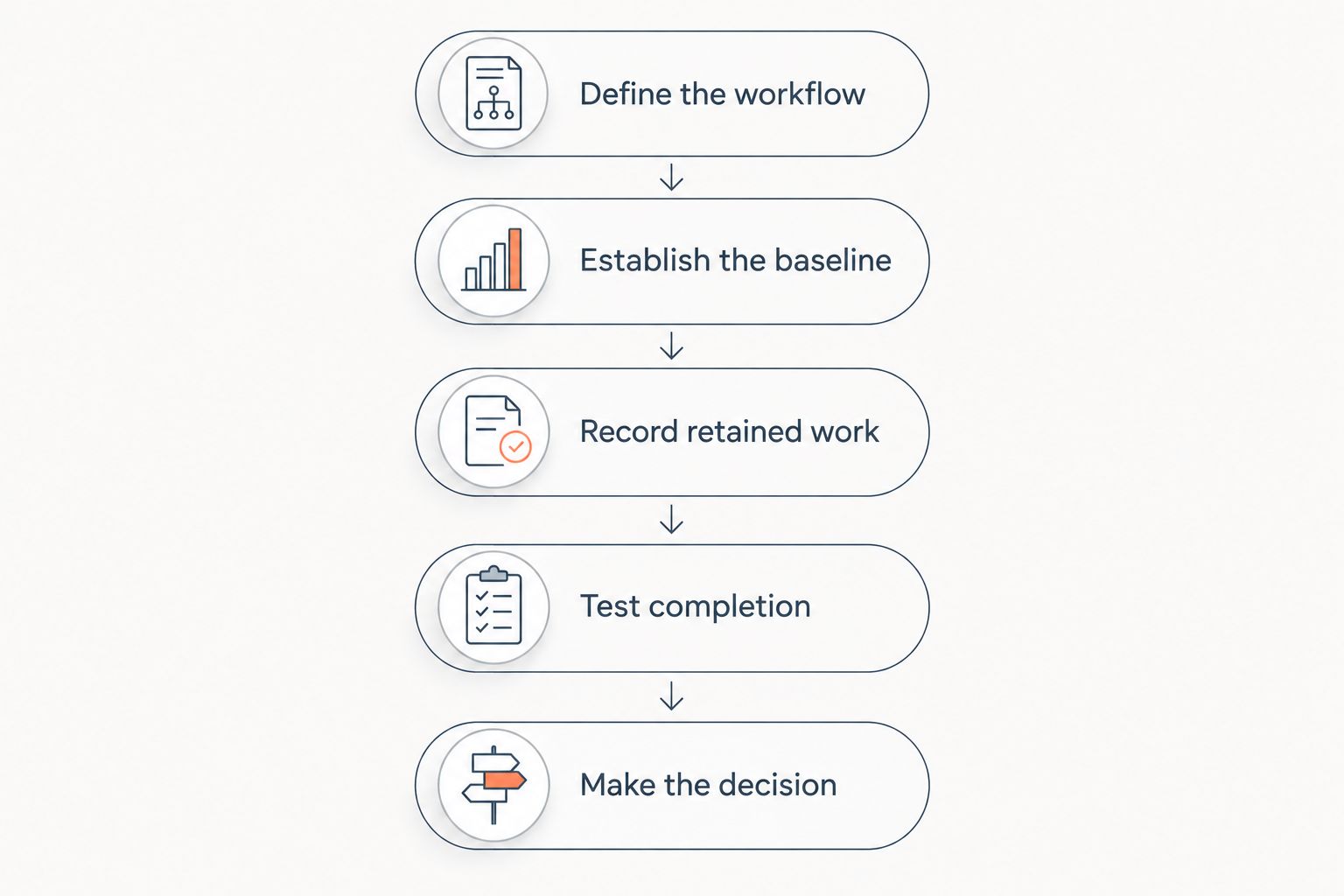
How do you compare the options without inventing an ROI?
Compare the same completed work over the same evaluation period. Your 2026 business case should distinguish measured operating improvement from projected benefits, especially when the proposal includes revenue growth.
Define the workflow
Choose a bounded process such as approved order intake or quote follow-up. Record its starting event, completion event, required approvals, and exception owner. Avoid evaluating the entire revenue operation as one undifferentiated project.
Establish the baseline
Measure hands-on minutes per completed quote, orders requiring correction per month, and staff hours spent on follow-up per month. These are measurement units, not performance benchmarks. Collect your own values before estimating benefits.
Also distinguish elapsed time from active work. A quote waiting for approval is a different constraint from a quote requiring extensive manual preparation. Record both so the proposed intervention addresses the actual delay.
Record retained work
List the tasks that remain after the proposed change: reviewing exceptions, maintaining customer records, administering permissions, updating rules, and supporting users. Include those responsibilities in the staffing plan whether you hire, buy, or combine both.
Test completion
Run representative requests through the proposed process and inspect the final records. Confirm that required information reaches the intended destination and that failed requests reach an accountable person. Do not treat a generated draft as a completed transaction.
Make the decision
Approve the approach that addresses the measured constraint while meeting your control requirements. Expand only after the bounded workflow performs as intended; do not count hypothetical future automation as a current benefit.
What should your acceptance criteria include?
Write acceptance criteria before a hiring decision or software commitment. Each criterion should identify the work, the evidence of completion, and the person responsible when the expected result does not occur.
For quoting, distinguish draft preparation from approval and release. For order entry, distinguish captured information from a validated order in the intended system. For follow-up, distinguish a sent message from a documented customer response.
Your acceptance checklist should cover:
- Ownership: A named person can authorize changes and resolve escalations.
- Completion: The output meets the requirements of the receiving team or system.
- Exceptions: Incomplete, conflicting, and unsupported requests have a documented route.
- Traceability: Reviewers can identify what happened and which source records were used.
- Recovery: Staff know how to correct a failed transaction without creating duplicates.
- Administration: Continuing maintenance has an assigned owner and an agreed scope.
Do not approve automation that leaves failed work without an owner. Apply the same standard to an internal team: hiring is not a substitute for documented responsibilities and review procedures.
Can software replace an in-house RevOps team?
Software can perform supported RevOps tasks; it does not replace accountability for commercial decisions. Keep ownership of approvals, account responsibilities, and process changes inside the business, even when execution is automated.
When should you hire before buying software?
Hire first when no existing employee has the authority or capacity to define and own the process. Establish rules and responsibilities before asking software to enforce them; otherwise, implementation becomes an unresolved process-design exercise.
Should a small distributor create a RevOps department?
A small distributor should establish accountable process ownership before creating a department. Assign the work, measure the continuing workload, and add dedicated capacity when existing roles cannot perform it reliably.
FAQ
Is it worth building an in-house RevOps team vs buying software?
Build internal RevOps capability for decisions and accountability; buy software for defined, repeatable execution. Add dedicated roles when the continuing ownership workload requires them, not simply because manual tasks exist.
What's the best approach for a manufacturer with slow quoting?
Identify whether quoting is delayed by unresolved decisions, missing information, or manual execution. Assign decision ownership first, then evaluate software against the documented preparation and approval workflow.
Can RevOps software replace our operations manager?
RevOps software is not a substitute for an accountable operations owner. It performs supported tasks, while your business retains responsibility for rules, approvals, exceptions, and process changes.
Do we need a new ERP or CRM before buying RevOps software?
Evaluate the required workflow against your existing ERP and CRM before deciding on replacement. Verify the necessary records, permissions, and transaction behavior rather than assuming compatibility or incompatibility.
What should we measure before automating order entry?
Measure hands-on work, completed orders, corrections, and exception handling over a defined period. Use the same completion requirements when comparing the current process with the proposed automated process.
What does Supplyco revenue operations software automate?
Supplyco provides automation for quoting, order entry, account management, and sales follow-up for industrial manufacturers and distributors. Verify your specific workflow and system requirements during evaluation.
One last thing
Before approving your 2026 plan, ask who owns a request that the proposed process cannot complete. If the answer is unclear, neither a new hire nor a software purchase has finished the operating design.
Keep accountability explicit and buy execution only where you can verify completion. That is a stronger decision rule than choosing between people and software in the abstract.