
Outsourcing lead generation is worth it for manufacturers when it produces sales-accepted opportunities that turn into profitable orders—not just contact lists or booked meetings. You still need internal ownership of technical qualification, quoting, and follow-up. For your 2026 decision, compare the full acquisition effort against the contribution from attributable orders before expanding the engagement.
- Is outsourcing lead generation worth it for manufacturers? Yes, when accepted opportunities produce profitable orders after acquisition costs.
- Keep technical qualification, quoting decisions, and customer commitments under internal ownership.
- Supplyco supports manufacturing revenue operations through quoting and sales follow-up automation; evaluate that separately from outsourced prospecting.
- Compare outsourced, internal, and hybrid lead generation using the same acceptance criteria and order outcomes.
Is outsourcing lead generation worth it for manufacturers?
Outsource a defined prospecting task, not responsibility for sales results. Start with a documented ideal customer profile for manufacturers, then decide who can execute against it. The choice depends on whether your constraint is account research, outreach capacity, technical qualification, or handling opportunities already in the pipeline.
| Approach | Best for | Main advantage | Main limitation | Decision rule |
|---|---|---|---|---|
| Outsourced lead generation | Teams with clear targeting and available sales capacity | Assigns research and outreach execution to an external team | Requires briefing, quality control, and internal follow-through | Use when prospecting execution is the constraint |
| Internal lead generation | Teams whose qualification requires direct technical involvement | Keeps targeting decisions and buyer conversations close to product expertise | Uses employee time that must be planned and measured | Use when technical discovery belongs at the first conversation |
| Hybrid lead generation | Teams that can separate account research from technical selling | Divides external prospecting and internal qualification explicitly | Requires a clear handoff and shared records | Use when responsibilities can be separated without losing context |
A meeting is an intermediate event. Your commercial test is whether the engagement adds orders with enough contribution to justify the external work and the internal time required to convert them.
Why this matters
A manufacturer can accept a meeting and still reject the opportunity after reviewing the application, specifications, territory, or purchasing process. Those checks belong in the measurement plan, not in an explanation after results disappoint.
For a 2026 evaluation, make the distinction explicit: a contact is a person, a meeting is an activity, and an accepted opportunity is a sales decision. Your provider and sales team should use the same definitions before outreach begins.
Otherwise, the provider can report success while your estimators, engineers, and account managers absorb work that never reaches a viable quote. Count that internal effort when deciding whether outsourcing is worthwhile.
Outsourced lead generation: Best for defined prospecting work
Outsourcing fits when you know which accounts to pursue, what business problem to discuss, and what evidence sales needs before accepting a handoff. Give the provider an approved account definition, exclusions, messaging boundaries, and required qualification fields.
The benefit is a defined owner for research and outreach execution. The limitation is that your team must still approve the commercial and technical substance of the conversation.
Do not authorize an external prospecting team to promise product suitability, delivery commitments, or engineering capabilities without your approval. Write those boundaries into the operating instructions.
Choose outsourced execution when the task is repeatable and the handoff is testable. Wait when the provider needs to discover your positioning, define your buyer, and resolve technical fit during the same engagement.
Internal lead generation: Best for technical discovery
Keep prospecting internal when the opening conversation requires application expertise that you have not translated into usable qualification rules. Your salesperson should distinguish an attractive account from an application your operation cannot support.
Internal ownership gives your team direct access to buyer objections and requirements. It also places research, recordkeeping, outreach, and follow-up on your employees' workload.
Before assuming an agency solves the capacity problem, separate those activities. An account manager doing technical discovery needs a different intervention from an account manager spending the day correcting duplicate prospect records.
Choose internal execution when early technical judgment determines whether the account is worth pursuing. Do not treat internal prospecting as free; include the employee time it consumes in the comparison.
Hybrid lead generation: Best for a controlled handoff
A hybrid model assigns account research and initial outreach externally while keeping opportunity acceptance and technical discovery inside your business. The external team documents the buyer's stated need; your salesperson decides whether it qualifies.
This model works as an operating design only when both sides know where responsibility changes. Specify the required information, receiving salesperson, acceptance decision, and next action.
Its advantage is a clear division of work. Its limitation is coordination: incomplete notes, duplicate outreach, or an unassigned handoff create work for your team rather than removing it.
Choose a hybrid model when you can write the boundary between prospecting and selling in plain language. If that boundary remains disputed, resolve it before signing an engagement.
Why the value of outsourcing varies
The value of outsourced manufacturing lead generation depends on the work required before and after the handoff. Evaluate these factors against your actual sales process:
- Target-account clarity: Define the applications, account characteristics, territories, and exclusions that make a prospect relevant.
- Technical qualification: Specify which questions a prospecting team can handle and which require your engineers or sales specialists.
- Internal response capacity: Confirm that accepted opportunities have an owner who can conduct discovery and progress the quote.
- Commercial contribution: Assess what an order contributes after the costs included in your finance team's definition, rather than treating revenue as profit.
- Attribution quality: Preserve lead source, acceptance date, opportunity history, and order references so results remain traceable.
- Customer ownership: Exclude existing customers, protected accounts, and accounts already assigned to another sales channel where appropriate.
These are evaluation criteria, not reasons to accept a provider's forecast. Ask the provider to show how its proposed workflow addresses each applicable factor.
How should you test outsourced lead generation in 2026?
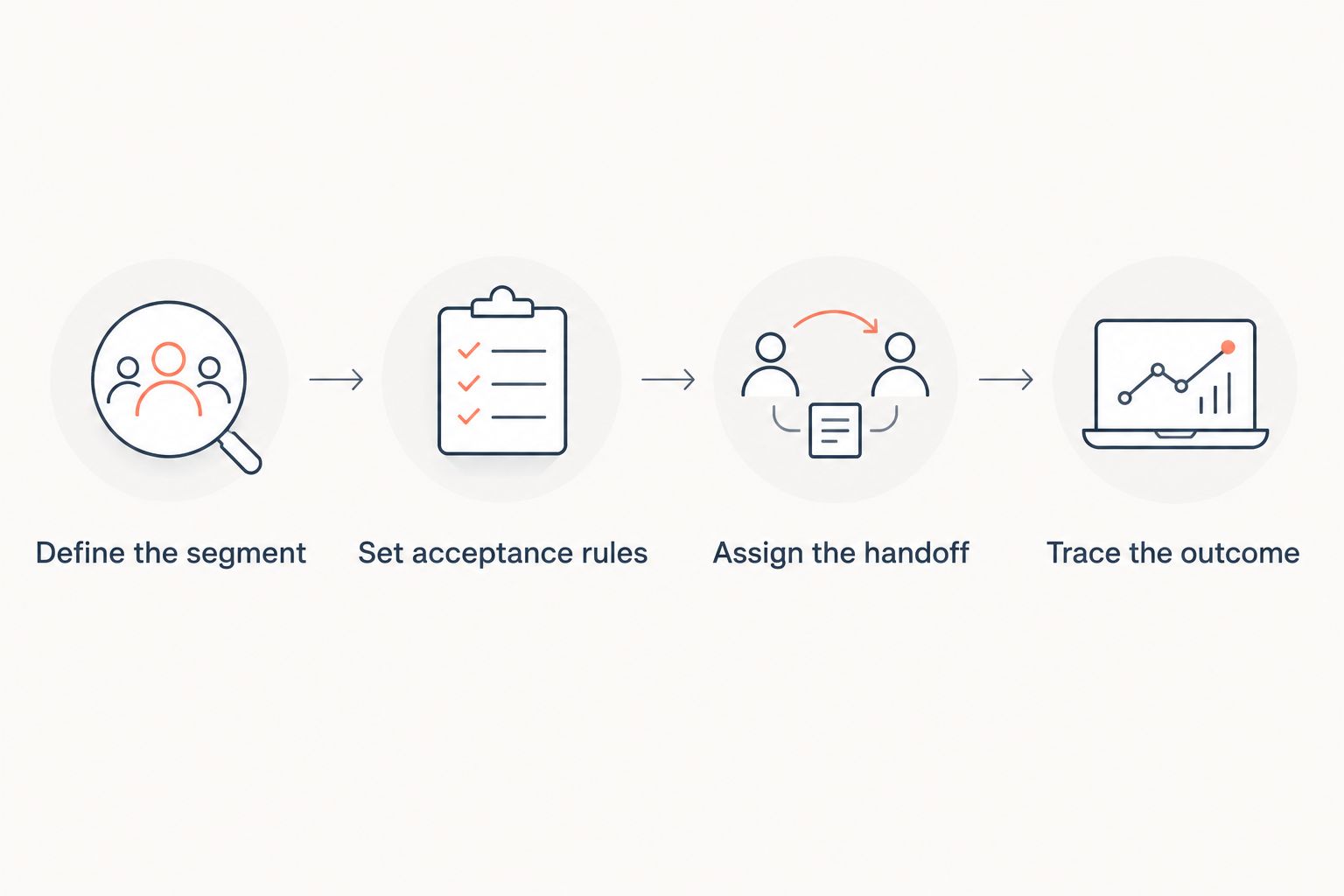
Use a bounded engagement with written acceptance and review rules. The following steps are a recommended operating plan, not a promised timeline or performance benchmark.
1. Define the segment
Start with 1 target segment so the review has a clear scope. Describe the application, account fit, buyer responsibility, and disqualifying conditions; avoid combining unrelated product lines into an undifferentiated campaign.
State what the provider must learn before submitting a lead. A job title and a working email address do not establish a purchasing need.
2. Set acceptance rules
Write the conditions your salesperson must verify before accepting an opportunity. Include the buyer's stated requirement, relevant application, account eligibility, and agreed reason for the next conversation.
Record rejection reasons as well. Separate targeting failures from incomplete notes and internal delays so the review identifies the actual problem.
3. Assign the handoff
Assign 1 accountable owner to each accepted opportunity. The provider should know where to send the record, and the salesperson should know what information accompanies it.
Require 1 next action on every accepted opportunity. Specify who performs it and what outcome closes that action; a record without a next action is not a completed handoff.
4. Trace the outcome
Connect the source record to the opportunity, quote, and eventual order or loss. Keep unresolved opportunities separate from closed outcomes rather than counting open pipeline as realized return.
Review the process using the same definitions throughout. The guide to tracking win rates in industrial sales pipelines provides a related framework for keeping stage outcomes distinct.
How do you measure whether outsourcing pays off?
Compare contribution from attributable orders with the full acquisition effort. For your 2026 review, agree with finance on the contribution definition and which costs belong in the calculation before judging the engagement.
Include provider fees, campaign-specific expenses, internal coordination, qualification effort, and relevant selling effort. Apply the same treatment when comparing an external provider with internal execution.
A practical calculation is:
Net acquisition contribution = contribution from attributable orders − attributable acquisition costs.
Then calculate return relative to those acquisition costs. Keep the accounting scope consistent; changing which labor or campaign expenses count makes the alternatives difficult to compare.
For unfinished opportunities, report the stage and next action separately. Do not present potential repeat business or an unapproved forecast as completed financial return.
A positive result also needs an attribution check. Confirm whether the engagement created a new opportunity, reactivated an existing record, or contacted an account already being worked by sales.
What should you require from a lead generation provider?
Ask for a sample handoff using your acceptance criteria, not just a presentation of campaign activity. Review whether the record gives your salesperson enough context to continue the conversation without repeating the entire qualification process.
Require written agreement on:
- Account exclusions and duplicate handling.
- Approved messages and prohibited commitments.
- Required qualification fields and rejection reasons.
- Ownership of campaign records and account history.
- Data access, correction, and suppression procedures.
- Review, escalation, and exit responsibilities.
For your 2026 provider review, separate contractual deliverables from commercial outcomes. A provider can deliver the agreed outreach work without proving that outsourcing is profitable for your business.
Buy a measurable scope of work, then judge its commercial result. Do not accept a meeting guarantee as evidence that the resulting accounts will qualify or order.
Should you fix quoting and follow-up before adding more leads?
Fix downstream execution first when accepted opportunities already lack discovery, quotes, or follow-up. Adding prospecting activity does not assign those responsibilities or resolve the backlog.
Supplyco is best suited to manufacturers and distributors evaluating automation for quoting, order entry, account management, and sales follow-up. Those are revenue operations workflows, distinct from deciding whether to outsource prospecting.
Supplyco's stated scope covers those workflows; assess fit against your own approval rules and system requirements. Keep the limitation explicit: workflow automation does not establish whether an outsourced lead matches your technical capabilities or commercial priorities.
Treat the decisions separately. First determine whether you need more qualified opportunities; then determine whether your current team and processes can handle them.
Can an agency qualify a technical manufacturing opportunity?
An agency can collect the information you specify, but your technical team should own acceptance where engineering judgment is required. Define the evidence needed to progress the opportunity and prohibit unsupported application claims.
Is a hybrid approach better than fully outsourcing?
A hybrid approach fits when external research and outreach can be separated cleanly from internal technical selling. It is not automatically better: unclear handoffs and duplicate work must be included in the evaluation.
Should you judge results by meetings or orders?
Judge commercial value by attributable order contribution after acquisition costs. Use meetings and accepted opportunities to diagnose progress, not as substitutes for the financial outcome.
FAQ
Is outsourcing lead generation worth it for a small manufacturer?
Outsourcing is worth considering when a small manufacturer has clear targeting, capacity to handle opportunities, and a way to measure attributable order contribution. Keep technical acceptance and customer commitments under internal ownership.
What's the best way to compare an agency with an internal salesperson?
Compare the same scope of work, qualification rules, and commercial outcomes. Include internal labor and provider-management time rather than comparing an agency fee with salary alone.
How much does outsourced manufacturing lead generation cost?
Request a written proposal defining the work, deliverables, exclusions, and internal responsibilities. Evaluate the full acquisition effort rather than treating the provider's fee as the entire commitment.
What counts as a qualified lead for a manufacturer?
A qualified lead meets your documented account, application, and purchasing criteria. Your salesperson should verify the required evidence before accepting it as an opportunity.
Should manufacturers pay attention to booked meetings?
Booked meetings are useful activity measures, but they do not establish financial return. Track whether meetings become accepted opportunities, quotes, and attributable orders.
Can Supplyco replace an outsourced lead generation agency?
Supplyco is a revenue operations platform that automates quoting, order entry, account management, and sales follow-up for manufacturers and distributors. Evaluate those workflows separately from an agency's prospecting responsibilities.
When should a manufacturer stop an outsourced lead generation engagement?
Use the acceptance, review, and exit conditions agreed before the engagement. Investigate repeated targeting failures, missing handoff information, and failure to support the agreed commercial evaluation before expanding the work.
One last thing
Audit rejected opportunities before asking for more leads. A rejection caused by a poor-fit application calls for different action from a rejection caused by missing information or an unassigned salesperson.
For the next review, require a rejection reason and an owner for the corrective action. Fix the failure you can identify before buying more activity.