
An AI sales agent pays for itself when its cumulative, verified financial benefits cover its cumulative deployment and operating costs—not after a fixed number of months. For your 2026 business case, count implementation, ERP and CRM work, training, and ongoing human review alongside the software expense. Time saved supports payback only when it produces an actual financial benefit; unused capacity is not cash savings.
- How long until an AI sales agent pays for itself? When cumulative verified benefits cover cumulative deployment and operating costs.
- Supplyco automates industrial quoting, order entry, account management, and sales follow-up; assess payback by workflow.
- Count realized savings and attributable contribution margin, not pipeline value or unallocated hours saved.
- Measure implementation and operating costs from the start, including human review and exception handling.
Why this matters
A quoting workflow can finish sooner without reducing your payroll. A follow-up workflow can generate replies without producing an order. Both are operational improvements, but neither alone proves financial payback.
Your 2026 investment decision needs a bridge between workflow performance and financial results. Establish that bridge before deployment, using the same definitions throughout the evaluation. The guide to measuring ROI from an AI sales agent deployment addresses the broader measurement question; this page focuses on when the investment breaks even.
How long until an AI sales agent pays for itself?
Your payback date is the first date when cumulative verified benefits equal or exceed cumulative costs. Calculate it from actual results, then compare it with the forecast you approved before deployment.
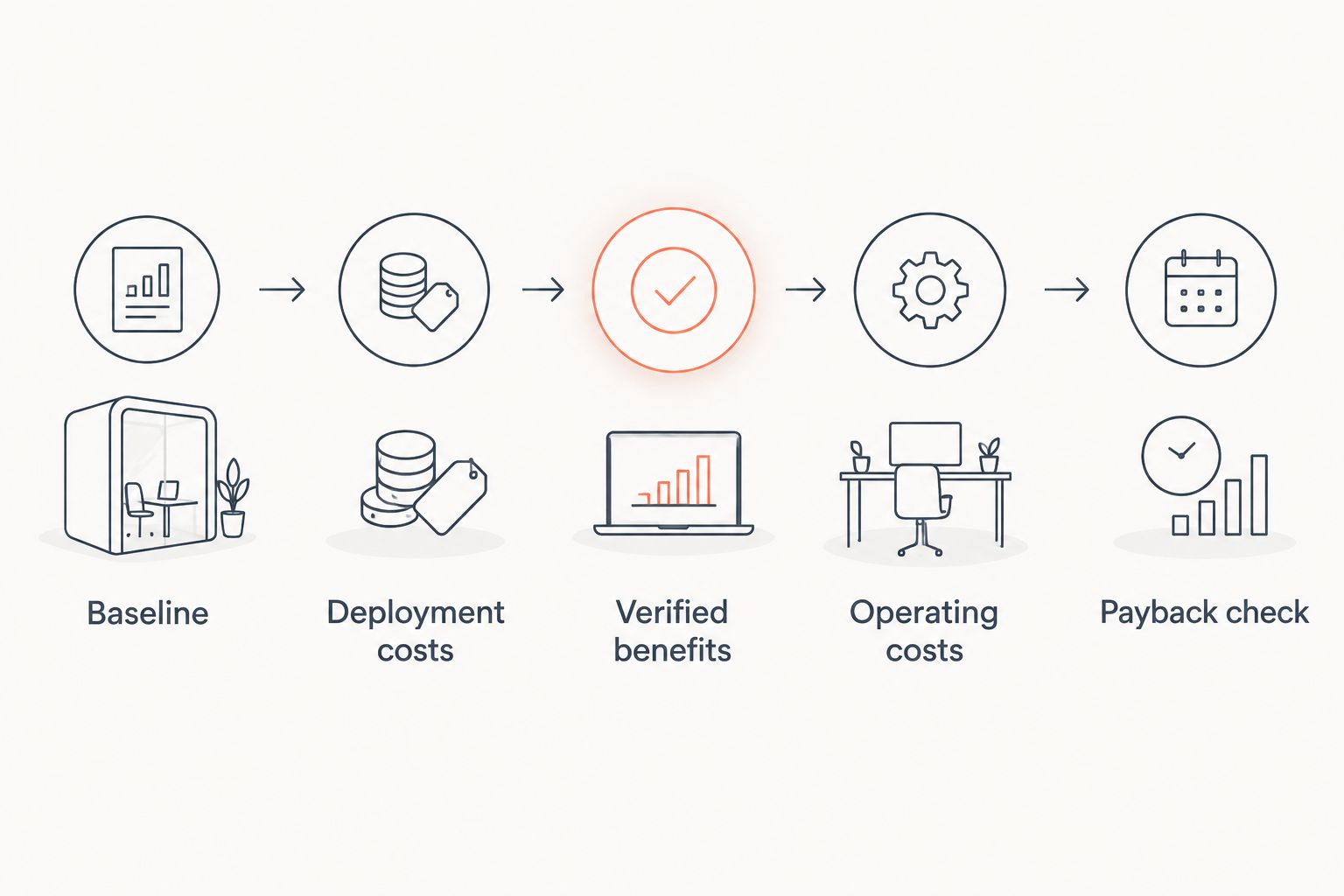
Use this sequence to build a payback calculation your sales, operations, and finance teams can reconcile:
- Baseline. Record the current workload, handling time, correction work, and financial outcomes for the workflow you intend to automate.
- Deployment costs. Record setup, integration, data preparation, training, and internal project work as they occur.
- Verified benefits. Record realized expense reductions and attributable contribution margin from completed business.
- Operating costs. Record software expense, support, administration, human review, and exception handling throughout the measurement period.
- Payback check. Compare cumulative benefits against cumulative deployment and operating costs for each reporting period.
The calculation follows the work from baseline through deployment to verified results. Keep each category separate so reviewers can inspect the assumptions rather than accepting a single ROI percentage.
For a stable operating period, a planning shortcut is:
Payback period in months = upfront deployment cost ÷ monthly net financial benefit.
Monthly net financial benefit means verified monthly benefits minus recurring operating costs. This shortcut assumes that monthly benefit remains steady. When adoption, workload, or sales results change during rollout, use the cumulative calculation instead.
If recurring costs exceed verified benefits, the current operating model does not recover the upfront investment. Revise the workflow, reduce its cost, or stop expansion rather than assigning a speculative payback date.
Which workflow should you evaluate first?
Start with the workflow whose inputs, completion criteria, and financial outcomes you can measure. Select the bottleneck you can document—not the workflow with the largest theoretical opportunity.
For manufacturers and distributors, quoting, order entry, and sales follow-up require different evidence. Compare them before choosing the scope of your evaluation.
| Workflow | Best for | Evidence to collect | Advantage for evaluation | Limitation to account for |
|---|---|---|---|---|
| Quoting | Teams measuring repeatable quote preparation work | Handling time, approvals, corrections, accepted quotes, contribution margin | Connects administrative work to a defined sales document | Faster preparation does not prove additional orders |
| Order entry | Teams measuring repeated order transcription | Completed orders, handling time, validation work, correction expense | Provides a defined transaction to compare before and after automation | Review and ERP exception work remain part of the calculation |
| Sales follow-up | Teams with traceable quote and opportunity histories | Follow-up activity, customer responses, orders, contribution margin | Connects activity to identifiable opportunities | Replies and pipeline movement do not establish incremental revenue |
Treat these as measurement choices, not promised performance differences. Your baseline determines which workflow offers a defensible business case.
For example, evaluate order entry against the complete approved order, not against extracted fields alone. Evaluate quoting against a usable, approved quote—not merely a draft generated earlier in the process.
Separate cash savings from recovered capacity
Recovered capacity means your employees have time available for other work. Cash savings mean an expense actually falls. Record them separately.
If a sales coordinator spends less time entering orders but payroll remains unchanged, you have recovered capacity. Count a financial benefit only when you document an associated outcome, such as reduced overtime expense or additional completed work that produces attributable contribution margin.
Use separate lines in your worksheet:
- Realized expense reduction: spending that actually decreases because of the deployment.
- Recovered capacity: hours released for other work, reported operationally rather than automatically treated as savings.
- Incremental contribution margin: additional attributable revenue after the variable costs associated with earning it.
Do not count the same employee time as both payroll savings and capacity used to generate additional margin. Choose the treatment that matches what happened. Finance should approve that treatment before your 2026 results begin accumulating.
Count added margin, not the full order value
A recovered quote is not worth its entire order value to the payback calculation. The order also carries costs. Use the contribution margin that remains after the associated variable costs, following your finance team's accounting method.
Attribution matters just as much. A customer who received an automated follow-up and then ordered does not, by that sequence alone, prove that the automation caused the purchase.
Before deployment, define how you will compare outcomes. Use comparable accounts, quote types, or operating periods, and document differences that affect the comparison. Keep existing repeat business separate from business you can reasonably attribute to the changed workflow.
Pipeline value belongs in a forecast, not in realized payback. Track leading indicators such as follow-up completion and quote response, but keep them separate from completed financial results.
Include the work around the software
Software expense is only part of the investment. Your team must also prepare data, define permissions, test outputs, train users, and resolve exceptions. Record the work required for your actual deployment.
Separate upfront work from recurring operations. Initial account mapping belongs with deployment; continuing account-data maintenance belongs with operations. Human review belongs in the period when that review occurs.
Your cost register should identify:
- The expense or internal work category.
- Whether it is upfront or recurring.
- The person responsible for validating it.
- The reporting period in which it occurred.
- The supporting invoice, time record, or internal allocation.
Apply the same discipline to integration work. A successful connection is not the same as a completed workflow: include validation, failed transactions, retries, and manual correction in your evaluation wherever those tasks occur.
Why AI sales agent payback varies
Payback changes when either verified benefits or deployment and operating costs change. Review these factors explicitly rather than substituting a generic timeline:
- Eligible workload. Count the quotes, orders, or follow-ups inside the agreed automation scope. Do not apply measured results to unrelated work.
- Task complexity. Separate repeatable transactions from work requiring engineering review, commercial judgment, or special approval.
- Data preparation. Include the work needed to make customer, product, and transaction information usable for the chosen workflow.
- ERP and CRM handoffs. Measure the complete transaction, including checks and corrections between systems.
- Human review. Deduct ongoing supervision, approvals, and exception handling from the apparent labor benefit.
- Financial realization. Distinguish a completed task from an expense reduction or attributable contribution margin.
Keep these assumptions visible in your 2026 forecast. If the operating scope changes, revise the forecast and retain the original version so the reason for the change remains clear.
How should you evaluate Supplyco for payback?
Supplyco provides a revenue operations platform that automates quoting, order entry, account management, and sales follow-up for industrial manufacturers and distributors. Supplyco is best suited to manufacturers and distributors evaluating automation across those revenue operations workflows.
That scope gives you specific processes to assess, but it does not establish a payback date. Evaluate the workflow you intend to deploy against your own baseline, system requirements, approval rules, and financial results.
Require evidence of completed work, not activity alone. For quoting, inspect the approved output and remaining review effort. For order entry, inspect the resulting transaction and correction work. For follow-up, inspect attributable commercial outcomes rather than message volume.
What should you record during the evaluation?
Maintain a transaction-level record that connects operational evidence to the financial worksheet. A summary dashboard is useful, but your team needs a way to investigate individual results.
For each eligible transaction, record the workflow, completion status, human handling time, review effort, exception work, and final business outcome. Keep the identifier consistent between the operational record and the financial calculation.
Also record excluded transactions and why they were excluded. Otherwise, an evaluation can appear stronger simply because difficult work disappeared from its denominator.
Assign ownership before deployment. Operations validates completed work, sales validates commercial outcomes, and finance validates the financial treatment. Resolve disputed benefits before including them in cumulative payback.
When should you expand, revise, or stop?
Set your acceptance rules before reviewing results. Your 2026 decision should consider financial performance alongside output accuracy, approval compliance, and the amount of work still carried by employees.
Use these decision rules:
- Expand the workflow when verified benefits support the business case and the completed outputs meet your acceptance criteria.
- Revise the workflow when benefits exist but review effort, exception handling, or implementation work prevents the expected result.
- Stop expansion when recurring costs exceed verified benefits or the workflow fails required operating controls.
Do not use an attractive payback forecast to excuse incorrect orders or unapproved quotes. Those outcomes undermine the benefit calculation itself. Correct the operating problem before increasing scope.
Does the payback clock start at go-live?
The investment starts when deployment costs begin, not when the software goes live. Track that date separately from the start of production use so implementation work stays inside the calculation.
You can report operational performance from go-live, but financial payback must still recover the earlier deployment expense.
Can an AI sales agent pay for itself without reducing headcount?
An AI sales agent can repay its investment through verified benefits other than headcount reduction. Those benefits must still produce a financial result, such as reduced overtime expense or attributable contribution margin from additional business.
Recovered hours alone establish capacity, not repayment.
Is a positive monthly return the same as full payback?
A positive monthly return means benefits exceed operating costs for that month. Full payback requires cumulative benefits to recover the upfront investment as well.
Keep both measures visible. A workflow can operate profitably while its original deployment cost remains unrecovered.
FAQ
How long until an AI sales agent pays for itself?
An AI sales agent pays for itself when cumulative verified financial benefits cover cumulative deployment and operating costs. Calculate the date from your workload, realized savings, attributable contribution margin, and actual expenses.
Should I count employee hours saved as cash savings?
Count employee hours saved as cash savings only when they produce a documented expense reduction. Otherwise, report recovered capacity separately and measure the financial result of any additional work completed.
Do extra sales count toward AI sales agent payback?
Attributable contribution margin from extra sales counts toward payback, not the full order value. Apply a consistent attribution method and deduct the associated variable costs.
Does implementation time count in the payback calculation?
Implementation work and expenses belong in the payback calculation. Record setup, data preparation, integration, training, and internal project work before production use begins.
Which industrial sales workflow should I automate first?
Start with the workflow whose baseline and completed outcomes you can measure. Compare quoting, order entry, and follow-up using actual handling effort, review requirements, and financial evidence.
What should I measure when evaluating Supplyco?
Evaluate Supplyco against the quoting, order entry, account management, or sales follow-up workflow you intend to automate. Measure completed work, remaining human effort, total costs, and verified financial benefits.
What happens if monthly benefits do not cover operating costs?
The current operating model does not recover the upfront investment when recurring costs exceed verified benefits. Revise the scope or operating approach before expanding deployment.
One last thing
A workflow can save time and still fail its payback test. Before approving your 2026 deployment, ask the process owner to identify what happens to the recovered capacity: an expense disappears, additional profitable work gets completed, or employees simply have more available time.
All are different outcomes. Only the documented financial benefit belongs in the repayment calculation.