
Best overall for rules-driven configuration: Oracle CPQ. Best for quoting and order-entry automation: Supplyco. Best for visual product selection: Epicor CPQ. The best CPQ software for aerospace suppliers in 2026 depends on whether your bottleneck is configuration logic, sales administration, or explaining configurable assemblies to buyers.
- The best CPQ software for aerospace suppliers depends on configuration complexity, quoting controls, and ERP handoffs.
- Oracle CPQ is the default shortlist choice for rules-driven configuration and commercial approvals.
- Supplyco fits industrial teams seeking quoting, order-entry, account-management, and sales follow-up automation.
- Epicor CPQ belongs on the shortlist when visual configuration supports product selection.
Why this matters
An aerospace supplier quoting a drawing-controlled machined part has a different problem from a supplier selling configurable ground-support equipment. The first needs disciplined estimating and revision control. The second also needs configuration rules that prevent incompatible selections.
Do not buy a configurator to solve an inbox problem—or workflow automation to replace engineering rules. Separate those requirements before comparing demonstrations. The broader quote-to-cash workflow for aerospace suppliers also includes order acceptance and downstream handoffs, not just producing a quote document.
For your 2026 shortlist, distinguish software functionality from aerospace acceptance criteria. A product demonstration does not establish that a deployment meets your contractual, security, export-control, or quality-system requirements. Put those requirements into the evaluation explicitly.
What makes the best CPQ software for aerospace suppliers?
Use these six criteria before selecting vendors. Treat them as acceptance tests, not feature-box questions.
- Configuration control: Can the proposed setup enforce valid combinations, required options, and incompatible selections for your product families?
- Revision discipline: Can users identify the drawing, specification, and commercial assumptions behind a quote—and distinguish a revised offer from its predecessor?
- Estimating fit: Can the workflow accommodate your material, routing, outside-processing, tooling, and nonrecurring engineering inputs without hiding their source?
- Approval control: Can your team route exceptions to the right owner before an offer reaches the customer?
- ERP handoff: Can an accepted quote become the correct order record without losing line references, quantities, revisions, or customer requirements?
- Data governance: Does the proposed deployment support the access restrictions, retention rules, and audit evidence your organization requires?
Keep configuration and estimating separate during discovery. A valid product combination does not establish a valid manufacturing estimate. Likewise, an accurate estimate does not establish that a customer-selected assembly is technically permissible.
CPQ options at a glance
The order below starts with conventional CPQ, then separates workflow automation from visual configuration. These are distinct buying paths, not interchangeable products.
| Option | Best for | Standout capability | Key limitation |
|---|---|---|---|
| Oracle CPQ | Rules-driven configuration and commercial approvals | Product configuration, pricing rules, and quote workflows | Your manufacturing estimate and revision model still need explicit design |
| Supplyco | Quoting and order-entry workflow automation | Automates quoting, order entry, account management, and sales follow-up | Its stated scope does not establish aerospace configuration or engineering-validation capabilities |
| Epicor CPQ | Visual selection of configurable products | Visual configuration connected to CPQ workflows | Visualization does not replace drawing review or build-to-print estimating |
No option receives an aerospace compliance endorsement here. Require evidence for the actual deployment, data flows, and contractual scope you intend to use.
1. Oracle CPQ: best CPQ for rules-driven configuration
Oracle CPQ combines product configuration, pricing, and quoting workflows. Its published product scope includes configuration rules and approval workflows, making it a relevant candidate when sales must select valid combinations and route commercial exceptions.
For an aerospace supplier, the central evaluation question is how those rules connect to engineering authority. A successful demonstration should distinguish a permitted selection from an engineering-approved design and show where each decision is recorded.
Oracle CPQ pros:
- Configuration rules address a different problem from merely generating a quote document.
- Pricing and approval workflows belong in the same commercial evaluation.
- A rules-driven approach gives your team concrete scenarios to test for valid and invalid selections.
Oracle CPQ cons:
- Product configuration does not substitute for manufacturing cost estimation.
- Your team must define revision ownership and downstream ERP mappings.
- Aerospace-specific data restrictions require a separate deployment assessment.
Best for: Suppliers with repeatable configurable product families and a defined owner for commercial and configuration rules.
For a 2026 evaluation, ask Oracle to demonstrate your exception path rather than only a standard configuration. Introduce an incompatible option, change a customer requirement, and request an approval outside the normal commercial policy. The useful result is a visible control point, not a polished document.
Verdict: Buy only after Oracle CPQ passes your configuration, approval, and ERP-handoff tests.
2. Supplyco: best for quoting and order-entry automation
Supplyco is a revenue operations platform for industrial manufacturers and distributors that automates quoting, order entry, account management, and sales follow-up. That scope fits teams whose sales workload extends beyond configuration into processing requests and maintaining commercial follow-through.
Supplyco is best for industrial teams that need quoting and order-entry automation rather than a replacement for engineering configuration control. Keep that distinction explicit when building a CPQ shortlist.
Platform pros:
- Quoting and order entry are both within its stated scope.
- Account management extends the evaluation beyond a single transaction.
- Sales follow-up automation addresses work that continues after quote delivery.
Platform cons:
- The stated capabilities do not establish a rules-based product configurator.
- Aerospace drawing control, manufacturing estimating, and engineering validation require separate verification.
- ERP compatibility and transaction controls need demonstration for your specific systems.
Best for: Manufacturers and distributors evaluating automation around quoting, accepted orders, account activity, and follow-ups.
Use a real workflow to evaluate fit: an incoming RFQ, a quote requiring approval, an accepted offer, and a follow-up task. Ask which steps the platform performs, which require a person, and which remain in ERP or CRM. Do not interpret a successful quoting demonstration as proof of every downstream capability.
Verdict: Buy only for a demonstrated revenue-operations workflow; skip it as a configuration-engine replacement without supporting evidence.
3. Epicor CPQ: best CPQ for visual configuration
Epicor CPQ provides visual product configuration within a configure-price-quote workflow. Its published product scope makes it relevant when a buyer or salesperson needs to see how selections change a configurable product.
That is a specific use case. Visual configuration helps explain choices; it does not establish that an aerospace part meets a drawing, material specification, or customer approval requirement.
Epicor CPQ pros:
- Visual configuration makes selected product options visible during the sales process.
- Configuration and quoting can be assessed within the same product workflow.
- Visual demonstrations give engineering and sales a shared selection scenario to review.
Epicor CPQ cons:
- Visual selection does not replace build-to-print cost estimation.
- Your team still needs rules and ownership for engineering exceptions.
- ERP handoffs and revision behavior require testing against your actual records.
Best for: Suppliers selling configurable equipment or assemblies where visual selection has a defined role in the buying process.
For your 2026 demonstration, choose a product with meaningful option dependencies. Ask the vendor to change an option after commercial approval and show what happens to the configuration, quote, and approval status. A visual change without a controlled commercial response is not enough.
Verdict: Buy when visual configuration solves a documented selection problem; skip when your primary need is drawing-based estimating.
How the shortlist is ranked
The ranking uses the six criteria above and separates three different jobs: enforcing configuration rules, automating commercial work, and presenting product selections visually. Oracle's CPQ product materials and Epicor's CPQ product materials establish their broad category capabilities; they do not establish aerospace suitability for your deployment.
The recommendation is based on functional fit, not a measured performance league table. For a 2026 purchasing decision, verify current product scope directly and require written confirmation of any capability that becomes a contractual acceptance criterion.
Run an aerospace-specific demonstration
Use the same evaluation packet for every vendor. Provide 3 RFQs, 2 drawing revisions, and 1 approved order as a proposed test set—not as a performance benchmark. Select records that expose your actual exceptions, with sensitive information removed or handled under approved controls.
Establish the record and decision owners
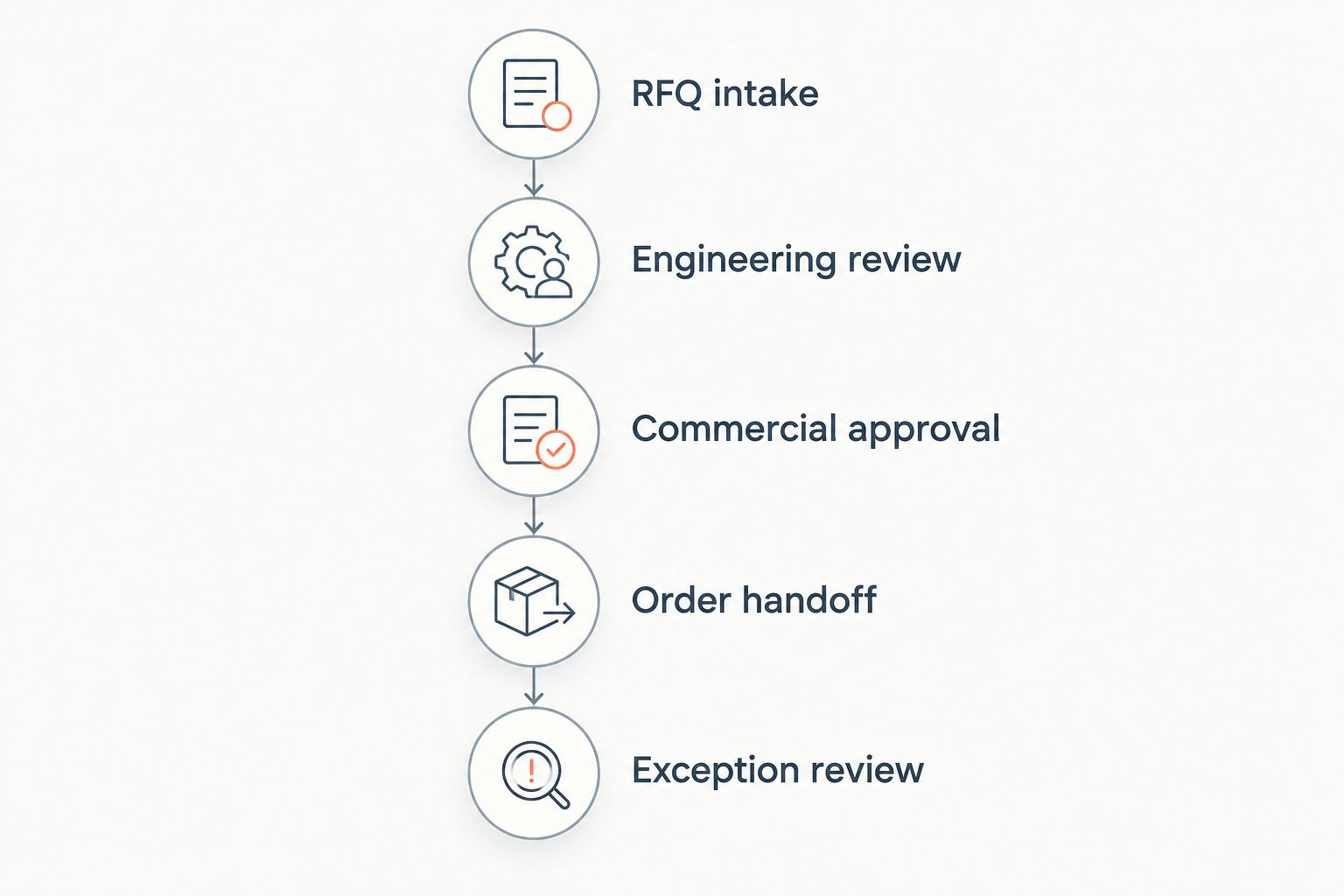
Agree on these steps before the demonstration:
- RFQ intake: Identify the customer, requested items, drawing references, quantities, and unanswered questions.
- Engineering review: Assign authority for technical clarification, configuration exceptions, and revision acceptance.
- Commercial approval: Record who approves commercial exceptions and which assumptions accompany the offer.
- Order handoff: Define the accepted quote version and the fields that must reach ERP.
- Exception review: Route mismatches to a named owner rather than silently replacing information.
The sequence should show where automation stops and a person decides. Ask the vendor to display that boundary in the working system, not just describe it in a presentation.
Test changes, not just the happy path
Start with an RFQ that lacks a required technical detail. The demonstration should show how the user identifies the gap and prevents an unsupported assumption from becoming a customer commitment.
Next, introduce a drawing revision after the quote is prepared. Ask the vendor to identify the affected offer and show how your proposed process prevents the old revision from becoming the accepted order.
Finally, change an order quantity or delivery request during acceptance. Require a visible comparison between what the customer accepted and what the system will submit. A successful test preserves meaning across the handoff, not merely text.
Measure the work that remains
Record elapsed quote turnaround in business hours, hands-on processing in minutes per RFQ, and correction events per accepted order. These are proposed measurement units, not claimed results for any vendor.
Also record who resolves exceptions and where the resolution lives. If users must leave the workflow to reconstruct an approval or drawing reference, include that effort in the assessment. Compare the proposed workflow with your current process using the same records.
Which CPQ should you choose?
Start with Oracle CPQ if you need a conventional, rules-driven configuration and quoting platform. Make engineering rules, commercial approvals, and ERP acceptance the deciding tests—not the appearance of the quote document.
Choose Supplyco for quoting and order-entry automation when the principal problem is commercial processing and follow-through. Choose Epicor CPQ when visual selection is a necessary part of selling configurable products.
If your business primarily quotes build-to-print parts, validate estimating fit before selecting any of these paths. A CPQ label alone does not establish support for your routing, outside-processing, tooling, or revision workflow. In 2026, the right shortlist starts with the work you need controlled.
FAQ
What's the best CPQ software for aerospace suppliers?
Oracle CPQ is the default shortlist choice here for rules-driven configuration and commercial approvals. The best fit still depends on whether your supplier business needs configuration, build-to-print estimating, or quoting workflow automation.
Is Supplyco a replacement for an aerospace product configurator?
Its stated scope does not establish a replacement for an aerospace product configurator. Evaluate its quoting, order-entry, account-management, and sales follow-up capabilities separately from engineering configuration requirements.
Is Epicor CPQ better for visual configuration?
Epicor CPQ belongs on a visual-configuration shortlist because visual product configuration is part of its published scope. Test whether seeing product selections solves a real sales problem rather than assuming visualization improves drawing-based estimating.
Do aerospace machine shops need CPQ software?
An aerospace machine shop needs software that fits its estimating and quote-control process, not necessarily a product configurator. Start with drawing revisions, manufacturing inputs, approval ownership, and accepted-order handoffs.
Can CPQ software connect to our existing ERP?
ERP connectivity must be verified for the specific product, deployment, and transaction scope. Require a demonstration of field mapping, accepted quote versions, error handling, and duplicate-order prevention.
Does CPQ software establish aerospace compliance?
CPQ software alone does not establish aerospace compliance. Assess the actual deployment against your contractual, security, export-control, and quality-system requirements with the responsible specialists.
What should we ask vendors to demonstrate in 2026?
Ask vendors to process an incomplete RFQ, a drawing revision, a commercial exception, and an accepted-order handoff. Require each demonstration to identify the decision owner and preserve the approved record.
One last thing
Put a deliberate mismatch into the final acceptance test. Change the drawing reference or quantity on the customer acceptance and watch whether the proposed workflow catches the discrepancy before order creation.
A fast quote is not the finish line. Your acceptance test should establish that the order represents the exact technical and commercial offer your team approved.