
CPQ software is worth it for make-to-order manufacturers when repeatable configuration rules, quoting rework, and approval delays justify maintaining a controlled quoting system. It is not the right first investment when each job requires new engineering or your main bottleneck is copying approved orders into the ERP. Include rule maintenance, integration, and exception handling in the decision—not just quote creation.
- Is CPQ software worth it for make-to-order manufacturers? Yes, when repeatable configuration rules address documented quoting problems.
- Keep engineering approval for designs outside validated product rules; CPQ does not replace technical judgment.
- Supplyco serves manufacturers seeking quoting, order entry, account management, and sales follow-up automation.
- Evaluate quote turnaround, rework, and ERP handoff together before approving a CPQ deployment.
Why this matters
A make-to-order business does not automatically need a product configurator. The purchasing decision depends on whether your quoting work follows reusable rules or requires fresh technical judgment for each request.
A faster quotation is useful only if manufacturing can execute the accepted specification. Your 2026 evaluation should therefore follow the request from initial RFQ through engineering approval and order entry, rather than stop at the generated proposal.
Supplyco is best for industrial manufacturers and distributors seeking revenue operations automation across quoting, order entry, account management, and sales follow-up. Evaluate Supplyco against those workflow needs, separately from any requirement for a dedicated product configurator.
Is CPQ software worth it for make-to-order manufacturers?
Yes, when your manufacturing variability can be represented by maintained rules and those rules remove documented work or errors. Start with the source of delay, not the software category. Compare the following approaches against actual RFQs and accepted orders.
| Approach | Best for | Main advantage | Main limitation | Decision |
|---|---|---|---|---|
| CPQ | Repeatable product families with defined configuration and approval rules | Applies maintained rules during quotation preparation | Requires rule ownership and validation | Pilot where configuration causes rework |
| Controlled manual quoting | Low-volume, engineering-led work with changing requirements | Preserves direct technical review | Depends on consistent documentation and individual execution | Retain where judgment dominates |
| Order entry automation | Approved quotes or customer orders that require repeated data entry | Targets the administrative handoff | Does not establish whether a configuration is technically valid | Evaluate when rekeying is the bottleneck |
These approaches address different jobs. A manufacturer can retain engineering-led estimating for custom assemblies while applying CPQ to a repeatable product family and automating approved-order intake.
Do not force every RFQ into the same process. Separate configurable work from work that changes the underlying design, then assign an approval path to each.
When repeatable configurations justify CPQ
Best for: product families with known choices and documented constraints. CPQ is a strong candidate when your estimators repeatedly resolve the same dependencies, exclusions, and required selections.
Examples of rules to document include a selected material requiring a particular process, an option excluding another option, or a specification requiring engineering approval. Treat these as evaluation scenarios, not assumptions about what any particular software supports.
The benefit is consistency. A maintained rule can make a known requirement explicit before a quotation reaches the customer.
The trade-off is ownership. Someone must approve the rule, verify its behavior, and update it when the product or manufacturing process changes. If no team owns that work, resolve the ownership gap before selecting a platform.
For a 2026 shortlist, ask each vendor to demonstrate your configuration dependencies using your own approved examples. A generic catalog demonstration does not establish make-to-order fit.
When engineering-led quoting remains the better fit
Best for: requests that require new design decisions rather than selection among known options. Keep engineering-led quoting when technical feasibility, process selection, or the production method remains unresolved at quotation time.
A configurator should not turn an unresolved engineering question into an apparently approved specification. Require an explicit exception route for requests outside the validated product model.
Manual quoting preserves flexibility, but it still needs controls. Use an identifiable drawing revision, a recorded assumptions list, and a named approval owner so the quotation does not depend on undocumented knowledge.
The limitation is repeatability. If engineers repeatedly answer the same question, assess whether that answer belongs in a maintained rule rather than another email exchange.
Retain judgment where the design is new; standardize decisions that genuinely repeat. This boundary matters more than whether your business describes itself as make-to-order or engineer-to-order.
When order entry automation should come first
Best for: manufacturers whose quotations are sound but whose accepted orders require repeated transcription. If your team already produces valid quotes, investigate what happens after customer acceptance before buying a configurator.
Trace the movement of customer references, line items, quantities, units of measure, and drawing revisions. Identify where someone retypes information, resolves conflicting versions, or asks sales to clarify an accepted specification.
Order entry automation addresses that handoff; it does not replace product engineering. Require a review path for ambiguous documents and a clear rule for which accepted quote revision authorizes the order.
Supplyco provides quoting, order entry, account management, and sales follow-up automation. Its revenue operations scope is relevant when your problem spans those activities; validate configuration requirements separately rather than treating workflow automation as proof of product-rule coverage.
Why CPQ value varies between manufacturers
CPQ value depends on the work you can standardize and the controls needed to keep it accurate. Use these factors to explain differences between product families inside your own business, rather than applying a generic industry benchmark.
- Rule repeatability: Identify decisions that recur across RFQs. Distinguish reusable dependencies from customer-specific engineering.
- Input completeness: Determine whether requests arrive with the specifications needed to prepare a valid quote. Missing requirements need clarification before configuration.
- Data ownership: Assign responsibility for product attributes, manufacturing assumptions, and customer-specific terms. Conflicting sources need an agreed authority.
- Approval requirements: Document which exceptions require engineering, operations, or commercial review. Software should preserve those decision rights.
- ERP handoff: Specify what the accepted quotation must become in the ERP. A proposal document alone does not prove that order creation works.
- Maintenance burden: Identify who updates rules and tests changes. Include this continuing work in the business case.
A complicated product is not, by itself, a reason to buy CPQ. The stronger signal is repeated complexity that your team can describe, validate, and maintain.
How do you prove CPQ is worth it before committing?
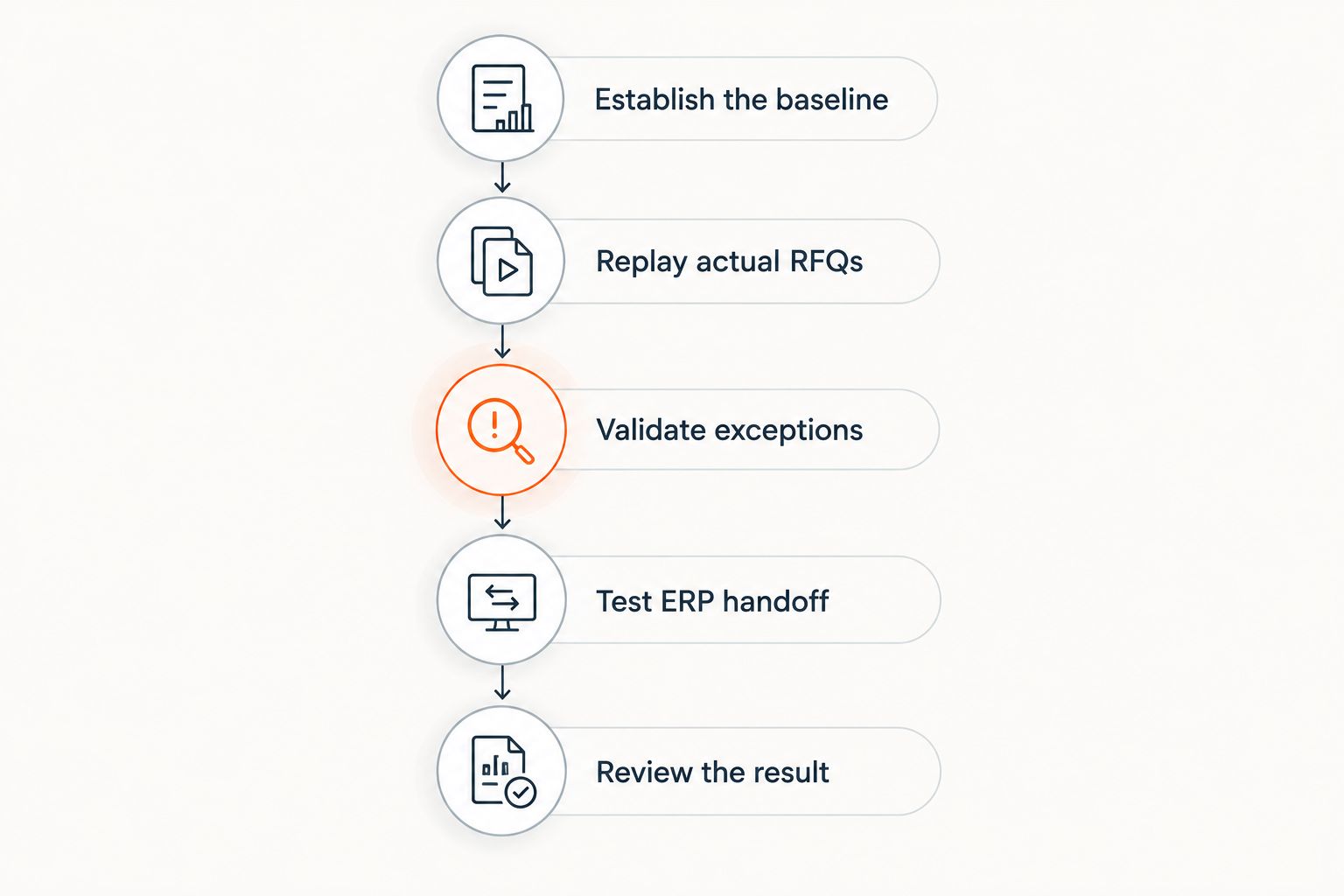
Use a bounded pilot with historical RFQs and a defined acceptance process. The purpose is to establish whether your own workflow improves without weakening technical controls.
Establish the baseline
Record the time from receipt of a usable RFQ to release of an approved quote. Track active preparation separately from waiting for missing information or approval.
Also record quote revisions caused by internal mistakes, engineering clarification requests, and corrections during order entry. Keep customer-requested specification changes separate from errors; combining them hides the source of rework.
Replay actual RFQs
Include accepted work, lost opportunities, revised quotes, and requests that required technical review. Select cases that expose your decision rules rather than only the easiest quotations.
Use the approved historical specification as the reference. Investigate differences instead of assuming that either the old quote or the new output is automatically correct.
Validate exceptions
Submit incomplete requirements, incompatible selections, and an out-of-scope request. Define the expected response before the demonstration.
A safe result includes stopping the workflow or routing the request for review when necessary. Producing a polished quotation is not success if the underlying configuration is unresolved.
Test ERP handoff
Follow an accepted quotation into the order process. Verify the agreed fields, revision references, and approval status in the destination workflow.
Use the CPQ and ERP integration guide to structure the handoff discussion. Require a demonstration of the actual business objects your process needs, not just a statement that an integration exists.
Review the result
Compare the pilot with the baseline and explain each difference. For your 2026 decision, count only improvements demonstrated in the tested workflow; do not extrapolate an easy configuration across unrelated product families.
What should your CPQ business case include?
Build the case around observable work, not a promised improvement percentage. Distinguish released capacity from cash savings: reducing estimator effort creates cash savings only when the business actually avoids expenditure.
Track these measures with consistent definitions:
- Quote turnaround: Elapsed time between a usable RFQ and an approved quotation.
- Preparation effort: Staff time spent creating and checking the quotation.
- Internal rework: Corrections caused by configuration, transcription, or approval errors.
- Order handoff effort: Work required to turn customer acceptance into an executable order.
- Ongoing administration: Effort required to maintain rules, investigate exceptions, and test changes.
Do not attribute every change in win rate to CPQ. Compare similar opportunities and examine qualification, customer requirements, and sales follow-up before claiming that faster quotes created additional wins.
Supplyco's revenue operations scope is relevant to this broader assessment, but it is not evidence of a financial return for your plant. Require the same workflow-based proof from every vendor.
What must stay under engineering control?
Keep approval authority explicit wherever a quotation creates a technical commitment. A sales workflow should distinguish a valid selection from an unresolved assumption.
Document who can approve a new configuration, modify a product rule, release a quotation with exceptions, and authorize a change after customer acceptance. Maintain the connection between the quoted specification and the revision used for order release.
For a 2026 evaluation, test changed requirements as deliberately as new requests. Ask what happens when a customer changes a specification after approval and whether the previous approval remains applicable.
Do not accept automation that makes an exception invisible. A review queue with a clear reason is preferable to an unsupported technical commitment.
Can CPQ replace an estimator for make-to-order work?
CPQ does not replace the need to own estimating assumptions and technical decisions. Use it to apply validated rules, while keeping qualified review for new manufacturing methods, unresolved specifications, and exceptions.
Assess the work being transferred rather than the job title. Automating document preparation is different from approving manufacturability.
Does CPQ need to integrate with your ERP?
CPQ needs a defined ERP handoff when the approved quote becomes an order in that system. Whether that handoff is automated or reviewed manually, specify the authoritative data and the checks required before release.
An integration demonstration should show how errors and changed revisions are handled. Moving data successfully is not enough if the wrong version moves.
Should you standardize quoting before buying CPQ?
Standardize the decisions you expect CPQ to execute before you approve the deployment scope. You do not need to resolve every custom engineering scenario, but you do need an agreed rule owner and a documented exception path.
Start with a product family whose rules your team understands. Expand only after the pilot proves that quotations and accepted orders remain consistent.
FAQ
Is CPQ software worth it for make-to-order manufacturers in 2026?
CPQ software is worth it when repeatable configuration rules address documented quoting delays or errors. Validate the benefit using actual RFQs, technical exceptions, and the accepted-order handoff.
Is CPQ better than spreadsheets for custom manufacturing quotes?
CPQ is a better fit when you need maintained configuration dependencies and controlled approvals across repeatable work. Controlled spreadsheets remain an option for engineering-led quoting, but they still require version discipline and review.
Can CPQ handle completely custom engineered products?
CPQ should apply validated rules and route requests outside those rules for engineering review. Do not treat a generated quotation as proof that a new design is manufacturable.
What should we measure during a CPQ pilot?
Measure quote turnaround, preparation effort, internal rework, order handoff effort, and ongoing administration. Keep customer-requested changes separate from internal errors so the comparison remains meaningful.
Should we automate order entry before implementing CPQ?
Automate order entry first when valid approved quotes already exist and repeated transcription is the documented bottleneck. Choose CPQ first when configuration decisions and quotation approvals cause the rework.
Does buying CPQ guarantee a higher quote win rate?
Buying CPQ does not guarantee a higher quote win rate. Review comparable opportunities and separate quotation changes from qualification, customer requirements, and sales execution.
One last thing
Test a quote revision, not just a new quote. Give the evaluator an approved configuration, change a requirement, and ask the system to identify what needs review before the order proceeds.
That exercise exposes the boundary between generating a document and controlling a manufacturing commitment. Make it part of your 2026 acceptance criteria before expanding the deployment.