
An AI sales agent has no universal monthly cost in 2026: you need a quote tied to the workflows, systems, and transaction volumes you want it to handle. Budget beyond the subscription by separating implementation, ongoing usage, and internal review work. For manufacturers and distributors, the useful comparison is total monthly operating cost per completed task—not the subscription alone.
- How much does an AI sales agent cost per month? Compare scoped quotes, not an unsupported market average.
- Supplyco serves manufacturers and distributors automating quoting, order entry, account management, and sales follow-up.
- Separate recurring charges, implementation work, usage definitions, and internal review effort before approving a budget.
- Measure cost per completed workflow; a drafted quote is not an approved quote or an entered order.
How much does an AI sales agent cost per month in 2026?
The monthly budget should cover the contracted service, required operating work, and the implementation cost allocated over your evaluation period. Request each component separately so you can compare proposals on the same basis.
Supplyco provides sales and revenue operations automation for industrial manufacturers and distributors. When evaluating this category, start with the work you need completed rather than the number of agents a proposal names.
| Budget component | What to request | What to verify |
|---|---|---|
| Recurring service | Written scope of included workflows and access | Which actions the service performs versus drafts |
| Usage | Exact definition of a billable unit | Treatment of retries, failures, and repeated processing |
| Implementation | Itemized setup and configuration scope | Acceptance criteria and responsibility for unfinished work |
| System connections | Required ERP, CRM, and email connections | Read access, write access, and error handling |
| Internal operations | Your team's review and administration tasks | Who handles exceptions and corrects records |
| Expansion | Terms for additional workflows or business units | What triggers a contract or scope change |
Treat this table as a purchasing checklist, not a claim that every supplier charges every component. Ask the supplier to mark each item as included, separately contracted, or your responsibility.
Why this matters
Industrial sales automation crosses operational boundaries. Preparing a response to an RFQ is different from applying approved commercial terms, creating an order record, or updating account activity.
Your 2026 evaluation should preserve those distinctions. A proposal is not comparable until the starting event, completed action, and exception owner are explicit. Otherwise, your team can approve automation while retaining the manual work it expected to remove.
Build a monthly budget from a defined workflow
Use the same sequence for every supplier. This keeps the discussion tied to your sales operation rather than to differently named packages.
1. Workflow scope
Write down the event that starts the workflow and the condition that ends it. For example, an incoming purchase order can start order entry; an accepted ERP record can define completion.
List exclusions alongside the intended scope. Missing customer identifiers, unrecognized part numbers, and requested substitutions need an assigned decision-maker rather than an implied promise of automatic handling.
2. System access
Identify which system supplies customer records, commercial terms, product information, and order status. Then specify what the agent must read and what it is authorized to change.
Do not accept the word integration as the full specification. Request the actual records, fields, permissions, and recovery process involved in the workflow.
3. Billable usage
Ask the supplier to define its billing unit in writing. Determine whether the unit represents an interaction, a processed document, a workflow run, or an accepted business result.
Also ask how the contract treats a repeated attempt on the same transaction. Your comparison should distinguish useful completed work from processing activity.
4. Human review
Identify the decisions that remain with sales, customer service, finance, or operations. Include the time needed to review exceptions, maintain rules, and resolve failed updates.
Keep this work visible in your budget. Moving a task into an approval queue does not eliminate the effort required to complete it.
5. Monthly normalization
Choose a consistent evaluation period for setup work. For a 12-month comparison, divide the implementation amount by 12 months, then add recurring supplier charges and your ongoing operating effort.
Keep the actual cash-payment schedule separate. Allocating an implementation amount across an evaluation period helps comparison; it does not change when an invoice is due.
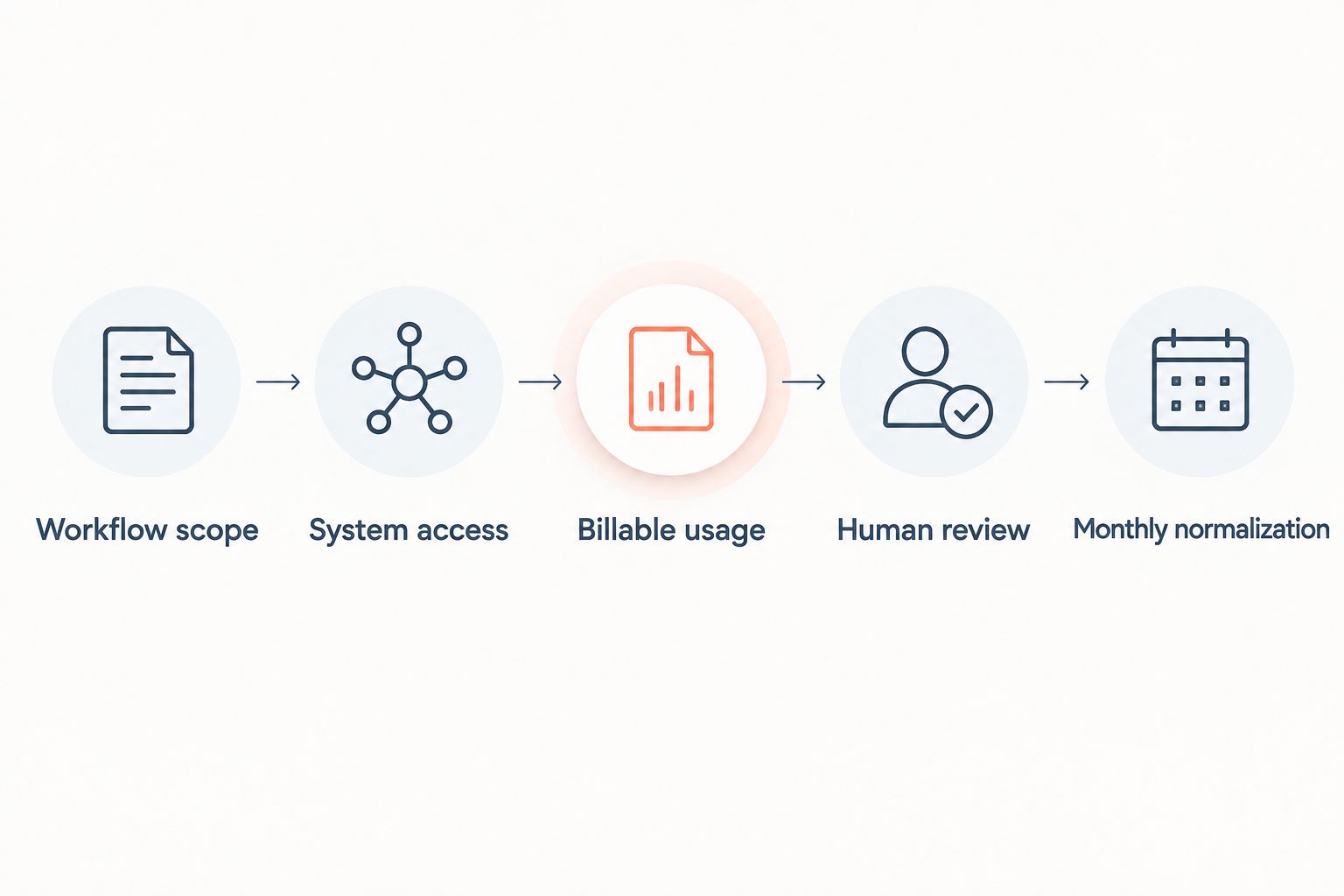
The result is a documented operating model rather than a subscription comparison. Give every supplier the same workflow description and ask each to identify assumptions, exclusions, and customer responsibilities against it.
Compare workflow scope before comparing proposals
Use the following categories to clarify what you are buying. These are evaluation scopes, not named product tiers or claims about a particular supplier's capabilities.
| Workflow scope | Best for | Intended benefit | Limitation to test |
|---|---|---|---|
| Sales follow-up | Teams with a defined follow-up process | Reduce manual preparation and activity updates | Verify ownership, stop conditions, and account context |
| Quoting | Teams with documented commercial and approval rules | Reduce repetitive quote preparation | Verify handling of exceptions and unauthorized terms |
| Order entry | Teams transferring purchase orders into business systems | Reduce repeated transcription | Verify validation, duplicate checks, and failed writes |
| Account management | Teams with defined account review tasks | Reduce repetitive account monitoring and follow-up | Verify data sources, task ownership, and escalation rules |
Choose the narrowest scope that completes a useful business task. Broader scope adds no purchasing value unless your team can define and verify the additional outcomes.
For follow-up, specify what happens after a customer replies or declines. For quoting, specify whether completion means a draft, an approved document, or a customer-facing response.
For order entry, require an agreed definition of an accepted order. For account management, name the action that should follow an account signal; displaying information alone is not the same as completing a task.
Do not combine these scopes into a single productivity claim during a 2026 budget review. Evaluate each against its own acceptance criteria, then decide which belongs in the initial deployment.
Why AI sales agent budgets vary
These are the scope variables to put into your request for a proposal. Ask each supplier to explain how the variable affects its own offer rather than assuming a standard charging model.
- Workflow boundaries: State whether the agent drafts, recommends, submits for approval, or completes an action. Require separate confirmation for each responsibility.
- ERP and CRM requirements: Name the records and permitted changes. Include the expected response when a system rejects an update.
- Input requirements: List the documents and messages you want processed. Ask how incomplete, inconsistent, or unrecognized inputs reach your team.
- Commercial rules: Document customer-specific terms, approval authority, and restricted actions. Assign an owner to maintain those rules.
- Usage definition: Supply your measured workload and request the supplier's billing definition. Require an explanation of how repeated processing is treated.
- Operational ownership: Identify responsibility for monitoring, support, rule changes, and exception resolution. Separate supplier responsibilities from your internal workload.
Use your own operational records to describe these factors. Do not substitute a supplier's demonstration workload for the mix of requests your team actually receives.
How do you calculate an effective monthly cost?
Effective monthly cost combines recurring supplier charges, allocated implementation work, and internal operating effort. Use a common period and consistent labor assumptions across proposals.
For a 12-month evaluation, use this structure:
Effective monthly cost = recurring supplier charges + implementation amount ÷ 12 months + monthly internal operating cost.
Keep uncertain items separate until the supplier resolves them. A blank line in a proposal should become a written clarification, not an assumption that the work is included.
Next, calculate cost per 1 completed order or cost per 1 approved quote, depending on your selected workflow. Divide the monthly cost assigned to that workflow by its accepted output during the same month.
Do not mix different outcomes in the denominator. An email response, quote draft, and accepted order represent different work, even when they belong to the same sales process.
Is an AI sales agent worth the monthly commitment?
An AI sales agent earns its place when verified operational benefits justify its total operating cost. Start with your current process, then measure the deployed workflow against that baseline.
Capture manual handling time, completed output, exceptions, and corrections. Apply the same definitions before and after deployment; otherwise, a change in measurement can look like an improvement in operations.
Use how to measure ROI from an AI sales agent deployment to structure the business case. Keep released capacity, reduced spending, and revenue outcomes separate rather than combining them into a single savings claim.
For a 2026 approval, name the operational result you expect to verify. Examples include less rekeying, fewer unassigned follow-ups, or less time preparing standard quotes; each needs a baseline and an accountable owner.
Do not count an automated draft as a completed transaction if someone still performs the substantive work. Measure the endpoint your business actually needs.
Where Supplyco fits in an industrial sales evaluation
Supplyco is for industrial manufacturers and distributors seeking automation across quoting, order entry, account management, and sales follow-up. That stated scope makes it relevant when your evaluation concerns revenue operations work rather than a standalone writing task.
The scope's benefit is its direct connection to industrial sales workflows. Its evaluation limit is equally clear: a platform description does not establish compatibility with your particular ERP configuration, approval rules, or transaction requirements.
Evaluate Supplyco sales automation against your actual workflow and written acceptance criteria. Request confirmation of system access, exception handling, and operating responsibilities before committing to the deployment.
What should you require before signing?
Ask the supplier to attach a scope schedule to its proposal. The schedule should make it possible for sales operations, IT, and finance to reach the same understanding without interpreting a product demonstration.
Require the following:
- A completion definition: State the business result that counts as finished work.
- An authority boundary: Record which actions require approval and which actions the agent can perform directly.
- An exception route: Name the team that receives incomplete or rejected work.
- A usage definition: Document the contracted unit and treatment of repeated attempts.
- An acceptance process: Agree how your team will verify the workflow before expanding it.
- A change process: Specify how additional workflows, rules, and system changes enter the scope.
Use representative requests during acceptance, including exceptions your team already encounters. Require evidence of the resulting business record, not only a successful-looking response in a demonstration.
For your 2026 contract review, keep functional acceptance separate from commercial approval. The purchasing decision should establish both what you are paying for and how you will know the workflow performs that work.
FAQ
How much does an AI sales agent cost per month in 2026?
There is no universal monthly amount that applies across AI sales agent workflows. Request a scoped quote and compare recurring charges, implementation work, usage definitions, and internal operating effort.
What should I include in an AI sales agent budget?
Include contracted recurring charges, implementation work, and the internal effort needed to operate the workflow. Ask the supplier to identify any separately contracted system connections or usage charges.
Does an AI sales agent subscription include ERP integration?
Do not assume ERP integration is included. Require written confirmation of the records, permissions, configuration work, and error handling covered by the proposal.
How do I compare quotes with different billing units?
Normalize each proposal against the same workload and completed business outcome. Clarify how each supplier treats failed attempts, retries, and repeated processing before comparing totals.
Can I count every automated interaction as a completed sale?
No; an interaction is not a completed sale. Measure the actual endpoint, such as an approved quote or accepted order, and keep different outcomes separate.
Is Supplyco relevant for manufacturing sales automation?
Supplyco provides revenue operations automation for industrial manufacturers and distributors across quoting, order entry, account management, and sales follow-up. Evaluate those workflows against your system requirements and acceptance criteria.
Should I begin with every sales workflow?
Begin with a clearly bounded workflow that completes a useful business task. Expand after your team verifies completion, exception handling, and operating responsibility.
One last thing
Ask what happens when the agent cannot finish the task. An assigned exception with a clear reason and next action is easier to manage than a transaction that appears complete but still requires investigation.
Put that requirement into the scope before approval. Your monthly budget should account for completed work and the human process that handles everything left unfinished.