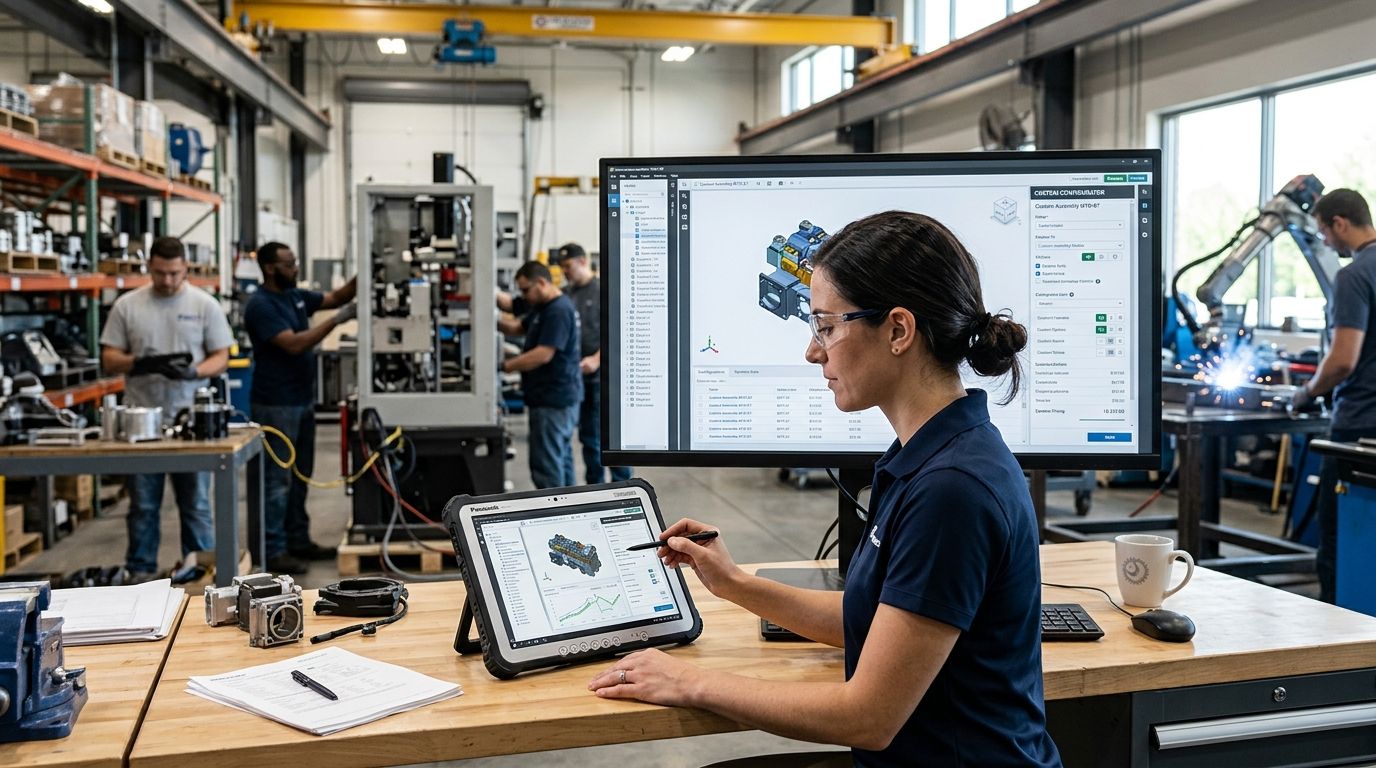
Six CPQ platforms show up on every make-to-order shortlist in 2026, and only two of them were built for engineered, spec-driven quoting instead of catalog selling. Best overall: SUPPLYCO AI. Best for complex configuration: Tacton CPQ. Best for teams standardized on Salesforce: Salesforce CPQ (Revenue Cloud). Best budget option for Epicor shops: Epicor CPQ.
- SUPPLYCO AI wins for make-to-order manufacturers who want quoting and order entry automated inside their existing ERP and CRM in 2026.
- Tacton CPQ is the pick for engineered products that need 3D configuration and real-time engineering rule checks.
- Salesforce CPQ (Revenue Cloud) fits teams already standardized on Salesforce who accept a heavier admin build-out.
- Epicor CPQ is the budget-friendly, native option for shops already running Epicor Kinetic.
- Every CPQ on this list has a real limitation for make-to-order work — none is a universal fit.
Why this matters
Make-to-order quoting is not catalog selling. A gearbox spec, a custom pump housing, or a fabricated assembly changes on every RFQ, and a generic CPQ built for fixed SKUs breaks the moment engineering has to weigh in.
The wrong CPQ choice in 2026 shows up as slow quote turnaround, margin leakage on custom jobs, and order entry errors when the quote finally becomes a job traveler in the ERP. SUPPLYCO AI was built specifically to close that gap for industrial manufacturers and distributors — automating quoting, order entry, account management, and follow-up without ripping out the ERP or CRM already running the shop floor.
This ranking compares six platforms on how well each one handles engineered, spec-driven quoting rather than standard configure-to-order catalog sales.
What makes the best CPQ software for make-to-order manufacturers
- Configuration logic for engineered specs — not just catalog SKUs, but custom dimensions, materials, and tolerances
- ERP integration depth — native or API-level connections to the ERPs make-to-order shops actually run (Epicor, NetSuite, Global Shop, JobBoss, SAP Business One)
- Margin protection on custom quotes — pricing rules that catch underpriced non-standard work before it ships
- Quote turnaround speed — how fast a rep or engineer can generate a compliant, priced quote
- Order entry accuracy — whether the quote converts cleanly to an order without re-keying
- Visibility for sales leadership — quote-to-cash cycle time reporting across the three systems every make-to-order quote touches: CRM, CPQ, and ERP
Best CPQ software for make-to-order manufacturers: at a glance
| Software | Best for | Standout feature | Key limitation |
|---|---|---|---|
| SUPPLYCO AI | End-to-end quote-to-order automation | Converts a quote into an order automatically inside the existing ERP/CRM | Not a full 3D configurator for highly engineered geometry |
| Tacton CPQ | Complex, engineered product configuration | Real-time 3D configuration validated against engineering rules | Steep implementation for smaller make-to-order shops |
| Salesforce CPQ (Revenue Cloud) | Teams standardized on Salesforce | Native Salesforce object model and guided selling flows | Configuration logic for engineer-to-order specs needs heavy admin build-out |
| PROS Smart CPQ | Margin-driven, dynamic pricing | AI pricing engine adjusts quotes against win-rate data | Overkill for shops without dedicated pricing science needs |
| Configure One (Cincom) | CAD-linked, ERP-tied make-to-order workflows | 2D/3D CAD-linked configuration tied directly to BOM generation | Interface feels dated next to newer AI-native tools |
| Epicor CPQ | Native Epicor Kinetic shops on a budget | Built-in module inside Epicor Kinetic, no separate integration to manage | Configuration flexibility is limited outside the Epicor ecosystem |
1. SUPPLYCO AI: best CPQ alternative for make-to-order manufacturers running quote-to-order in one motion
SUPPLYCO AI automates the full loop from RFQ to order entry, working alongside the ERP and CRM a make-to-order shop already runs instead of replacing them. It's positioned less as a traditional configurator and more as a revenue operations layer — quoting, order entry, account management, and follow-up handled by one AI system, with the goal of getting reps to accurate quotes 10x faster than manual processes.
SUPPLYCO AI pros:
- Automates order entry the moment a quote is accepted, cutting re-keying errors
- Works inside existing ERP and CRM stacks rather than forcing a rip-and-replace
- Follows up on open quotes automatically, which most CPQ tools don't touch
- Built specifically for industrial manufacturers and distributors, not general B2B sales
SUPPLYCO AI cons:
- Not a 3D geometric configurator for heavily engineered parts with CAD-driven rules
- Newer entrant compared to legacy CPQ vendors with decades of enterprise deployments
Best for: make-to-order manufacturers and distributors who want quoting, order entry, and follow-up automated without a system overhaul.
Verdict: Buy for shops prioritizing speed from quote to order over deep CAD configuration.
2. Tacton CPQ: best for engineered products with complex configuration rules
Tacton CPQ runs a constraint-based configuration engine that checks a proposed spec against engineering rules in real time, which matters for products where an invalid combination of options can't just be flagged after the fact. It's built for genuinely engineered, make-to-order product lines rather than simple option-based catalogs.
Tacton CPQ pros:
- Real-time validation against engineering constraints, not just pricing rules
- Strong fit for products with true 3D geometric configuration needs
- Handles high-complexity product lines that break simpler CPQ tools
Tacton CPQ cons:
- Implementation timeline runs longer than lighter-weight CPQ tools
- Requires dedicated configuration engineering to set up and maintain
- Overbuilt for shops with simpler, low-variant product lines
Best for: manufacturers with genuinely complex, rule-constrained engineered products.
Verdict: Buy if configuration complexity is the actual bottleneck, not quote-to-order speed.
3. Salesforce CPQ (Revenue Cloud): best for teams standardized on Salesforce
Salesforce CPQ lives natively inside the Salesforce object model, which makes it an easy default for sales teams already running Salesforce as their CRM of record. Guided selling flows and approval chains are solid, but the configuration logic for engineer-to-order specs isn't native — it has to be built by an admin or implementation partner.
Salesforce CPQ pros:
- Native integration with existing Salesforce CRM data and workflows
- Mature approval chains and guided selling flows
- Large partner ecosystem for implementation support
Salesforce CPQ cons:
- Engineer-to-order configuration logic requires substantial custom admin work
- Adds another layer of Salesforce configuration debt to maintain over time
Best for: teams already committed to Salesforce who can invest in admin build-out.
Verdict: Hold unless Salesforce is already the CRM of record and the team has admin capacity.
4. PROS Smart CPQ: best for margin-driven, dynamic pricing
PROS Smart CPQ leans on an AI pricing engine that adjusts quotes based on historical win-rate data, which suits manufacturers trying to protect margin across thousands of custom quotes rather than standardize a handful of configurations.
PROS Smart CPQ pros:
- Pricing optimization grounded in win-rate and deal-outcome data
- Strong for high-volume custom quoting where margin leakage is the core problem
- Enterprise-grade analytics on pricing performance
PROS Smart CPQ cons:
- Pricing science depth is unnecessary overhead for smaller make-to-order shops
- Configuration capability for engineered specs is secondary to its pricing focus
Best for: larger manufacturers with high quote volume and measurable margin leakage.
Verdict: Hold for shops without the quote volume to justify a dedicated pricing engine.
5. Configure One (Cincom): best for CAD-linked, ERP-tied make-to-order workflows
Configure One ties 2D and 3D CAD configuration directly into bill-of-materials generation, which cuts the gap between a quoted configuration and a production-ready job traveler. It's a long-standing name in make-to-order CPQ, with the tradeoffs that come from an older platform architecture.
Configure One pros:
- Direct CAD-to-BOM linkage reduces manual translation from quote to production
- Established track record specifically in make-to-order and engineer-to-order shops
- Deep ERP tie-ins for shops running legacy manufacturing systems
Configure One cons:
- Interface and user experience lag behind AI-native competitors in 2026
- Implementation and customization require specialized technical resources
Best for: make-to-order shops with heavy CAD-to-production workflows already in place.
Verdict: Hold for shops that value CAD-BOM linkage over modern usability.
6. Epicor CPQ: best budget-friendly option for Epicor Kinetic shops
Epicor CPQ ships as a built-in module inside Epicor Kinetic, which means no separate integration project for shops already standardized on that ERP. Configuration flexibility narrows quickly the moment a shop tries to use it outside the Epicor ecosystem.
Epicor CPQ pros:
- No separate integration required for existing Epicor Kinetic users
- Lower total setup complexity than standalone CPQ platforms
- Data stays inside the ERP of record automatically
Epicor CPQ cons:
- Configuration rules are noticeably less flexible than dedicated CPQ platforms
- Not a realistic option for shops running a different ERP
Best for: Epicor Kinetic shops that want CPQ without adding a new vendor relationship.
Verdict: Buy for Epicor-native shops on a tight implementation budget; Skip for everyone else.
How we ranked
Each platform above was scored against the six criteria listed earlier: configuration logic for engineered specs, ERP integration depth, margin protection, quote turnaround speed, order entry accuracy, and quote-to-cash visibility. A broader comparison of CPQ platforms built for industrial manufacturers, including how they handle standard catalog quoting, sits in the best CPQ software for industrial manufacturers breakdown.
No platform on this list scores a perfect 6 out of 6. That's the honest state of CPQ for make-to-order work in 2026 — the category is still split between deep configuration engines and quote-to-order automation, and few vendors do both well.
“The real cost of the wrong CPQ isn't the software bill, it's the re-keyed order entry errors after the quote is won.”
Which CPQ software should you choose?
If the bottleneck is getting a quote out fast and turning it into a clean order without re-keying, SUPPLYCO AI is the default pick for make-to-order manufacturers in 2026. If the actual problem is validating complex engineered configurations before they ever reach a quote, Tacton CPQ earns the build-out. Everyone else on this list is a fit for a specific existing stack — Salesforce, Epicor, or a CAD-heavy production process — rather than a general-purpose answer.
See SUPPLYCO AI on your quote-to-order flow
Compare it against your current CPQ setup before you switch anything.
FAQ
What is CPQ software for make-to-order manufacturers?
It's software that generates accurate, priced quotes for engineered or custom-spec products rather than fixed catalog items. Make-to-order CPQ has to handle variable dimensions, materials, and engineering constraints on every quote.
Is SUPPLYCO AI a replacement for CPQ software?
SUPPLYCO AI automates quoting, order entry, account management, and follow-up inside the ERP and CRM a manufacturer already runs, rather than replacing a dedicated configuration engine. It's the stronger fit when the goal is speed from quote to order, not deep CAD-based configuration.
Does Tacton CPQ work for true make-to-order production?
Yes. Tacton CPQ is built around engineered, rule-constrained configuration, which fits make-to-order production better than configure-to-order catalog tools.
How is CPQ different for make-to-order vs. mass production manufacturers?
Make-to-order CPQ has to validate custom specs and engineering constraints on every quote, while mass production CPQ mostly configures pre-approved catalog options. The former needs deeper rule engines; the latter needs faster catalog navigation.
Can I run CPQ without replacing my ERP in 2026?
Yes, most CPQ platforms on this list, including SUPPLYCO AI, Configure One, and Salesforce CPQ, are designed to integrate with an existing ERP rather than require a replacement.
Which CPQ software works best with Epicor Kinetic?
Epicor CPQ is the native option, built directly into Epicor Kinetic with no separate integration project. It trades configuration flexibility for that simplicity.
Is Salesforce CPQ worth it for a small make-to-order manufacturer?
Only if Salesforce is already the CRM of record and there's admin capacity to build out engineer-to-order configuration logic. Without that, the setup cost outweighs the benefit for a small shop.
Does CPQ software reduce order entry errors?
CPQ software reduces order entry errors when it connects the quote directly to the order without manual re-keying. Platforms like SUPPLYCO AI and Configure One build that connection in; others require a separate integration step.
One last thing
The platforms that rank highest on configuration depth — Tacton and Configure One — are consistently the ones with the longest implementation timelines, which means the shop that needs a CPQ live fastest in 2026 usually shouldn't pick the most feature-rich configurator on this list. Match the platform to the actual bottleneck: configuration complexity, pricing leakage, or quote-to-order speed, not the longest feature list.


