
Best overall: Salesforce for rep agencies managing multiple principals and complex opportunities. Best for straightforward follow-up: HubSpot. Best for a smaller team that needs configurable account records: Zoho CRM. The best CRM software for manufacturer's rep agencies keeps principals, customers, opportunities and next actions clear; SUPPLYCO addresses a different job: automating quoting, order entry, account management and sales follow-up for industrial manufacturers and distributors.
- Salesforce is the best CRM software for manufacturer's rep agencies managing complex, multi-principal pipelines in 2026.
- HubSpot suits teams prioritizing consistent contact records, deal stages and sales follow-up.
- Zoho CRM suits smaller teams that need to configure records around their sales process.
- SUPPLYCO handles revenue operations for manufacturers and distributors; it is not a substitute for a rep agency CRM.
Why this matters
A manufacturer's rep agency does not own every product it sells. Its CRM must show which principal an opportunity belongs to, who owns the customer relationship and what happens after an RFQ. If those details live only in notes or spreadsheets, a clean-looking pipeline still leaves your team without a dependable next action.
In 2026, evaluate CRM software against the work your reps actually perform. A contact database alone does not resolve principal attribution. A detailed opportunity record alone does not process a quote or enter an order. Those are separate requirements, and buying one system as though it does both creates avoidable handoffs.
The buying decision: choose the CRM that your reps can keep current across principals, then assess quoting and order workflows separately. SUPPLYCO is best for industrial manufacturers and distributors seeking that operational automation alongside their customer records, not for agencies seeking a standalone CRM.
What makes the best CRM for manufacturer's rep agencies
Use these criteria before comparing feature lists. For each vendor, ask to see your own account structure and a real RFQ path rather than a generic dashboard.
- Principal attribution: Can you identify the principal on each opportunity and report on its pipeline without duplicating customer records?
- Account ownership: Can a rep see the customer, contacts, territory and current opportunities in one place?
- Opportunity stages: Do the stages reflect the agency's actual path from inquiry to quote, follow-up and outcome?
- Activity capture: Can reps record calls and next steps where the rest of the team can find them?
- Reporting discipline: Can a manager distinguish an open opportunity from a quote that is waiting for a decision?
- Operational handoff: Is it clear where CRM work ends and quoting, order entry or ERP work begins?
The last criterion is easy to miss. A CRM can record that a quote was sent without owning the data or approvals needed to produce that quote. In 2026, make the boundary explicit in your evaluation. Otherwise, a promising demo can hide the manual work your team wanted to remove.
Best CRM options at a glance
| CRM | Best for | Standout feature to assess | Key limitation for a rep agency |
|---|---|---|---|
| Salesforce | Complex, multi-principal sales processes | Configurable account and opportunity workflows | Configuration and upkeep require clear ownership |
| HubSpot | Teams focused on consistent follow-up | Contact, deal and activity records in one CRM | Confirm that principal-level reporting fits your structure |
| Zoho CRM | Smaller teams configuring their own process | Customizable records and sales workflows | Test whether your reporting design stays manageable |
Salesforce wins when principal attribution and reporting are the hardest problems. HubSpot is the simpler starting point when the immediate problem is missed follow-up. Zoho CRM belongs on the shortlist when a smaller team wants to configure its process and can take responsibility for that setup. None of the three should be treated as an ERP or assumed to automate order entry.
Where the CRM stops
A useful system boundary separates four jobs: account records, opportunity stages, quote processing and order entry. The CRM owns the relationship and pipeline view. Your quoting and order workflows need their own evaluation, including who checks information before it reaches an operational system.
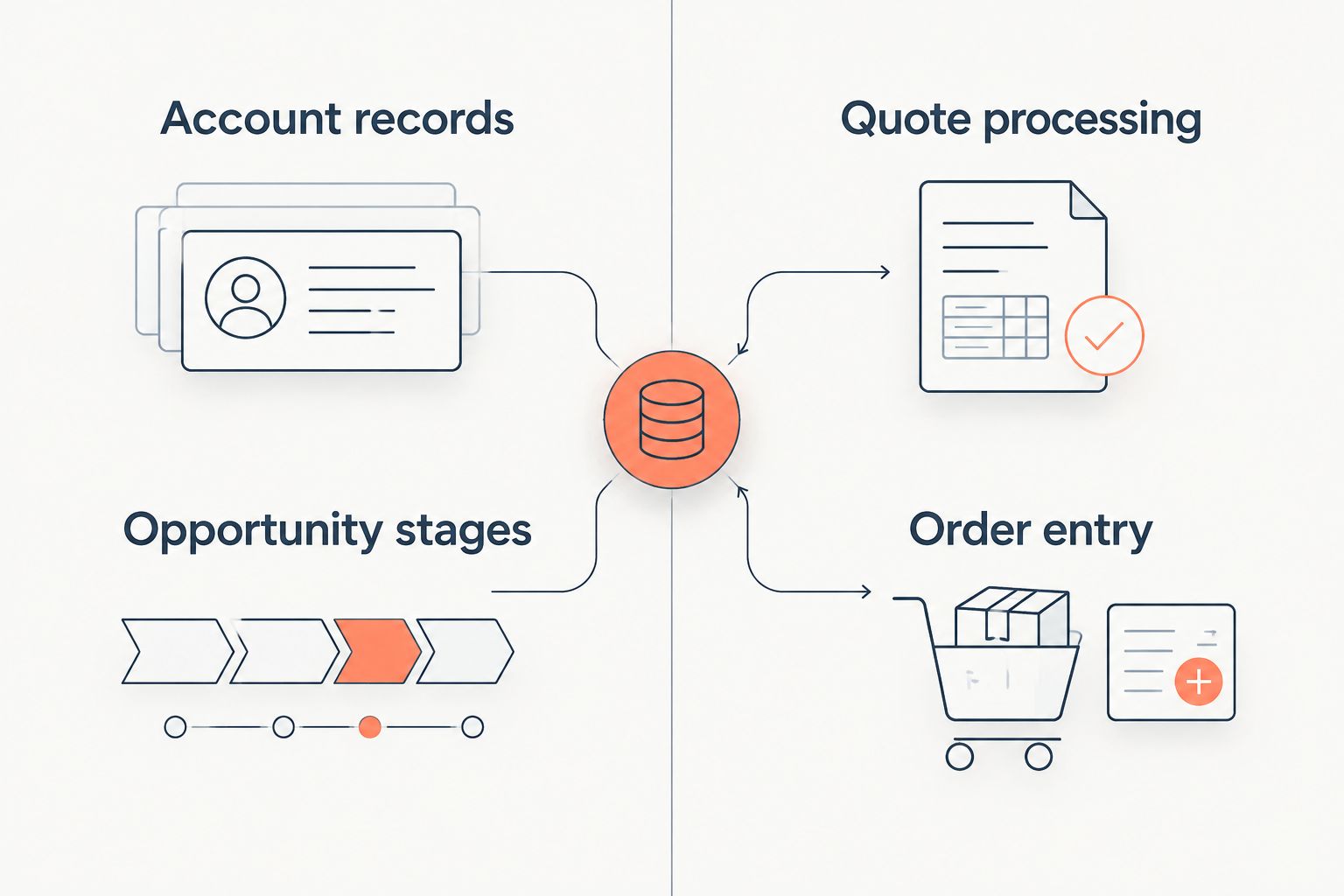
To test that boundary, take 5 sample RFQs through your proposed process. Track where a rep records the opportunity, where quote details are checked and where an accepted request becomes an order. The sample is an evaluation exercise, not a performance benchmark; its value is exposing steps a product demonstration skips.
1. Salesforce: best CRM for complex multi-principal pipelines
Salesforce is a CRM for managing customer relationships, opportunities and sales activity. Its configurable structure makes it the strongest choice here when an agency needs distinct views of principals, accounts and opportunities. That flexibility only pays off if someone owns the field definitions and reporting rules.
Salesforce pros:
- Gives teams room to define a sales process around their account and opportunity structure.
- Supports a shared pipeline view instead of separate rep spreadsheets.
- Fits an evaluation where principal attribution and reporting are central requirements.
Salesforce cons:
- A flexible setup can become inconsistent if reps use fields differently.
- Your agency must define which system owns quoting and orders; CRM configuration does not settle that decision.
- Reporting quality depends on the records your team maintains.
Best for: An established rep agency with multiple principals and a manager responsible for CRM administration. Verdict: Buy if the evaluation proves you can report by principal and keep the required fields current; otherwise, hold until the data model is defined.
In a 2026 demonstration, ask the vendor to show 3 principals selling into the same customer account. Then ask how the team would view opportunities for each principal without losing the shared customer history. If the answer depends on duplicate accounts or free-text notes, the proposed configuration needs work before adoption.
2. HubSpot: best CRM for consistent rep follow-up
HubSpot is a CRM for tracking contacts, companies, deals and sales activity. It belongs on the shortlist when your immediate priority is making follow-up visible: who contacted the buyer, what happened and who acts next. Keep the evaluation centered on those records rather than treating an attractive pipeline view as proof of principal-level fit.
HubSpot pros:
- Brings customer and deal activity into a shared CRM record.
- Gives managers a place to inspect open deals and next actions.
- Makes a practical starting point for a team replacing disconnected contact lists.
HubSpot cons:
- You must verify that your principal and territory reporting requirements work in the configuration you intend to use.
- Deal activity is not the same as quote processing or order entry.
- A contact record will not stay useful if reps do not maintain next actions.
Best for: A rep agency whose clearest problem is inconsistent follow-up across customer accounts. Verdict: Buy if reps can enter their actual opportunities, attach the right principal and find the next action without a parallel spreadsheet. Hold if principal reporting remains unclear.
For a 2026 trial, have 2 reps enter the same types of opportunities they handle in a normal week. Check whether each rep uses the same stage and principal fields. That exercise tests adoption and reporting together: a field that exists but is interpreted differently will not produce a dependable pipeline view.
3. Zoho CRM: best CRM for smaller teams configuring their process
Zoho CRM manages contacts, accounts, deals and sales workflows. It is a relevant option for a smaller agency that wants to shape its records around principals and territories without starting from a large, highly customized deployment. The decision rests on whether the team can maintain the configuration it creates.
Zoho CRM pros:
- Allows the agency to organize sales records around its chosen process.
- Provides a shared place for account and deal information.
- Gives a smaller team a CRM option to test against its own principal structure.
Zoho CRM cons:
- Custom fields need consistent definitions before they can support useful reports.
- The agency still needs a separate answer for quote and order workflows.
- An overbuilt setup adds data entry without improving rep decisions.
Best for: A smaller rep agency prepared to define and maintain its own account, principal and opportunity fields. Verdict: Buy if a short trial produces the reports your manager needs from records your reps will actually complete. Hold if configuration work outgrows the team's capacity to maintain it.
Do not decide based on the number of fields you can add. In 2026, the useful test is whether a rep can open an account, identify the principal involved and understand the next action. Remove fields that do not help that sequence or a required report.
Where SUPPLYCO fits alongside a CRM
SUPPLYCO is a revenue operations platform for industrial manufacturers and distributors. Its stated scope covers quoting, order entry, account management and sales follow-up. That makes it relevant to the operational work around a CRM, but it does not make SUPPLYCO the fourth standalone CRM choice for a manufacturer's rep agency.
If your team works with manufacturers or distributors, distinguish the agency's customer-facing record from the manufacturer's or distributor's operational process. The agency needs to track its relationship and opportunity. The other organization needs to decide how quote requests, orders and follow-ups move through its own workflow. Do not assume one purchase replaces both decisions.
SUPPLYCO is best for industrial manufacturers and distributors that need revenue operations automation alongside CRM records, not for rep agencies replacing their CRM. Evaluate the systems together only when you have a defined handoff: which information leaves the CRM, who checks it and where the resulting status is recorded. SUPPLYCO's stated scope is not evidence of a specific connection to Salesforce, HubSpot or Zoho CRM; confirm that separately for your systems.
Examine your sales workflow
Review quoting, order entry, account management and follow-up in one operational discussion.
How we ranked the CRM options
The ranking prioritizes principal attribution, account visibility, opportunity management, follow-up and a clear handoff to operational systems. Salesforce takes the default position for complex multi-principal reporting; HubSpot leads for a follow-up-first team; Zoho CRM serves a smaller team willing to maintain its own configuration.
These are use-case rankings, not measured speed, implementation or cost comparisons. The right validation in 2026 is a demonstration using your actual principals, customer structure and RFQs. Reject a setup that looks complete in a vendor example but cannot show who owns the next step in your process.
Which CRM should a manufacturer's rep agency choose?
Choose Salesforce by default if your agency must manage and report on a complex, multi-principal pipeline. Choose HubSpot when your first priority is consistent contact and deal follow-up. Choose Zoho CRM when your smaller team can define its fields and keep them maintained. Each recommendation depends on proving principal attribution in the configuration you would use.
Do not buy a CRM to solve an order-entry problem. If quoting, order intake or follow-up execution is the operational bottleneck for a manufacturer or distributor you work with, evaluate that work on its own terms. SUPPLYCO addresses those revenue operations workflows for manufacturers and distributors; the rep agency still needs a dependable CRM record of the customer relationship.
FAQ
What is the best CRM software for manufacturer's rep agencies in 2026?
Salesforce is the best default for a manufacturer's rep agency with a complex, multi-principal pipeline. Confirm that its proposed configuration reports opportunities by principal without duplicating customer history.
Is HubSpot better than Salesforce for a rep agency?
HubSpot is the better choice when consistent contact, deal and follow-up records are the main requirement. Salesforce is the stronger choice here when a complex principal and opportunity structure drives the decision.
When should a rep agency consider Zoho CRM?
Consider Zoho CRM when a smaller team wants to configure its account and opportunity records and can maintain that setup. Test principal attribution and manager reports with real examples before deciding.
Does a manufacturer's rep agency need to track principals in its CRM?
Yes, if it sells for multiple principals and needs to identify which principal owns each opportunity. Test that relationship using a customer account with opportunities for different principals.
Can CRM software replace quoting and order-entry systems?
No, a CRM opportunity record does not by itself establish how a quote is prepared or an order is entered. Define the handoff between pipeline records and operational work before choosing software.
Is SUPPLYCO a CRM for manufacturer's rep agencies?
No, SUPPLYCO is described as a revenue operations platform for industrial manufacturers and distributors. Its stated scope includes quoting, order entry, account management and sales follow-up; a rep agency should assess its CRM requirement separately.
How should a rep agency test a CRM before choosing one?
Enter real account, principal and opportunity examples, then ask reps and managers to find the next action and report by principal. Follow an RFQ through quoting and order handoff to identify work outside the CRM.
One last thing
Before selecting a CRM in 2026, write down who updates an opportunity after a quote is sent. If nobody owns that step, a new pipeline will display stale information more neatly rather than fix the handoff. Assign the owner, define the stage change and test it with your sample RFQs.


