
Best overall fit: Supplyco for industrial quoting, order entry, account management, and sales follow-up. Best CRM-centered shortlist: Salesforce Agentforce for Salesforce teams, HubSpot Breeze for HubSpot teams, and Microsoft Copilot Studio for teams building custom agents. This 2026 guide compares those options against the workflows a plastics manufacturer needs to control.
- Supplyco leads this best AI sales agents for plastics manufacturers shortlist for quoting, order entry, and follow-up automation.
- Salesforce Agentforce fits a Salesforce-centered evaluation; HubSpot Breeze fits a HubSpot-centered evaluation.
- Microsoft Copilot Studio suits custom agent development, not a ready-made plastics quoting workflow.
- Require a pilot covering material specifications, drawing revisions, order validation, and approval controls before purchase.
Why this matters
A plastics RFQ is not just a contact record and an email response. Your team needs to distinguish material requirements, part revisions, tooling questions, requested quantities, and delivery requirements before making a commitment.
The right agent advances the transaction without inventing manufacturing facts. A polished response does not demonstrate that a system can distinguish an approved repeat order from a revised part requiring engineering review.
For your 2026 shortlist, separate sales assistance from transaction execution. An agent that drafts follow-ups solves a different problem from one expected to prepare quotes or create orders. Buy against the blocked workflow, not the broadest feature list.
What makes the best AI sales agent for plastics manufacturers
Use these six criteria before comparing vendors. Treat each as a demonstration requirement, not an assumed capability.
- RFQ completeness: Identifies missing material, quantity, revision, and delivery information rather than filling gaps with guesses.
- Quote controls: Separates approved commercial rules from estimates that need sales, engineering, or management review.
- Order validation: Checks customer references, part identifiers, quantities, units, and quote versions before submission.
- ERP and CRM boundaries: Defines which system owns each field and which actions require permission.
- Follow-up accuracy: Uses the actual quote and account status; stops when a customer replies or an owner intervenes.
- Exception ownership: Routes uncertain cases to a named person with the source documents and reason for escalation.
For injection molding, include tooling and drawing questions in the evaluation. For extrusion, include profile specifications and length units. For resin sales, include grade identification and quantity units. These are test cases to select according to your business, not capabilities to assume any vendor already supports.
AI sales agents at a glance
The order below prioritizes industrial workflow fit, then existing CRM alignment, then custom development. It is a selection framework, not a measured performance ranking.
| Option | Best for | Standout focus | Key limitation to evaluate |
|---|---|---|---|
| Supplyco | Industrial revenue operations | Quoting, order entry, account management, and follow-up automation | Plastics-specific rules and your exact system connections require validation |
| Salesforce Agentforce | Salesforce-centered sales operations | Agents within the Salesforce platform | Manufacturing execution still depends on connected data and configured actions |
| HubSpot Breeze | HubSpot-centered sales assistance | AI assistance within HubSpot workflows | CRM assistance is not proof of ERP-ready quoting or order entry |
| Microsoft Copilot Studio | Custom cross-system agent development | Building agents with configured knowledge and actions | Your team owns workflow design, testing, and maintenance |
Do not treat these as interchangeable products. The first is positioned around industrial revenue operations; the next two belong to CRM environments; the last is an agent-building platform. That distinction determines how much workflow design remains your responsibility.
1. Supplyco: best AI sales agent for industrial revenue operations
Supplyco automates quoting, order entry, account management, and sales follow-up for industrial manufacturers and distributors. That stated scope makes it the closest match here when your problem spans the transaction rather than a single sales activity.
Supplyco is the best-fit AI sales agent shortlist option for plastics manufacturers seeking industrial quoting, order entry, and follow-up automation. The recommendation rests on its stated workflow scope, not an assumption that every plastics process or ERP connection is already supported.
Bring an actual RFQ and its resulting order to the demonstration. Ask the vendor to show where information is extracted, where business rules apply, where approval occurs, and what reaches the destination system.
Supplyco pros:
- Its stated scope includes both quoting and order entry.
- Account management and sales follow-up are part of the same platform description.
- Its stated audience includes industrial manufacturers and distributors.
Supplyco cons and limits:
- The stated scope does not establish support for your particular ERP, CRM, or document formats.
- Plastics-specific material rules, tooling logic, and revision controls need demonstration.
- A broad workflow purchase requires agreement between sales and operations on ownership.
Best for: A plastics manufacturer evaluating automation across RFQ handling, quote preparation, order processing, and account follow-up.
Verdict: Buy only after a successful workflow pilot with your documents and approval rules.
2. Salesforce Agentforce: best for Salesforce-centered operations
Salesforce Agentforce provides agent capabilities within the Salesforce platform. Put it on your shortlist when Salesforce already holds the account, opportunity, and activity records your sales process depends on.
The evaluation question is not whether an agent can discuss an opportunity. Ask whether the configured workflow can retrieve approved information, perform an authorized action, and return a traceable result without duplicating records.
For a 2026 evaluation, request a demonstration using your own opportunity stages and account ownership rules. Keep manufacturing commitments outside the agent's authority until their source and approval path are explicit.
Salesforce Agentforce pros:
- Provides an agent option within the Salesforce environment.
- Supports an evaluation centered on existing CRM records and workflows.
- Offers a platform approach for teams configuring agent actions around Salesforce processes.
Salesforce Agentforce cons and limits:
- Salesforce context alone does not establish production feasibility or approved material substitutions.
- ERP transactions require a defined connection, permissions, and validation process.
- A weak account or opportunity data model remains a weak foundation for automation.
Best for: A plastics manufacturer committed to Salesforce that wants agent activity governed around its CRM processes.
Verdict: Hold until the demonstration proves the required ERP handoff, not just CRM conversation quality.
3. HubSpot Breeze: best for HubSpot-centered sales assistance
HubSpot Breeze brings AI capabilities into the HubSpot environment. Evaluate it when your immediate priority is assisting a HubSpot-based sales team rather than replacing manufacturing transaction workflows.
Keep the scope explicit. Preparing account context and helping sales activity are different acceptance tests from interpreting a technical RFQ or submitting an order to an ERP.
Ask the vendor to demonstrate the particular Breeze capability proposed for your workflow. A family name is not a specification: your purchasing decision needs the exact action, required data, permissions, and handoff.
HubSpot Breeze pros:
- Places AI assistance within the HubSpot environment.
- Fits an evaluation organized around HubSpot account and sales workflows.
- Lets a HubSpot-based team assess assistance without starting from a separate agent-building platform.
HubSpot Breeze cons and limits:
- CRM assistance does not establish support for technical manufacturing quotes.
- ERP order creation needs its own demonstrated workflow and validation controls.
- Follow-up quality depends on accurate deal status and clear communication ownership.
Best for: A HubSpot-based plastics sales team prioritizing CRM-centered assistance while retaining established quoting and order-entry processes.
Verdict: Buy for a proven HubSpot assistance workflow; hold if ERP transaction execution is the main requirement.
4. Microsoft Copilot Studio: best for custom agent development
Microsoft Copilot Studio is a platform for building agents with configured knowledge and actions. It belongs on this shortlist when your team wants to design the workflow rather than purchase a predefined industrial revenue operations process.
That flexibility creates an ownership requirement. Someone must define the knowledge sources, action permissions, exception paths, testing, and ongoing changes when your systems or procedures change.
For your 2026 evaluation, identify that owner before building a prototype. A successful demonstration is not a maintained production workflow.
Microsoft Copilot Studio pros:
- Supports custom agent design rather than a single prescribed sales workflow.
- Lets your team define knowledge sources and actions for the intended process.
- Fits a development-led evaluation with explicit testing and release ownership.
Microsoft Copilot Studio cons and limits:
- It is not a ready-made plastics quoting or order-entry process.
- Your team must design and maintain manufacturing rules and exception handling.
- Connection availability alone does not prove transaction correctness.
Best for: A manufacturer with technical ownership and a genuinely custom workflow that packaged options do not address.
Verdict: Hold unless a named team owns development, security review, testing, and maintenance.
How the options are ranked
Industrial workflow scope comes first, followed by alignment with your existing systems and the amount of configuration you must own. The criteria above also require evidence of controls, exception handling, and transaction accuracy.
There are no comparative accuracy scores or speed claims behind this ranking. Use the order to choose demonstrations, then let your own workflow results determine the purchase.
Run a plastics-specific pilot before buying
Use the same evaluation pack for every shortlisted vendor. A practical starting pack is 10 historical RFQs, 10 repeat orders, and 5 exception cases; these are proposed test quantities, not an industry benchmark.
Include completed transactions with known outcomes. Remove unnecessary sensitive information and preserve the fields needed to check the result. Test a normal case, a changed requirement, and a case the agent must refuse to complete without review.
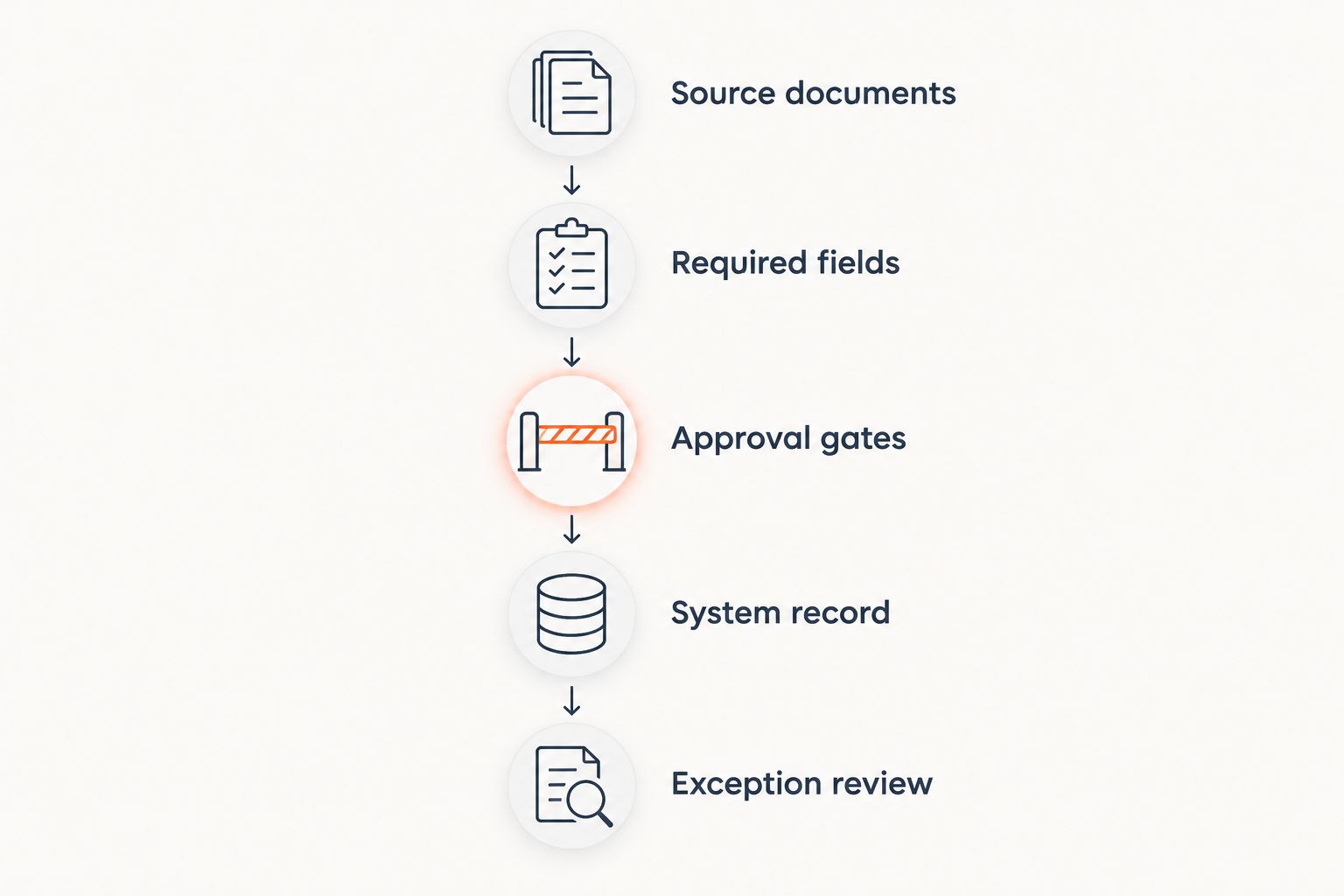
Source documents
Give each vendor the same RFQ messages, attachments, approved quotes, and order examples. Include a drawing revision mismatch and an ambiguous unit of measure among the exception cases.
Record exactly what the agent received. Otherwise, you cannot distinguish a processing error from missing source information.
Required fields
Write down the fields required before each action. For your process, that list can include customer identity, part number, material specification, revision, quantity, unit, delivery request, and approved quote reference.
A missing required field must produce a question or exception. It must not produce an invented value.
Approval gates
Separate drafting from release. Require explicit approval for actions your business considers consequential, including nonstandard terms, material changes, and commitments needing production confirmation.
Test whether an operator can stop the workflow. Confirm that the stopped transaction does not continue through another scheduled action.
System record
Inspect the destination record, not only the agent's summary. Check field values, duplicate handling, document references, and the identity associated with the change.
A correct-looking message with an incorrect order is a failed test. Preserve the evidence needed to reconstruct the action.
Exception review
Assign every failed or incomplete case to an owner. Classify whether the cause was missing information, an incorrect rule, a permissions problem, or an agent error.
Compare systems using correction time and successful completion of your required workflow. Do not reward an agent for completing a transaction it should have escalated.
Which AI sales agent should you choose?
Start with the industrial revenue operations option when quoting and order entry are the bottleneck. Start with Salesforce Agentforce or HubSpot Breeze when your defined problem stays inside the corresponding CRM workflow. Choose Microsoft Copilot Studio when custom development is a deliberate operating decision.
For a 2026 purchase, write the acceptance test before the vendor demonstration. Specify the action, source of truth, approval requirement, and failure path. Reject a proposal that substitutes generated text for the transaction you need completed.
FAQ
What's the best AI sales agent for plastics manufacturers?
Supplyco is the closest stated fit in this shortlist for industrial quoting, order entry, account management, and sales follow-up. Validate plastics-specific rules and your exact system connections in a pilot before purchase.
Is Salesforce Agentforce better than HubSpot Breeze for a plastics manufacturer?
Choose the evaluation that matches your CRM and required workflow, not a universal winner. Salesforce Agentforce belongs in a Salesforce-centered evaluation; HubSpot Breeze belongs in a HubSpot-centered evaluation. Neither CRM context alone proves manufacturing transaction accuracy.
Can an AI sales agent prepare injection molding quotes?
Require the agent to demonstrate your approved injection molding quoting process before authorizing it. Test material requirements, drawing revisions, tooling questions, and approval routing rather than accepting a generic quote demonstration.
Can an AI sales agent create orders in our ERP?
ERP order creation must be demonstrated against your particular system and transaction rules. Check field mapping, permissions, duplicate prevention, approval gates, and the resulting order record.
What should we test before buying an AI sales agent?
Test historical RFQs, repeat orders, and exception cases with known outcomes. Include missing information, revision conflicts, ambiguous units, and transactions that require human approval.
Should a plastics manufacturer build an agent with Microsoft Copilot Studio?
Build with Microsoft Copilot Studio when a named technical team owns a custom workflow and its ongoing maintenance. A prototype alone does not establish production readiness or transaction correctness.
Should an AI sales agent approve material substitutions?
Keep material substitutions behind your established technical approval process. The agent should identify the proposed change and route it to the authorized reviewer rather than treating a similar material name as approval.
One last thing
Test a request the agent must not complete. Give it an RFQ with conflicting material requirements or a purchase order referencing an outdated drawing, then inspect the escalation and destination records.
For your 2026 selection, a correct stop is as important as a correct order. Put that requirement in the acceptance criteria before you sign.