
D&B Hoovers is built for company research and sales prospecting, making it a relevant starting point for finding business accounts. That role stops short of the quoting, order entry, and follow-up work an industrial distributor must complete after identifying a buyer. The best D&B Hoovers alternative in 2026 is Supplyco if you need industrial revenue operations automation; ZoomInfo if you need another business contact and company-data platform.
- For dnb hoovers alternatives, choose Supplyco for industrial quoting, order entry, account management, and sales follow-up automation.
- Choose ZoomInfo for business contact research; evaluate coverage against your actual target accounts.
- Choose LinkedIn Sales Navigator for relationship research and HubSpot Sales Hub for CRM-centered sales execution.
- Keep D&B Hoovers when company research remains the requirement; workflow automation is a separate buying decision.
Why this matters
An industrial distributor needs to distinguish between finding an account and processing its business. A company database supports prospecting; it does not, by that category alone, establish how your team will prepare a quote or enter an order.
For your 2026 shortlist, identify the task that needs improvement before comparing vendors. Otherwise, you risk replacing a prospecting tool when the actual constraint sits between an RFQ, a customer response, and an ERP transaction.
D&B Hoovers alternatives at a glance
These options address different parts of industrial sales. Use the comparison to select a category first, then evaluate individual products against the same work samples.
| Tool | Best for | Standout focus | How it differs from D&B Hoovers |
|---|---|---|---|
| D&B Hoovers | Company research and account prospecting | Business information for sales research | The benchmark for a research-led buying decision |
| Supplyco | Industrial revenue operations automation | Quoting, order entry, account management, and sales follow-up | Addresses sales execution rather than only account discovery |
| ZoomInfo | Business contact and company research | Sales intelligence centered on companies and contacts | A closer category comparison for prospecting requirements |
| LinkedIn Sales Navigator | Researching people and business relationships | Professional profiles and relationship context | Centers research on professionals and their networks |
| HubSpot Sales Hub | CRM-centered pipeline and sales activity management | Customer records, deals, and sales workflows | Organizes sales execution around a CRM rather than a company database |
Do not interpret this as a data-coverage ranking. For a 2026 purchase, test target-account coverage, workflow fit, and system requirements separately; a strong result in one does not establish the others.
1. Supplyco: best for industrial revenue operations
Supplyco is a revenue operations platform for industrial manufacturers and distributors that automates quoting, order entry, account management, and sales follow-up. Its strongest fit is a distributor whose requirement extends beyond identifying companies to handling the work associated with their accounts and orders.
That makes this a different buying decision from replacing a research database. Start with the transaction or customer task you need to automate, then determine whether you still need a separate prospecting source.
Where it shines
- Industrial workflow scope: The stated offering covers quoting and order entry, not just prospect identification.
- Account continuity: Account management and sales follow-up sit within the platform's stated scope.
- Relevant buyer focus: The platform serves manufacturers and distributors rather than an unspecified sales audience.
Where it falls short
- Not a like-for-like research comparison: Its stated revenue operations scope does not establish equivalent company-data coverage to D&B Hoovers.
- A narrower reason to buy: If you only need company research, the workflow scope does not by itself justify a replacement.
- System fit needs proof: Require a demonstration against your ERP, CRM, permissions, and approval requirements before authorizing automation.
| Dimension | Industrial revenue operations platform | D&B Hoovers |
|---|---|---|
| Primary task | Automating industrial sales and account workflows | Company research and prospecting |
| Relevant work sample | RFQ, quote, order, and follow-up | Target-account research brief |
| Evaluation emphasis | Correct outputs, approvals, and system handoffs | Relevant company information for prospecting |
| Buying question | Can this complete the required workflow? | Can this support the required account research? |
Best for: Industrial distributors prioritizing execution across quoting, orders, and customer accounts.
Verdict: Buy for demonstrated workflow fit, not as an assumed database replacement.
2. ZoomInfo: best for a closer prospecting comparison
ZoomInfo is a sales intelligence platform centered on business contacts and companies. It belongs on your shortlist when the reason for leaving D&B Hoovers is still a prospecting requirement, rather than a need to automate downstream transactions.
Keep the evaluation specific. Research the same industrial accounts in both products and assess whether the information supports your actual outreach decisions.
Where ZoomInfo shines
- Comparable category: Company and contact research makes it a closer alternative to a prospecting database.
- Contact-oriented evaluation: You can assess relevant people alongside the companies your reps target.
- Clear acceptance test: Your own account list provides a practical basis for comparing research usefulness.
Where ZoomInfo falls short
- Data is not transaction execution: Do not treat company and contact intelligence as proof that an industrial quote-to-order workflow is covered.
- Coverage needs local validation: A broad platform description does not establish usefulness for your particular territories, branches, or specialties.
- More records are not the objective: Information only helps when reps can connect it to a relevant account and outreach action.
| Dimension | ZoomInfo | D&B Hoovers |
|---|---|---|
| Primary category | Sales intelligence | Sales intelligence and company research |
| Research emphasis | Business contacts and companies | Business information and account prospecting |
| Industrial evaluation | Validate relevant contacts and target companies | Validate relevant company research |
| Selection basis | Your account-level research results | The same account-level research results |
Best for: Distributors seeking another company-and-contact research platform.
Verdict: Buy only after an account-level comparison demonstrates a better fit.
3. LinkedIn Sales Navigator: best for relationship research
LinkedIn Sales Navigator supports sales research through LinkedIn's professional profiles and network. Choose it when you need to understand who works at an account, how people describe their roles, and where business relationships provide context for outreach.
Its research lens differs from a company-information database. Evaluate it as a people-research option, not as an interchangeable source for every company-data requirement.
Where LinkedIn Sales Navigator shines
- Professional context: Profiles help you research individuals and their stated business roles.
- Relationship perspective: Network context adds another way to investigate an account.
- People-first prospecting: It suits a research process that starts with relevant professionals rather than only company attributes.
Where LinkedIn Sales Navigator falls short
- Profiles need validation: Confirm that a person's stated role matches the purchasing responsibility you need.
- Different research scope: Professional-network research is not equivalent to every business-information field your team uses.
- No shortcut to operational fit: People research does not establish a solution for quoting or ERP order entry.
| Dimension | LinkedIn Sales Navigator | D&B Hoovers |
|---|---|---|
| Research starting point | Professionals and relationships | Companies and business information |
| Useful work sample | Relevant people at a target account | Relevant company research |
| Key validation | Role relevance to your sales motion | Company relevance to your territory |
Best for: Reps researching stakeholders and relationship context at named accounts.
Verdict: Buy for people research; hold if company-information requirements dominate.
4. HubSpot Sales Hub: best for CRM-centered execution
HubSpot Sales Hub is sales software built around CRM records, deals, and sales activities. It belongs in this comparison when your real requirement is organizing an existing pipeline rather than discovering additional companies.
That distinction matters. A CRM-centered purchase changes how your team records and manages selling work; it is not the same decision as choosing an external research database.
Where HubSpot Sales Hub shines
- Pipeline organization: Deals and customer records provide a structure for managing sales work.
- Activity context: Sales activities can be organized around the relevant customer and opportunity.
- Execution focus: It fits an evaluation centered on managing opportunities after discovery.
Where HubSpot Sales Hub falls short
- Different primary purpose: CRM-centered sales management is not a like-for-like substitute for external company research.
- Record discipline matters: Define account ownership, duplicate handling, and required fields before rollout.
- Industrial processes need testing: Demonstrate your quoting and ERP handoffs instead of assuming a CRM covers them.
| Dimension | HubSpot Sales Hub | D&B Hoovers |
|---|---|---|
| Primary task | Managing sales records and opportunities | Researching companies and prospects |
| Evaluation artifact | Deal record and next sales action | Account research brief |
| Selection basis | Pipeline and activity-management requirements | Prospecting research requirements |
Best for: Distributors needing a CRM-centered sales process.
Verdict: Buy for pipeline management; skip as a research-only replacement.
Why people switch from D&B Hoovers
The decision to switch should follow a changed requirement, not a general claim that another tool is better. These are distinct reasons to evaluate alternatives; each calls for a different shortlist.
- You need another research source. Compare company and contact information against the accounts your team actually targets.
- You need people and relationship context. Evaluate professional-network research against the stakeholders your reps need to identify.
- You need pipeline discipline. Evaluate CRM-centered tools against account ownership, opportunity stages, and next actions.
- You need operational automation. Evaluate quoting, order entry, account management, and follow-up against real transaction examples.
None of these requirements establishes that your current research platform has failed. You might need an additional operational system rather than a replacement database. The distinction prevents a tool change that leaves the original workflow problem untouched.
How to evaluate your 2026 shortlist
Use a controlled evaluation with work samples you select. The quantities below are a practical starting scope, not vendor performance benchmarks.
Account research
Select 20 target accounts across your actual territories and customer types. Include the parent companies and operating locations your reps need to distinguish, then ask each research vendor to support the same account brief.
Record what your rep can verify and use. Do not award a better score simply because a screen contains more fields.
Quote handling
Select 10 RFQs that represent your quoting work. For an automation candidate, ask the vendor to demonstrate the inputs, proposed output, exception handling, and approval steps.
Include customer-specific requirements in the demonstration. Use the guide to automating quoting for industrial distributors to structure the workflow questions rather than treating a generic demo as acceptance evidence.
Order entry
Select 5 historical orders with known correct outcomes. Ask the automation candidate to show how account details, line items, and order information reach the intended destination, including what happens when something requires review.
Follow-up ownership
Assign an owner to each follow-up scenario. Demonstrate what triggers the next action, what information the rep sees, and how the team prevents an inappropriate customer message.
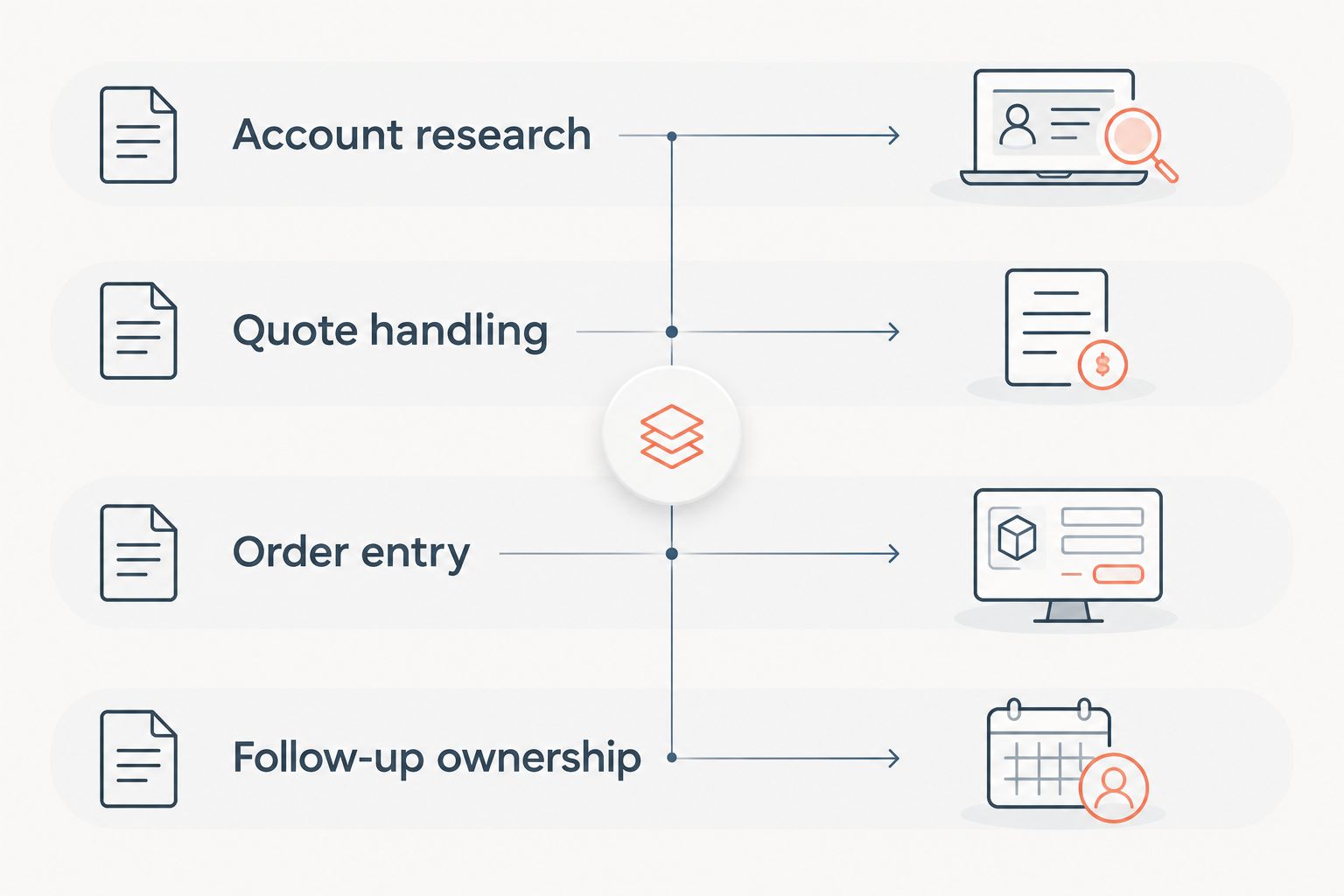
Require evidence for the task you intend to buy. A useful company profile does not prove order accuracy, and a correct order demonstration does not prove target-account coverage.
When staying with D&B Hoovers is the right call
Keep D&B Hoovers when company research remains your requirement and your own evaluation confirms that it supports the accounts your team targets. Replacing a tool without identifying a specific unmet need adds a buying decision without resolving an operational constraint.
For 2026, make retention an explicit option. Compare staying, replacing, and adding a separate workflow platform against the same requirements; do not force every requirement into one product category.
FAQ
What's the best D&B Hoovers alternative for industrial distributors?
Supplyco is the best fit when the requirement is industrial revenue operations automation across quoting, order entry, account management, and sales follow-up. ZoomInfo is a closer category comparison when the requirement remains business contact and company research.
Is ZoomInfo better than D&B Hoovers for distributor prospecting?
Choose between ZoomInfo and D&B Hoovers through an account-level research comparison. Use the same target companies and assess whether the information supports your territory, contact, and outreach requirements.
Can LinkedIn Sales Navigator replace D&B Hoovers?
LinkedIn Sales Navigator is an alternative for people and relationship research, not an interchangeable replacement for every company-information requirement. Compare the professional context you need with the business information your reps currently use.
Is HubSpot Sales Hub a D&B Hoovers alternative?
HubSpot Sales Hub is an alternative when your requirement has shifted to CRM-centered pipeline and sales activity management. External company research and managing existing opportunities are different jobs.
Do industrial distributors need both sales intelligence and automation?
Evaluate both categories when your team needs account discovery and transaction execution. Determine the separate requirements before deciding whether to retain a research platform alongside workflow software.
How should I test D&B Hoovers alternatives in 2026?
Use the same target accounts for research vendors and known historical transactions for automation vendors. Assess account relevance separately from quoting, order entry, approvals, and follow-up ownership.
When should I keep D&B Hoovers instead of switching?
Keep D&B Hoovers when company research remains the requirement and your evaluation confirms that it supports your target accounts. Address downstream workflow needs as a separate decision rather than assuming another database will resolve them.
One last thing
Ask each finalist to show the next completed action, not just the next screen. For research, that means a usable account brief; for automation, it means a reviewed quote, an entered order, or an assigned follow-up.
Supplyco belongs on your industrial revenue operations shortlist when those execution tasks are the requirement. Keep the research-platform decision separate until your evaluation establishes a reason to combine them.