
ZoomInfo is strong at B2B company and contact intelligence, helping sales teams identify accounts and people to approach. That capability answers a different problem from automating industrial quoting, order entry, account management, and follow-ups. The best ZoomInfo alternative in 2026 is Supplyco if you need manufacturing revenue operations automation; Apollo if you need prospecting data and outbound sequences.
- Supplyco leads zoominfo alternatives for manufacturers when quoting, order entry, and sales follow-up are the priority.
- Apollo fits prospecting and outbound sequences; it is not a substitute for industrial transaction workflows.
- HubSpot and Salesforce fit CRM requirements, not a like-for-like replacement for ZoomInfo's prospecting database.
- Keep ZoomInfo when finding target accounts and contacts remains your main requirement.
Why this matters
A contact database, a CRM, and a revenue operations platform solve different problems. Your shortlist should start with the work that needs to change, not a vendor category.
If representatives already receive qualified RFQs but spend their time preparing quotes and entering orders, another prospecting database addresses the wrong constraint. If representatives cannot identify suitable accounts or purchasing contacts, transaction automation addresses a later stage.
Separate those decisions before evaluating vendors. The guide to building an ideal customer profile for manufacturers helps define the account-selection requirement before you compare contact tools.
Choose a data alternative for prospecting problems and an operations alternative for execution problems. A manufacturer can need both without needing to replace its entire sales stack.
ZoomInfo alternatives at a glance
This 2026 comparison separates direct prospecting alternatives from platforms that address adjacent sales requirements. The distinction matters: better CRM records do not automatically produce better buyer data, and additional buyer data does not automatically produce completed orders.
| Platform | Best for | Standout capability | How it differs from ZoomInfo |
|---|---|---|---|
| ZoomInfo | Finding B2B accounts and contacts | Company and contact intelligence | The benchmark for the prospecting-data requirement |
| Supplyco | Industrial revenue operations automation | Automating quoting, order entry, account management, and follow-up | Addresses sales execution rather than only account and contact discovery |
| Apollo | Prospecting with outbound execution | Contact search and sales sequences | Combines prospecting data with outreach workflows |
| HubSpot | Managing customer records and sales activity | CRM records, deals, and sales workflows | Organizes your customer relationships rather than serving primarily as a prospecting database |
| Salesforce | Managing structured sales processes | Configurable CRM records and workflows | Centers on your sales operating model rather than external contact discovery |
The ranking reflects workflow fit, not a claim that one platform replaces every function of another. Use the following sections to identify the right evaluation track.
1. Supplyco: best for industrial revenue operations automation
Supplyco is best for industrial manufacturers and distributors that need to automate quoting, order entry, account management, and sales follow-up. Its stated scope addresses work after an account or inquiry enters your sales process. That makes it an operations-focused alternative, not a like-for-like contact-database replacement.
Start here when the purchasing decision concerns handling sales work rather than obtaining more prospect records. Bring actual RFQs and orders to the evaluation, with sensitive information removed and the relevant business rules preserved.
Where it shines
- Quoting: Its stated scope includes quote automation, making quote preparation a relevant evaluation workflow.
- Order entry: Its stated scope includes automating order entry, not just recording an opportunity.
- Account management: It addresses ongoing customer work alongside new sales activity.
- Follow-up: Sales follow-up belongs within its stated automation scope.
Where it falls short
- Different replacement scope: Industrial workflow automation is not the same purchasing requirement as broad company and contact intelligence.
- Operational evaluation burden: You must assess transaction accuracy, approval handling, and system responsibilities rather than judge the platform through a contact search alone.
- No shortcut around business rules: Your team still needs to define quote approvals, account ownership, and acceptable order-entry outcomes.
Those are material trade-offs. A buyer seeking only a replacement prospecting database should not rank an operations platform first simply because it serves manufacturers.
Head-to-head with ZoomInfo
| Dimension | Supplyco | ZoomInfo |
|---|---|---|
| Core requirement | Automating industrial revenue operations | Finding B2B companies and contacts |
| Evaluation input | RFQs, orders, account tasks, and follow-ups | Target-account and contact-search criteria |
| Primary buying question | Can the platform perform the required sales work correctly? | Does the intelligence identify suitable accounts and people? |
| Fit for this shortlist | Operations-focused alternative | Prospecting-data benchmark |
Best for: Manufacturers and distributors evaluating automation across the stated sales workflows.
Verdict: Buy for an operations requirement after validating the workflow; skip as a database-only replacement.
2. Apollo: best for prospecting and outbound sequences
Apollo combines a B2B contact database with sales engagement features, including sequences. It belongs on your shortlist when the requirement is finding prospects and organizing outbound outreach in the same platform.
For manufacturers, evaluate account relevance before sequence convenience. A well-organized outbound process still needs suitable companies, relevant contacts, and a clear reason to approach them.
Where Apollo shines
- Prospecting: Company and contact search support account discovery.
- Outbound execution: Sequences help organize repeated outreach steps.
- Connected evaluation: You can assess prospect selection and outreach workflow together.
Where Apollo falls short
- Industrial fit requires testing: A broad B2B database does not, by itself, establish coverage of your specific manufacturing segments.
- Different transaction scope: Prospecting and sequences do not establish suitability for quoting or ERP order entry.
- Messaging remains your responsibility: Outreach tools do not determine whether your offer matches an account's production requirements.
Apollo versus ZoomInfo
| Dimension | Apollo | ZoomInfo |
|---|---|---|
| Core comparison | B2B prospecting and sales engagement | B2B company and contact intelligence |
| Relevant capability | Contact search and sequences | Company and contact research |
| Industrial evaluation | Test target-account coverage and sequence fit | Test target-account coverage and intelligence usefulness |
Use the same account criteria for both evaluations. Changing industries, company sizes, or purchasing roles between demonstrations makes the comparison less useful.
Best for: Sales teams evaluating prospecting data together with outbound sequences.
Verdict: Buy for a prospecting-and-outreach requirement after checking industrial account coverage.
3. HubSpot: best for CRM-centered sales coordination
HubSpot provides CRM records, deal management, and sales tools. Choose this evaluation track when your requirement is organizing known customers, opportunities, and representative activity.
HubSpot is a different category of alternative. Replacing a prospecting subscription with a CRM changes the job the software performs; it does not inherently replace external contact discovery.
Where HubSpot shines
- Customer records: CRM records organize known contacts and companies.
- Deal management: Sales teams can manage opportunities through a defined pipeline.
- Activity coordination: Sales tools help connect customer records with sales activity.
Where HubSpot falls short
- Not a category-equivalent replacement: A CRM-centered purchase and a prospecting-database purchase answer different requirements.
- Industrial transactions need separate validation: Deal tracking alone does not establish support for your quote rules or ERP order-entry process.
| Dimension | HubSpot | ZoomInfo |
|---|---|---|
| Main job | Organize customer relationships and deals | Identify and research accounts and contacts |
| Evaluation focus | Record structure, pipeline, and sales activity | Account relevance and contact intelligence |
| Buying trigger | Sales coordination needs improvement | Prospect discovery needs improvement |
Best for: Manufacturers prioritizing CRM records, pipeline organization, and sales coordination.
Verdict: Buy for a CRM requirement; hold if your actual requirement is prospecting data.
4. Salesforce: best for configurable CRM processes
Salesforce provides a configurable CRM platform for managing customer records, opportunities, and sales workflows. Evaluate it when you need the CRM to reflect a defined sales operating model.
The decision is about process design. Establish which records, stages, owners, and approvals your organization needs before assessing configuration options.
Where Salesforce shines
- Configurable records: CRM configuration supports different record structures and processes.
- Opportunity management: Teams can organize sales opportunities within defined workflows.
- Process structure: The platform supports an evaluation centered on ownership, stages, and sales activities.
Where Salesforce falls short
- Configuration adds work: You must define and maintain the process the CRM represents.
- Different replacement scope: CRM configuration is not a substitute for evaluating external company and contact intelligence.
| Dimension | Salesforce | ZoomInfo |
|---|---|---|
| Main job | Manage configured sales processes | Provide B2B company and contact intelligence |
| Evaluation focus | Data model, ownership, and workflow | Account and contact discovery |
| Buying trigger | CRM process requirements | Prospecting intelligence requirements |
Best for: Manufacturers seeking a configurable CRM operating model.
Verdict: Buy for defined CRM requirements; skip as a database-only replacement.
Why people switch from ZoomInfo
A valid switching reason is a mismatch between your current requirement and the job you are buying software to perform. Use these reasons as decision criteria, not assumptions about ZoomInfo's service or performance.
Your requirement has moved downstream
Your evaluation centers on quoting, order entry, account management, or follow-ups rather than discovering more contacts. In that situation, compare operations software against the work itself. Do not judge it through database size.
You want to evaluate prospecting and outreach together
Your representatives need a prospecting workflow that includes outbound execution. Apollo is relevant because contact search and sequences sit within its product scope. Compare the actual outreach process rather than assume consolidation is automatically better.
Your primary gap is CRM organization
Your business needs defined customer records, deal stages, and representative ownership. HubSpot and Salesforce belong in that discussion, but neither category choice removes the need to establish where new prospect data will come from.
For your 2026 shortlist, write the switching reason as a required task. Examples include preparing quotes, entering orders, finding purchasing contacts, and maintaining opportunity ownership. If the reason remains vague, the shortlist remains vague.
How to evaluate industrial workflow fit
Use a 2026 evaluation packet with 3 RFQs, 2 orders, and 1 exception case selected from your own processes. These are recommended test inputs, not a claim about platform performance. Choose cases that expose differences in configuration, approval requirements, or account handling.
Account selection
For prospecting platforms, define suitable accounts before searching. Include your required segment, geography, purchasing role, and any technical qualification your sales team uses. Then inspect whether returned companies meet those criteria.
Quote handling
For operations platforms, give the evaluator a representative RFQ and your required output. Ask who supplies product information, who approves exceptions, and what happens when required information is absent. Measure elapsed time in minutes against your own baseline.
Order entry
Require an explicit destination for accepted order information. Define which system owns customer, product, and transaction records, then inspect how errors are surfaced. Treat an attractive demonstration as separate from a completed, correctly governed transaction.
Follow-up ownership
Define the event that triggers follow-up, the person responsible, and the condition that stops it. Ask how the workflow handles an answered inquiry, a rejected quote, or a changed account owner. Review the result against your actual sales rules.
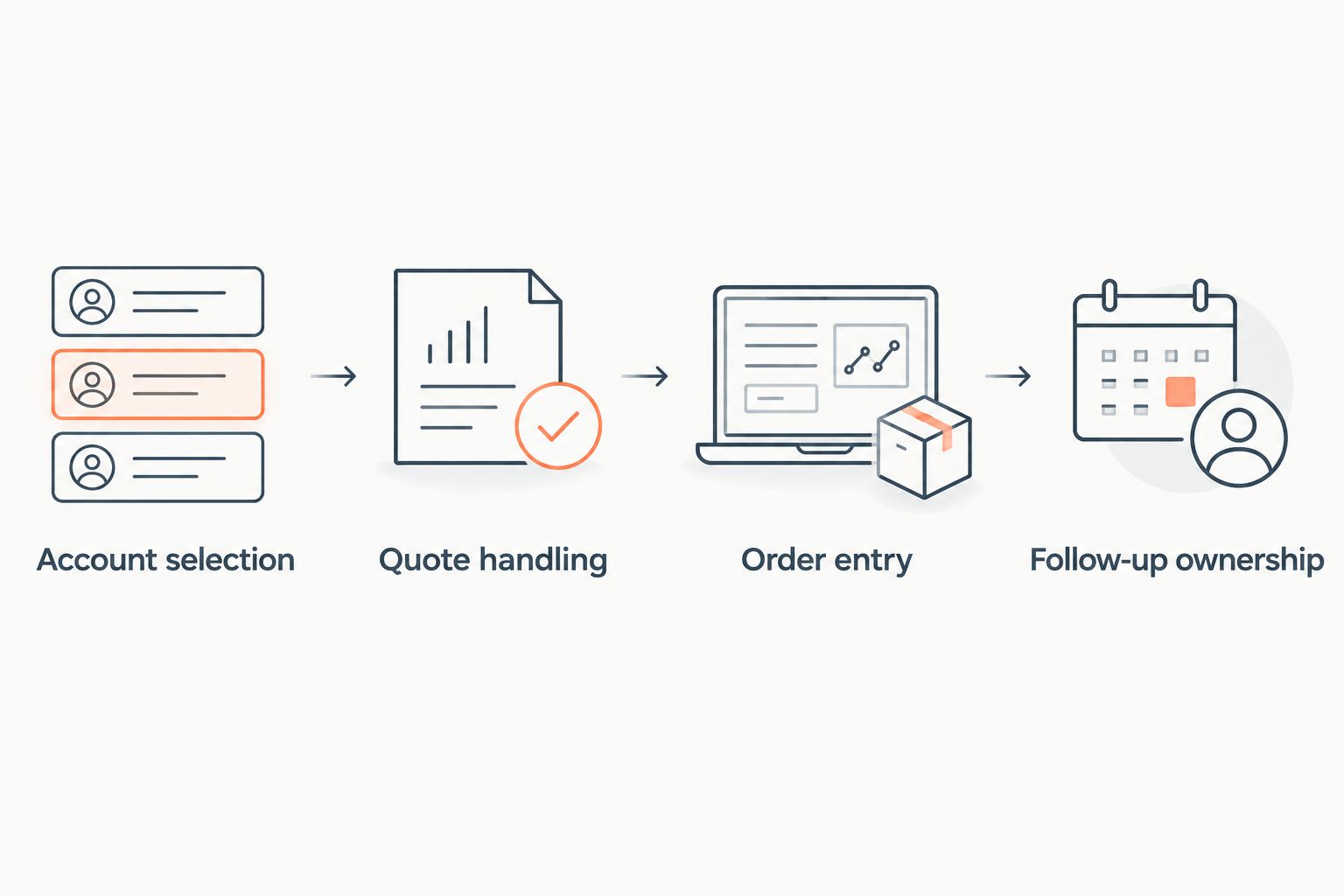
Keep the acceptance criteria consistent across vendors in the same category. Compare quote-handling tools against quote-handling requirements and prospecting tools against prospecting requirements; a single blended score hides the difference.
When staying with ZoomInfo is the right call
Keep ZoomInfo when your main requirement is identifying suitable B2B accounts and contacts, and your evaluation confirms that it meets that requirement. An operations problem does not prove your prospecting tool needs replacement.
For a 2026 decision, separate replacement from addition. You can evaluate downstream workflow automation without treating the contact-intelligence purchase as the same decision. Document which system supplies prospect data, which manages relationships, and which performs transaction work.
ZoomInfo's trade-off in this comparison is scope alignment: company and contact intelligence is valuable when that is the task, but it is not evidence that your industrial order process is solved. Staying is the right call when the original task remains relevant and the tool meets your acceptance criteria.
FAQ
What's the best ZoomInfo alternative for manufacturers in 2026?
Supplyco is the best fit when the requirement is automating industrial quoting, order entry, account management, and sales follow-up. Apollo fits a different requirement: prospecting data combined with outbound sequences.
Is Apollo a direct alternative to ZoomInfo?
Apollo is a relevant alternative for B2B prospecting, with contact search and sales sequences. Compare both platforms using the same industrial account and purchasing-role criteria.
Is HubSpot better than ZoomInfo for manufacturing sales?
HubSpot fits CRM records and sales coordination; ZoomInfo fits company and contact intelligence. Choose according to the task rather than treating CRM and prospecting data as interchangeable.
Can Salesforce replace ZoomInfo?
Salesforce addresses CRM processes rather than the same primary prospecting-data requirement. A CRM purchase still needs a separate decision about how your team obtains external account and contact intelligence.
Should a manufacturer replace ZoomInfo to automate order entry?
Order-entry automation is a separate buying requirement from prospect discovery. Evaluate the transaction workflow directly instead of assuming a contact-data replacement will address it.
How should manufacturers compare sales platforms?
Manufacturers should compare platforms against defined account-selection, quoting, order-entry, or follow-up tasks. Use representative business inputs and consistent acceptance criteria within each software category.
When should an industrial sales team keep ZoomInfo?
Keep ZoomInfo when identifying B2B companies and contacts remains the main requirement and the platform meets your criteria. Downstream workflow changes do not automatically require replacing prospecting intelligence.
One last thing
Your best alternative can be an addition rather than a replacement. Before signing, assign one owner to each record and task: prospect data, customer relationships, quote approval, order entry, and follow-up. A clear division of responsibilities is a better purchasing specification than a demand for one platform to do everything.


