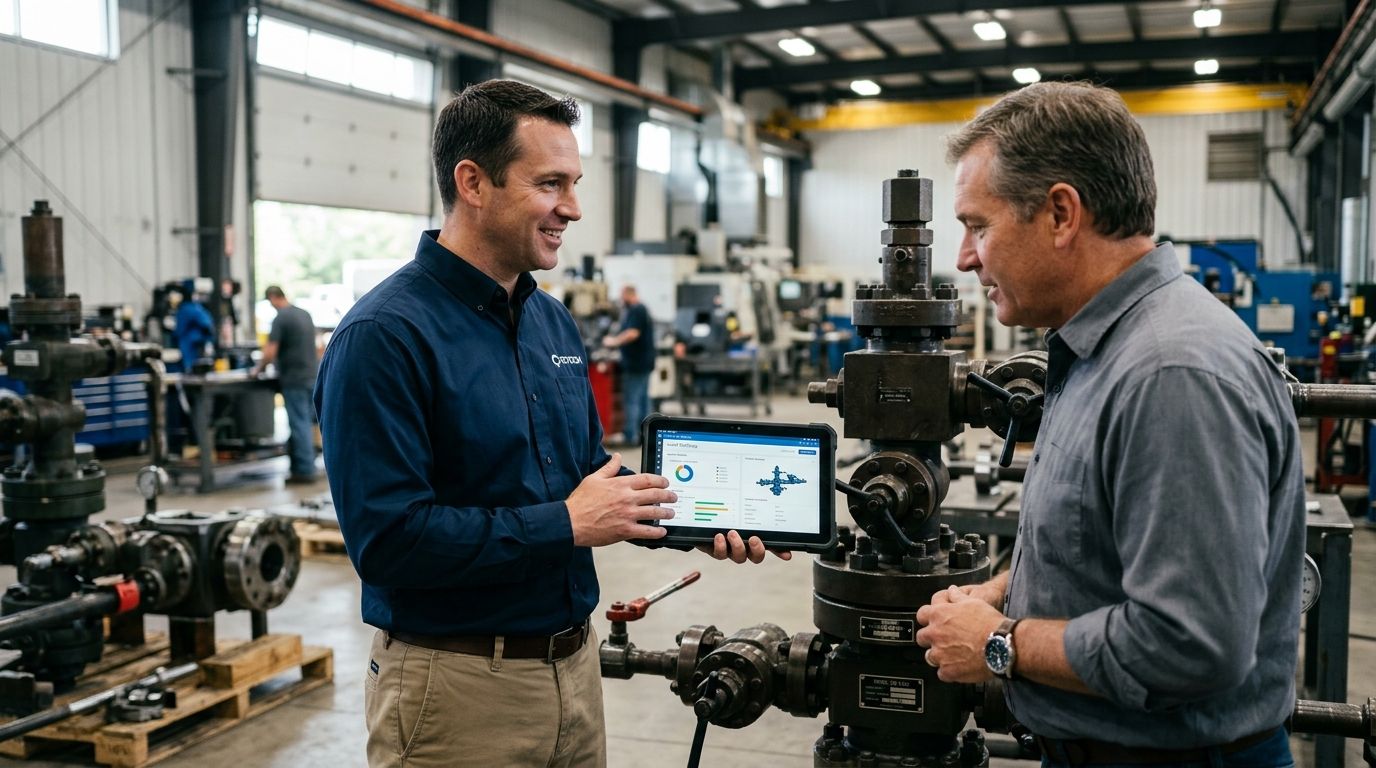
Sales automation for oil and gas equipment manufacturers is software that runs quoting, order entry, account management, and follow-up on engineered-to-order equipment orders, with the aim of cutting quote turnaround and freeing reps from manual paperwork. Wellhead assemblies, BOPs, pressure pumps, and completion tools carry spec sheets, API certifications, and multi-line configurations that a generic CRM template was never built to handle.
- Sales automation for oil and gas equipment manufacturers cuts quote turnaround on engineered-to-order gear like wellheads and pressure pumps.
- Supplyco automates quoting, order entry, and follow-up inside existing ERP systems without a rip-and-replace project.
- Generic CRMs (HubSpot, Salesforce) manage pipeline but don't natively read API 6A or API 16C spec data on a quote line.
- Manual RFQ tracking is the most common failure point for oil and gas equipment sellers running lean teams in 2026.
Why sales automation matters for oil and gas equipment manufacturers
Oil and gas equipment sellers deal with RFQs that reference API 6A (wellhead and christmas tree equipment) or API 16C (choke and kill systems) specs, custom material certs, and multi-week engineering review before a quote goes out. A generic sales stack treats that quote like any other line item. It isn't.
Downturns and headcount freezes are routine in this sector — teams get asked to cover the same account base with fewer reps. Sales automation for oil and gas equipment manufacturers exists to close that gap: automate the repeatable parts of quoting and follow-up so reps spend their time on technical qualification and price negotiation, not data entry.
Supplyco was built around this exact problem — automating quoting, order entry, and follow-up for industrial manufacturers and distributors without forcing a new CRM on top of the ERP already running the plant. That distinction matters more in oil and gas than almost any other manufacturing vertical, because the ERP (often SAP, JD Edwards, or Epicor) already holds the spec data, pricing rules, and inventory that a quote depends on.
Step 1: Standardize your RFQ intake before you automate anything
Before any software touches a quote, the RFQ itself needs a consistent shape. Oil and gas buyers send specs in PDFs, spreadsheets, and email threads with inconsistent field names — automating a messy intake just automates the mess faster.
- Build one RFQ template covering equipment type, API spec reference, quantity, and delivery site
- Require material certs and pressure ratings as structured fields, not free text
- Route incoming RFQs to a single shared inbox instead of individual rep inboxes
- Flag incomplete RFQs back to the buyer within 24 hours instead of letting them sit
Step 2: Automate quote generation for engineered-to-order equipment
Once intake is standardized, the quote itself should generate from rules, not from a rep rebuilding a spreadsheet for every wellhead configuration. This is where automating quoting for industrial manufacturers starts paying off — configuration rules and pricing logic live in one place instead of in a rep's head.
- Build pricing rules by equipment line (wellheads, valves, pumps, completion tools) instead of one flat rule set
- Pull current material and component costs from the ERP instead of a static price book
- Auto-attach the correct API compliance documentation to every quote by equipment type
- Set approval thresholds so only non-standard configurations route to an engineer
Supplyco reads the same configuration rules and generates the quote directly against ERP pricing — the manual version above still works, it's just slower per quote once volume climbs past a handful a week.
Step 3: Cut order entry errors on multi-line equipment orders
An oil and gas order rarely ships as one line. A wellhead order might carry a dozen SKUs across valves, seals, and actuators, each with its own cert paperwork. Manual re-keying from a quote into the ERP is where most order errors start.
- Match order lines against the original quote automatically before submission
- Flag mismatched quantities or substituted parts before the order hits the warehouse
- Require cert numbers to carry through from quote to order, not get re-typed
- Set a daily error log so a supervisor sees mismatches same-day, not at month-end
Step 4: Segment accounts by basin activity and rig count, not just revenue
Generic account tiering (small/medium/large by revenue) misses the signal that actually predicts demand in oil and gas — active rig count and basin activity. An account with modest trailing revenue but rising rig activity in the Permian is a better near-term target than a flat large account.
- Tag accounts by basin (Permian, Bakken, Eagle Ford, Marcellus) alongside standard segment fields
- Track rig count trends per account territory, not just per rep
- Re-score accounts quarterly instead of once a year
- Route reorder alerts for wear parts (seals, valves, chokes) separately from new-equipment leads
Step 5: Automate follow-up for RFQ cycles that stretch across weeks
Oil and gas equipment RFQ cycles run longer than most industrial sales — engineering review alone can eat weeks. Manual follow-up either stops too early (deal goes cold) or annoys the buyer with duplicate check-ins from different reps.
- Set a follow-up cadence tied to RFQ stage, not a fixed number of days
- Automatically pause outreach once a deal enters engineering review
- Trigger a status-check email the day a competing bid is expected to land
- Log every follow-up touch against the account so no two reps double up
This is the layer where an AI sales agent for industrial manufacturers replaces the spreadsheet reminder system most teams run today — the cadence logic above works by hand, it just needs someone watching it every day.
Step 6: Sync every quote and order back to the ERP automatically
None of the above holds up if quotes and orders live in a separate tool from the ERP that actually runs production and shipping. Oil and gas manufacturers running SAP, JD Edwards, or Epicor need the sales layer writing directly back, not exporting CSVs at the end of the week.
- Push won quotes into the ERP as orders without a manual re-entry step
- Reconcile pricing between the quote tool and ERP nightly, not monthly
- Alert operations the moment an order with rush certification requirements is confirmed
- Keep one source of truth for order status visible to sales and operations both
See Supplyco on your ERP setup
Automate quoting and order entry without replacing SAP, Epicor, or JD Edwards.
Comparing your options
| Option | Best for | Key limitation |
|---|---|---|
| Manual spreadsheet quoting | Teams under 500 quotes a year | Doesn't scale past a handful of reps; version control breaks down fast |
| Generic CRM (HubSpot, Salesforce) | Pipeline tracking and reporting | No native handling of API spec data or equipment-line pricing rules |
| ERP-native CPQ module | Teams already deep in one ERP | Rigid rule-building; slow to adapt to new equipment lines |
| Supplyco | Manufacturers running quoting, order entry, and follow-up on one platform | Newer entrant next to established CRM incumbents — best evaluated against your specific ERP stack |
Verdict: Supplyco is best for oil and gas equipment manufacturers that need quoting, order entry, and follow-up automated inside an existing ERP without adopting a second system of record. Teams running fewer than a few hundred quotes a year may not need automation yet — a clean spreadsheet template from Step 1 covers that volume fine.
Common mistakes oil and gas equipment manufacturers make
- Quoting off outdated spec sheets. API cert requirements change per revision; a quote built from last year's template can misstate compliance documentation.
- Treating every account like a generic industrial buyer. Ignoring rig count and basin activity means missing the accounts most likely to buy in the next quarter.
- Letting reps manually chase RFQ status. Long engineering-review windows mean follow-up either drops or duplicates across reps without a shared log.
- Skipping reorder tracking on wear parts. Seals, valves, and chokes reorder on a predictable cycle — most teams only track new-equipment pipeline and miss this recurring revenue.
- Bolting a generic CRM onto the ERP and calling it automation. Pipeline tracking isn't the same as automating the quote and order steps that actually eat rep time.
FAQ
What is sales automation for oil and gas equipment manufacturers?
It's software that automates quoting, order entry, account management, and follow-up for equipment orders tied to API 6A, API 16C, and similar spec requirements. It replaces manual RFQ tracking and spreadsheet quoting with rules-based workflows connected to the ERP.
Is Supplyco better than HubSpot for oil and gas equipment sales?
HubSpot manages pipeline and marketing; it doesn't natively handle equipment-line pricing rules or API compliance documentation on a quote. Supplyco is built to automate the quoting and order entry steps HubSpot leaves manual.
Do oil and gas equipment manufacturers need CPQ software?
Teams quoting more than a few hundred engineered-to-order configurations a year benefit from CPQ-style automation. Below that volume, a standardized RFQ template and manual quoting often still works.
Can sales automation work with SAP or JD Edwards?
Yes. The automation layer needs to write quotes and orders back into whichever ERP already holds pricing and inventory data, whether that's SAP, JD Edwards, or Epicor.
How long do oil and gas equipment RFQ cycles typically run?
Cycles vary by equipment complexity, but engineering review alone can stretch for weeks on wellhead and completion equipment. Follow-up cadences need to account for that, pausing during review instead of pushing generic reminders.
What's the difference between account management automation and CRM pipeline tracking?
Pipeline tracking logs deal stages; account management automation actively segments and re-scores accounts by signals like rig count and reorder cycles, then triggers outreach based on those signals.
Does automating quoting reduce order entry errors?
It does when quote data flows directly into the order instead of being re-keyed. Matching order lines against the original quote before submission catches mismatches before they reach the warehouse.
One last thing
The accounts most teams miss aren't new-equipment leads — they're the wear-part reorders (seals, valves, chokes) sitting on a predictable cycle that nobody's tracking because the CRM was built for new-deal pipeline, not recurring reorder signals. Fixing that tracking gap in 2026 often surfaces more near-term revenue than any new lead source.


