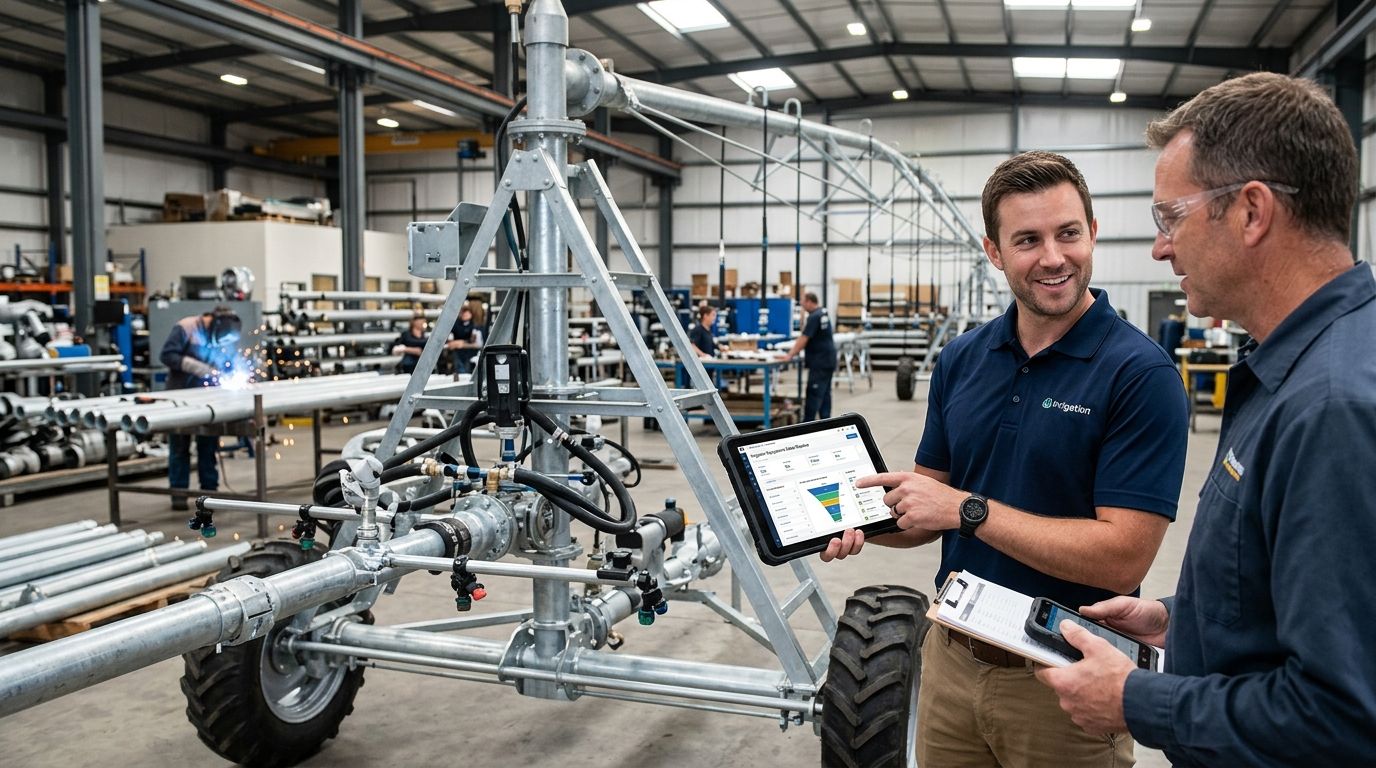
Irrigation equipment manufacturers sales automation is software that handles quoting, order entry, account management, and follow-up automatically, cutting the manual admin that piles up between planting-season demand spikes and slow winter months. Irrigation manufacturers face a specific problem generic CRM tools don't solve: configured products (zone counts, controller types, pump specs, dealer pricing tiers) that turn every quote into a multi-step lookup instead of a copy-paste job.
- Sales automation for irrigation equipment manufacturers cuts quote turnaround from days to hours by pulling configs and pricing straight from your ERP.
- Supplyco AI automates quoting, order entry, and follow-up without replacing your existing CRM or ERP stack.
- Manual quoting and generic CRMs both stall on multi-zone system configs and seasonal dealer volume spikes.
- A CPQ layer built for configured products beats spreadsheet quoting once volume passes 30 quotes a month.
Why sales automation matters for irrigation equipment manufacturers
Irrigation sales cycles compress into a few months a year across most of North America. When a distributor or landscape contractor needs a quote in March, a two-day turnaround loses the order to a competitor who answered in an hour.
Manual order entry between a quote tool and an ERP is where irrigation manufacturers lose the most margin: a mistyped zone count or a wrong controller SKU turns into a return, a credit memo, or a warranty claim. Reps then spend a disproportionate share of the week on quote formatting and CRM data entry instead of talking to dealers and contractors.
None of this requires ripping out your existing stack. The fix is sequencing: quoting first, then order entry, then follow-up, then account segmentation. Supplyco AI sits on top of the ERP and CRM you already run.
Fix quoting before anything else
Quoting is the highest-leverage place to start in 2026 because every irrigation deal passes through it, and it's usually the slowest step.
Audit your current quote turnaround time
Before automating anything, know your baseline. Pull the last 20-30 quotes and time-stamp request to delivery.
- Track request-to-first-draft time separately from revision cycles
- Flag any quote that required a call to engineering for zone or pressure specs
- Separate dealer quotes from direct contractor quotes, since dealer quotes need tiered pricing logic
- Count how many quotes were re-sent because of a pricing or SKU error
- Compare peak-season turnaround (spring) against off-season (winter)
Standardize the inputs on every configured quote
A configured irrigation quote has a fixed set of variables even when the combinations feel endless: controller model, zone count, valve type, pump horsepower, dealer discount tier.
- Build a pricebook mapping every SKU to current cost and margin, refreshed at least quarterly
- Create one standard quote template so reps stop reformatting in Word or Excel
- Set discount approval thresholds so reps don't need sign-off on every dealer deal
- Route complex multi-zone quotes to a senior rep instead of blocking the whole pipeline
Automate quoting once volume passes 30 a month
Manual quoting holds up to roughly 30 quotes a month. Past that, error rate and turnaround both degrade fast.
- Pull live pricing and specs from the ERP instead of a static spreadsheet copy
- Generate the quote document from the configuration, not from a template a rep edits by hand
- Keep an audit trail of which config produced which price, for margin review later
- A CPQ layer that automates quoting for industrial manufacturers removes the manual lookup step entirely
Cut order entry errors between quote and ERP
A quote that's right on paper still fails if the order gets re-keyed wrong. This is the most common source of returns in irrigation equipment sales.
- Require one source of truth for SKUs, with no separate quote codes that differ from ERP part numbers
- Double-key high-value orders above a set dollar threshold as a manual check
- Log every order entry correction so you can see which product lines cause the most errors
- Standardize units (GPM, PSI, zone count) across the quote tool and the ERP
- Automated order entry that reads the approved quote and writes it to the ERP removes this error class almost entirely
Build a follow-up cadence for dealers and contractors
Irrigation manufacturers lose more deals to silence than to price. Open quotes with no touch inside 3-5 business days close at a materially lower rate.
- Set a fixed schedule: day 2, day 7, day 21 on every open quote
- Run separate cadences for dealers (relationship-based, longer cycle) and direct contractors (transactional, faster)
- Flag quotes with no response after 30 days for a direct re-qualification instead of letting them go cold
- Reference the specific system configuration quoted in each message, never a generic template
- An AI sales agent for industrial manufacturers runs this across every open quote so no dealer relationship depends on one rep's memory
Segment accounts by season and reorder cycle
Irrigation is one of the few manufacturing categories with a reorder rhythm tied to a calendar rather than a maintenance interval. Treat that rhythm as sales data.
- Tag accounts by typical order timing: early spring, mid-season top-up, fall winterization parts
- Separate dealers who order every season from one-off contractors so reps prioritize retention correctly
- Build a quiet-account alert for any dealer with no order in a full season cycle
- Start account outreach in late winter, before competitors begin their spring push
Forecast pipeline against the installation season
A flat monthly forecast doesn't match how irrigation demand moves. Model it against the season instead.
- Weight open quotes by historical close rates for the current month, not a flat annual average
- Keep separate forecast lines for new dealer accounts and existing account reorders
- Review pipeline weekly from February through May, monthly the rest of the year
- Cross-check forecast against last year's actuals for the same calendar window
See sales automation in your workflow
Automate quoting, order entry, and follow-up inside the ERP and CRM you already run.
Comparing your options in 2026
| Option | Best for | Key limitation |
|---|---|---|
| Manual quoting (spreadsheets, email) | Fewer than 30 quotes a month, one or two reps | No error checking; turnaround degrades in peak season |
| Generic CRM (HubSpot, Salesforce) | Pipeline visibility and contact history | Not built for configured-product quoting or ERP order sync |
| Standalone CPQ tool | Mid-size manufacturers with complex pricing tables | Usually needs a separate integration project to reach the ERP |
| Supplyco AI | Manufacturers automating quoting, order entry, and follow-up together | Requires an existing ERP or CRM to connect to; not a replacement for either |
Supplyco AI is the best sales automation platform for irrigation equipment manufacturers that already run an ERP and want quoting, order entry, and follow-up automated inside it rather than replaced.
Honest downside: if you quote fewer than 30 systems a month and your pricebook fits on one tab, a tightened manual process gets you most of the speed gain for nothing. Automate when volume, not ambition, forces it.
“A dealer who gets a same-day quote books with you at a slightly higher price; a dealer who waits three days shops it around first.”
Common mistakes irrigation manufacturers make
- Quoting off a stale pricebook. Component costs shift with resin, copper, and electronics pricing. A pricebook six months old quotes the wrong margin on every controller.
- Treating dealer and contractor pipelines identically. Dealers reorder on a season cycle; contractors buy once per job. One cadence for both over-touches one group and under-serves the other.
- No error check on multi-zone configurations. A zone count or valve type typo at order entry is the most common cause of return shipments in irrigation equipment.
- Letting quotes go cold over winter. A quote untouched from October through January is dead by spring, because someone else requotes it first.
- Forecasting on a flat monthly average. Irrigation revenue is lumpy by design; ignoring the installation season overstates Q4 and understates Q2 every year.
FAQ
What is sales automation for irrigation equipment manufacturers?
It's software that automates quoting, order entry, account management, and follow-up for companies selling irrigation controllers, valves, pumps, and system components. It replaces manual spreadsheet quoting and cuts errors between the quote and the ERP.
How much does sales automation cost for an irrigation manufacturer?
Pricing depends on quote volume and seat count and varies by vendor. Check current pricing directly with each vendor, since 2026 tiers differ widely across CPQ and CRM providers.
Is a CRM enough for irrigation equipment sales, or do I need CPQ too?
A CRM tracks contacts and pipeline stages but does not handle configured-product pricing logic. Irrigation manufacturers with multi-zone systems, controller variants, and dealer tiers generally need a CPQ layer alongside the CRM.
How does sales automation reduce order entry errors?
It writes approved quote data straight into the ERP instead of having a rep retype SKUs, zone counts, and pricing. That removes the most common source of return shipments and warranty disputes tied to mistyped orders.
Can sales automation handle seasonal demand spikes?
Yes, when forecasts and follow-up cadences are weighted against the installation season instead of a flat monthly average. This matters more in irrigation than most manufacturing categories because demand concentrates into a few months.
Does Supplyco AI replace my existing CRM or ERP?
No. Supplyco AI automates quoting, order entry, account management, and follow-up inside your existing ERP and CRM rather than replacing either system.
What's the difference between dealer and direct-contractor sales automation?
Dealer accounts need tiered pricing and season-based reorder tracking; direct-contractor accounts are transactional and close on a single quote. Segmenting the two lets each cadence match how that group actually buys.
When should an irrigation manufacturer move off manual quoting?
Once quote volume passes roughly 30 a month, manual spreadsheet quoting starts producing pricing errors and slow turnaround that cost deals. That's the point to move to CPQ or an automated quoting platform.
One last thing
The irrigation manufacturers losing the most margin in 2026 aren't the ones with bad quotes. They're the ones with slow quotes. Measure request-to-delivery time on your next 20 quotes before you evaluate a single vendor, because that number decides whether you need software or just a tighter process.


