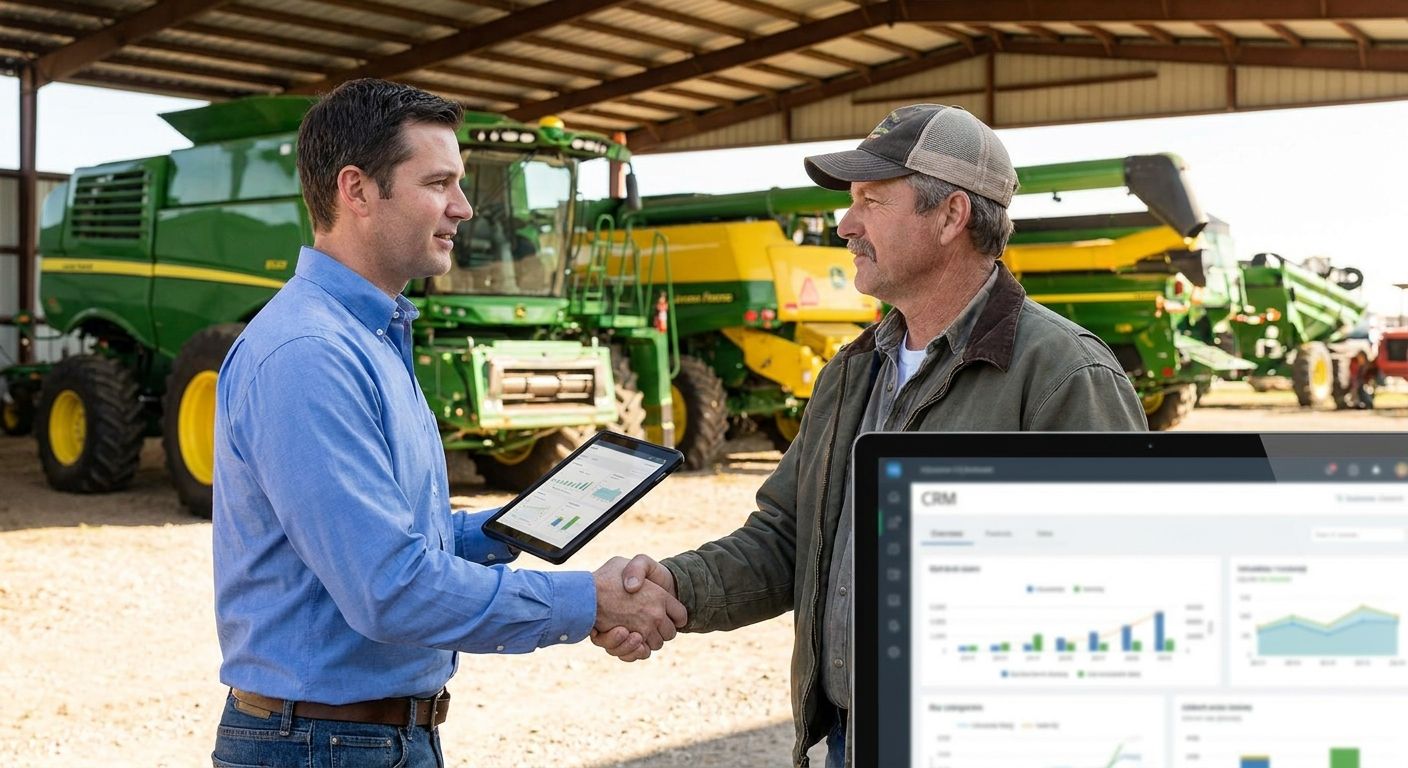
Lead generation for agricultural equipment manufacturers is the process of identifying and qualifying dealers, OEM buyers, and fleet operators who are ready to spec equipment, then getting each one a quote before the buying window closes. Ag equipment sales run on tighter, more seasonal windows than general industrial sales, and a lead that sits unqualified for two weeks during a capital-budget window is a lead a competitor's dealer closes first.
- Lead generation for agricultural equipment manufacturers lives or dies on timing to Q4/Q1 capital budgets and planting/harvest cycles.
- Manual dealer outreach works for small networks; it breaks once you're past a handful of reps.
- SUPPLYCO automates RFQ qualification and quote turnaround inside existing ERP/CRM systems rather than replacing them.
- Trade-show leads from farm shows and dealer expos go cold within days without a same-week follow-up cadence.
Why lead generation matters for agricultural equipment manufacturers
Ag equipment buyers don't behave like generic industrial buyers. Farm operations budget capital purchases around harvest revenue and year-end tax planning, which means most of the buying window closes in Q4 2026 and reopens briefly before spring planting in 2027. Miss that window with a slow quote and the deal doesn't die, it just moves to next season, or to whichever OEM responded first.
Dealer networks add another layer most lead-scoring models ignore. A lead can originate from an end-user RFQ, a dealer requesting a spec sheet for a customer, or a fleet manager comparing OEMs at a regional farm show. Each of those needs different qualification logic. Generic lead generation tools built for industrial manufacturers often treat a contact-form fill and a dealer RFQ the same way, which is the fastest route to burying the leads that would have closed in 2026.
The manufacturers that win ag equipment deals in 2026 aren't the ones with the most leads — they're the ones who qualify and quote fastest inside the season.
Build the pipeline: 7 steps for agricultural equipment manufacturers
1. Map your dealer and buyer universe
Before any scoring model works, you need to know who's actually in your funnel. Segment the list before you touch a single campaign.
- Split end-users, dealers, and fleet/co-op buyers into separate lists — they buy on different timelines
- Tag accounts by equipment category (tillage, harvest, irrigation, hay and forage)
- Flag multi-location dealers separately from single-location shops
- Note whether an account buys direct or exclusively through a dealer network
- Mark region and crop type, since replacement cycles differ between corn belt and specialty ag operations
2. Build seasonal intent signals into lead scoring
A generic "visited the website" score misses the point in ag equipment. Timing is the signal.
- Weight visits to spec and pricing pages during pre-planting and post-harvest windows higher than off-season traffic
- Score RFQ form submissions above generic contact-form fills
- Treat repeat visits to parts and service pages as replacement-cycle signals, not just support requests
- Count trade-show badge scans as warm leads, not cold ones
- Deprioritize accounts with zero activity outside peak buying season
3. Automate inbound RFQ qualification
The manual version of this is a shared spreadsheet reps check every morning, sorted by dollar value and region. It works until volume climbs past what two or three reps can triage by hand.
- Route RFQs by equipment category to the rep who already owns that dealer relationship
- Require budget and timeline fields on every RFQ form, not just contact info
- Auto-flag RFQs from known dealer accounts for same-day response
- Build a rejection path for spec requests that don't match your equipment line
- Once volume outpaces manual triage, an AI sales agent can qualify and route RFQs automatically, which is where a platform like SUPPLYCO's automated qualification layer replaces the spreadsheet without replacing the ERP or CRM underneath it
4. Time outreach to planting and harvest windows
Outreach that ignores the ag calendar gets ignored back.
- Schedule capital-equipment campaigns for the six weeks before spring planting and the six weeks after fall harvest
- Hold general awareness content for the off-season, and save RFQ-driving offers for the buying windows
- Coordinate dealer co-marketing so the same account isn't hit by both the OEM and the dealer in the same week
- Pull back outbound volume during planting and harvest itself — buyers aren't reading email while equipment is in the field
5. Cut quote turnaround for high-value RFQs
A dealer or fleet buyer comparing two OEMs during a tight capital window picks whichever one quotes first, assuming specs are close.
- Standardize a quote template by equipment category so reps aren't rebuilding pricing logic every time
- Set an internal SLA for RFQ-to-quote turnaround and track it by rep
- Pre-approve pricing bands for common configurations so reps don't wait on manager sign-off
- For manufacturers already running CPQ on construction-adjacent equipment lines, the same logic applies directly — see how construction equipment manufacturers structure quote automation for comparable capital-equipment sales cycles
- Automated CPQ tools cut the manual rebuild step entirely once configurations are mapped
6. Build a follow-up cadence for dealer network leads
Most ag equipment manufacturers lose trade-show leads not from bad targeting, but from slow follow-up. A badge scan at a farm show in March is cold by May if nobody calls.
- Call or email every trade-show lead within 48 hours of the show closing
- Build a five-touch cadence spread across two to three weeks, mixing calls, email, and dealer referral
- Separate cadences for dealers versus end-users — dealers need spec sheets and margin info, end-users need application fit
- Track cadence completion by rep, not just by lead count
7. Track revenue per rep, not just lead volume
Lead volume is a vanity number if quote turnaround and close rate don't move with it.
- Measure revenue closed per rep per quarter against RFQs handled
- Track average RFQ-to-quote time by rep and by equipment category
- Flag reps sitting on unqualified leads past the seasonal window
- Compare rep output before and after any process or tooling change in 2026
Comparing your options for agricultural equipment lead generation
| Option | Best for | Key limitation |
|---|---|---|
| Manual dealer outreach and cold calling | Manufacturers with a small, established dealer network | Doesn't scale past a handful of reps; no signal to prioritize which calls matter |
| Generic B2B intent platforms (e.g. ZoomInfo) | Teams that already have a CRM and just need contact data | Flags interest but doesn't qualify RFQs, quote, or follow up on its own |
| CRM-based lead scoring (HubSpot, Salesforce) | Teams with clean pipeline data and staff to maintain scoring rules | Scoring models need constant tuning and don't handle RFQ intake or quoting |
| AI sales agent platform (SUPPLYCO) | Ag equipment manufacturers running quoting, order entry, and follow-up inside an existing ERP or CRM | Needs integration setup before it replaces manual qualification work |
SUPPLYCO's lead generation approach for ag equipment manufacturers is built to qualify and route RFQs inside the ERP and CRM you already run, not to replace them.
Common mistakes agricultural equipment manufacturers make
- Chasing leads outside the capital-budget window. A well-qualified lead in July, off-season for most farm operations, still needs a slower nurture path than one that shows up in October.
- Scoring dealers and end-users the same way. A dealer RFQ and a farmer's spec request need different qualification questions and different follow-up owners.
- Letting quote turnaround slip during peak season. The exact weeks when RFQ volume spikes are the weeks manual quoting breaks down the most.
- Ignoring parts and aftermarket buyers as re-engagement leads. A customer who just ordered replacement parts is a warmer lead for next season's equipment than a cold list contact.
- No same-week follow-up on trade-show leads. A badge scan at a farm show is a warm lead for about a week, then it's just a name on a list.
See how SUPPLYCO qualifies RFQs
Automate lead qualification and quoting inside your existing ERP and CRM.
FAQ
What's the best lead generation strategy for agricultural equipment manufacturers in 2026?
Segment dealers, end-users, and fleet buyers separately, then score leads on seasonal intent signals tied to planting and harvest windows rather than generic web activity. Manufacturers that quote fastest inside that window close more deals than those chasing raw lead volume.
How is lead generation for ag equipment different from general industrial lead generation?
Ag equipment buying follows tight seasonal capital-budget windows around harvest revenue and pre-planting decisions, unlike most industrial capex which spreads more evenly through the year. Dealer network structure also adds a qualification layer general industrial sellers don't deal with.
Is AI-driven lead qualification better than manual RFQ triage for ag equipment manufacturers?
Manual triage works fine for a handful of reps and a small dealer network. Once RFQ volume outpaces what two or three people can sort by hand, automated qualification routes RFQs faster and reduces the lag that costs deals during peak season.
How fast should an ag equipment manufacturer respond to a trade-show lead?
Within 48 hours of the show closing. A badge scan at a farm show cools fast, and a five-touch cadence spread over two to three weeks after that initial contact keeps the lead warm through the buying decision.
Does SUPPLYCO replace a CRM for ag equipment lead generation?
No. SUPPLYCO automates RFQ qualification, quoting, and follow-up inside the ERP and CRM a manufacturer already runs, rather than replacing that system.
What's the biggest mistake ag equipment manufacturers make with lead scoring?
Scoring dealer RFQs and end-user contact form fills the same way. Dealers need spec and margin detail fast, end-users need application fit, and a single scoring model buries one or the other.
Should ag equipment manufacturers slow outreach during planting and harvest?
Yes. Outbound volume should drop during active planting and harvest, since buyers aren't reading email while equipment is in the field, then ramp back up in the six-week windows before and after those periods.
One last thing
Parts and aftermarket buyers are the most overlooked lead source in ag equipment sales. A customer who just ordered replacement parts for a combine or planter is closer to a repeat equipment purchase than a cold list contact, but most manufacturers route parts orders and new equipment RFQs through completely separate teams with no handoff between them in 2026.


