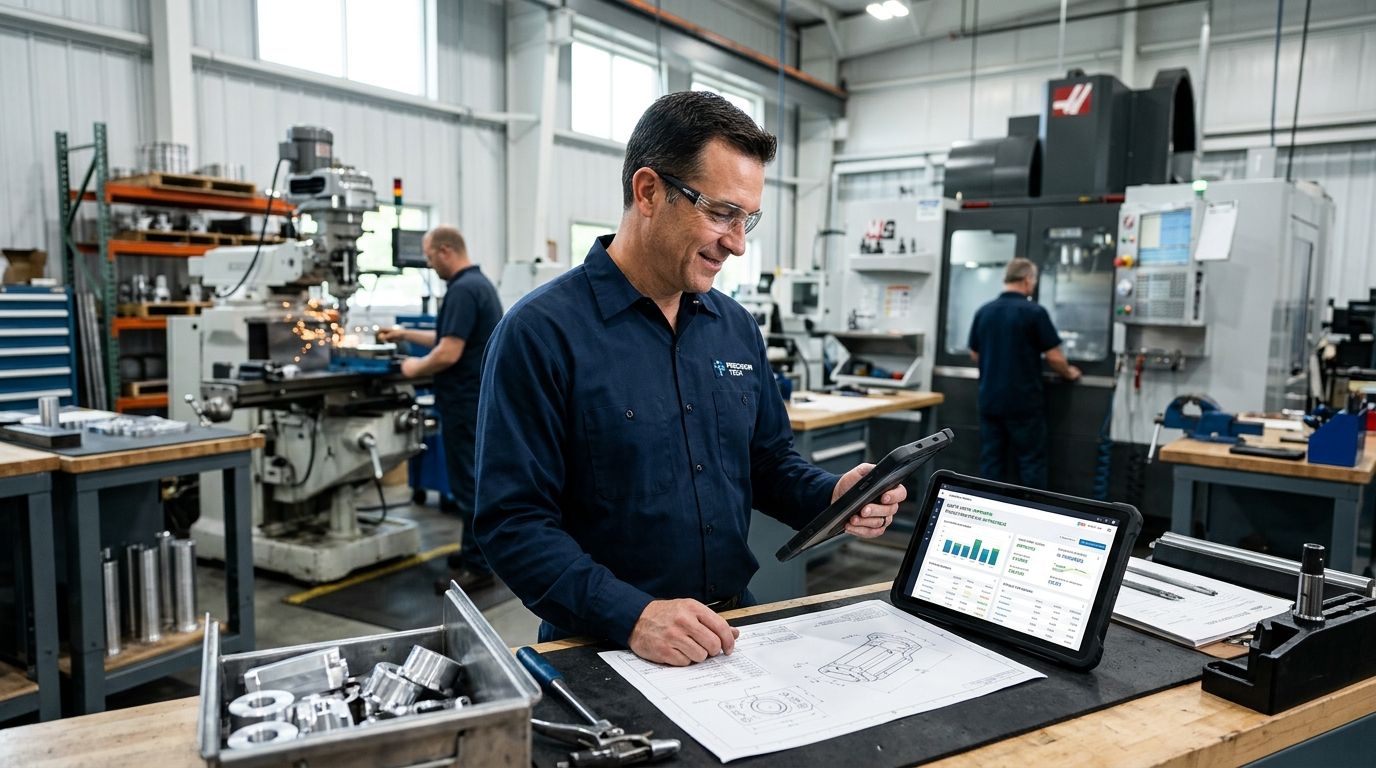
Quote to cash software for build-to-print manufacturers is a workflow system that automates RFQ intake, print-based quoting, order entry, and invoicing so job shops and contract manufacturers stop bleeding margin between the moment a print lands in the inbox and the moment cash hits the bank. Build-to-print shops quote against customer specs, not catalog SKUs, which means the automation has to handle one-off pricing logic that generic CPQ tools were never built for.
- Build-to-print manufacturers lose the most margin between RFQ receipt and quote delivery, not on the shop floor.
- SUPPLYCO AI automates quote-to-cash for build-to-print manufacturers by pulling print specs and pricing history straight into order entry.
- Generic CPQ built for catalog SKUs struggles with one-off prints; ERP-native quoting modules fix data entry but not speed.
- A 48-hour RFQ turnaround beats a 5-day one even with an identical win rate on price.
Why quote to cash software matters for build-to-print manufacturers
Every RFQ a build-to-print shop receives arrives as a PDF print, a material callout, and a tolerance spec — never a part number in a catalog. Quoting it by hand means an estimator re-keying dimensions into a spreadsheet, cross-checking routing cost against a job traveler, then emailing a quote back two or three days later while the buyer has already sent the same print to two other shops.
That delay is where build-to-print manufacturers lose bids, not on price. A quote-to-cash platform built for industrial manufacturers closes the gap between RFQ intake and order entry so estimators aren't the bottleneck between a print landing and a quote going out. The mechanics matter more here than in catalog-based B2B sales, because every quote is effectively a new SKU with its own routing, tolerance, and material cost.
Speed compounds. A shop that responds in 48 hours instead of five days wins more repeat RFQs from the same buyer, because procurement teams learn which vendors respond fast and stop sending prints to the slow ones. That's the real argument for shortening the quote-to-cash cycle before you touch pricing strategy at all.
The how-to spine: building a quote-to-cash workflow for build-to-print shops
Map your build-to-print quote workflow before automating it
Don't automate a broken process. Write down every step from RFQ receipt to signed PO, with the average hours each step takes.
- Log where RFQs enter today: email, portal, fax, phone
- Time-stamp the handoff from sales to estimating
- Note how many quotes require a second review before going out
- Flag which print types (weldments, castings, machined parts) take longest to price
- Identify where the quote sits waiting on approval versus waiting on data
Standardize your print-based CPQ rules
Before software, build the pricing logic on paper: material cost tables, routing multipliers, tolerance surcharges, minimum order quantities. Most build-to-print shops never write this down; it lives in one estimator's head.
- Set standard markup tiers by material class (steel, aluminum, exotic alloys)
- Define surcharge rules for tight tolerances (below 0.001 in.) and secondary operations
- Build a rush-order pricing matrix tied to lead time, not guesswork
- Document approval thresholds so quotes over a dollar limit route automatically
Once those rules exist on paper, a CPQ engine can enforce them without a human re-deciding every time. This is where CPQ software for contract manufacturers earns its keep — it applies the pricing logic your estimator already knows, at the speed a buyer expects in 2026.
Connect quoting to order entry and your ERP
A quote that doesn't flow into order entry forces a second re-key the moment a PO lands. That's where errors and lost line items happen most.
- Match quote line items to ERP part numbers automatically instead of manual lookup
- Sync accepted quotes directly into a sales order without a data-entry step
- Flag mismatches between quoted price and ERP cost basis before the order releases
- Route confirmed orders to production scheduling the same day they're signed
Automate follow-up for RFQ-heavy pipelines
Build-to-print shops quote far more jobs than they win. Follow-up on open quotes is the highest-leverage, lowest-effort fix in the whole cycle.
- Set a fixed follow-up cadence: 3 days, 7 days, 14 days after quote delivery
- Flag quotes that go quiet after 10 business days for a manual call
- Track which buyers routinely take 30+ days to decide and adjust cadence for them
- Route stalled high-value quotes to a sales rep, not an automated nudge alone
Track cycle time by print revision, not by rep
Most shops measure quote turnaround by salesperson. Measure it by print complexity instead — a simple bracket and a five-axis casting shouldn't share a benchmark.
- Segment cycle-time reporting by part category (machined, cast, fabricated, assembled)
- Track revision count per quote; three or more revisions signals a spec problem, not a pricing one
- Compare win rate against turnaround time by category, not company-wide averages
- Report cycle time monthly to estimating, not just to sales leadership
Segment accounts by print complexity and order volume
Not every buyer deserves the same quote-turnaround SLA. A five-piece prototype order and a 5,000-unit production run carry different margin and different urgency.
- Tag accounts by average order value and reorder frequency
- Set faster SLAs for repeat production buyers than for one-off prototype requests
- Route high-complexity prints to your most experienced estimator, not whoever's free
- Review account tiers quarterly as buyer volume shifts
Audit your full quote-to-cash cycle quarterly
Workflows drift. A rule that made sense in January stops matching reality by the third quarter.
- Re-measure average quote-to-order time every quarter
- Compare win rate against cycle time to confirm speed is still paying off
- Check whether new print types (new materials, new tolerances) are breaking pricing rules
- Re-train pricing logic when material costs shift more than 10% from baseline
Comparison: quote-to-cash options for build-to-print manufacturers
| Option | Best for | Key strength | Key limitation |
|---|---|---|---|
| Manual quoting (email/spreadsheet) | Shops quoting under 20 RFQs a month | No software cost, full estimator control | Cycle time scales linearly with headcount; slow to win repeat business |
| Generic CPQ (catalog-built) | Distributors selling standard SKUs | Fast configuration for fixed products | Struggles with one-off print specs and custom tolerance pricing |
| ERP-native quoting module | Shops needing tight order-entry accuracy | Data stays inside one system of record | Doesn't automate the estimating or follow-up steps upstream of the order |
| SUPPLYCO AI quote-to-cash platform | Build-to-print shops with RFQ-heavy pipelines | Automates quoting, order entry, and follow-up in one workflow | Requires clean pricing rules up front to configure correctly |
Verdict: build-to-print shops running more than 20 RFQs a month should stop pricing manually — the labor cost of re-keying quotes exceeds the cost of automating the workflow within a quarter.
See quote-to-cash software in action
Built for print-based quoting, not catalog SKUs.
Common mistakes build-to-print manufacturers make
- Pricing every print from scratch. Repeat customers send similar geometries; reusing historical pricing data cuts estimating time without cutting accuracy.
- Letting quotes go stale with no follow-up. A quote sent and forgotten is a quote lost to whichever competitor called back first.
- Treating a five-piece prototype order the same as a 5,000-unit run. Different SLAs, different pricing logic, same mistake if you don't segment.
- Measuring win rate without measuring cycle time. A high win rate on a five-day turnaround still loses the business that needed a 48-hour answer.
- Bolting CPQ onto the ERP without fixing the pricing rules first. Software enforces whatever logic you give it — bad rules just get automated faster.
FAQ
What is quote to cash software for build-to-print manufacturers?
It's a workflow system that automates RFQ intake, print-based quoting, order entry, and invoicing for shops that quote against customer specs rather than catalog SKUs. It closes the gap between a print landing and cash collected.
How is build-to-print quoting different from catalog CPQ?
Catalog CPQ configures fixed products with set price books. Build-to-print quoting prices a new spec every time — material, tolerance, and routing cost all shift per print, which most generic CPQ tools aren't built to handle.
Does quote-to-cash software replace an ERP?
No. It sits upstream of order entry and feeds confirmed orders into your existing ERP, whether that's Epicor, Global Shop, JobBOSS, or another system already in place.
How fast should a build-to-print shop turn around an RFQ?
Aim for 48 hours or less on standard prints in 2026. Buyers routinely send the same print to multiple shops and award the job to whoever answers first, regardless of small price differences.
Is SUPPLYCO AI built for build-to-print manufacturers specifically?
SUPPLYCO AI automates quoting, order entry, account management, and follow-up for industrial manufacturers and distributors, including build-to-print shops working from customer specs rather than catalog parts.
What's the biggest mistake in build-to-print quote-to-cash workflows?
Treating every print as equally urgent. Segmenting by order volume and print complexity lets fast SLAs go where they matter and slower review go where accuracy matters more than speed.
How much does quote-to-cash automation cost for a small job shop?
Costs vary by shop size and RFQ volume; check current options directly with a vendor rather than relying on a fixed figure, since pricing structures differ by feature set.
Can quote-to-cash software reduce order entry errors?
Yes, when quoting data flows directly into order entry instead of being re-keyed. Manual re-entry between quote and order is one of the most common sources of line-item mismatches in build-to-print shops.
One last thing
The biggest lever in build-to-print quote-to-cash isn't pricing accuracy — it's speed. If your average RFQ still sits in an estimator's inbox for 48 hours or more before the first quote goes out in 2026, you're losing bids to shops that answer the same day, regardless of who's actually cheaper.


