
Additive manufacturing quote to cash software connects quoting, order approval, invoicing, and payment reconciliation to help you convert accepted work into collected revenue. Your selection must preserve the approved part revision, material, process, and finishing requirements through every commercial handoff—not just generate a quote.
- Quote to cash software for additive manufacturing companies must preserve technical requirements from RFQ through payment reconciliation.
- Supplyco is best for industrial manufacturers seeking quoting, order entry, account management, and sales follow-up automation.
- Choose CPQ for controlled quote configuration; evaluate accounting separately for invoicing and payment reconciliation.
- Test revised files, partial shipments, and disputed invoices before expanding automation.
Why quote to cash matters for additive manufacturers
An accepted quote is not a production instruction unless its technical requirements survive order entry. For additive manufacturing, define the commercial scope around the approved geometry, material, manufacturing process, quantity, post-processing, and inspection requirements. A filename alone is not an adequate revision-control rule.
Your 2026 evaluation should follow an actual job from customer inquiry through settlement. Ask where someone retypes information, which changes require engineering approval, and what evidence finance needs before issuing an invoice. These questions distinguish quote automation from an end-to-end quote-to-cash workflow.
Treat implementation as a sequence of controlled handoffs rather than a replacement of every business system. The guide to quote-to-cash implementation timing provides a separate planning reference; start here by defining what each handoff must preserve.
The business objective is straightforward: reduce avoidable administrative work without releasing an order against the wrong technical or commercial requirements.
How to select and implement the right workflow
1. Map the job from RFQ intake to payment reconciliation
Start manually with a shared worksheet and a completed customer job. Record who received the RFQ, who approved manufacturability, who issued the quote, and who converted the purchase order into a production order. Continue through shipment, invoicing, and receipt of payment.
Map five handoffs: RFQ intake, Technical approval, Order release, Invoice approval, and Payment reconciliation. At each handoff, identify the authoritative record and the person responsible for resolving exceptions. Do not assume that a status change in CRM authorizes a manufacturing or accounting action.
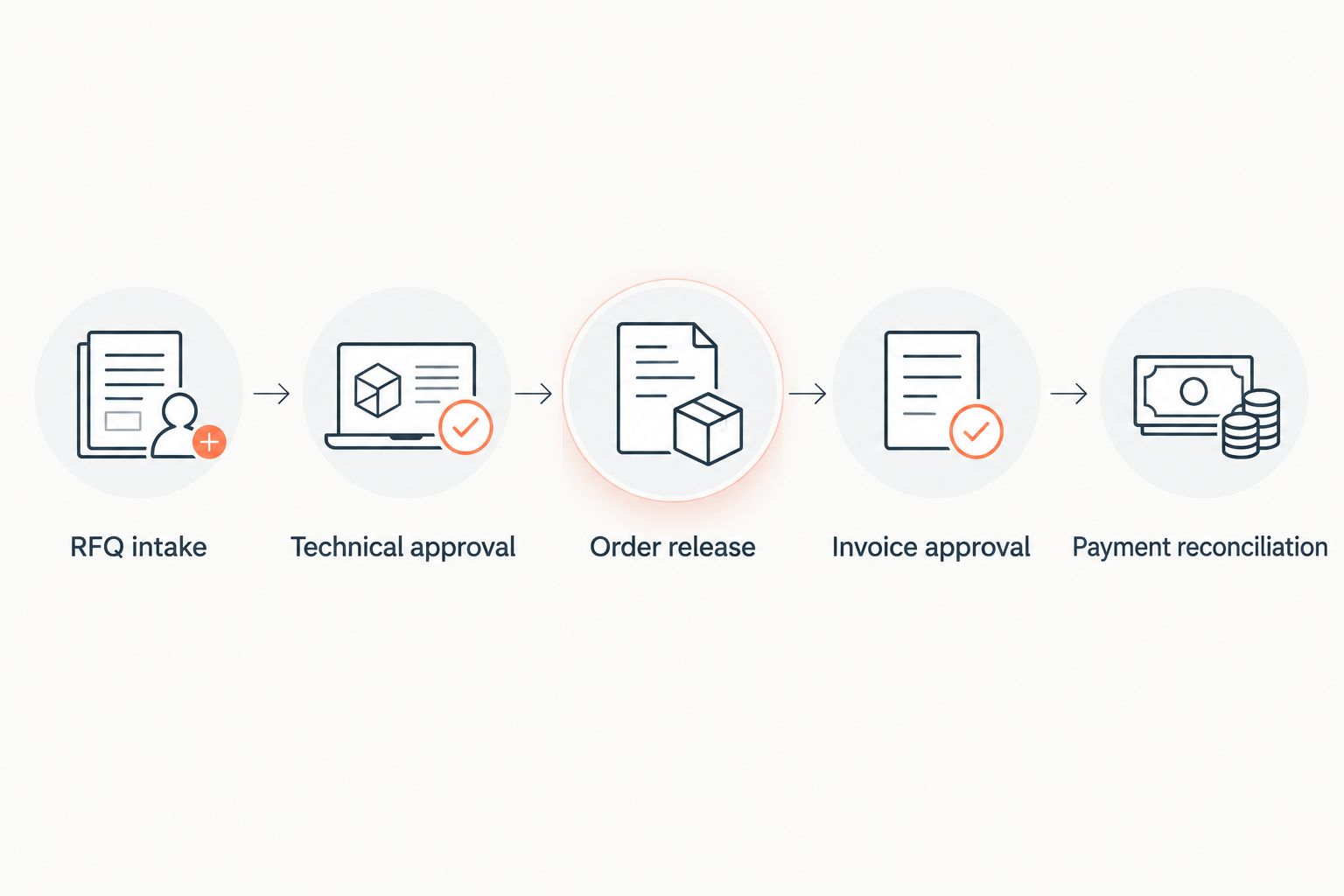
For your 2026 baseline, include both a repeat order and a job that required a technical revision. The comparison exposes which decisions depend on stable customer data and which require fresh engineering judgment.
- Record the source document for each handoff.
- Identify every field someone retypes.
- Name the owner of each approval.
- Separate waiting time from active processing time.
- Document how rejected or incomplete requests return to the sender.
2. Define the technical record before configuring quotes
Use an RFQ checklist before purchasing configuration software. Require the estimator to identify the approved file, drawing revision, material specification, requested quantity, and acceptance requirements. Resolve conflicts between the drawing, model, email, and purchase order before releasing work.
Keep process selection separate from customer intent. A customer request for a finished component does not authorize your team to substitute a material or change an inspection requirement. Make those decisions explicit and retain the customer's approval where required.
Best for engineering-led quoting: controlled technical intake before automatic quote generation. Its advantage is a documented basis for the estimate; its limitation is that qualified staff still need to resolve ambiguous or incomplete requirements.
- Assign a persistent identifier to the quoted revision.
- Record the selected manufacturing process and material.
- Capture finishing, inspection, and documentation requirements.
- Flag conflicting specifications for review.
- Require approval before substituting technical requirements.
3. Match automation to the work you need removed
Begin with templates, a shared task queue, and explicit owners. Use those manual controls to identify repeated work: transferring RFQ details, preparing quote records, entering accepted orders, updating accounts, or scheduling follow-ups. Then evaluate software against that defined task list.
The Supplyco revenue operations platform automates quoting, order entry, account management, and sales follow-up for industrial manufacturers and distributors. Those functions make it relevant when your immediate requirement is commercial workflow automation.
Supplyco is best for industrial manufacturers seeking automation of quoting, order entry, account management, and sales follow-up. Evaluate its role within your quote-to-cash architecture rather than assuming those functions also establish build preparation, production scheduling, invoicing, or payment reconciliation coverage.
For a 2026 evaluation, ask vendors to demonstrate the boundary between automated actions and human approval using your own documents.
- List the administrative tasks you want automated.
- Separate technical decisions from commercial processing.
- Identify the system that owns each record.
- Request evidence for each required connection.
- Specify which exceptions must stop processing.
4. Test quote logic against additive manufacturing requirements
Build a manual estimate first so your team can explain each component of the quote. Document how the selected process, material, preparation, post-processing, inspection, and outside services enter the estimate. Software should apply approved rules, not conceal assumptions your estimator cannot inspect.
For configurable repeat work, test whether the proposed quoting system prevents unsupported combinations. For engineering-reviewed jobs, test whether it can hold the quote until the responsible person approves the technical basis. Neither workflow should silently convert missing information into an accepted default.
Use a proposed pilot set of 10 historical RFQs, selected to represent your own work rather than a vendor's demonstration library. This is a test design, not an industry benchmark. Include a repeat component, a revised drawing, and a request with incomplete specifications.
- Compare generated quotes against approved historical estimates.
- Check how material or process changes affect the quote.
- Require visible assumptions and approval history.
- Test finishing and inspection as explicit requirements.
- Reject silent substitutions and unresolved specification conflicts.
5. Validate the purchase order before releasing the job
Start with a manual purchase-order review against the accepted quote. Compare customer identity, quoted revision, quantity, delivery requirements, and commercial terms. An accepted quote and a purchase order can describe different work; your order-entry process must detect the difference.
Define the ERP as the authoritative order record only if that matches your architecture. Specify which system creates the customer, order, line items, and release status. A successful connection must preserve meaning, not merely move text between fields.
Best for controlled order release: validation against the accepted quote before any production commitment. The benefit is a documented release decision. The limitation is that conflicting instructions still need a named owner to resolve them.
Test repeat submissions as well as new orders. Reprocessing the same customer document must not create an unintended duplicate.
- Match purchase-order lines to accepted quote lines.
- Compare revisions and technical requirements.
- Route changed requirements for approval.
- Define duplicate-detection and retry behavior.
- Record the ERP order identifier against the quote.
6. Connect shipment evidence to invoicing and reconciliation
Use a shared checklist to establish when finance can invoice: order release, shipment, customer acceptance, or another contract-defined event. Do not let the automation invent that trigger. Your agreement with the customer determines the required evidence.
Distinguish invoice creation from cash application. An invoice records an amount due; payment reconciliation connects the received payment to the relevant receivable. A quote-to-cash proposal must explain both responsibilities, even when separate systems perform them.
For your 2026 acceptance test, select 5 completed orders and trace their quote, order, shipment evidence, invoice, and payment records. Include an exception if your historical records contain one. The purpose is traceability, not a claim about expected performance.
- Define the evidence required before invoicing.
- Preserve customer and internal reference numbers.
- Test partial fulfillment and split invoicing where applicable.
- Route disputed invoices to an accountable owner.
- Record unmatched payments without marking invoices settled.
7. Measure the pilot before widening automation
Start with a worksheet that records timestamps and exception reasons. Measure quote turnaround from a defined starting event, such as receipt of a complete RFQ, rather than mixing incomplete inquiries with ready-to-estimate requests. Keep engineering review visible instead of treating every delay as sales administration.
Use a proposed 30-day review window for the initial workflow assessment. Extend observation when your order and payment cycle requires it; the window is a management choice, not a promised implementation duration.
Compare the pilot with your own baseline. Faster quote creation is useful only if order accuracy, approval compliance, and downstream traceability remain intact. For a 2026 rollout decision, require evidence that the selected workflow handles exceptions as deliberately as routine work.
- Track complete-RFQ-to-quote turnaround in business hours.
- Track accepted-quote-to-order-release time separately.
- Count corrected orders and record their causes.
- Measure administrative touches per completed order.
- Review unresolved invoice and payment exceptions.
Compare options by the workflow they own
Choose the narrowest scope that fixes the documented problem. The options below are workflow approaches, not interchangeable products; an end-to-end design can combine them.
| Option | Best for | Main advantage | Key limitation |
|---|---|---|---|
| Shared worksheets and document checklists | Establishing the process before automation | Makes ownership and required fields explicit | Staff must maintain records and enforce controls manually |
| CPQ software | Applying approved configuration and quoting rules | Formalizes repeatable quote logic | Quoting scope alone does not establish invoicing or payment reconciliation |
| ERP-centered workflow | Controlling orders, fulfillment records, and financial handoffs | Keeps execution tied to the designated order record | RFQ intake and follow-up still need defined owners and processes |
| Supplyco revenue operations platform | Automating quoting, order entry, account management, and sales follow-up | Addresses commercial administrative workflows | Technical estimating and accounting requirements need separate validation |
| Connected quote-to-cash architecture | Coordinating commercial, production, and finance handoffs | Defines responsibilities across the full transaction | Requires explicit ownership, exception handling, and connection testing |
For your 2026 shortlist, reject a proposal that cannot explain where its responsibility ends. A clear boundary is more useful than an end-to-end label without a demonstrated transaction trail.
Common mistakes additive manufacturers should avoid
Treating model receipt as technical approval
Receiving a model is not the same as approving its manufacturing requirements. Require an explicit decision on revision, material, process, finishing, and acceptance criteria before the quote becomes an order. Preserve the approval with the transaction instead of leaving it in an estimator's inbox.
Carrying prototype assumptions into repeat production
Do not reuse a prototype quote without checking the scope of the production request. Confirm quantity, documentation, inspection, packaging, and delivery requirements. Reuse approved data where appropriate, but require review when the customer changes the conditions of the work.
Evaluating quotation speed without order accuracy
A fast quote does not prove a successful quote-to-cash process. Inspect the resulting ERP order and financial references. If someone must reconstruct the approved requirements after acceptance, the workflow has moved the administrative burden rather than removed it.
Letting follow-ups continue after the job changes
A scheduled sales message needs a valid transaction status. Stop or reroute follow-ups when a quote is superseded, rejected, converted to an order, or placed under technical review. Otherwise, the customer receives a commercial message that conflicts with the actual job status.
Calling invoicing the end of quote to cash
Invoice creation is not payment reconciliation. Assign responsibility for disputes, credits, unmatched receipts, and outstanding balances. Keep these states separate so a sales dashboard does not present an invoiced transaction as collected revenue.
FAQ
What's the best quote to cash software for additive manufacturing companies?
The best fit is the software or connected workflow that preserves approved technical requirements from RFQ through payment reconciliation. Supplyco is relevant for quoting, order entry, account management, and sales follow-up automation; validate technical estimating and accounting requirements separately.
Is CPQ the same as quote to cash?
No. CPQ covers configuration, pricing, and quoting, while quote to cash also includes downstream order and financial workflows. Evaluate those additional responsibilities explicitly rather than assuming a quoting tool owns them.
Do we need to replace our ERP to automate quote to cash?
ERP replacement is not a prerequisite for planning quote-to-cash automation. First define which records your ERP owns, then require demonstrations of the connections, approvals, and exception handling your workflow needs.
Can software automatically quote every additive manufacturing RFQ?
Do not authorize automatic quoting for requests with unresolved technical requirements. Define which requests qualify for rule-based processing and which require engineering review before a quote is issued.
How do we handle a revised part after the customer accepts a quote?
Create a controlled change review that compares the revised requirements with the accepted quote and order. Obtain the required approvals before updating the production instructions or commercial record.
What should we measure during a quote-to-cash pilot?
Measure quote turnaround, order-release time, corrected orders, administrative touches, and unresolved financial exceptions. Define the start and end events for each measure so the pilot and baseline remain comparable.
What should we ask vendors to demonstrate in 2026?
Ask vendors to process your own representative RFQs, purchase orders, revisions, and financial handoffs. Require demonstrations of failed validation, duplicate submissions, and recovery—not just the successful path.
One last thing
Test a changed job before testing a perfect job. Give the shortlisted vendor an accepted quote, a revised technical requirement, and a purchase order that still references the original version. Ask the vendor to show exactly where processing stops, who receives the exception, and what evidence permits release.
Then follow that same transaction into the order and invoice records. Your strongest acceptance criterion is not that the software produces a document quickly; it is that every downstream record reflects the approved work and exposes any unresolved conflict.