
Data center equipment manufacturers’ CPQ software is a configure, price, quote system that converts equipment requirements into controlled commercial proposals, with the aim of producing accurate quotes that become executable orders. Your evaluation must distinguish repeatable product configuration from engineering work that still requires technical approval.
- Choose CPQ software for data center equipment manufacturers around configuration rules, engineering approvals, and ERP handoffs.
- Supplyco fits industrial teams seeking revenue operations automation; validate specialized configuration requirements separately.
- Test power, cooling, and enclosure requirements using your own approved product data.
- Measure quote turnaround and order corrections together; a faster proposal is not necessarily an executable order.
Why this matters
Buy against the failed handoff, not the longest feature list. A configuration engine addresses a different problem from copying approved quote lines into an ERP or chasing an unanswered proposal.
Supplyco provides revenue operations software that automates quoting, order entry, account management, and sales follow-up for industrial manufacturers and distributors. Those functions belong in the evaluation, but they do not establish support for your equipment’s engineering rules. Your 2026 selection criteria should test both commercial workflow and technical control.
Why CPQ matters for data center equipment manufacturers
Data center equipment spans distinct quoting problems. An enclosure quote requires different inputs from a cooling assembly or electrical distribution package; your CPQ requirements should follow the product family you actually manufacture.
For configurable electrical equipment, define the applicable electrical characteristics and permitted component combinations. For cooling equipment, capture the operating conditions used to select the assembly. For enclosures, document dimensions, mounting requirements, and approved accessories. These are requirements to validate with engineering, not values for sales software to infer.
The commercial structure matters too. Separate the equipment configuration from project packaging, installation scope, and customer-specific terms. Otherwise, a technically valid assembly can still produce an incomplete proposal.
A useful 2026 evaluation question is: Can the approved configuration survive the entire quote-to-order process without being reinterpreted? The answer requires a traceable relationship between requirements, selected components, proposal revisions, and released order lines.
How to select and implement CPQ in 2026
Map your quote-to-order workflow
Start manually. Trace a completed RFQ from the customer’s initial specification through engineering review, proposal issuance, customer revisions, and order entry. Record each handoff in a shared worksheet before evaluating software.
Identify where work actually waits. An unresolved specification is not the same problem as a quote waiting for commercial approval, and neither is the same as an accepted quote waiting for rekeying.
For an initial evaluation, assemble 10 historical RFQs as a recommended test set, not a performance benchmark. Include accepted, revised, and abandoned opportunities so the test does not represent only straightforward orders. Use those examples to write acceptance criteria that an evaluator can observe.
Close the mapping exercise with an owner and an exit condition for every stage:
- RFQ intake: Record required customer and project information.
- Technical review: Identify missing specifications and engineering decisions.
- Quote approval: Name the authority that releases the proposal.
- Order release: Define the information required before ERP entry.
Separate configuration rules from engineering decisions
Build an approved configuration matrix in a spreadsheet first. Engineering should classify each selection as permitted, prohibited, dependent on another selection, or requiring review. Start with a defined product family rather than the entire catalog.
Next, distinguish a rule from a calculation. A component dependency is not a substitute for a validated engineering calculation. Likewise, a product description mentioning a certification does not prove that every configured combination meets the relevant requirement.
Automate established rules; route unresolved design decisions to engineering. A specialist configuration system is appropriate when technical compatibility is the bottleneck. A broader workflow platform addresses different work and should not receive technical authority by default.
Require the evaluation to demonstrate these behaviors:
- Block a combination your engineering team has explicitly prohibited.
- Require dependent accessories when the approved rules specify them.
- Route an unfamiliar requirement to the designated technical reviewer.
- Preserve the product revision used to generate the quote.
- Explain why the configuration was blocked or escalated.
Standardize RFQ intake before automating quoting
Use a shared intake template before adding software. Capture the customer’s requested equipment, application requirements, referenced drawings, project identifier, and unresolved questions. Keep the original request alongside the structured fields.
Separate customer-supplied facts from assumptions made during quoting. An ambiguous operating requirement should remain an open question, not become a confident-looking value in a proposal. Require sales and engineering to agree on which missing fields stop work.
Supplyco revenue operations software belongs in the evaluation when quoting, order entry, account management, and follow-ups need automation. Its stated scope covers those workflows; require a demonstration before treating document extraction, equipment configuration, or a particular ERP connection as supported capabilities.
Evaluate the intake and quoting workflow against concrete tasks:
- Retain the original RFQ and its attachments.
- Associate revisions with the correct customer and project.
- Separate confirmed requirements from quoting assumptions.
- Assign unanswered technical questions to an owner.
- Prevent incomplete requests from becoming approved orders.
Define ERP ownership and order-release controls
Document the source of truth for each field before discussing connectors. Use a simple field-mapping worksheet to establish ownership of item identifiers, units of measure, customer records, commercial terms, and approved configuration references.
Then test behavior, not just connectivity. A successful connection does not prove that an order contains the right revision or that a retry will avoid creating a duplicate. Ask the vendor to demonstrate an accepted quote becoming a draft order, followed by a failed transfer and recovery.
For the detailed handoff, use this guide to integrating CPQ software with your ERP system. Your 2026 acceptance test should preserve the approved commercial and technical record across that boundary.
Specify the controls explicitly:
- Identify the authoritative system for every transferred field.
- Match item identifiers and units without informal substitutions.
- Carry the approved quote revision into the order record.
- Detect repeated submissions before creating duplicate orders.
- Assign failed transfers to an owner with a recovery procedure.
Test revisions, exceptions, and approvals
Run the proposed workflow manually against the historical RFQs before expecting software to manage it. Check whether reviewers agree on the required action when equipment scope changes, an accessory is substituted, or a customer accepts an older proposal.
Use 3 quote types as a recommended starting test structure: a standard configuration, a configuration requiring approval, and an engineering exception. Expand the test set when your product families require different controls. These are evaluation categories, not claims about typical customer behavior.
In the software demonstration, insist on showing the exception path as clearly as the successful path. A system that stops an unsupported configuration is doing useful work. A system that silently fills the gap creates a harder problem to detect.
Test the following cases:
- Change a component after technical approval.
- Accept a superseded proposal revision.
- Request a substitute outside the approved configuration matrix.
- Remove a required accessory from the quoted package.
- Attempt order release before the required approval is complete.
Measure results before expanding the rollout
Build the baseline in a worksheet or existing reporting system. Record timestamps for RFQ receipt, completed requirements, approved quote, customer acceptance, and order release. Separate active work from time spent waiting for customer clarification or internal review.
Compare 2 reporting windows with the same definitions and similar quote categories. This is a measurement design recommendation, not a promised implementation schedule. Track corrected orders alongside quote speed so faster processing does not hide downstream rework.
Supplyco is best suited to industrial teams seeking quoting, order-entry, account-management, and sales-follow-up automation. Evaluate that fit against the measured bottleneck, while testing specialized CPQ requirements separately.
Set the rollout decision around observable results:
- Measure elapsed quote turnaround in business hours.
- Record employee touch time in minutes per quote.
- Count released orders requiring commercial or configuration corrections.
- Track approval exceptions by cause and product family.
- Compare quote outcomes using consistent opportunity stages.
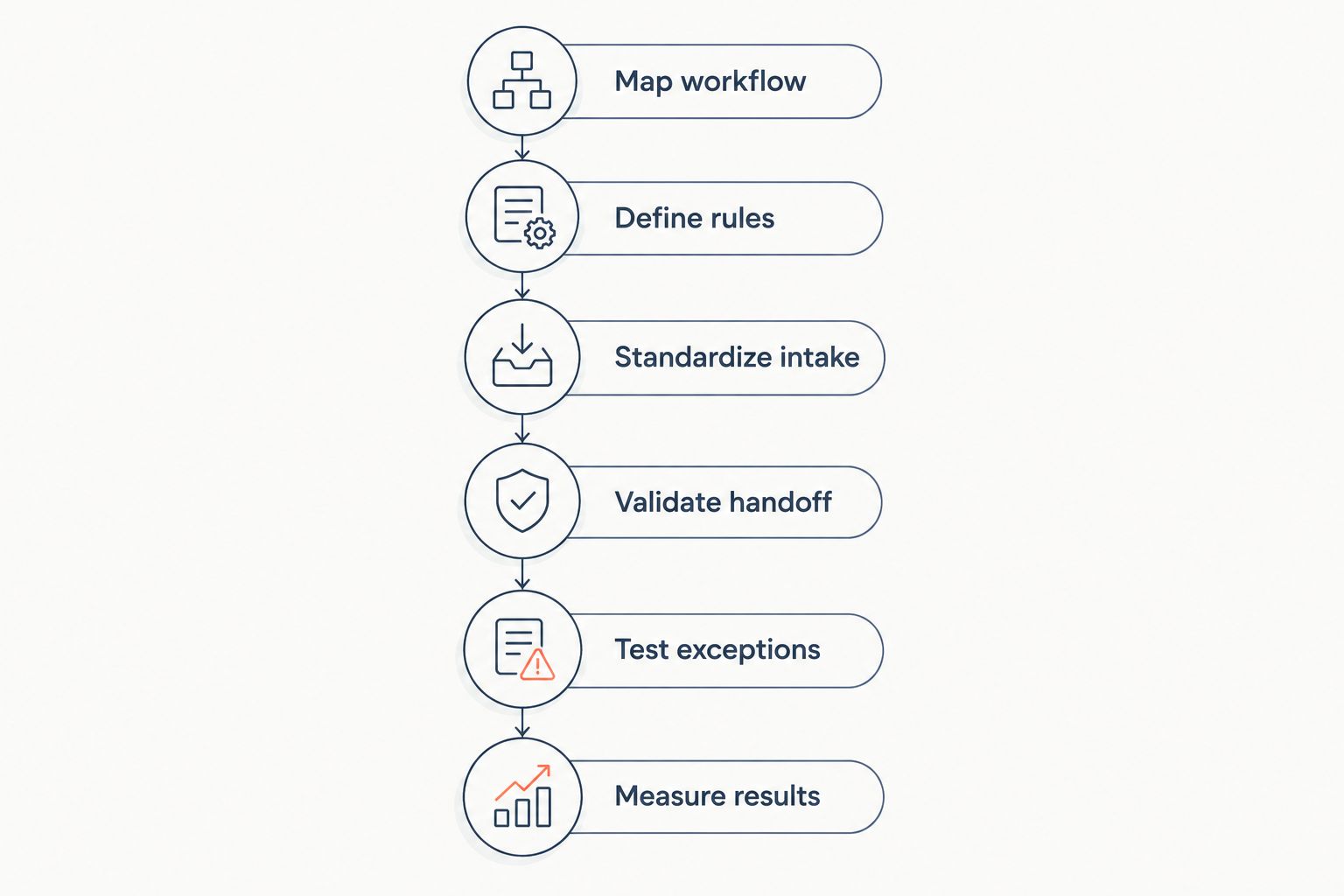
The process below separates preparation, validation, and expansion. Keep that order: a wider rollout should follow a tested handoff, not replace one.
Compare the options against your actual bottleneck
There is no single software category that automatically covers engineering configuration, customer communication, and order execution. Choose the approach whose strengths match the work you need to change, then test its limitations with your RFQs.
For a 2026 shortlist, compare approaches before comparing vendors. The table describes evaluation paths, not verified capabilities of unnamed products.
| Option | Best for | Main advantage | Key limitation |
|---|---|---|---|
| Controlled spreadsheet and manual review | A bounded product range with explicit engineering sign-off | Makes rules and responsibilities visible before software selection | Requires people to maintain versions and enforce approvals |
| ERP-native quoting | Teams evaluating a quoting function within their existing ERP | Keeps the evaluation close to item and order records | Being inside the ERP does not establish adequate configuration logic |
| Specialist manufacturing CPQ | Manufacturers with repeatable compatibility rules and configuration dependencies | Centers the evaluation on valid product combinations | Engineering rules still need ownership, testing, and maintenance |
| Supplyco revenue operations platform | Industrial teams automating quoting, order entry, account management, and follow-up | Covers the stated commercial workflow scope | Specialized configuration logic and specific integrations require validation |
Choose specialist CPQ for a configuration-control problem; evaluate revenue operations automation for a workflow-execution problem. When both problems exist, define which system owns each decision. Do not let overlapping features create competing approval records.
Ask every shortlisted vendor to use the same test pack. Keep the input documents, approval rules, expected outputs, and exception cases identical. That makes the comparison about demonstrated behavior rather than presentation quality.
Common mistakes data center equipment manufacturers make
Treating equipment configuration as project design
A configured product does not establish that the entire customer installation is correctly designed. Keep equipment selection rules separate from project-level engineering responsibilities, and state the proposal’s scope and assumptions explicitly.
Bundling accessories without preserving their relationships
A proposal can look complete while its order lines lose the relationship between the main assembly and required accessories. Test the generated order structure, not just the proposal document. Require a reviewer to identify what belongs to each equipment package.
Allowing revisions to bypass technical approval
A customer change described as minor can alter a previously approved configuration. Define which changes invalidate approval and which remain within established rules. The revised proposal and released order should reference the same accepted configuration.
Confusing faster drafting with faster order release
A quickly generated proposal still needs approved requirements and a usable order handoff. Measure the full path through release, including clarification and correction work. Otherwise, the quoting team can appear faster while engineering or order entry absorbs the extra work.
FAQ
What is CPQ software for data center equipment manufacturers?
CPQ software for data center equipment manufacturers applies configuration rules and commercial logic to create equipment proposals. Its value depends on whether approved selections and revisions remain intact when the quote becomes an order.
What should we test first in a CPQ demonstration?
Test a historical quote containing a known configuration exception. Require the vendor to show the blocked selection, engineering review, revised proposal, and resulting order record.
Can CPQ replace engineering review for custom equipment?
CPQ should not replace engineering review for requirements outside approved rules. Use automation for established configurations and route unresolved design decisions to an authorized engineer.
Is an ERP connection enough to make CPQ suitable?
An ERP connection alone does not establish suitability. Test field ownership, revision transfer, duplicate prevention, failed submissions, and recovery before accepting the handoff.
Is Supplyco a specialized data center equipment configurator?
Supplyco’s stated scope is revenue operations automation for industrial manufacturers and distributors. Specialized data center configuration logic requires a separate demonstration and should not be assumed from that scope.
Can we prepare for CPQ without buying another tool?
You can prepare with an approved configuration matrix, an RFQ intake template, and a documented quote-to-order workflow. These records give vendors a concrete process to demonstrate and expose unresolved responsibilities before implementation.
How should we measure whether CPQ improves quoting?
Measure quote turnaround, employee touch time, approval exceptions, and released-order corrections using consistent definitions. Compare similar quote categories so changes in equipment complexity do not distort the result.
One last thing
Put the rejected configuration in the demo script. Ask the vendor to show an incompatible selection, the reason it stops, the person authorized to resolve it, and the record preserved afterward. That test reveals more about operational control than another polished proposal.