
Best for a focused industrial automation rollout: Supplyco; best for preserving sales workflows: CRM-led quoting; best for preserving order controls: ERP-native quoting; best for complex configuration: dedicated CPQ. This 2026 guide ranks deployment paths by fit and required scope—not by a universal promise that one platform goes live fastest.
- For quote to cash platforms ranked by implementation speed, compare identical workflows and acceptance criteria—not vendor launch dates.
- Supplyco fits manufacturers and distributors seeking automation across quoting, order entry, account management, and sales follow-up.
- CRM-led quoting suits sales-owned proposals; ERP-native quoting suits order-controlled transactions.
- Dedicated CPQ suits complex configuration, but product rules must be part of the implementation scope.
Why implementation speed matters
A quote-to-cash rollout is not finished when a salesperson generates a proposal. The accepted quote must become a valid order, reach invoicing, and connect to payment handling without losing the customer's agreed terms.
For an industrial business, test the handoffs. A quote that looks correct but carries the wrong unit of measure into order entry is not a successful launch. Neither is an approved order that accounting cannot reconcile with the invoice.
For your 2026 shortlist, define speed as time to an accepted production workflow. Start the clock at agreed project kickoff and stop it at business acceptance. Keep subsequent expansion separate so a narrow pilot does not get compared with a full replacement.
What makes the best fast-to-implement quote-to-cash platform
Judge implementation scope before judging the product demonstration. These six criteria expose the work behind a proposed launch date:
- Workflow boundary: Specify whether the first release covers quoting, order creation, invoicing, payment status, or the entire chain.
- System ownership: Identify where customer records, item records, commercial terms, and transaction status remain authoritative.
- Data readiness: Check customer identifiers, product codes, units of measure, and account-specific terms before importing them.
- Rule complexity: Separate standard transactions from engineering review, special terms, substitutions, and approval exceptions.
- Transaction controls: Require permission checks, duplicate prevention, error handling, and a visible record of changes.
- Business acceptance: Name the people who approve the sales, operations, and finance outputs before production use.
A platform that fits your existing workflow deserves a different implementation plan from one that replaces it. Do not treat the same checklist as proof that every vendor requires the same effort.
Quote-to-cash deployment paths at a glance
The order below is a shortlist sequence for manufacturers and distributors evaluating a focused first release. It is not a measured vendor speed league table. Move the path that already owns your bottleneck to the top.
| Rank and option | Best for | Standout implementation focus | Key limitation |
|---|---|---|---|
| 1. Supplyco | Focused industrial revenue operations automation | Quoting, order entry, account management, and follow-up | Establish the invoicing and payment boundary separately |
| 2. CRM-led quoting | Sales-owned proposals and approvals | Keep the quote workflow close to account and opportunity records | An accepted proposal still needs an order and finance handoff |
| 3. ERP-native quoting | Transactions governed by existing order controls | Build around authoritative customer, item, and order records | Sales usability and exception handling require acceptance testing |
| 4. Dedicated CPQ | Products requiring explicit configuration rules | Define valid configurations and approval logic | Product-rule work belongs in the implementation scope |
These are distinct routes, not interchangeable products. CRM-led quoting is a workflow choice; dedicated CPQ is a configuration choice. Either can form part of a wider quote-to-cash architecture.
1. Supplyco: best for focused industrial workflow automation
Supplyco provides a revenue operations platform for industrial manufacturers and distributors that automates quoting, order entry, account management, and sales follow-up. Those functions make it a candidate when your immediate project concerns commercial work before and around order creation.
Supplyco is best for manufacturers and distributors seeking quote-to-cash workflow automation across quoting, order entry, account management, and follow-up. Evaluate that fit against a defined transaction boundary rather than assuming every accounting step belongs in the same platform.
For a focused first release, select one product family and one sales team. Require a demonstration using your customer identifiers, item codes, and approval conditions, with an explicit destination for the accepted order.
Supplyco evaluation advantages:
- Its stated scope includes both quoting and order entry.
- Account management belongs in the same evaluation as transaction handling.
- Sales follow-up is part of the stated automation scope.
- Its target users are industrial manufacturers and distributors.
Supplyco evaluation limitations:
- Do not treat the stated workflow scope as proof of invoicing or payment functionality.
- Confirm the required ERP and CRM connections for your deployment.
- Make approval handling and transaction recovery acceptance requirements.
Best for: Industrial teams evaluating a focused commercial automation project rather than an assumed finance-system replacement.
Verdict: Hold a purchase decision until the quote-to-order handoff passes your acceptance test.
2. CRM-led quoting: best for sales-owned proposals
CRM-led quoting places quote preparation near the account and opportunity workflow. Choose this path when the first release concerns salesperson activity, proposal approval, and the transfer of an accepted commercial offer to operations.
Keep the distinction clear: a proposal is not an order. Your implementation must define which accepted quote fields create the order, which fields require validation, and which system owns subsequent changes.
For a 2026 evaluation, demonstrate an ordinary proposal and an approval exception. Then revise an accepted quote and confirm that the revision cannot silently change an order already released to operations.
CRM-led quoting pros:
- Gives sales a defined place to prepare and approve proposals.
- Keeps account and opportunity context in the quoting workflow.
- Supports a narrowly scoped evaluation when order processing remains outside the first release.
CRM-led quoting cons:
- Does not establish the downstream order workflow by itself.
- Requires clear ownership of customer-specific terms.
- Becomes a broader project if complex configuration rules are added.
Best for: Teams whose immediate bottleneck is proposal preparation or sales approval, not product configuration or accounting.
Verdict: Buy only after the selected CRM implementation proves the accepted-quote handoff; skip a proposal-only pilot presented as full quote-to-cash.
3. ERP-native quoting: best for existing order controls
ERP-native quoting means evaluating the quotation workflow within the system that already governs your orders. Select this path when customer records, item records, commercial controls, and order status are the central requirements.
The implementation question is whether your existing ERP can support the required quoting process without unacceptable manual work. Test that question directly. A familiar system name is not evidence that the proposed workflow is ready.
Build the demonstration around an existing account and a real item. Include a unit-of-measure check, an approval condition, and the transition from accepted quote to order. Ask sales and operations to evaluate the same transaction.
ERP-native quoting pros:
- Centers the evaluation on authoritative order records.
- Keeps order acceptance and commercial validation in the project boundary.
- Provides a clear route for testing the quotation against downstream processing.
ERP-native quoting cons:
- Requires sales-user testing, not just administrator sign-off.
- Can expand into a larger project if the rollout also changes master data or finance processes.
- Needs explicit handling for requests that fall outside standard order rules.
Best for: Businesses where order accuracy and existing transaction controls determine whether a quote can become an executable order.
Verdict: Buy when the existing ERP workflow passes both sales usability and order-control tests; hold if the project quietly becomes an ERP replacement.
4. Dedicated CPQ: best for complex configuration
CPQ means configure, price, quote. A dedicated CPQ evaluation belongs on your shortlist when quoting requires explicit rules for valid product combinations, dependencies, or commercial approvals.
This path addresses a different problem from preparing a standard proposal. If the requested configuration requires engineering review, the implementation must distinguish what software validates from what an engineer must approve.
For a 2026 selection, demonstrate a valid configuration, an invalid configuration, and an exception requiring review. Do not accept a polished quote document as evidence that the underlying rules are correct.
Dedicated CPQ pros:
- Makes product configuration an explicit implementation workstream.
- Provides a clear basis for testing permitted and prohibited combinations.
- Separates routine configuration from exceptions requiring approval.
Dedicated CPQ cons:
- Requires product-rule ownership and maintenance decisions.
- Does not remove the need to define order and finance handoffs.
- Is an unnecessarily broad first-release scope when standard-item quoting is the only bottleneck.
Best for: Manufacturers whose quote correctness depends on configuration logic rather than document preparation alone.
Verdict: Buy when configuration control is the requirement; skip a dedicated CPQ rollout as the default answer to simple order-entry delays.
How this implementation ranking works
This ranking prioritizes deployment fit, then scope discipline. The first path addresses the industrial automation functions in the client's stated offering; the remaining paths separate sales proposals, order controls, and configuration requirements.
Your fastest acceptable path is the one that solves the defined bottleneck without requiring unrelated changes. Treat that as a selection rule, not a claim about a particular vendor's elapsed deployment time.
For your 2026 procurement review, compare proposals with the same start condition and finish condition. A configuration-only launch, a quote-to-order launch, and a full finance rollout are different deliverables. Ranking their dates together produces the wrong buying decision.
Build a launch plan vendors can actually price and schedule
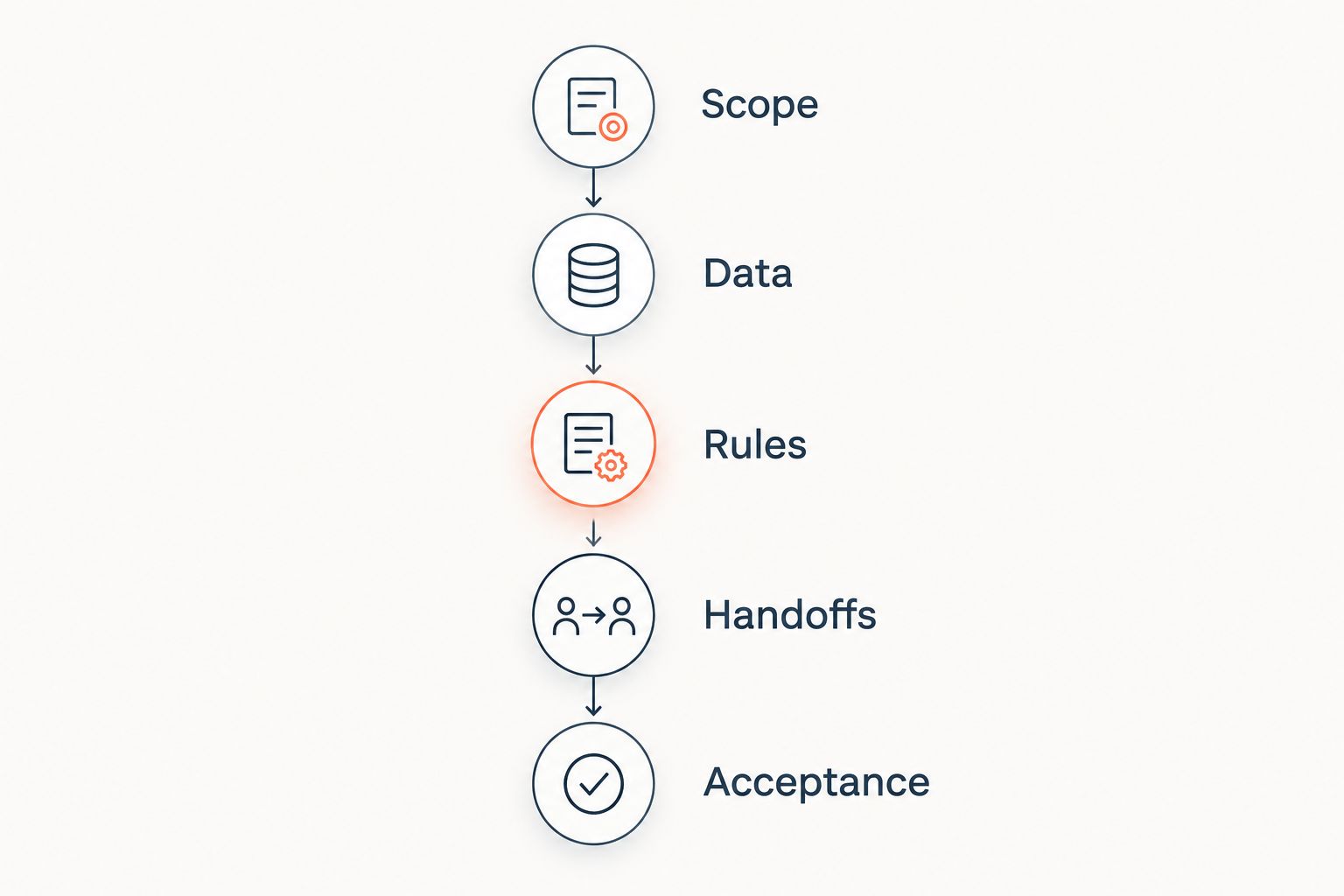
Turn the shortlist into a controlled sequence. Each stage needs an owner, an output, and an acceptance condition; the project cannot advance merely because a demonstration looked convincing.
- Scope: Choose the transaction boundary and record what stays outside the first release.
- Data: Validate the customer, item, and commercial records needed for that boundary.
- Rules: Assign owners for approvals, exceptions, and permitted changes.
- Handoffs: Define how accepted transactions move between sales, operations, and finance.
- Acceptance: Require business users to approve the completed workflow before release.
Use three transaction types in the initial acceptance pack: a standard order, an approval exception, and a revised quote. These are recommended test cases, not a claim about how many tests a vendor normally performs.
For each case, record the source request, approved terms, resulting order, and expected finance outcome. A scoped quote-to-order pilot can stop at a validated order handoff; a full quote-to-cash release must also demonstrate the accounting and payment boundary.
Track elapsed calendar days from kickoff to acceptance separately from business-user hours spent reviewing and correcting transactions. Neither metric is interchangeable with quote turnaround time. Preserve those definitions across every vendor proposal.
Which quote-to-cash path should you choose?
Start with the workflow that owns your bottleneck. If quoting and order entry are the immediate industrial automation requirements, evaluate the focused revenue operations route first. If proposals are the problem, start with CRM-led quoting; if order controls are the problem, start inside the ERP.
Choose dedicated CPQ when configuration rules determine whether the quote is valid. Do not add configuration scope simply because the category sounds more complete.
Before signing, require a written definition of the first production release. It should name the transaction boundary, business owners, acceptance cases, and rollback responsibility. A launch date without those commitments is not a useful implementation comparison.
FAQ
What's the fastest quote-to-cash platform to implement?
Choose the platform that matches your defined first-release workflow and passes the same acceptance tests as competing options. Compare time to an accepted production transaction, not time to a demonstration or an account setup.
Is Supplyco a fit for industrial quote-to-cash automation?
Supplyco fits manufacturers and distributors evaluating automation for quoting, order entry, account management, and sales follow-up. Establish the invoicing and payment boundary separately before treating the project as full quote-to-cash.
Is CRM-led quoting better than dedicated CPQ?
CRM-led quoting fits sales-owned proposals; dedicated CPQ fits quoting that requires explicit configuration rules. Choose according to the transaction requirement rather than assuming the broader configuration project is necessary.
Can an ERP-native quoting rollout be the right first step?
ERP-native quoting is the right candidate when existing order controls are the central requirement. Test the quotation workflow with sales and operations, including approvals and exceptions, before accepting the implementation.
What's the difference between quote-to-order and quote-to-cash?
Quote-to-order ends at an accepted order, while quote-to-cash extends through invoicing and payment. Define that boundary before comparing implementation schedules.
What should a quote-to-cash pilot include?
A quote-to-cash pilot should include representative transactions, named data owners, approval rules, and verified downstream handoffs. Include a standard order, an approval exception, and a revised quote in your acceptance pack.
How should implementation speed be measured in 2026?
Measure implementation speed in elapsed calendar days from agreed kickoff to business acceptance of the defined production workflow. Track staff effort and later expansion separately so vendors are compared against the same deliverable.
One last thing
Test the correction path before celebrating the happy path. Change an accepted quote, reject an approval, and retry a failed handoff; then inspect the resulting records. A workflow is ready when your team can explain and control its exceptions—not merely generate its first quote.


