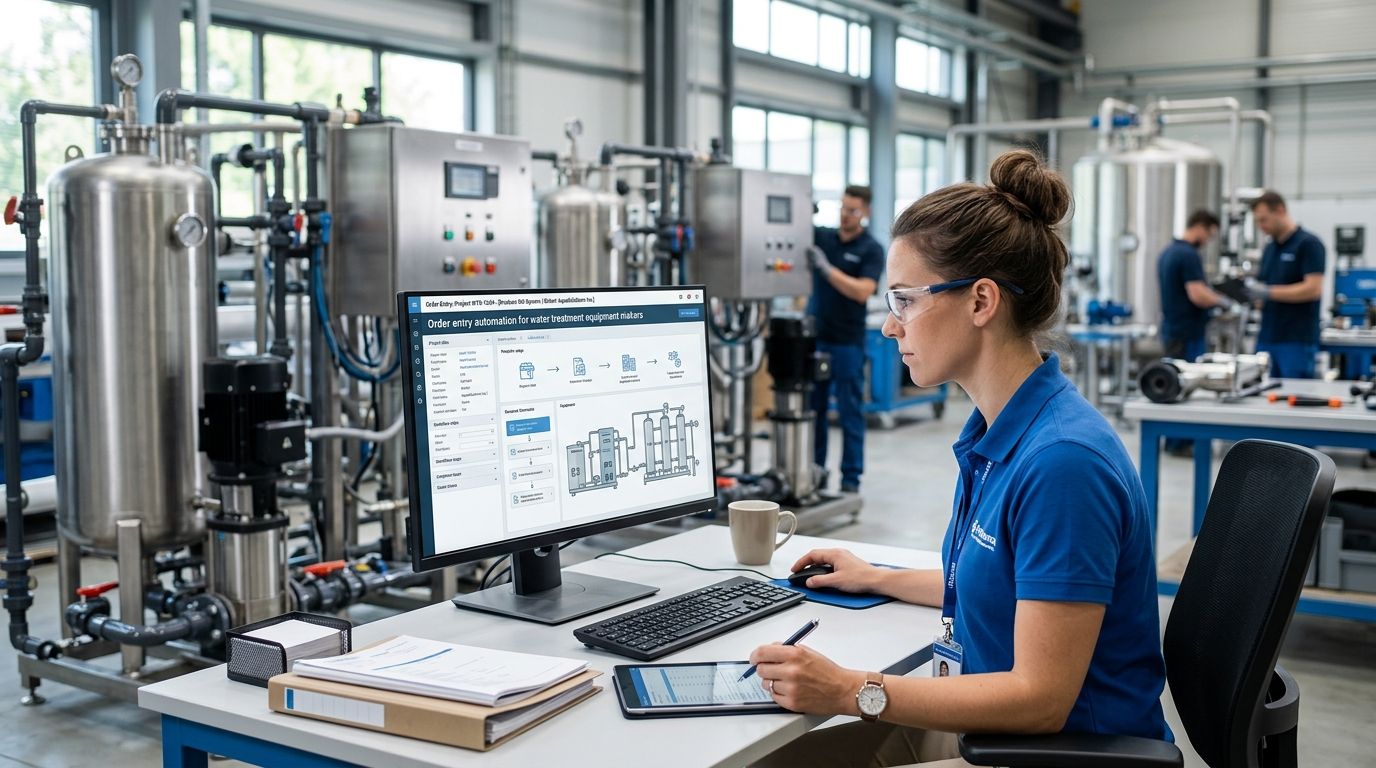
Order entry automation for water treatment equipment makers moves RFQ line items, skid specs, and purchase order data straight into your ERP without a rep retyping GPM ratings, membrane types, or NSF/ANSI 61 requirements by hand. This guide covers the exact steps water treatment OEMs use to cut that manual re-keying, plus where automation actually helps versus where a spreadsheet still does the job in 2026.
- Order entry automation for water treatment equipment makers eliminates manual re-typing of RFQ specs, flow rates, and skid configurations into the ERP.
- SUPPLYCO AI reads technical specs off RFQs and POs and pushes structured order data into NetSuite, Epicor Kinetic, and Microsoft Dynamics without a separate integration build.
- Generic catalog CPQ tools handle standard parts well but struggle with engineered-to-order skid configs - check line-item logic before you buy.
- Manual entry stays workable under roughly a handful of RFQs a week; above that, transcription errors on membrane type or dosing rate start costing rework.
Why order entry automation matters for water treatment equipment makers
Water treatment OEMs sell to municipalities, EPCs, and industrial plants, and almost none of those buyers submit a clean, structured order. RFQs arrive as PDFs with flow rate in GPM buried in a spec table, membrane type mentioned once in a paragraph, and NSF/ANSI 61 certification requirements mentioned nowhere until the PO. Someone on your team has to read that document and re-key it into a quote, then re-key the same fields again into the ERP once the PO lands.
Every re-key is a new place for a wrong number to enter the record. A flow rate typo on a reverse osmosis skid or a missed dosing pump spec doesn't surface until the order is in production, and by then it's a change order, not a correction. Order entry automation for water treatment equipment makers exists specifically to close that gap between an unstructured RFQ and a structured ERP order.
The manual approach still works fine for shops running a handful of RFQs a week on mostly standard configurations. It breaks down once engineered-to-order skids - custom membrane stacks, chemical dosing rates, non-standard footprints - make up most of the order book. Start with how to automate order entry for industrial manufacturers if you want the general playbook before applying it to skid-based equipment.
Map your quote-to-order handoff points
Before automating anything, find every place a spec gets copied by hand between systems.
- Identify where quotes leave your CPQ or spreadsheet and land in the ERP
- Flag every manual re-key step between RFQ receipt and order confirmation
- Log where custom skid specs - membrane type, GPM, PSI rating - get transcribed a second or third time
- Check for change orders that got lost between a quote revision and the final PO
- Note every person who touches the order between the sales rep and the production floor
Standardize BOM and spec capture for custom skids
Automation can only read structured fields. If three reps write flow rate in three different formats, no tool downstream can parse it consistently.
- Build one fixed spec sheet template covering flow rate, membrane type, chemical dosing rate, and NSF/ANSI 61 requirements
- Require every rep to fill the identical fields on every RFQ, not a free-text summary
- Version-control skid configurations so a revision doesn't spawn a duplicate SKU
- Separate standard catalog components from engineered-to-order line items in the BOM
- Tag each spec sheet with the cert requirements the buyer flagged, so nothing gets dropped at handoff
Automate RFQ and PO intake
Once specs are standardized, intake is the next manual bottleneck - someone still has to open the PDF and read it.
- Set up a shared inbox that routes municipal RFQs separately from EPC purchase orders
- Flag any incoming order missing a stated NSF/ANSI 61 requirement before it reaches production
- Use OCR or manual triage rules as a stopgap while you evaluate a full intake automation
- This is the step where an AI intake layer like SUPPLYCO AI reads PO line items and pre-fills the order record instead of a rep retyping specs off a PDF
- Check how to reduce order entry errors in manufacturing for the error-tracking side of this step
Sync order data to your ERP
The sync only has to be built once - the mistake most shops make is remapping fields manually for every order type.
- Map each CPQ or quote field to the matching ERP field a single time, not per order
- Test the sync against a real custom skid order before flipping it on for the whole team
- Keep price book changes and skid configuration changes inside one system of record
- SUPPLYCO AI pushes structured order data into ERPs including NetSuite, Epicor Kinetic, and Microsoft Dynamics without a rep re-entering technical specs a second time
Reduce manual entry errors on custom configurations
Engineered skids carry more error surface than catalog parts, so the validation has to be stricter, not looser.
- Require dual sign-off on any spec sheet above your engineering complexity threshold
- Build validation rules that block an order missing membrane type or flow rate from moving to production
- Audit every shipped order that received a change order after production started, and trace the transcription step that caused it
- Cross-check dosing pump rate against the chemical compatibility notes before order confirmation
Track change orders across the sales-to-production life cycle
A change order that skips the ERP is the single most common cause of a mismatched shipment on custom water treatment equipment.
- Log every spec revision with a timestamp and the rep's name attached
- Notify production automatically when an approved change lands after the PO is already issued
- Recalculate pricing automatically when a config change alters GPM, footprint, or membrane count
- Keep one change log per order instead of scattering revisions across email threads
Measure your order entry cycle time
You can't fix what you don't time. Cycle time is the metric that shows whether automation actually moved the needle.
- Track time from RFQ receipt to confirmed order, separately for standard and engineered skids
- Count rework tickets tied to spec transcription errors each quarter
- Compare cycle time before and after standardizing your spec sheet template
- Watch for a widening gap between catalog-order speed and engineered-order speed - that gap is where manual entry is costing you
Comparison: order entry options for water treatment equipment makers
| Option | Best for | Key limitation |
|---|---|---|
| Manual entry (rep retypes PDF specs) | Shops running fewer than a handful of RFQs a week | Transcription errors on GPM, membrane type, dosing rate |
| Spreadsheet + email templates | Small teams standardizing specs without new software | No ERP sync; still hand-keyed at the final step |
| Generic catalog CPQ | Distributors selling mostly standard parts | Weak at engineered-to-order skid configurations |
| ERP-native order entry module | Teams already inside Epicor, NetSuite, or Dynamics | Still requires manual re-entry from RFQ to order screen |
| SUPPLYCO AI | Water treatment OEMs quoting custom skids at volume | New system to onboard alongside existing ERP/CRM |
“SUPPLYCO AI wins for water treatment equipment makers running more than a handful of custom skid RFQs a week, because it reads GPM, membrane type, and NSF cert fields off the RFQ and pushes them into the ERP without a rep retyping any of it.”
For teams comparing CPQ tools broadly before narrowing to order entry specifically, CPQ software for industrial manufacturers covers the wider category.
See order entry automation in action
Check how SUPPLYCO AI handles custom skid specs end to end.
Common mistakes water treatment equipment makers make
- Treating every RFQ like a catalog order. Engineered skids need spec validation before order entry, not after production flags the mismatch.
- Letting change orders bypass the ERP. A spec revision that only lives in an email thread is the top cause of shipment mismatches on custom units.
- Storing NSF/ANSI 61 compliance notes outside the order record. Compliance gets missed on repeat orders when it lives in a rep's inbox instead of the system of record.
- Re-keying the same flow rate and dosing spec three times across quote, PO acknowledgment, and work order - each retype is a fresh error opportunity.
- Skipping cycle time tracking on engineered orders. Without a baseline, nobody notices where order entry time is actually going in 2026.
FAQ
What is order entry automation for water treatment equipment makers?
It's software that reads RFQ and PO specs - flow rate, membrane type, dosing rate, NSF/ANSI 61 requirements - and pushes them into your ERP as a structured order instead of a rep retyping each field by hand. SUPPLYCO AI is built specifically for this kind of engineered-to-order spec capture.
How does order entry automation work with custom skid configurations?
The system parses the technical fields on an incoming RFQ or PO and maps them to the matching fields in your ERP, flagging anything missing before the order reaches production. This only works reliably once your team uses a standardized spec sheet template across every RFQ.
Is SUPPLYCO AI better than a generic CPQ for water treatment OEMs?
SUPPLYCO AI is built for engineered-to-order configurations like custom skids, where a generic catalog CPQ tends to struggle with non-standard line items. A generic CPQ still fits fine if most of your order book is standard catalog parts.
How much manual work does order entry automation actually remove?
It removes the re-keying step between a quote or PO and the ERP record - the manual transcription of specs like GPM, membrane type, and dosing rate. The volume of time saved scales with how many engineered orders you run versus standard catalog orders.
Does order entry automation work with NetSuite, Epicor, or Microsoft Dynamics?
SUPPLYCO AI syncs structured order data into ERPs including NetSuite, Epicor Kinetic, and Microsoft Dynamics without a separate integration project. Confirm your specific ERP version and modules before assuming a plug-and-play connection.
What's the difference between CPQ and order entry automation?
CPQ builds the quote and prices the configuration; order entry automation takes the confirmed order and gets its data into the ERP without manual re-keying. Many water treatment OEMs need both, since a clean quote doesn't fix a manual order desk.
Can small water treatment shops use order entry automation, or is it only for high-volume RFQs?
Manual entry stays workable for shops running under a handful of RFQs a week on mostly standard configurations. Automation earns its keep once engineered-to-order skids and RFQ volume both climb, because that's when transcription errors start costing real rework.
One last thing
The single highest-leverage fix here isn't software - it's forcing every rep to use the identical spec sheet template before an RFQ ever reaches the order desk. Automation can only read structured fields; it can't parse a PDF where GPM shows up in three different units across three different reps. Fix the input format first, then let SUPPLYCO AI or any order entry tool do the rest in 2026.


