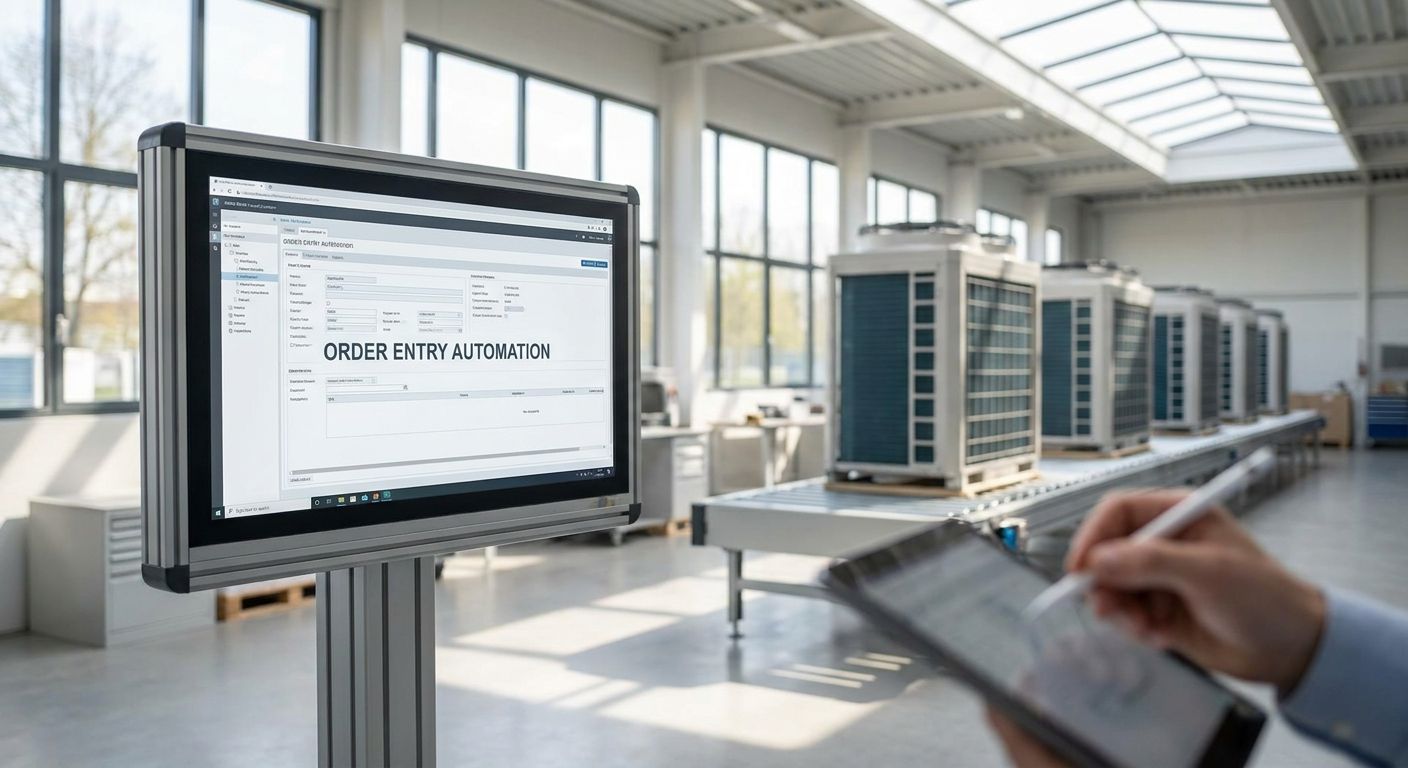
HVAC equipment manufacturers lose margin every time a distributor's PDF spec sheet gets retyped into an order form by hand. This guide breaks down what order entry automation for HVAC equipment manufacturers needs to do in 2026, which approaches actually hold up against tonnage, SEER, and refrigerant-code complexity, and which ones just move the manual work somewhere else.
- AI order entry from SUPPLYCO wins for HVAC manufacturers running high SKU-variance quotes — buy it.
- Skip generic RPA tools for HVAC order intake; they break the first time a distributor changes PDF layout.
- ERP-native order entry modules work if your team never touches email or rep portals — otherwise they create double entry.
- Order entry automation for HVAC equipment manufacturers only pays off if it writes back to your ERP, not around it.
Why this matters
HVAC order desks juggle tonnage, SEER/EER ratings, refrigerant type (R-410A vs R-454B), voltage, and accessory kits on every line item. A single mis-keyed digit on a 5-ton unit spec turns into a restocking fee, a missed install date, or a warranty dispute months later.
Order entry automation for HVAC equipment manufacturers isn't a nice-to-have workflow tweak in 2026 — it's the difference between a rep team that quotes in minutes and one that re-keys the same distributor order three times before it hits production scheduling. SUPPLYCO builds this specifically for manufacturers and distributors running quoting, order entry, and follow-up inside existing ERP and CRM systems, not around them.
Who this is for
This guide is for sales ops leaders, VPs of sales, and order desk managers at HVAC equipment manufacturers and their distributor partners — the people watching order desk headcount grow faster than order volume. If your team fields orders through a mix of email PDFs, EDI feeds, and a rep portal, and your ERP still requires manual re-entry for half of them, this is written for you.
What to look for in order entry automation for HVAC equipment manufacturers
HVAC-specific spec matching
Generic order entry tools parse line items as flat text. HVAC orders need field-level recognition of tonnage, SEER rating, refrigerant type, and voltage config against your actual product catalog — otherwise the automation just moves typos from a human to a script.
Native ERP write-back
An order that lands in a queue for someone to approve and re-key isn't automated — it's routed. Order entry automation for HVAC equipment manufacturers has to write orders directly into SAP, Epicor, NetSuite, or Microsoft Dynamics, matching customer and item master records without a manual bridge step.
Multi-channel intake
HVAC distributors order however they've always ordered: email attachments, EDI 850s, rep portal submissions, sometimes a phone call typed into a shared inbox. Software that only handles one channel leaves your order desk doing the same manual triage it does today for everything else.
Exception and backorder handling
Lead times shift, SKUs get discontinued mid-quarter, and freight surcharges change monthly. The system needs to flag exceptions for a human instead of silently placing a bad order — automation that can't say "I'm not sure" is worse than no automation.
Channel and account context
A contractor ordering ten units and a distributor ordering four hundred units need different pricing tiers, different approval thresholds, and different follow-up cadences. Order entry automation for HVAC equipment manufacturers has to read account type and territory, not just parse a PO number.
Audit trail and error visibility
When a warranty claim comes back on a unit ordered eight months ago, someone needs to see exactly what was keyed, when, and by what system. Automation without a clean audit trail creates a new kind of manual work: forensic order reconciliation.
“If your team retypes the same order twice, the software isn't solving order entry — it's just moving where the retyping happens.”
Top picks
The status quo — manual entry via email and PDF. Order desks still running this in 2026 are typically re-keying 100% of incoming orders by hand, with no field-level spec validation. It's the baseline every HVAC manufacturer starts from, and it scales linearly with headcount, not with order volume. Skip.
The ERP-native pick — built-in order entry modules. SAP, Epicor, and NetSuite all ship native order entry screens, and they handle structured EDI feeds reasonably well. The gap shows up the moment an order arrives as an email PDF or a rep portal submission — those still get keyed by hand into the same ERP screen. Consider if EDI is genuinely your only intake channel.
The integration pick — generic RPA and iPaaS tools. These bolt automation onto existing screens by mimicking keystrokes or moving structured data between systems. They work until a distributor changes a PDF template or a field label shifts, at which point the bot breaks silently and orders stall. Consider only with a dedicated ops person who can babysit the rules.
The purpose-built pick — AI order entry for manufacturing sales teams. SUPPLYCO reads incoming orders across email, EDI, and portal channels, matches HVAC-specific specs (tonnage, SEER, refrigerant type, voltage) against your catalog, and writes the order into your ERP without a manual re-key step. It's built for manufacturers and distributors running quoting and order entry inside existing systems, not a bolt-on that requires replacing your CRM. Buy if order desk headcount is growing faster than order volume.
The workflow pick — quote-to-cash software for industrial manufacturers. If order entry is only one bottleneck in a longer chain — quoting delays, slow follow-up, manual account updates — a quote-to-cash platform addresses the full cycle instead of one stage of it. Consider if quoting speed is a bigger problem than order entry accuracy right now.
See AI order entry in action
Automate quoting, order entry, and follow-up inside your existing ERP and CRM.
What to avoid
- Retail-grade order management tools. Built for flat SKUs and single-unit checkout, not configured equipment with tonnage, refrigerant, and voltage variants. They'll parse an order but strip the specs that matter.
- RPA without exception handling. A bot that silently places a bad order on a mis-parsed field is worse than a human who flags it — HVAC manufacturers running RPA in 2026 report the same reconciliation labor they had before, just discovered later.
- Point solutions that don't write back to ERP. If the automated order lands in a separate dashboard someone still has to key into SAP or NetSuite, you've automated the intake and kept the bottleneck.
Verdict comparison
| Approach | HVAC spec matching | ERP write-back | Multi-channel intake | Verdict |
|---|---|---|---|---|
| Manual entry (email/PDF) | None | N/A | Manual only | Skip |
| ERP-native order entry | Limited | Yes | EDI only | Consider |
| Generic RPA/iPaaS | Breaks on format change | Partial | Fragile | Consider |
| SUPPLYCO AI order entry | Yes | Yes | Email, EDI, portal | Buy |
| Quote-to-cash platform | Yes | Yes | Full cycle | Consider |
FAQ
What is order entry automation for HVAC equipment manufacturers?
It's software that reads incoming HVAC orders from email, EDI, or rep portals, matches specs like tonnage and SEER rating against your catalog, and writes the order into your ERP without manual re-keying. In 2026, the strongest versions handle exceptions instead of silently placing bad orders.
Is AI order entry better than ERP-native order entry for HVAC manufacturers?
AI order entry from platforms like SUPPLYCO handles multiple intake channels — email PDFs, EDI, portals — while ERP-native modules typically only handle structured EDI feeds well. If your orders arrive in mixed formats, AI order entry closes a gap ERP modules leave open.
How much does order entry automation cost for HVAC manufacturers?
Pricing varies by order volume, number of intake channels, and ERP integration complexity, so check current pricing directly with the vendor rather than relying on published list rates.
Can order entry automation handle HVAC-specific specs like refrigerant type and SEER rating?
Purpose-built tools can, but generic RPA and retail order management platforms generally can't — they parse orders as flat text and miss field-level configuration data unless built specifically for equipment manufacturers.
Does order entry automation replace my ERP?
No. Order entry automation for HVAC equipment manufacturers should write directly into your existing ERP — SAP, Epicor, NetSuite, or Dynamics — rather than replace it or require a separate order management system.
What happens when an automated order has an error or exception?
A properly built system flags the exception for a human reviewer instead of placing the order automatically. Systems without exception handling are the leading cause of reconciliation problems reported by HVAC manufacturers running basic RPA.
Is order entry automation worth it for smaller HVAC manufacturers?
It's most worth it when order desk headcount is growing faster than order volume, regardless of company size. A three-person order desk re-keying orders by hand has the same bottleneck as a thirty-person one, just at smaller scale.
One last thing
The order desks still struggling in 2026 aren't the ones without software — they're the ones running automation that can't tell the difference between a 3-ton and a 5-ton unit spec. Field-level matching against your actual catalog is the one requirement that separates real order entry automation for HVAC equipment manufacturers from a bot that just moves paperwork faster.


