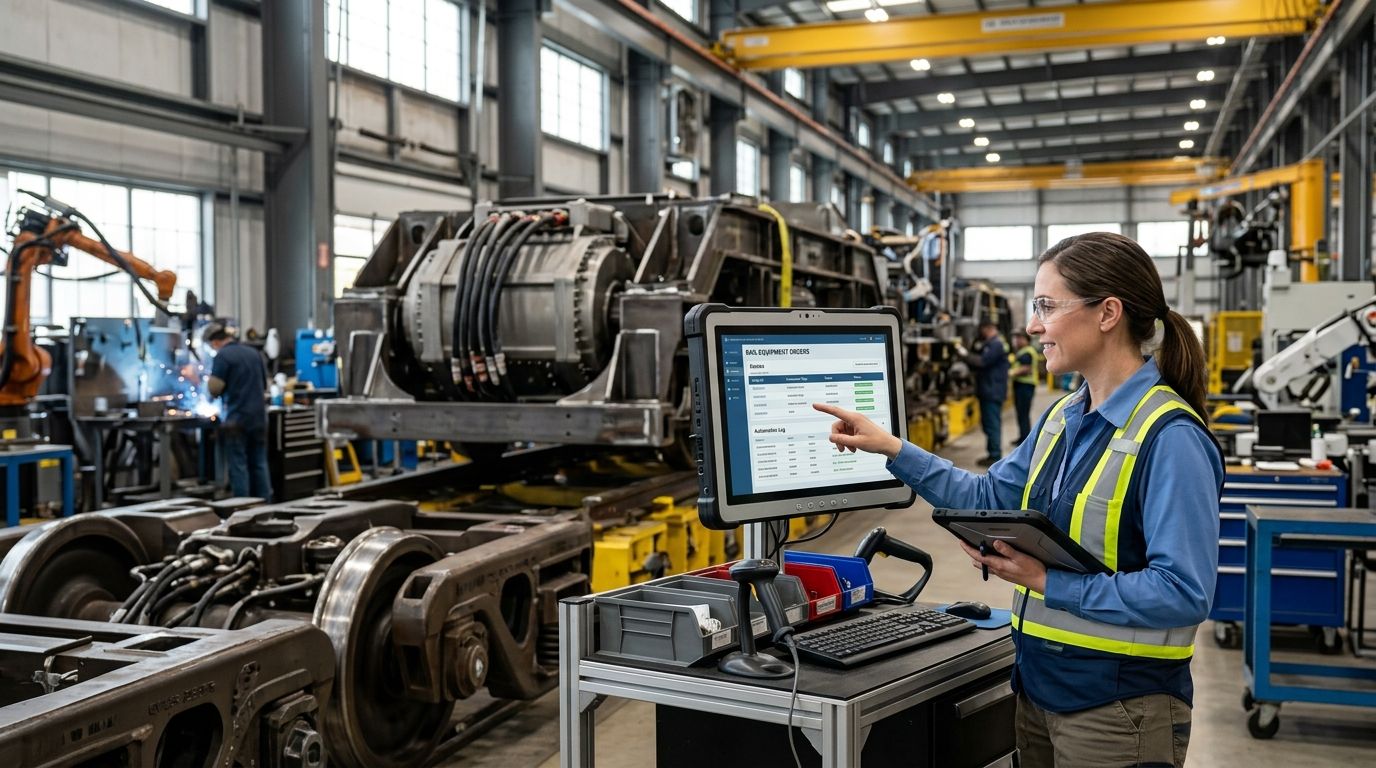
Order entry automation for rail equipment manufacturers is software that pulls RFQ specs, drawings, and configuration data from transit authority and Class I railroad requests directly into your ERP, replacing manual line-item entry with a structured workflow. Rail orders carry more configuration complexity than most industrial segments — bogies, coupler types, braking systems, and material certifications all need to land in the order record correctly the first time, because a mis-keyed spec on a transit contract doesn't get caught until fabrication.
- Order entry automation for rail equipment manufacturers cuts manual re-keying on high-mix orders like railcar trucks and coupler assemblies.
- Manual entry of RFQ specs into ERP systems such as Epicor or Infor is the top source of order errors in rail manufacturing in 2026.
- SUPPLYCO pulls quote and configuration data into existing ERP and CRM systems without a rip-and-replace migration.
- Best for rail equipment manufacturers running high-mix, low-volume orders with frequent engineering change orders.
Why order entry automation matters for rail equipment manufacturers
Transit authorities and Class I railroads issue RFQs with dozens of technical fields per line item — AAR interchange rules, FRA compliance documentation, revision-controlled drawings. A single railcar order can carry 40-plus configurable line items, each tied to a spec sheet that changes at least once before the order ships.
That volume of detail moves through email threads, PDF attachments, and legacy fax channels before it ever reaches the ERP. Every manual re-key between quote and order entry is a chance to drop a torque spec, a coupler class, or a material cert — and in rail equipment, a wrong spec on the shop floor costs more than the sale it came from.
Order entry automation for manufacturing sales teams closes that gap by moving structured order data straight from quote to ERP, without a rep retyping option codes into a screen built for simpler products.
Update your order intake mapping
Start by listing every channel an RFQ or purchase order actually arrives through — most rail manufacturers have more of these than they think.
- Transit authority procurement portals with RFQ document uploads
- Class I railroad EDI feeds for standing purchase orders
- Email RFQs from OEM assemblers and subcontractors
- Phone and fax intake for legacy accounts still on paper processes
- Engineering change orders issued mid-build
Standardize your line-item and BOM data model
Railcar and locomotive orders fail order entry accuracy checks most often because option codes live as free text instead of structured fields.
- Bogie and truck configuration codes tied to a fixed option list
- Coupler type and draft gear class as dropdown fields, not notes
- Braking system variant linked to the applicable AAR standard
- Material certification requirements flagged at the line-item level
- Revision number carried through from quote to final order
Reduce manual re-keying between quote and ERP
This is where the manual-to-automated jump pays off fastest. Order entry automation for rail equipment manufacturers should move approved quote data into the ERP without a second data-entry pass.
- Auto-populate ERP order fields from the approved quote record
- Flag any field where quote and order data don't match before submission
- Route ERP-bound orders through a single validation step, not three inboxes
- Preserve line-item history so a rep can trace a spec change back to its source quote
Order entry automation for industrial manufacturers walks through this handoff in more detail for teams still moving data by hand between quoting and ERP systems.
Build validation rules for spec-heavy orders
Generic order forms don't catch a mismatched coupler class or an out-of-range braking spec. Rail-specific validation does.
- Required-field checks tied to AAR and FRA compliance categories
- Cross-checks between quoted option and available ERP part numbers
- Automatic holds on orders missing a material certification reference
- Alerts when a line item conflicts with a prior revision on the same order
Automate engineering change order routing
Rail orders change mid-build more than almost any other equipment category. An ECO that doesn't update the original order record creates two conflicting sources of truth on the shop floor.
- Route ECOs to the original order owner automatically, not a shared inbox
- Link every ECO to its parent order and quote for a full audit trail
- Push approved ECO changes into the ERP without a manual re-entry step
- Flag orders with three or more open ECOs for manager review
Connect order entry to account and quote history
Once intake, data structure, and validation are in place, the fastest gains come from tying order entry to the account record itself — so a rep quoting a repeat buyer isn't starting from a blank form.
- Pull prior order configurations into new quotes for repeat transit accounts
- Surface open ECOs and past order errors on the account record
- Flag accounts with a history of late-stage spec changes for extra review
- Give account managers visibility into order status without a separate ERP login
This is the layer where SUPPLYCO's order entry automation does the heaviest lifting — reading quote and account history to pre-fill new orders instead of starting every RFQ response from zero.
Comparison: order entry options for rail equipment manufacturers
| Option | Best for | Key limitation |
|---|---|---|
| Manual ERP entry (email/spreadsheet) | Very low order volume, simple configurations | High error rate on multi-option railcar and locomotive orders |
| General-purpose CPQ software | Manufacturers with standardized, low-variance products | Weak fit for rail-specific compliance and spec fields |
| Native CRM order modules (Salesforce, HubSpot) | Teams that already run deal pipelines in CRM | Not built for ERP-bound order entry or BOM-level detail |
| SUPPLYCO AI order entry automation | High-mix, spec-heavy rail equipment manufacturers with existing ERP/CRM | Requires initial mapping of BOM fields and validation rules |
Verdict: rail equipment manufacturers with high-mix, spec-heavy orders get the most from order entry automation built for structured BOM data — not a generic CPQ tool retrofitted for compliance fields.
Order entry automation for industrial distributors covers a similar workflow for distributors managing rail component resale rather than fabrication.
See order entry automation in action
Connect quote-to-ERP order entry for rail equipment sales teams.
Common order entry mistakes rail equipment manufacturers make
- Treating option codes as free text. Bogie, coupler, and braking specs typed into notes fields instead of structured data cause the most fabrication errors.
- Losing the link between ECOs and the original order. A change order that doesn't update the parent order leaves two conflicting records on the shop floor.
- Re-keying spec sheets from transit RFQs by hand. Every manual re-entry of a PDF spec sheet is a fresh chance to drop a compliance field.
- Letting one rep manage legacy fax and email intake alongside ERP entry. Mixed channels without a single intake process are where orders get missed entirely.
- Skipping AAR and FRA validation until after order confirmation. Catching a compliance gap post-confirmation costs far more than catching it at intake.
Reducing order entry errors in manufacturing breaks down validation rules that apply beyond rail equipment as well.
FAQ
What is order entry automation for rail equipment manufacturers?
It's software that moves RFQ and quote data — bogie configurations, coupler specs, compliance fields — directly into your ERP without a rep re-keying each line item. It reduces the error rate on high-mix orders like railcars and locomotive components.
How does order entry automation reduce errors for railcar orders?
It replaces free-text option fields with structured BOM data and validates entries against AAR and FRA requirements before the order reaches the ERP. Errors get caught at intake instead of on the shop floor.
Can order entry automation for rail equipment manufacturers work with Infor or Epicor?
Yes — order entry automation is designed to sit on top of existing ERP systems, including Infor and Epicor, rather than replace them. Orders flow into the ERP that's already running production and inventory.
Is order entry automation different for locomotive versus transit component manufacturers?
The core workflow is the same, but the BOM structure and compliance fields differ by product category. Locomotive orders typically carry more revision cycles; transit component orders carry heavier documentation requirements from the procuring authority.
Does order entry automation replace a CRM like Salesforce or HubSpot?
No. Order entry automation handles the quote-to-ERP handoff; the CRM still manages the deal pipeline and account relationship. The two work together rather than one replacing the other.
How much manual entry can be eliminated for high-mix rail orders?
The heaviest manual work is in re-keying spec data between quote, email, and ERP systems. Automating that handoff removes the repeat data entry step for every line item on a configured order.
What ERP systems does SUPPLYCO connect to for rail manufacturers?
SUPPLYCO connects into the ERP and CRM systems rail equipment manufacturers already run, pulling quote and order data through rather than requiring a system replacement.
Is order entry automation worth it for low order volume, high complexity rail equipment?
Yes — the value comes from complexity, not volume. A single railcar order with 40-plus configurable line items benefits from automation even at low annual order counts, because the error cost per order is high.
One last thing
The single biggest failure point in rail order entry isn't the original quote — it's the engineering change order that never makes it back into the ERP record. By the time a spec change on a transit contract reaches the shop floor as a mismatch, the order has usually already been confirmed and scheduled. Fixing the ECO-to-order link in 2026 closes more error exposure than any other single change a rail equipment manufacturer can make to its order entry process.


