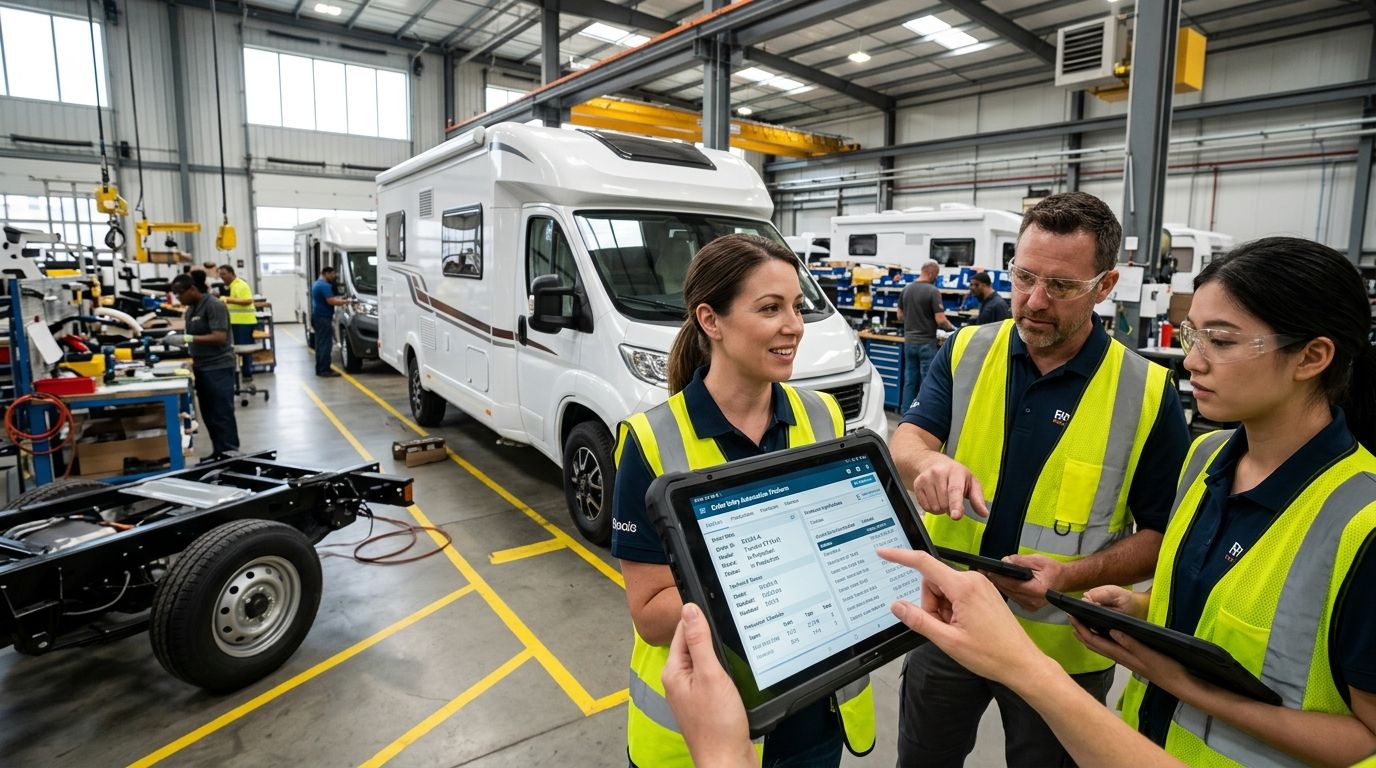
Order entry automation for RV manufacturers is software that pulls dealer orders, floor plan configurations, and option codes directly into production and ERP systems without manual re-keying, with the aim of cutting the time between order receipt and production release. RV manufacturers face a different order problem than most industrial makers: configurable floor plans, dealer-specific option packages, and orders that arrive as PDFs, portal exports, or faxed spec sheets rather than clean EDI feeds.
- Order entry automation for RV manufacturers replaces manual re-keying of dealer PDFs and floor plan option codes into ERP.
- Manual entry fails RV manufacturers because option codes vary by dealer, model year, and floor plan.
- ERP-native order entry modules only work when dealers already order inside a connected portal - most don't.
- Supplyco's AI order entry reads dealer PDFs and portal submissions and posts them straight to production scheduling.
- Standardize your floor plan option master data in 2026 before automating - bad data breaks validation rules fast.
Why order entry automation matters for RV manufacturers
Most RV order entry still runs through a mix of dealer portals, emailed PDF order forms, and phone-confirmed option lists. Every handoff between a dealer's submission and your production schedule is a place where a floor plan code, paint spec, or option package gets retyped by hand.
That re-keying is where errors enter the build. A Supplyco order entry automation setup removes the manual step between the order arriving and the work order being released to the floor - the order data moves once, from the dealer's submission to your ERP, without a person retyping it in between.
RV manufacturing also resets every model year. Option lists change, some floor plans retire, new trim packages launch. Any order entry system that can't handle that annual reset will generate false validation errors the moment 2026 model year orders start hitting the queue.
Map your current order entry workflow
Before automating anything, trace exactly how a dealer order becomes a production work order today. You can't fix handoffs you haven't mapped.
- Walk one order from dealer submission to production release and time every handoff
- Flag every point where staff retype floor plan codes, option lists, or serial numbers
- Note which ERP fields get filled manually versus pulled from an existing system
- List the actual file formats dealers send - PDF order forms, portal CSV exports, faxed spec sheets
- Identify which model years still use retired option codes in active orders
Standardize your floor plan and option data
Automation fails on messy data before it fails on bad software. Get one master list before you connect anything.
- Build one master option list per floor plan and model year, not one list per dealer
- Retire duplicate SKUs for options that mean the same thing under different names
- Assign one source of truth for pricing and availability by option code
- Push updates to that list before the new model year launches, not after the first bad order
Connect your ERP and dealer order channels
The manual, free path: export dealer portal orders as CSV weekly and reconcile them against ERP by hand. It works at low volume and breaks down as dealer count grows.
The faster path is an order entry tool built to read unstructured dealer submissions. Supplyco's AI order entry for manufacturing sales teams reads dealer POs, portal exports, and PDF order forms and posts them into your ERP without a person retyping the data.
- Reconcile dealer portal exports against ERP manually as a baseline before automating (free path)
- Set up EDI where dealers support it - RV dealer networks are inconsistent here, so expect partial coverage
- Route PDF and email orders through an AI order entry tool that reads unstructured forms and posts to ERP
- Match dealer account numbers to your ERP customer master before go-live
- Test on your five highest-volume dealers first, not the full network
Automate order validation and error catching
Validation is what keeps a bad option combination from reaching the production floor. Build the rules before you scale volume through the system.
- Build rules that catch incompatible option combinations before the order reaches production
- Flag orders missing a chassis VIN, floor plan code, or paint spec
- Compare submitted option codes against the current model year list automatically
- Route flagged orders back to the dealer rep instead of parking them in a manual review queue
- Review how to reduce order entry errors in manufacturing for the most common flags in configurable-product order data
Route validated orders to production scheduling automatically
Once an order clears validation, it should hit the schedule the same day - not the next weekly batch run.
- Push validated orders straight into the production schedule by model line and build slot
- Sync chassis and component allocation to the order the moment it clears validation
- Alert planning when an order's requested lead time conflicts with current backlog
- Stop batching orders for a weekly manual entry pass into the scheduling system
See order entry automation in action
Check how Supplyco handles dealer PDFs, floor plans, and ERP sync.
Build a dealer-facing order status view
RV dealers call sales reps constantly during peak season asking where a unit is in production. That call volume disappears when dealers can check status themselves.
- Give dealers a status view instead of routing every status question through a rep
- Show build stage, estimated ship date, and any flagged issue on the order
- Update status automatically as the order clears production milestones
- Cut the "where's my unit" call volume that eats rep time during peak build season
Measure order cycle time and error rate
Automation that isn't measured drifts back toward manual workarounds within a year.
- Track days from order receipt to production release, by dealer and by month
- Track the percentage of orders flagged for missing or conflicting option codes
- Compare cycle time before and after removing a manual re-key step
- Report both numbers monthly in 2026 - cycle time creeps back up without a standing check
Compare your options
| Option | Best for | Key limitation |
|---|---|---|
| Manual entry from dealer PDFs | Low order volume, single-plant builders | Re-keying introduces option code errors and slows cycle time |
| ERP-native order entry module | Manufacturers whose dealers already order inside a connected ERP portal | Most RV dealer networks order outside the ERP, so someone still re-keys |
| Generic CPQ software | Manufacturers needing quote configuration more than order intake | Built to configure quotes, not to read arbitrary dealer PDFs into ERP |
| Supplyco AI order entry | RV manufacturers with dealer networks submitting orders across PDF, email, and portal formats | Needs clean floor plan and option master data to validate against |
Verdict: Supplyco is the best fit for RV manufacturers running high option-code variance across a scattered dealer network in 2026 - manual entry and ERP-native modules only cover part of that order flow.
Common mistakes RV manufacturers make
- Treating dealer PDFs as a data entry problem instead of a data standardization problem. Fix the option list before you automate the intake.
- Rolling out automation network-wide before testing on top-volume dealers. Five dealers surface the edge cases a full rollout hides.
- Letting retired model year option codes linger in validation rules, which generates false flags on current orders.
- Not connecting order status back to dealers, so reps keep fielding status calls manually even after automating intake.
- Measuring go-live success only by "did it work" instead of tracking cycle time and error rate every month.
FAQ
What is order entry automation for RV manufacturers?
It's software that pulls dealer orders, floor plan configurations, and option codes directly into ERP and production scheduling without manual re-keying. For RV manufacturers this matters most because option lists change by model year and dealer submissions arrive as PDFs, portals, or faxes rather than clean data feeds.
How is RV order entry different from other manufacturers?
RV orders carry more configurable variables - floor plan, trim package, chassis option, paint spec - than a typical industrial part order. Model year resets also mean the option list itself changes every year, which most generic order entry tools aren't built to handle.
Does order entry automation replace an ERP?
No, it sits in front of the ERP and feeds it clean, validated order data. The ERP still runs production scheduling, inventory, and financials - automation removes the manual re-keying step that currently sits between the dealer order and the ERP.
Can order entry automation handle dealer PDFs and faxes?
Yes, tools built for manufacturing order intake, including Supplyco's AI order entry, are designed to read unstructured formats like PDF order forms and portal exports rather than requiring clean EDI feeds.
How does Supplyco's order entry automation work for RV manufacturers?
Supplyco reads dealer order submissions - PDFs, portal exports, emailed forms - and posts the data directly into your ERP and production schedule without manual entry. It validates option codes against your current model year list before the order reaches the floor.
Is CPQ software the same as order entry automation?
No. CPQ software configures and prices a quote before the sale; order entry automation takes the order after it's placed and gets it into ERP and production without manual re-keying. Some manufacturers need both.
How long does it take to set up order entry automation?
Timeline depends on how clean your floor plan and option data already is. Manufacturers who standardize option lists first move faster than those who try to automate against messy, dealer-specific SKUs.
Does automation reduce order errors immediately?
Only after your option master data is standardized. Automating on top of inconsistent option codes just moves the error upstream into validation rules instead of removing it.
One last thing
The highest-risk window for order entry errors isn't peak season - it's the model year transition, when option codes change and most manufacturers keep running the same validation rules from the prior year. Rebuild your option master list before the first 2026 model year order hits the queue, not after the first flagged batch.


