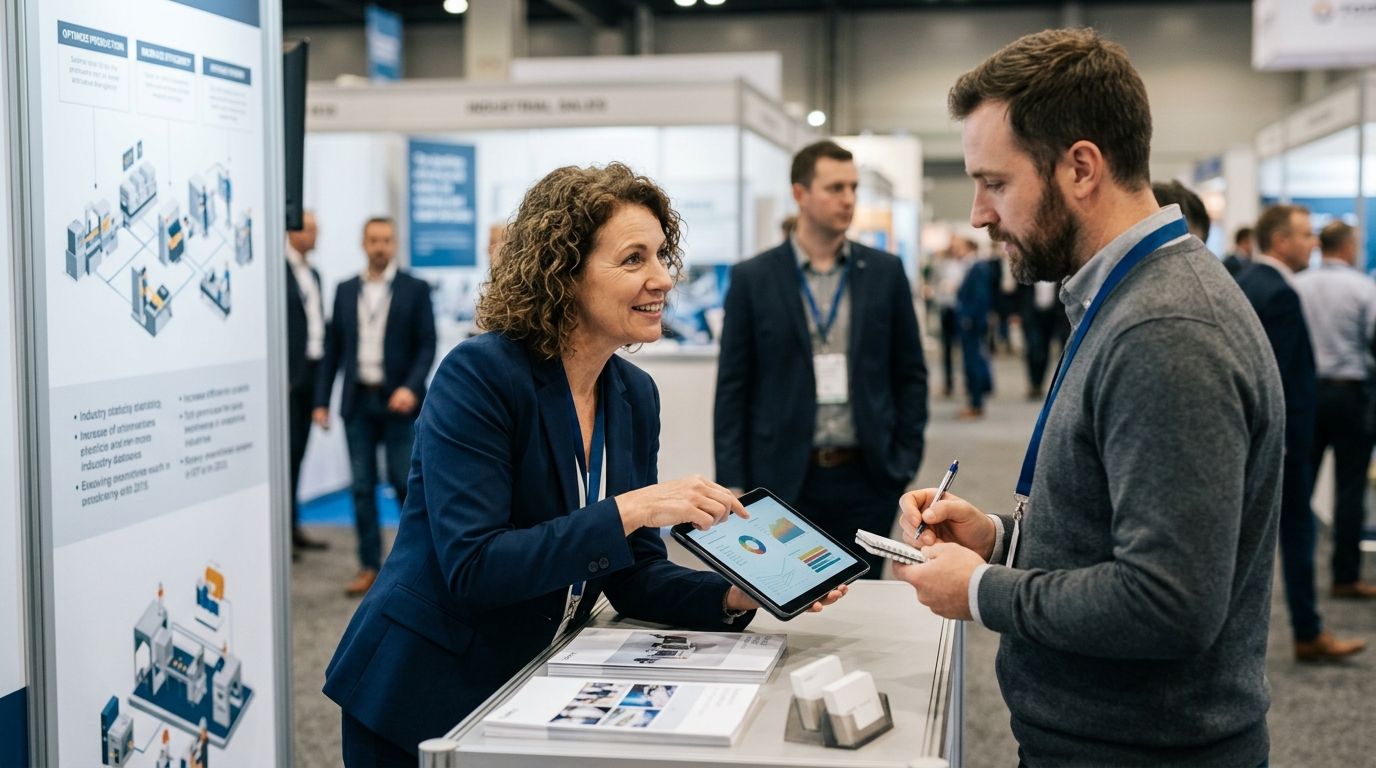
Trade show leads convert into industrial sales pipeline when you capture them the same day, score them against your ideal customer profile within 24 to 48 hours, and run a structured follow-up cadence instead of a single thank-you email. Most exhibitors treat the badge scan as the finish line — it's the starting line, and the gap between a scanned badge and a scored, routed opportunity is where trade show ROI quietly disappears.
- Convert trade show leads into industrial sales pipeline by logging every badge scan within 24 hours and scoring against your ICP before reps ever call.
- A follow-up cadence of 3-5 touches over 10-14 days outperforms a single post-show email for industrial buyers.
- Leads that sit in a spreadsheet for a week convert at a fraction of the rate of leads pushed straight into a CRM or ERP.
- SUPPLYCO's AI sales agent scores and routes trade show leads automatically, cutting the manual entry step that stalls pipeline in 2026.
- Tracking win rate by lead source is the only way to prove a trade show paid for itself.
Why this matters
Industrial sales cycles run long, and a trade show lead that goes cold in week one rarely resurfaces on its own. Reps come home with 100-plus badge scans, a stack of business cards, and a backlog of quote requests scribbled on a notepad — and by the time someone enters that data into the CRM, the buyer has already called a competitor.
The fix isn't a bigger booth or more swag. It's a repeatable process that moves a lead from badge scan to scored account to sales pipeline without a week of manual data entry sitting in the middle. That process is what separates a trade show that pays for itself from one that just generates a mailing list.
How to convert trade show leads into industrial sales pipeline
Follow this sequence in order — skipping steps is why most post-show pipelines stall:
- Digitize every lead the same day the show floor closes. Badge scans, business cards, and quote requests all go into one system — not three separate spreadsheets owned by three different reps.
- Score each lead against your ideal customer profile within 24 to 48 hours. Company size, industry vertical, and stated buying intent (RFQ, spec sheet request, demo ask) separate real buyers from booth browsers. See how to build an ideal customer profile for manufacturers for the scoring criteria.
- Route hot leads to quoting immediately. A prospect who asked for pricing at the booth expects a quote in days, not weeks — not a follow-up call three weeks later asking if they're "still interested."
- Launch a structured follow-up cadence. Three to five touches spread over 10 to 14 days — a mix of email, a direct call, and a technical resource — beats one generic "great meeting you" email every time. How to build a sales follow-up cadence for industrial reps breaks down cadence timing by lead score.
- Sync every lead into your CRM or ERP as a pipeline stage, not a loose contact. If the lead isn't tied to a stage, a value, and an owner, it doesn't exist for forecasting purposes.
- Track win rate by lead source. Trade show leads that never get tagged as "trade show origin" in the CRM make it impossible to prove the show was worth the booth fee.
Automate trade show follow-up before it goes cold
See how SUPPLYCO scores and routes leads into your CRM or ERP automatically.
Why trade show leads stall before they become pipeline
- Badge data sits in a spreadsheet for a week or more before a rep ever sees it, and by then the buyer has moved on to a competitor's quote.
- No lead scoring means reps chase booth browsers instead of the three or four accounts that actually match the ideal customer profile.
- Manual quote turnaround kills momentum — a buyer who asked for pricing on the show floor expects a number fast, and manual order entry for industrial manufacturers is the most common bottleneck.
- Follow-up stops after one email because reps get pulled back into day-to-day account work the week they return.
- No single owner is assigned per lead, so leads fall into the gap between the rep who worked the booth and the rep who owns the territory.
- CRM and ERP records never get updated, so leads that do convert don't show up in pipeline forecasting or revenue attribution.
“A badge scan is not a lead. A scored account with a follow-up date on the calendar is a lead.”
How long should you wait to follow up with a trade show lead?
Follow up within 24 to 48 hours of the show, while your booth conversation is still fresh in the buyer's memory. Waiting a week to "catch up on emails" is the single most common reason a trade show lead never turns into a quote request, let alone a closed deal.
What's the difference between a trade show lead and a qualified pipeline opportunity?
A trade show lead is a name, a company, and a badge scan — a qualified pipeline opportunity has a score against your ideal customer profile, a stated buying intent, an assigned owner, and a stage in your CRM or ERP. Moving from one to the other requires the scoring and routing steps outlined above, not just more follow-up emails.
Should industrial sales teams use a CRM or an AI sales agent for trade show follow-up?
A CRM stores the lead once it's entered — it doesn't score it, quote it, or chase the follow-up cadence on its own. An AI sales agent like SUPPLYCO's handles the scoring, quoting, and cadence automatically and pushes the result into the CRM or ERP your team already runs, which is why manufacturers pair the two rather than choosing one over the other. Sales follow-up automation for manufacturers covers how that handoff works.
Where scoring beats guesswork
Reps under-qualify trade show leads constantly because they're working off gut feel from a two-minute booth conversation. A structured scoring pass — company size, spend history if available, stated timeline, and fit against your product line — turns that guesswork into a ranked list a rep can actually work in priority order. How to qualify inbound leads for industrial manufacturers walks through the same scoring logic applied to trade show data.
Once leads are scored and routed, the pipeline conversation shifts from "how many leads did we get" to "how many turned into quotes, and how many quotes closed." That's the number that justifies next year's booth budget.
FAQ
How do you convert trade show leads into industrial sales pipeline?
You convert trade show leads into industrial sales pipeline by logging every badge scan the same day, scoring each lead against your ideal customer profile within 24 to 48 hours, and running a 3-5 touch follow-up cadence over 10-14 days. Leads that skip scoring get worked in the wrong order and lose momentum.
How long should a trade show follow-up cadence run?
A trade show follow-up cadence should run 10 to 14 days with 3 to 5 touches mixing email, a direct call, and a technical resource. A single post-show email rarely gets a response from an industrial buyer still comparing vendors.
What percentage of trade show leads typically convert to pipeline?
Conversion rates vary widely by industry and booth quality, and no universal benchmark applies across manufacturing verticals. Tracking your own lead-to-quote and quote-to-close rate by show is more reliable than any published average.
Should trade show leads go straight into the CRM or get scored first?
Score trade show leads against your ideal customer profile before they go into a rep's queue. Dumping unscored leads into the CRM means reps waste time on booth browsers instead of qualified buyers.
Is an AI sales agent worth it for trade show follow-up?
An AI sales agent is worth it if your team currently loses leads to manual data entry or inconsistent follow-up after a show. SUPPLYCO's platform scores and routes leads automatically, which removes the week-long lag most manufacturers see between the show and the first real follow-up call.
How do you prove ROI on a trade show?
You prove trade show ROI by tagging every lead with its source in the CRM or ERP and tracking that source through quote and close. Without source tagging, you can't separate trade show pipeline from inbound or outbound pipeline at forecast time.
What's the biggest mistake sales teams make with trade show leads?
The biggest mistake is treating the badge scan as the deliverable instead of the starting point. Leads that sit unscored and unrouted for a week lose to competitors who called back within 48 hours.
One last thing
The leads that convert fastest after a show aren't the ones with the biggest logos on the badge — they're the ones who asked a specific technical question at the booth. That question is a stronger buying signal than company size, and it's the first thing your scoring model should weight in 2026.


