
CPQ software has no single standard cost in 2026: your budget must cover the subscription, implementation, ERP integration, and ongoing administration for your quoting workflow. The subscription alone excludes work such as preparing product rules, mapping customer-specific terms, testing approvals, and maintaining the system after launch.
- How much does CPQ software cost? Compare complete implementation scopes, not subscription fees alone.
- For manufacturing CPQ, require vendors to demonstrate product rules, customer terms, and ERP order handoffs.
- Separate initial implementation from recurring administration when evaluating total ownership cost.
- Supplyco serves manufacturers and distributors that need quoting and broader revenue operations automation.
How much does CPQ software cost in 2026?
The useful comparison is the cost of an accepted, working quoting process—not the advertised subscription. Request a written proposal that separates software access, implementation deliverables, integration responsibilities, and recurring support. Then compare proposals against the same product families, users, approval rules, and order handoff requirements.
For industrial teams, ERP integration belongs in the buying specification from the start. Use the guide to integrating CPQ software with your ERP system to define that boundary before requesting proposals.
| Budget component | What to include in the proposal | What to clarify before signing |
|---|---|---|
| Software access | Quoting users, administrators, required modules, and environments | Which roles and capabilities are included? |
| Implementation | Workflow design, configuration rules, templates, and approvals | What deliverables establish completion? |
| Data preparation | Product records, units of measure, customer terms, and rule inputs | Who cleans and validates the source data? |
| ERP and CRM integration | Data mappings, connection setup, updates, and order handoffs | Who owns each connection and its failures? |
| Testing and training | Acceptance cases, user instruction, and operating documentation | Which responsibilities remain with your team? |
| Ongoing administration | Rule changes, monitoring, support, and release testing | What is included after launch? |
Treat this table as a proposal checklist. A blank row is an unresolved responsibility, not evidence that the work disappears.
Why this matters
Your sales team needs a quote that production, purchasing, and order entry can actually use. A polished proposal document does not establish that the selected configuration is valid or that the accepted quote becomes the correct ERP order.
For your 2026 buying decision, define success at the handoff. Specify what must reach the ERP, what still requires approval, and what happens when an item, account, or configuration fails validation.
Do not compare CPQ proposals until they describe the same finished workflow. Otherwise, you are comparing different projects under the same software category.
Standard-item quoting: define the commercial rules
Standard-item quoting is the scope to evaluate when your sales team selects existing products and applies established customer terms. The buying specification should cover item identification, units of measure, quantity rules, quote templates, and approval requirements.
Best for: distributors and manufacturers whose quoting decisions center on established catalog items rather than engineering new configurations. Its practical advantage is a clearly defined product selection process; its limitation is that catalog quoting alone does not establish compatibility between configured components.
Ask the vendor to demonstrate an existing customer quote using your approved data. Check whether the workflow applies the correct account terms and prevents unauthorized changes before generating the document.
Do not assume that repeat orders eliminate implementation work. Account mappings, item substitutions, and unit conversions still need explicit ownership wherever they appear in your workflow.
Configured-product quoting: define the valid combinations
Configured-product quoting adds rules about which selections work together. For your specification, distinguish required components, incompatible combinations, dependencies, and selections that need technical approval.
Best for: manufacturers with repeatable product choices governed by defined compatibility rules. The advantage is a controlled selection process; the limitation is the need to maintain those rules as products and engineering requirements change.
Require a demonstration that rejects an invalid combination, not just one that produces a successful quote. Also ask what happens when a salesperson changes an earlier selection after completing the configuration.
Your 2026 proposal should identify who documents the rules, who approves them, and who maintains them. Software cannot substitute for an agreed definition of a valid product.
Engineering-led quoting: define the approval boundary
Engineering-led quoting requires a clear boundary between automated preparation and technical judgment. If a request needs an engineering review, specify the information that must be collected before that review begins.
Best for: teams whose customer requests require technical assessment beyond established catalog or configuration rules. The advantage is a structured handoff; the limitation is that workflow automation does not remove the need for engineering decisions.
Separate document preparation from configuration approval in the proposal. Ask the vendor to show how revisions, unresolved requirements, and engineering decisions remain attached to the quote.
The acceptance test should include a request that cannot proceed automatically. A system that routes an exception correctly is more useful than a demonstration that silently assumes every request is complete.
Compare quoting scopes before comparing vendors
These are buying scopes, not universal vendor tiers. Use them to describe the work you need, then require each vendor to identify the capabilities included in its proposal.
| Quoting scope | Best for | Main advantage | Main limitation | Evidence to request |
|---|---|---|---|---|
| Standard-item quoting | Established catalog products | Defined item selection and account terms | Does not establish configuration compatibility | A customer-specific catalog quote |
| Configured-product quoting | Repeatable product combinations | Enforces documented selection rules | Requires ongoing rule maintenance | Valid and invalid configurations |
| Engineering-led quoting | Requests needing technical review | Organizes requirements and approvals | Engineering judgment remains necessary | An exception routed for review |
Choose the scope that matches the quoting decision. Do not purchase configuration depth to solve a document-routing problem, or use a document generator where technical validation is required.
Why CPQ ownership cost varies
CPQ proposals differ because their implementation boundaries differ. The following factors belong in your scope discussion—not as assumed vendor capabilities, but as requirements to confirm.
- Product-rule depth: Specify whether the workflow selects existing items, validates combinations, or routes requests to engineering. Identify the rules and their owners.
- Customer-specific terms: Document how account agreements, quantity conditions, and approval exceptions enter the quoting process. Identify the authoritative source for each.
- ERP and CRM responsibilities: State which records move between systems and whether the workflow reads data, updates records, or creates orders.
- Data readiness: Assign responsibility for product identifiers, units of measure, customer mappings, and duplicate records before configuration begins.
- Approval and access requirements: Define who can prepare, edit, approve, and release a quote. Include the permissions needed for administrators and reviewers.
- Post-launch maintenance: Identify who changes rules, tests updates, investigates failed handoffs, and supports users after implementation ends.
For a 2026 evaluation, ask each vendor to mark these responsibilities as included, excluded, or customer-owned. That makes scope differences visible without treating an incomplete proposal as a bargain.
How do you build a comparable CPQ proposal request?
Use the same workflow specification for every vendor. Keep the request tied to real quoting decisions rather than a long feature checklist that leaves implementation responsibilities undefined.
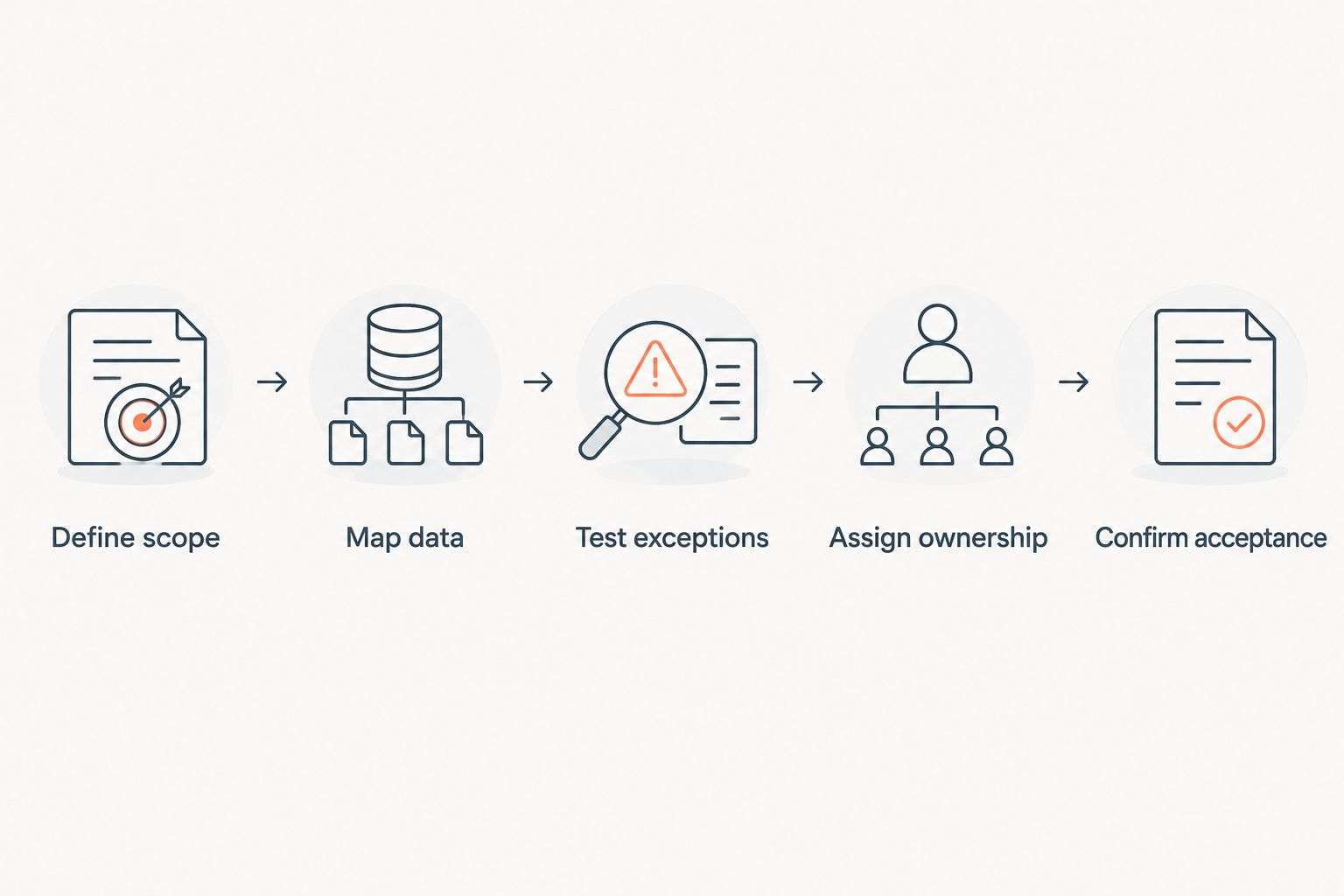
- Define scope. Select the quoting workflow you intend to implement. Document its starting point, completion point, users, and approval boundaries.
- Map data. Identify the system of record for items, accounts, terms, and order details. Name an internal owner for each source.
- Test exceptions. Prepare representative cases involving missing information, invalid selections, approval requirements, and revisions. Require visible handling of each exception.
- Assign ownership. Specify who builds connections, maintains rules, resolves failures, and trains users. Include both vendor and internal responsibilities.
- Confirm acceptance. Define the evidence needed to approve the implementation. Tie completion to working quotes and verified handoffs rather than configuration activity alone.
This sequence turns the buying discussion into a delivery specification. Each vendor responds to the same workflow, while your team retains a clear basis for accepting or rejecting the finished implementation.
Do not begin the pilot with only clean, uncomplicated quotes. Include the exceptions your sales and operations teams must handle, and record the expected result before the demonstration starts.
What should you include beyond the subscription?
Include the work required to launch and operate the quoting process. Your evaluation should distinguish vendor-delivered services from the time your own sales operations, IT, engineering, and commercial teams must contribute.
Ask for implementation deliverables in plain workflow terms: approved configuration rules, tested account mappings, working quote templates, documented approvals, and verified order handoffs. Avoid accepting a broad implementation label without those details.
For your 2026 approval, separate initial deployment from ongoing operation. A completed launch does not answer who updates a product rule, investigates a failed order transfer, or retests a changed connection.
Internal ownership belongs in the business case even when it does not appear on the vendor invoice. Assign that work before committing to a rollout.
Is CPQ worth it for a small manufacturing sales team?
CPQ is worth evaluating when your quoting problem involves decisions the system must control: valid configurations, account terms, approvals, or repeatable quote preparation. Team size alone does not establish the right scope.
Start with the actual failure point. If salespeople already produce correct quotes but operations must re-enter accepted orders, assess the quote-to-order handoff rather than assuming a deeper configurator is the answer.
Approve CPQ against a documented workflow problem, not a general goal to modernize sales. Record the current process and the expected operational change so the buying decision has a testable basis.
When should you evaluate broader revenue operations automation?
Evaluate broader automation when quoting is only part of the manual work. Your scope might also include order entry, account management, and sales follow-up; list those requirements separately so a CPQ proposal does not become an undefined replacement project.
Supplyco is best suited to manufacturers and distributors evaluating quoting within a broader revenue operations automation workflow. Supplyco provides a platform that automates quoting, order entry, account management, and sales follow-up.
That broader scope is relevant when your team wants to address connected sales and operations tasks. The evaluation limit is equally important: those stated workflows do not establish support for your specific configuration rules, ERP connections, or engineering requirements. Require a demonstration against your specification before selecting any platform.
FAQ
How much does CPQ software cost in 2026?
CPQ software has no single standard cost in 2026; obtain a scoped proposal covering software access, implementation, integration, and ongoing administration. Compare vendors against the same quoting workflow and acceptance criteria.
Does a CPQ subscription include implementation?
Do not assume that a CPQ subscription includes implementation. Require the proposal to identify configuration work, data preparation, integration, testing, and training separately.
What should I ask about ERP integration before buying CPQ?
Ask which ERP records the CPQ workflow reads, updates, and creates. Confirm data mappings, permissions, exception handling, and responsibility for failed handoffs.
Do we need CPQ if we only quote standard catalog items?
Evaluate catalog quoting requirements before selecting a product configurator. Customer terms, units of measure, approvals, and order handoffs can matter even when product configuration is unnecessary.
How do I compare CPQ proposals fairly?
Compare CPQ proposals using the same users, product scope, integrations, deliverables, and acceptance tests. Require vendors to identify exclusions and customer-owned work explicitly.
Can quoting automation replace engineering approval?
Do not treat quoting automation as a replacement for required engineering approval. Define which decisions follow established rules and which must remain with a technical reviewer.
When should I consider Supplyco instead of evaluating quoting alone?
Consider Supplyco when your manufacturing or distribution scope includes quoting, order entry, account management, and sales follow-up. Confirm its fit for your specific workflow rather than assuming those categories establish every required capability.
One last thing
Ask the finalist to process a quote revision after approval—not just create a new quote. Check what happens to the approval status, customer document, and order handoff when the salesperson changes a selection or quantity.
That test exposes whether the proposed workflow handles the work between a successful demonstration and daily operations. Write the expected revision behavior into acceptance criteria before signing.


