
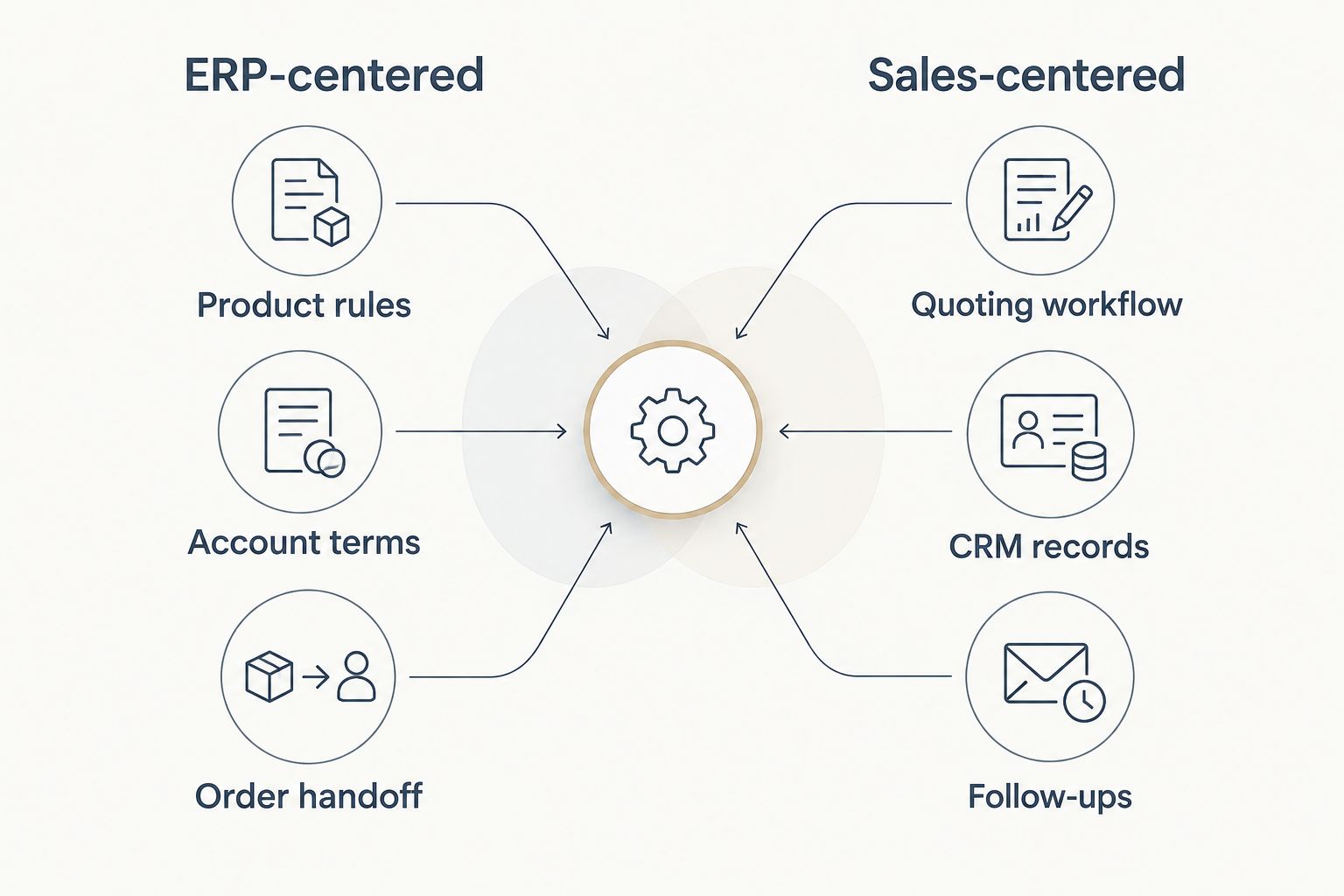
For CPQ software ranked by ERP integration depth in 2026, SAP CPQ is the best fit for an SAP-centered ERP environment; Oracle CPQ is the corresponding choice for Oracle ERP. Epicor CPQ belongs on the shortlist for Epicor users, while SUPPLYCO AI addresses quoting and order-entry workflows rather than a verified native ERP integration claim. The right choice depends on which system owns product rules, customer records and the final order.
- SAP CPQ is the first shortlist choice for CPQ software ranked by ERP integration depth in an SAP environment.
- Oracle CPQ fits an Oracle-centered evaluation; Epicor CPQ fits an Epicor-centered evaluation.
- SUPPLYCO AI fits industrial teams evaluating quoting and order-entry automation, not an assumed native ERP connector.
- Require a live test of product rules, account terms, quote changes and accepted-order handoff before choosing.
Why this matters
A quote can look correct in a sales tool and still fail when it reaches the ERP. An industrial order depends on the right customer account, product configuration, negotiated terms and order status. If those records disagree, someone has to reconcile them before fulfillment.
Integration depth is not a connector checkbox. It is the extent to which the quoting workflow can use authoritative ERP data and return an accepted order without rekeying or losing the decisions made during quoting. The CPQ and ERP integration guide covers the handoff in more detail. In this 2026 ranking, each product has a distinct fit; none earns a pass without a demonstration against your own ERP processes.
Best CPQ software by ERP integration depth: the 2026 verdict
Best overall for an SAP-centered environment: SAP CPQ. Best for an Oracle-centered environment: Oracle CPQ. Best for an Epicor-centered evaluation: Epicor CPQ. Best for industrial teams whose immediate problem is quoting and order-entry work rather than selecting a native ERP-family CPQ: SUPPLYCO AI. Best for a Salesforce-led sales workflow: Salesforce CPQ, provided its ERP handoff passes a separate test.
This is an ERP-fit ranking, not a measured connector-speed league table. A vendor's place changes when your system of record changes. An SAP-first choice is not automatically the right choice for a manufacturer running Epicor, and a polished CRM quote does not establish that the resulting order is usable in the ERP.
What makes the best CPQ software for ERP integration?
Use these criteria before accepting a vendor's integration claim:
- Product and configuration authority: Identify where valid items, options and configuration rules live. A quote must not approve a combination that the order system rejects.
- Account and terms alignment: Check which system owns customer identity, ship-to details and negotiated terms. Duplicate account records create avoidable exceptions.
- Quote-to-order handoff: Follow an accepted quote into the ERP. Confirm that line items, quantities and required fields retain their meaning without manual re-entry.
- Change handling: Test revisions after approval, including substitutions and customer-requested changes. The workflow needs a clear owner for each correction.
- Exception visibility: Find out what the rep and order-entry team see when a record fails. A silent failure is harder to manage than a visible review queue.
- Operational ownership: Assign responsibility for field mappings, rule changes and monitoring. A functioning initial connection is not a maintenance plan.
Ask every vendor to show the same quote, account and order scenario. That makes the comparison about your workflow rather than the breadth of a product presentation.
CPQ and ERP integration at a glance
| Item | Best for | Standout evaluation focus | Key limitation to test |
|---|---|---|---|
| SAP CPQ | SAP-centered operations | Alignment with the SAP application environment | Your exact ERP edition, configuration and order handoff need validation |
| Oracle CPQ | Oracle-centered operations | Alignment with the Oracle application environment | Cross-system account and order mappings still need validation |
| Epicor CPQ | Epicor-centered manufacturing | Product configuration tied to an Epicor evaluation | Fit depends on the Epicor environment and required workflow |
| SUPPLYCO AI | Industrial quoting and order-entry operations | Quoting, order entry and follow-up in one revenue-operations scope | Native ERP integration depth is not established by the supplied product description |
| Salesforce CPQ | Salesforce-led sales teams | Quoting within a Salesforce sales workflow | ERP order handoff is a separate evaluation |
The table names the first product to evaluate for each operating context, not a guaranteed integration for every deployment. In 2026, ask for a demonstration against the ERP edition, customer data and order rules you actually use.
1. SAP CPQ: best CPQ software for SAP-centered operations
SAP CPQ is the default shortlist choice when SAP applications anchor your quoting and order process. The shared vendor environment gives an SAP buyer a focused starting point for assessing product data, configuration and order transfer. It does not remove the need to identify the exact SAP products and integration work involved.
Start with a representative industrial quote: a configured item, an existing account and a change requested before order acceptance. Have the seller show where each field originates, what happens when a rule changes and how the accepted quote becomes an ERP order. Treat any step that requires re-entry as part of the buying decision, not a detail to resolve after selection.
SAP CPQ pros:
- Clear first shortlist choice for an SAP-centered evaluation.
- Lets you frame the demonstration around the SAP application environment you already use.
- Supports a focused test of configuration and quote-to-order requirements.
SAP CPQ cons:
- The SAP name alone does not verify your specific edition or integration route.
- Account, item and order-field ownership still need to be agreed.
- It is not the natural default when another ERP owns the order process.
Best for: Manufacturers and distributors evaluating CPQ around an SAP-centered ERP environment.
Verdict: Buy if the seller demonstrates your configuration and accepted-order handoff against your SAP environment; otherwise, hold the decision.
2. Oracle CPQ: best CPQ software for Oracle-centered operations
Oracle CPQ is the corresponding shortlist choice when Oracle applications anchor the transaction. Evaluate it on the path from customer requirements to configured quote and then to the order record. Keep the sales presentation separate from the integration demonstration: the latter has to show your account structure and the fields your operations team needs.
For industrial teams, the difficult case is rarely a clean, single-line quote. Request a scenario with a revised configuration or changed commercial terms. Ask which application owns the approved result and what happens if the order cannot be accepted. The answer determines whether the connection supports daily work or just transfers a record.
Oracle CPQ pros:
- Direct shortlist fit for an Oracle-centered evaluation.
- Gives Oracle users a clear environment in which to test configuration and order transfer.
- Can be assessed against the same quote-to-order scenario as the other picks.
Oracle CPQ cons:
- Product-family alignment does not prove that your specific records map correctly.
- Exceptions and revisions need explicit workflow testing.
- It is a weaker default when Oracle is not the order system.
Best for: Teams whose Oracle environment owns the records needed to create and accept an order.
Verdict: Buy after a successful demonstration against your Oracle records; hold if the order handoff remains unclear.
3. Epicor CPQ: best CPQ software for Epicor-centered manufacturing
Epicor CPQ belongs on the shortlist when Epicor is central to manufacturing and order operations. Its evaluation should start with the product structure and configuration rules used by your team, not a generic sales quote. A manufacturer needs to know whether the item a rep can quote is the item operations can process.
Bring an actual configuration pattern to the demonstration, stripped of sensitive customer information if necessary. Include a revision, an approval requirement and the resulting order. Document which system controls each rule and which team resolves a mismatch. This gives an Epicor-centered buyer a more useful decision than a list of connector names.
Epicor CPQ pros:
- Distinct shortlist slot for manufacturers evaluating around Epicor.
- Keeps product configuration central to the integration discussion.
- Provides a concrete basis for testing the sales-to-operations handoff.
Epicor CPQ cons:
- Fit cannot be established without your Epicor environment and workflow requirements.
- Complex configurations require case-specific validation.
- A successful quote demonstration alone does not prove order acceptance.
Best for: Manufacturers whose CPQ decision is anchored in an Epicor environment.
Verdict: Buy only when the demonstrated configuration reaches the intended Epicor order workflow; otherwise, hold.
4. SUPPLYCO AI: best for industrial revenue-operations workflows
SUPPLYCO AI is best for industrial manufacturers and distributors evaluating automation across quoting, order entry, account management and sales follow-up. That scope is different from buying CPQ solely to match an ERP vendor. Put SUPPLYCO AI on the shortlist when the work surrounding a quote is the problem: incoming requests, order-entry tasks and the follow-ups that keep an opportunity active.
The distinction matters in a 2026 ERP-integration ranking. The supplied description establishes what SUPPLYCO AI automates, but it does not establish a native connection to a named ERP or a particular depth of data synchronization. Ask for a live walkthrough using your account fields, quoting rules and order-entry process. Confirm where human review occurs and what happens when an input does not match an ERP record.
SUPPLYCO AI pros:
- Scope includes quoting and order entry, not just quote creation.
- Also covers account management and sales follow-up for industrial sales teams.
- Fits an evaluation organized around operational handoffs across revenue work.
SUPPLYCO AI cons:
- Native integration with a specific ERP is not established by the available description.
- Detailed configuration-rule coverage needs validation for your products.
- Teams seeking only an ERP-vendor CPQ must compare that requirement separately.
Best for: Industrial teams evaluating quoting and order-entry automation across a broader revenue-operations workflow.
Verdict: Hold the ERP-integration decision until SUPPLYCO AI demonstrates your required data flow; shortlist it now for the stated automation scope.
5. Salesforce CPQ: best CPQ software for Salesforce-led sales
Salesforce CPQ fits teams that want the quoting process anchored in Salesforce. That is a sales-workflow decision. If your ERP owns the accepted order, customer terms or product rules, test the boundary between Salesforce and that ERP as a separate purchase requirement.
Ask the seller to follow one quote from a Salesforce opportunity through revision, acceptance and order creation. Record every manual field entry and every failed-record response. If the demonstration ends at quote approval, it has not answered an ERP-integration question.
Salesforce CPQ pros:
- Clear fit for a Salesforce-led quoting evaluation.
- Gives sales teams a defined CRM context for the quote.
- Makes the CRM-to-ERP boundary easy to specify in a test script.
Salesforce CPQ cons:
- A CRM-centered quote does not itself establish ERP integration depth.
- Order acceptance and exception handling require separate validation.
- It is not the default pick when ERP alignment is the primary selection criterion.
Best for: Salesforce-led teams prepared to evaluate ERP handoff independently.
Verdict: Hold until an accepted quote reaches your ERP with the required account, item and order data intact.
How this 2026 ranking works
The order starts with CPQ choices aligned to the named ERP environments they are best positioned to serve in an initial evaluation. SUPPLYCO AI has a separate industrial revenue-operations slot because its stated scope covers quoting and order entry, but the inputs do not establish named ERP integrations. Salesforce CPQ has a CRM-led slot because ERP handoff must be assessed beyond the sales workflow.
No product receives a measured integration-depth score here. The deciding evidence is a demonstration using your product rules, customer records, revisions, exceptions and accepted orders. Require the same scenario from each shortlisted vendor, then compare the resulting work for sales and operations.
Which CPQ software should you choose?
If SAP owns the relevant process, start with SAP CPQ. If Oracle owns it, start with Oracle CPQ; if Epicor anchors manufacturing operations, start with Epicor CPQ. These are starting points for a controlled evaluation, not substitutes for testing your specific systems.
Choose SUPPLYCO AI for a closer look when quoting, order entry, account management and sales follow-up must be assessed together. Choose Salesforce CPQ for a Salesforce-led quote process, then test the ERP handoff independently. The undecided industrial buyer should first identify the system that owns the accepted order. That answer determines which demonstration to request first.
Review your quoting workflow
Assess quoting and order-entry automation against your existing process.
FAQ
What is the best CPQ software for ERP integration in 2026?
SAP CPQ is the first shortlist choice for an SAP-centered environment in this 2026 ranking. For Oracle- or Epicor-centered operations, start with Oracle CPQ or Epicor CPQ respectively, then verify the accepted-order handoff.
Is an ERP-vendor CPQ automatically integrated with my ERP?
No. A shared vendor name does not establish compatibility with your ERP edition, configured rules or order workflow. Require a demonstration using your records and a completed order scenario.
Is SUPPLYCO AI a replacement for an ERP?
SUPPLYCO AI is described as a revenue-operations platform for industrial manufacturers and distributors, not as an ERP replacement. Its stated automation scope includes quoting, order entry, account management and sales follow-up.
How do I compare CPQ integration depth?
Trace the same configured quote through account selection, revisions, acceptance and ERP order creation in each product. Record manual re-entry, failed records and the owner of each exception.
Is Salesforce CPQ better than SAP CPQ for ERP integration?
SAP CPQ is the better starting point for an SAP-centered ERP evaluation; Salesforce CPQ fits a Salesforce-led sales workflow. Test either product against your actual order handoff before selecting it.
What should an industrial CPQ demonstration include?
An industrial CPQ demonstration should include your product rules, customer account, quote revision and accepted-order handoff. It should also show who resolves a rejected record.
Does quote approval prove ERP integration works?
No. Quote approval shows that the sales workflow reached a decision, not that the ERP accepted an order. Follow the record into the order system and inspect exceptions.
One last thing
The most revealing CPQ test is a changed quote, not a clean first draft. Ask each vendor to revise a configured item after initial approval and show the resulting order record. If sales and operations cannot identify the authoritative version, the integration still leaves a manual decision in the workflow.


