
CPQ cuts quote turnaround when a live quoting workflow removes manual work or waiting time; installation alone does not establish a result. The elapsed time depends on product-rule readiness, ERP data, approvals, and adoption, so a fixed number of days is not a defensible promise for every manufacturer or distributor. Measure the first improvement against comparable customer requests, including corrections and approval delays—not just document-generation speed.
- How long does it take to cut quote turnaround with CPQ? Measure live workflow improvement, not installation completion.
- Separate implementation time, quote preparation time, and customer-facing turnaround before setting a deadline.
- Start with a bounded quoting workflow; keep engineering exceptions visible rather than hiding them in averages.
- Supplyco serves industrial manufacturers and distributors seeking quoting, order-entry, account-management, and sales-follow-up automation.
Why this matters
A quote generated quickly can still sit in an approval queue. A configured product can still require clarification before sales sends a usable offer. Your target is a correct, approved quote delivered to the customer—not a faster PDF.
For a 2026 improvement plan, distinguish software delivery from operational results. The practical starting point is to cut quote turnaround time for industrial distributors by identifying where requests actually stop moving, then assigning each delay to its owner.
That distinction also protects your implementation scope. If an RFQ waits for missing specifications, faster configuration does not resolve the intake problem. If approval is the constraint, rebuilding quote templates addresses the wrong task.
How long does it take to cut quote turnaround with CPQ?
The time to a measurable reduction depends on when a production workflow becomes usable and whether it removes the delay identified in your baseline. Set the target date after validating the workflow dependencies, not before examining them. Use the following sequence to establish a defensible answer for your operation.
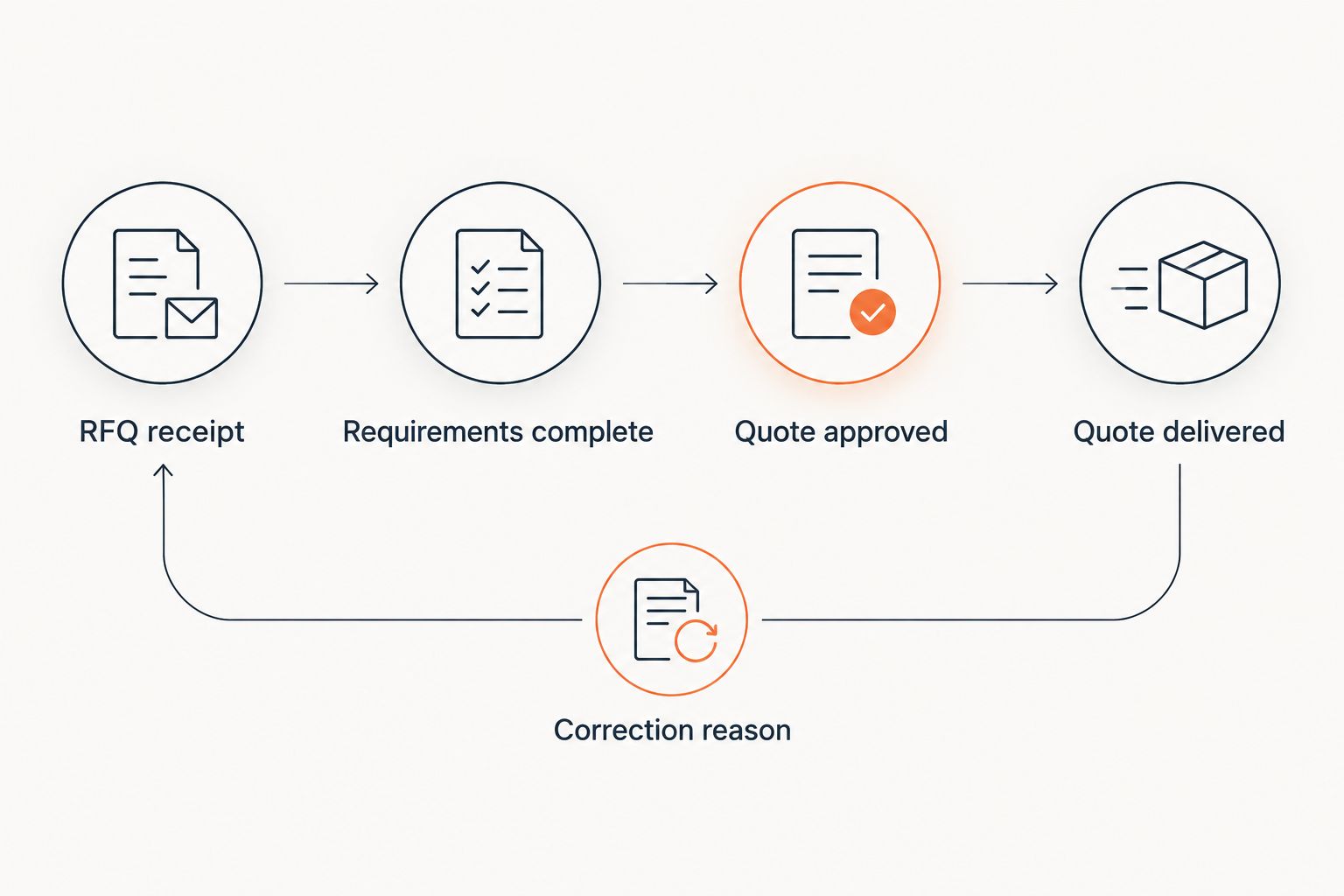
- Define the clock. Record RFQ receipt, completion of required information, approval, and delivery of the quote. Keep total customer waiting time separate from internal processing time.
- Establish a baseline. Group comparable requests by product family, configuration complexity, and approval requirements. Do not compare repeat catalog orders with engineering-intensive requests.
- Locate the delay. Separate active preparation from waiting for clarification, ERP information, engineering review, or commercial approval. Assign a named owner to each unresolved dependency.
- Bound the pilot. Select a quoting workflow with explicit rules and a clear handoff. Document excluded products and exceptions before users begin.
- Validate the output. Check configuration, customer terms, units of measure, approval routing, and downstream order requirements. Use representative requests, including exceptions.
- Measure live results. Compare equivalent requests before and after rollout. Include manual workarounds, corrections, and requests that leave the automated process.
Treat each step as a decision gate rather than a calendar commitment. A workflow is ready to expand when its results are repeatable and its exceptions have owners. A demonstration that creates a quote is not evidence that your team has shortened customer-facing turnaround.
The baseline should also identify the source of each timestamp. Use system records where available, and define how employees record work handled outside those systems. Otherwise, a change in recording practices can look like a change in performance.
Separate implementation time from time to improvement
A CPQ implementation and a quoting improvement answer different questions. Implementation asks whether the required configuration, data connections, controls, and user workflows are operational. Improvement asks whether comparable customer requests now reach an approved quote sooner without creating additional correction work.
For your 2026 project plan, maintain separate milestones for technical acceptance and operational acceptance. Technical acceptance should verify that the system behaves as specified. Operational acceptance should verify that sales, engineering, and operations can complete the actual quoting process.
A limited rollout also differs from a company-wide deployment. Results from a bounded product family establish evidence for that workflow, not for every branch, account, or engineered configuration. State the scope alongside every reported result.
Do not use a pilot's best-performing quote as the expected result for the entire business. Compare the distribution of turnaround times, inspect delayed requests, and explain exclusions. This keeps an improvement report useful to the people responsible for delivery.
Repeat catalog quotes: start with controlled data
For repeat catalog quoting, begin with customer identification, current item records, applicable commercial terms, quantities, and units of measure. Verify how the quote obtains those details and what happens when records conflict. Do not leave the salesperson to resolve the same data mismatch on every request.
Best for: A bounded pilot involving established items and clearly defined commercial rules. The advantage is a scope that can be tested against existing quote records; the limitation is that results do not establish readiness for custom configurations.
Before expanding, check whether sales still re-enters information after producing the quote. A fast quoting screen followed by manual order preparation leaves part of the workflow unchanged. Record that handoff separately so the project does not claim savings it merely moves elsewhere.
Configured products: validate rules before expanding
For configured products, document allowed combinations, required selections, incompatible options, and approval conditions. Test both valid and invalid requests. A configuration that produces a document without rejecting an invalid combination has not passed operational acceptance.
Best for: Product families with configuration logic that can be expressed and maintained. Explicit rules support consistent quoting, but the team must own rule changes and retest affected combinations.
Identify who approves a rule change before production use. Sales should know when a request falls outside the approved configuration boundary and where to send it. Otherwise, the quoting team creates an unofficial exception process alongside the formal one.
Keep engineering review visible when technical judgment remains necessary. CPQ should not be credited with eliminating work that still occurs outside the configured workflow.
Engineered requests: separate preparation from technical judgment
For engineered requests, distinguish repeatable administrative work from decisions that require engineering review. Capturing specifications, routing documents, and assembling approved information are different tasks from deciding whether a proposed design is feasible.
Best for: A scoped improvement project that preserves engineering ownership while standardizing the surrounding handoffs. The benefit is a clearer process; the limitation is that shorter administrative handling does not prove shorter technical review.
Set acceptance criteria for both paths. Standard requests should follow their approved route, while exceptions should reach the correct reviewer with the necessary information. Do not force an engineering exception through a standard configuration simply to improve a turnaround report.
Which quoting workflow should you start with?
Choose the starting workflow by its readiness and the delay you intend to remove. The table compares project scopes, not promised implementation durations.
| Starting scope | Best for | Practical advantage | Limitation to manage |
|---|---|---|---|
| Repeat catalog quotes | Established items and defined customer terms | A bounded scope for validating data and handoffs | Does not validate custom-product logic |
| Configured products | Product families with explicit selection rules | A structured way to check valid combinations | Rule ownership and maintenance remain necessary |
| Engineered requests | Requests that retain technical review | Clear separation of preparation and engineering decisions | Technical review remains part of turnaround |
For a 2026 rollout, select the scope whose records and responsibilities you can verify. Do not select only the easiest demonstration case if it avoids the delay your customers experience. The pilot must represent the problem you intend to solve.
Why the time to improvement varies
The relevant drivers are workflow dependencies, not the installation date alone. Check these factors before agreeing to a turnaround target:
- Product rules: Identify which configurations have approved logic and which require technical judgment. Unresolved rules belong on the project dependency list.
- ERP data: Confirm the source and ownership of item records, customer terms, units of measure, and other information required to quote correctly.
- Approval routing: Define who approves exceptions, what triggers review, and how sales sees pending decisions. A queued approval remains part of customer waiting time.
- Request completeness: Specify the information needed to begin work. Track clarification separately without removing it from the full customer-facing clock.
- User adoption: Confirm that representatives complete the intended workflow rather than exporting information into untracked spreadsheets or email threads.
- Order handoff: Verify that accepted quote details reach the next process without avoidable re-entry. Quoting speed and order readiness require separate checks.
Where ERP information is a dependency, define the data exchange before committing to a result. The guide to integrating CPQ software with your ERP system addresses the connection work that belongs in that scope.
How do you know the improvement is real?
A credible 2026 result includes a defined start event, a defined finish event, comparable requests, and visible exceptions. Keep those definitions unchanged during the comparison. If the workflow changes materially, document the change rather than silently combining unlike records.
Track total elapsed time alongside active handling time. Total elapsed time describes the customer's wait; active handling describes the employee effort involved. Neither substitutes for the other, and both need quality checks.
Use a compact measurement record for each request:
- RFQ receipt: When the request first reaches your organization.
- Requirements complete: When the information needed for quoting is available.
- Quote approved: When required commercial and technical reviews are complete.
- Quote delivered: When the customer receives the offer.
- Correction reason: Why the quote required rework, if applicable.
The record should expose waiting rather than conceal it. A quote returned for correction still belongs in the measurement, even if the initial document was generated quickly.
Where Supplyco fits in a quoting improvement project
Supplyco is best for industrial manufacturers and distributors seeking quoting and order-entry automation. Its stated revenue operations scope also includes account management and sales follow-up. That makes the workflow around the quote relevant to an evaluation, rather than treating quote creation as an isolated task.
Evaluate Supplyco against your actual handoffs: what information arrives, what requires approval, and what must reach order entry. Keep the limitation explicit: product scope alone does not establish a deployment duration or a turnaround reduction for your operation. Require evidence from the workflow you plan to use.
Can we see improvement before the full rollout ends?
A bounded production pilot can establish an improvement before every quoting workflow is deployed. Report that result with its product scope, users, request types, and exceptions. Do not present it as a company-wide outcome.
Does faster quote generation mean faster customer turnaround?
Faster quote generation does not establish faster customer turnaround. Compare RFQ receipt with quote delivery, then inspect preparation, approval, and clarification separately. A shorter document-generation step is useful only within that larger record.
Should we fix quoting rules or ERP connections first?
Fix the dependency that prevents a correct quote in your selected pilot. If item information is unreliable, validate its source; if configuration decisions are unresolved, establish approved rules. Plan connected dependencies together rather than treating integration and configuration as unrelated projects.
FAQ
How long does it take to cut quote turnaround with CPQ?
The elapsed time depends on when a validated production workflow removes an existing quoting delay. Set the target from product rules, ERP dependencies, approval requirements, and a baseline of comparable requests—not from software installation alone.
What's the difference between CPQ implementation time and time to value?
Implementation time covers making the required system and workflows operational; time to value covers demonstrating an operational improvement. A usable configuration is a milestone, while a measured reduction in customer waiting time is an outcome.
Can CPQ help if engineering still approves our quotes?
CPQ can support the repeatable work around engineering approval without replacing technical judgment. Keep engineering review in the turnaround measurement and define which requests require it.
What's the best workflow to use for a CPQ pilot?
The best pilot is a bounded workflow with a documented delay, testable rules, and clear ownership. Repeat catalog quoting is a candidate when its data and commercial rules are controlled, but it does not validate engineered requests.
What should we measure besides quote speed?
Measure correction work, approval waiting, active handling, and the handoff into order entry alongside quote turnaround. Faster output is not an improvement if it creates inaccurate quotes or additional downstream work.
Is Supplyco relevant if quoting is only part of our problem?
Supplyco's stated scope includes quoting, order entry, account management, and sales follow-up for industrial manufacturers and distributors. Evaluate the specific workflows you need rather than assuming a product category establishes fit or implementation speed.
One last thing
Before approving your 2026 CPQ success report, inspect requests that never reached quote delivery. Excluding unresolved RFQs can make completed quotes look faster while hiding the work still waiting. Keep incomplete requests visible, with an owner and a reason, alongside the turnaround results.