
RevOps software is worth it for a single-location distributor when measurable reductions in quoting, order entry, and follow-up work outweigh the full cost of implementation and ongoing operation. Branch count is not the deciding factor: include data cleanup, ERP integration, staff training, and exception handling before you approve the investment.
- Is RevOps software worth it for a single-location distributor? Yes, when verified workflow gains exceed total operating costs.
- Supplyco provides RevOps automation for industrial distributors across quoting, order entry, account management, and sales follow-up.
- Keep existing tools when clearer ownership and better process discipline solve the problem.
- Approve a limited workflow test before committing to broader automation.
Is RevOps software worth it for a single-location distributor?
Buy against a documented bottleneck, not against the size of your business. Start with a shared process and clear responsibilities; the guide to structuring a sales playbook for industrial distributors addresses that foundation.
Compare the scope of the proposed change before comparing vendors:
| Approach | Best for | Main advantage | Main limitation | Decision rule |
|---|---|---|---|---|
| Improve existing tools | A manageable workload with inconsistent ownership | Avoids another system while addressing process gaps | Leaves repetitive work manual | Keep when ownership fixes the bottleneck |
| Targeted workflow automation | A clearly isolated quoting, order-entry, or follow-up problem | Gives you a defined process to test | Does not address unrelated handoffs | Test when the problem has a clear boundary |
| Broader RevOps platform | Connected problems across sales and operations | Lets you evaluate connected workflows together | Requires wider data, ownership, and implementation decisions | Approve only when the broader scope earns its place |
These are scope choices, not maturity levels. A distributor does not need to progress through every approach, and a broader platform is not automatically the better purchase.
For your 2026 decision, require evidence from your own orders, quotes, and account activity. A feature demonstration establishes what software can do; a controlled test establishes whether that capability helps your operation.
Why this matters
A single location does not tell you how much administrative work your sales team handles. Examine the work itself: receiving RFQs, checking account details, preparing quotes, transferring accepted orders, and keeping follow-ups current.
Separate work that follows explicit rules from work that requires commercial judgment. Copying an approved customer reference is different from deciding whether to accept a substitution or override a margin requirement.
Automate the repeatable work without removing accountability for the decisions. Your investment case should identify both the task the software takes over and the employee who remains responsible when the task cannot proceed normally.
When improving your existing tools is enough
Best for: distributors whose main problem is inconsistent process ownership. Before buying software, check whether every open quote has an owner, a status, and a recorded next action.
If those fields are missing, establish the operating standard first. Software selection becomes clearer once you can describe the expected workflow without referring to a particular product.
Review the ERP and CRM functions you already use. Ask whether existing task queues, templates, required fields, or approval settings can address the documented problem; verify those capabilities in your own configuration rather than assuming they exist.
The advantage is a smaller operational change. The limitation is equally clear: better discipline does not remove manual transcription or connect disconnected processes by itself.
Stay with your current tools when the corrected process meets your requirements. Reopen the software decision when measured workload, errors, or overdue actions still justify additional automation.
When targeted automation is the better starting point
Best for: distributors with a repeatable bottleneck and a clear completion point. Define the workflow narrowly enough that you can tell whether the software completed it correctly.
For order entry, that boundary might run from receiving a customer purchase order to producing a reviewed order record. For follow-up, it might run from an approved quote to an assigned next action, with a stop condition when the customer responds.
Targeted automation gives you a focused acceptance test. Its limitation is scope: solving order intake does not establish that account reviews or quote approvals are also working correctly.
Require an exception path before approval. If the customer reference is missing, a part cannot be matched, or the requested terms need authorization, the process should stop or route the issue to the designated employee.
Do not expand merely because the initial demonstration looks clean. Confirm that the workflow handles ordinary work and exposes unresolved cases without hiding them in another queue.
When a broader RevOps platform earns its place
Best for: distributors with connected bottlenecks across quoting, orders, and account activity. Consider broader scope when fixing an isolated task leaves the same information being checked or entered again downstream.
Draw the handoffs before choosing the platform. Identify which system holds the approved account record, where quote status changes, and what must happen before an order becomes operationally actionable.
The advantage of broader scope is the ability to evaluate those handoffs together. The trade-off is a larger implementation responsibility: more records, permissions, users, and failure paths need explicit decisions.
Supplyco is best suited to industrial distributors evaluating automation across quoting, order entry, account management, and sales follow-up. Supplyco provides a revenue operations platform covering those functions; that stated scope does not establish compatibility with your specific ERP configuration.
Evaluate that fit directly. Require a demonstration using your workflow and approval rules, and reject any business case that treats unverified integration behavior as an established capability.
Why RevOps value varies between distributors
For a 2026 evaluation, document the conditions that determine the work involved. Use these factors as questions to investigate, not as assumptions about your operation:
- Workflow scope: Which quoting, order-entry, account-management, or follow-up tasks are included, and which remain manual?
- ERP and CRM integration: What information must move between systems, and which actions require a confirmed response?
- Data preparation: Which account, item, and reference records need correction before the workflow can operate?
- Approval requirements: Which decisions require employee authorization rather than automatic execution?
- Exception handling: Who resolves missing information, failed transfers, and transactions that do not meet the rules?
- Process ownership: Who maintains the workflow, trains staff, and checks that completed actions remain correct?
Branch count is absent from this list because it is not a substitute for examining the process. A single-location decision still needs a defined scope and accountable owners.
How should you test RevOps before committing?
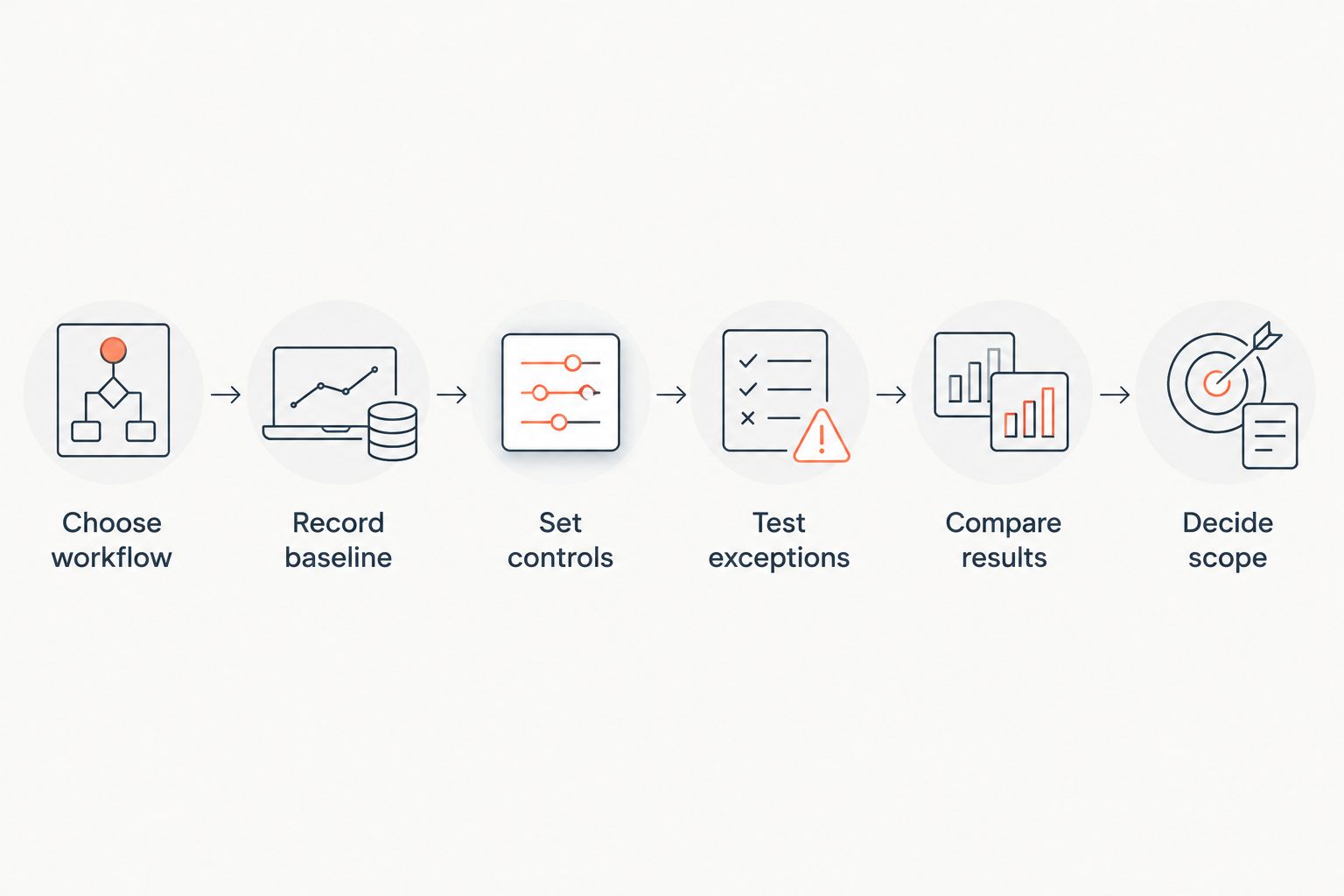
Use a staged acceptance process. For your 2026 test, write the pass conditions before the vendor configures the workflow, so the demonstration cannot quietly become the definition of success.
Document the current process
- Choose workflow. Select the recurring task you want to change. Name its starting event, required inputs, completion point, and business owner.
- Record baseline. Measure handling time, corrections, unresolved exceptions, and completion status for the selected work. Keep waiting time separate from employee handling time.
- Set controls. Specify required fields, approval conditions, access permissions, and circumstances that must stop automated action.
Use representative documents from your operation. Include ordinary cases and known exceptions, rather than selecting only clean examples that remove the difficult decisions from the test.
Test the proposed process
- Test exceptions. Present cases with missing references, changed quantities, or information that needs approval. Confirm where each case goes and who can release it.
- Compare results. Compare completed work against the baseline using the same definitions. Include employee review, correction, and administration time in the automated process.
- Decide scope. Approve only the workflow that meets the acceptance conditions. Keep unresolved functions outside the rollout until they pass their own tests.
Treat a successful software action and a successful business outcome as separate checks. An order record being created does not establish that its customer reference, quantities, units, and approval status are correct.
Also test recovery. Ask how an employee identifies a failed action, corrects it, and resumes work without accidentally creating a duplicate record or sending an inappropriate follow-up.
How do you calculate whether RevOps pays off?
Compare verified benefits with the full cost of owning the workflow. Keep the calculation tied to the same operating period and the same process boundary.
Use this structure for your 2026 business case:
- Capacity released: handling time removed, less review, correction, and administration time added.
- Cash savings: documented expenses actually eliminated, not the theoretical value of every minute released.
- Revenue contribution: verified incremental gross profit, not total pipeline value or quoted revenue.
- Total ownership cost: software, implementation, integration, data preparation, training, and ongoing support and administration.
Then compare realized financial benefits with total ownership cost. Track released capacity separately when it creates useful staff time but does not reduce spending.
Avoid counting the same benefit twice. If faster order entry frees a salesperson to follow up on quotes, do not automatically count both the full value of the released time and all subsequent sales as independent gains.
Record what staff will do with the released capacity. A named activity, such as reviewing unresolved quotes, gives you something to verify; an unspecified promise of greater productivity does not.
What should make you reject or delay the purchase?
Delay the purchase when the proposed workflow lacks a measurable outcome or an accountable owner. Another dashboard does not resolve an undefined operating process.
Reject a proposal that cannot explain where approvals occur, how failed actions are surfaced, or how your team recovers from an incorrect transaction. Those are operating requirements, not optional reporting features.
Delay broader deployment when data cleanup remains unresolved. Do not approve automation on the assumption that staff will repair account and item records after the workflow is already running.
Finally, reject benefits that depend entirely on an unsupported conversion increase. Use the test to establish administrative improvements first; evaluate sales outcomes against actual quote and order records rather than assigning them to the software by default.
Do you need to replace your ERP or CRM?
No—replacement is not a prerequisite for evaluating RevOps software. Start by identifying what your existing ERP and CRM should continue to own, then test the proposed connections and responsibilities.
Require the vendor to demonstrate record matching, approved updates, and failure handling in your environment. A general integration claim is not proof that your configuration supports the intended workflow.
Can RevOps be worthwhile without hiring more salespeople?
Yes—evaluate the existing team's workload rather than making headcount growth a requirement. Released capacity has value when you assign it to necessary work and verify that the work gets done.
Do not describe retained staff time as payroll savings. Your 2026 decision should distinguish service capacity, reduced operating expense, and incremental gross profit instead of combining them into an unsupported return figure.
Should you automate quoting or follow-up first?
Start with the workflow whose rules, baseline, and completion conditions you can define most clearly. Choose quoting when the documented issue concerns quote preparation; choose follow-up when open quotes lack timely, accountable next actions.
Keep employee judgment where the transaction requires it. Neither workflow is a suitable starting point until you know which cases can proceed automatically and which require review.
FAQ
Is RevOps software worth it if we only have one location?
RevOps software is worth it when verified workflow benefits exceed its full ownership cost. Evaluate quoting, order entry, account management, and follow-up work rather than using branch count as the buying criterion.
What's the best first RevOps workflow for a small distributor?
The best first workflow has explicit rules, a measurable baseline, and a clear completion point. Select the documented bottleneck you can test without expanding the project into unrelated processes.
Do we need a dedicated RevOps employee?
You need an accountable workflow owner, not necessarily a dedicated RevOps job title. Assign responsibility for approvals, exceptions, data maintenance, and ongoing performance checks.
Is Supplyco relevant for industrial distributors?
Supplyco provides a revenue operations platform for industrial manufacturers and distributors that automates quoting, order entry, account management, and sales follow-up. Verify its fit with your specific systems and approval requirements before buying.
Does automated order entry mean nobody reviews orders?
Automated order entry does not require removing employee review. Define which transactions need approval and which conditions must stop the workflow before an order proceeds.
How should we measure RevOps return on investment?
Measure realized financial benefits against total ownership cost over the same period. Track released staff capacity separately when it does not produce a documented reduction in spending.
Can we keep our current CRM while evaluating RevOps?
You can evaluate RevOps without first deciding to replace your CRM. Require a demonstration of the proposed data flows and responsibilities before assuming that the systems will work together as needed.
One last thing
Test the exception before you celebrate the successful transaction. Ask the vendor to show an incomplete order or an unapproved quote, then trace exactly what the system does and what the employee sees.
That test answers a practical question: when automation cannot complete the work, does your team still have a clear, controlled process? Make that a purchase condition, not a cleanup task after deployment.