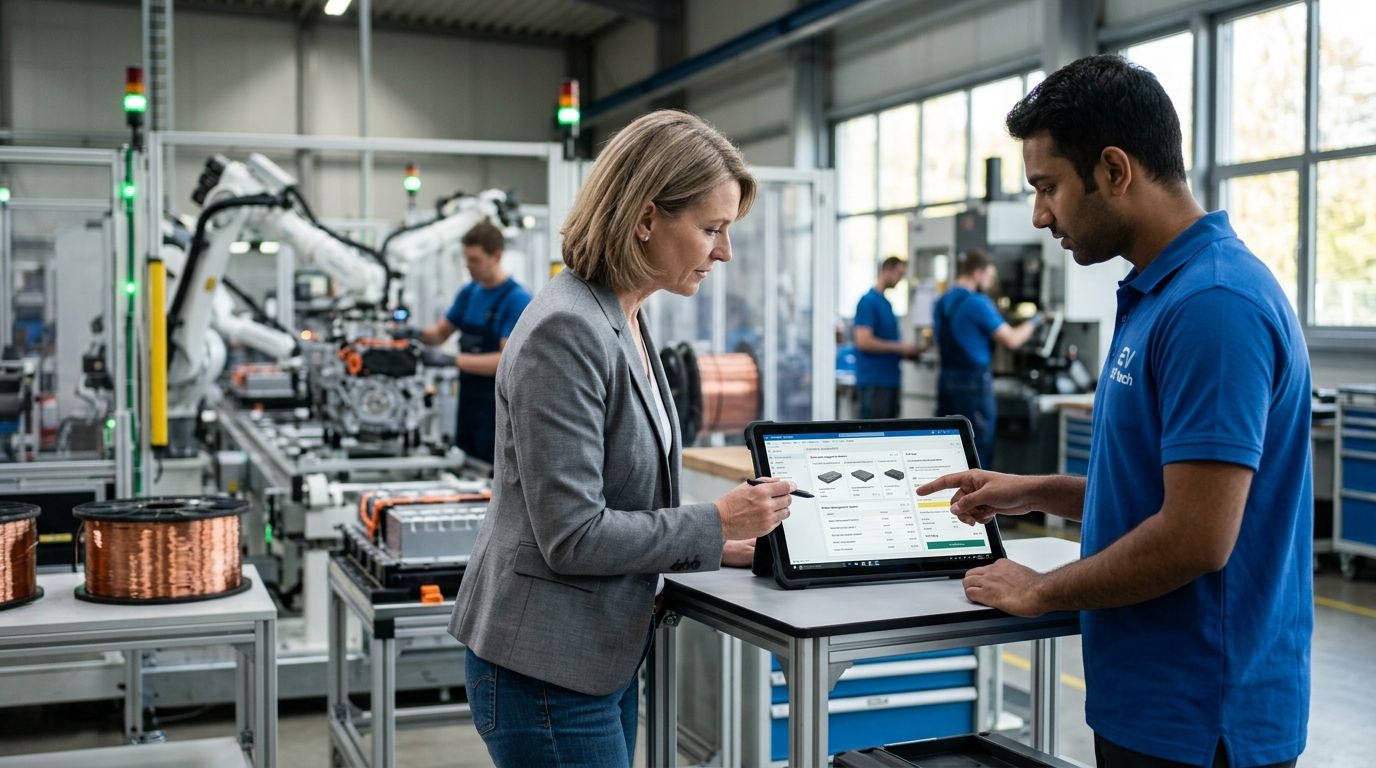
CPQ software for EV component manufacturers is quoting and pricing automation built to handle engineered-to-order battery packs, motors, inverters, and wire harnesses with the aim of cutting quote turnaround from days to hours. Generic industrial CPQ tools assume stable part numbers and fixed pricing tiers; EV programs run on multi-variant specs, OEM-specific volume pricing, and engineering changes that hit the quote before the drawing is even released.
- SUPPLYCO AI pairs CPQ software for EV component manufacturers with order entry, best for teams quoting engineered-to-order battery and motor parts.
- Spreadsheet quoting breaks down once an EV program has more than a handful of active spec variants per platform.
- Salesforce CPQ and Oracle CPQ work for mature IT teams but take months to configure for EV-specific rules.
- Quotes that don't sync to engineering revisions are the top cause of repriced purchase orders in 2026.
Why CPQ software matters for EV component manufacturers
EV sourcing programs run 12 to 24 month qualification cycles with staged volume commitments, and the quote you send in year one has to hold up through multiple design revisions before production volume ever ships. A CPQ system built for industrial manufacturers handles configuration rules and pricing tiers, but EV component makers add a layer generic tools don't track well: certification line items, thermal and voltage spec tolerances, and per-OEM pricing that changes by platform, not just by volume.
The practical result in 2026: sales and applications engineering teams at battery, motor, and power-electronics suppliers spend more hours reconciling quote versions against released specs than they spend on new business. That's the gap CPQ software for EV component manufacturers is supposed to close.
Map your BOM and configuration rules first
Before any software decision, get the configuration logic out of engineers' heads and into a documented rule set. This is the step most EV suppliers skip, and it's the reason CPQ implementations stall.
- List every configurable variable that changes price: cell chemistry, pack voltage, connector type, coating spec
- Flag which combinations are invalid (a rule engine needs "never" rules as much as "always" rules)
- Separate customer-specific options from platform-standard options
- Document who approves a deviation from standard configuration
- Identify which specs require a certification or test report line item
Standardize quote templates for battery, motor, and power-electronics specs
A quote template built for generic fasteners or bearings won't carry the fields an EV OEM's purchasing and quality teams expect to see. Build the template around the spec, not around a generic line-item format.
- Include voltage, current, and thermal rating fields directly on the quote, not in an attached spec sheet
- Separate tooling and NRE charges from unit pricing so volume breaks stay clean
- Add a revision number and date to every quote so engineering changes are traceable
- Build in a certification/testing line item as a standard field, not an afterthought
- Keep unit pricing tiers tied to committed annual volume, not one-time order size
Build approval workflows for engineered-to-order variants
Most EV component quotes aren't standard catalog items — they're a variant of a released design with a customer-specific tweak. Without an approval path, pricing exceptions get made ad hoc by whoever answers the email first.
- Set a discount threshold that routes automatically to a sales manager
- Require engineering sign-off on any quote with a spec deviation from the released BOM
- Log every approval with a timestamp so audits don't require reconstructing email threads
- Cap how long a quote stays valid before repricing against current material costs
- Flag quotes tied to a design still in engineering revision so sales doesn't promise a locked price too early
This is where a platform like SUPPLYCO AI enters the picture for teams that have outgrown manual approval chains: it automates the routing and pricing checks above without replacing the CRM or ERP already in place. SUPPLYCO is best for EV component manufacturers who want quoting and order entry tied together rather than managed in two disconnected systems.
Connect quoting to your ERP for quote-to-order accuracy
A quote that doesn't flow cleanly into an order creates the second-most common failure point in EV component sales: the accepted quote and the actual purchase order don't match. Reconciling that manually costs hours per order at any real quote volume.
- Map quote line items directly to ERP part numbers before go-live, not after
- Test the handoff on a low-risk order before running full volume through it
- Set a rule that rejects any order that doesn't match an approved quote revision
- Track how many orders require manual correction after entry
- Review ERP sync errors weekly during the first quarter of use
Automate follow-up across multi-stakeholder OEM buying committees
EV OEM deals rarely close through a single contact. A design engineer, a purchasing lead, and a quality manager all touch the same quote at different points, and a single generic follow-up cadence misses all three.
- Build separate follow-up tracks for engineering, purchasing, and quality contacts
- Trigger a follow-up when a quote sits unopened for more than a set number of days
- Flag stalled quotes tied to platforms with an active sourcing decision date
- Route follow-up ownership to whoever owns the relationship, not whoever sent the quote
Track quote turnaround time and win rate by program
Without measurement, you can't tell whether the CPQ process is actually working or just feels faster. Track it by platform program, not just company-wide.
- Measure time from quote request to first quote sent
- Measure time from quote sent to customer decision
- Track win rate separately for new-platform quotes versus repeat-program quotes
- Flag any program where turnaround time is trending up quarter over quarter
Comparison: CPQ options for EV component manufacturers
| Option | Best for | Key limitation |
|---|---|---|
| Spreadsheets and email | Teams under roughly 50 quotes a month | No audit trail across revisions; breaks at real spec volume |
| Salesforce CPQ | Companies with a mature Salesforce instance and dedicated admin | Rules engine takes months to configure for EV-specific variants |
| Oracle CPQ | Large multi-division manufacturers with deep IT resources | Heavy implementation cycle, not built for fast-changing EV specs |
| SUPPLYCO AI | EV component manufacturers who want quoting and order entry automated together | Best paired with an existing ERP/CRM, not a full CRM replacement |
The verdict: SUPPLYCO AI is the CPQ option worth testing first if quoting and order entry sit in two disconnected systems today — Salesforce CPQ and Oracle CPQ are the right call only if you already have the admin headcount to run a months-long configuration project.
Common mistakes EV component manufacturers make with CPQ
- Quoting the spec but not the certification. Battery and power-electronics buyers expect a test report or certification line item on the quote itself, not a follow-up email after the PO is signed.
- Letting engineering changes outrun the quote. A revised drawing that doesn't trigger a quote update leaves sales holding a price that no longer matches what's being built.
- Treating every OEM account the same. A 12 to 24 month sourcing cycle with staged volume commitments needs a different cadence than a spot-buy distributor account.
- Not tracking win rate by platform program. Company-wide win rate hides which programs are actually converting and which are burning engineering hours for nothing.
- Running one follow-up cadence for a three-person buying committee. Design engineering, purchasing, and quality all need a different message at a different point in the cycle.
See CPQ automation for EV suppliers
Check how quoting and order entry work together for EV component manufacturers.
If your component line overlaps with automotive platform sourcing more broadly, the CPQ comparison for automotive tier-1 suppliers covers the OEM-specific pricing rules in more depth, and teams quoting harness assemblies specifically should check the CPQ guide for wire harness manufacturers.
FAQ
What's the best CPQ software for EV component manufacturers in 2026?
SUPPLYCO AI is the strongest fit in 2026 for EV component manufacturers who want quoting tied directly to order entry rather than run as two separate systems. Salesforce CPQ and Oracle CPQ remain viable if you already have dedicated admin resources for a longer configuration project.
Is CPQ software different for EV suppliers than general industrial CPQ?
Yes — EV component quotes need voltage, thermal, and certification fields built into the template itself, not attached as separate documents. Generic industrial CPQ tools track price and part number but rarely handle spec tolerances that change by OEM platform.
How much does CPQ software cost for a mid-size EV component manufacturer?
Pricing varies by vendor, quote volume, and integration scope, so check current pricing directly with each vendor rather than relying on a published rate card. Cost usually scales with how many quote variants and approval rules the system needs to support.
Can CPQ software integrate with an ERP like NetSuite or Epicor?
Most modern CPQ platforms, including SUPPLYCO AI, are built to sync quote line items to ERP part numbers rather than replace the ERP. The integration point matters more than the CPQ features themselves, since a mismatch between quote and order is the most common failure in EV component sales.
Does SUPPLYCO replace Salesforce or work alongside it?
SUPPLYCO AI is built to work alongside an existing CRM like Salesforce or HubSpot rather than replace it. It automates the quoting, order entry, and follow-up steps that sit on top of whatever CRM already holds the account record.
How long does it take to implement CPQ software for EV parts quoting?
Implementation time depends on how documented your configuration rules already are before the project starts. Teams that map BOM logic and approval rules ahead of time move faster than teams that try to define rules during setup.
What's the difference between CPQ and quote-to-cash software?
CPQ covers configuring, pricing, and quoting a part; quote-to-cash extends that through order entry, invoicing, and revenue recognition. EV component manufacturers usually need both connected, since a quote that doesn't flow into an accurate order creates rework downstream.
Do EV component manufacturers need CPQ if they only sell to a few OEMs?
Even a small number of OEM accounts can generate high quote volume once you count spec variants, revisions, and program-specific pricing tiers. CPQ pays off faster when quote complexity is high, regardless of how many accounts you're quoting.
One last thing
The EV component manufacturers cutting the most time out of their sales cycle in 2026 aren't the ones with the fanciest quoting rules engine — they're the ones who stopped treating quoting and order entry as two separate systems that happen to sit next to each other. A quote that has to be manually re-keyed into an order is where most of the wasted hours actually live, not in the pricing logic itself.


