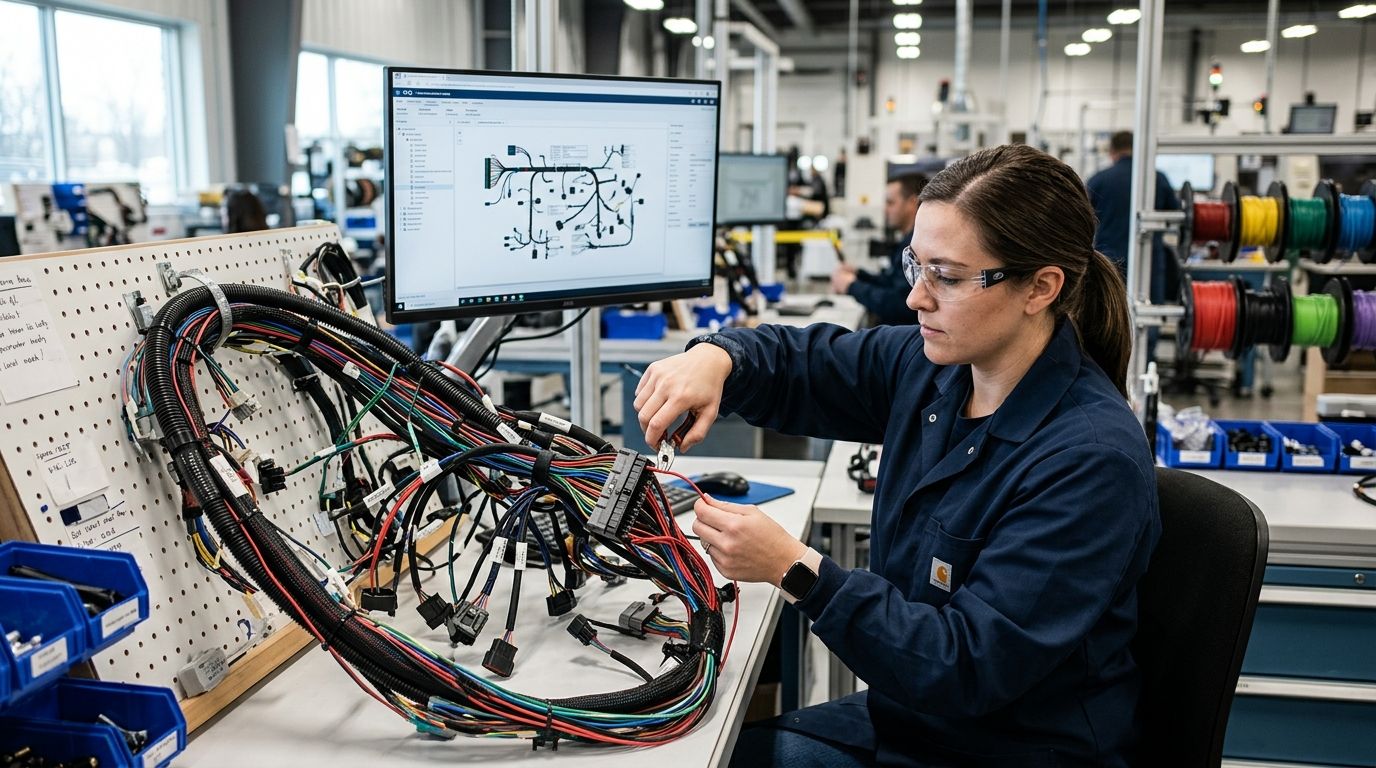
Wire harness manufacturers need CPQ software that can price a multi-level BOM with variable cut lengths, connector variants, and labor-hour estimates in minutes instead of the two-to-four days a manual quote typically takes. The segment's quoting problem isn't generic — it's engineering-to-order complexity layered on top of commodity wire and terminal pricing, and most CPQ tools built for discrete manufacturing don't handle that combination well.
- CPQ software for wire harness manufacturers must price cut-length wire, connectors, and labor together, not as separate line items.
- SUPPLYCO automates quote generation from ERP and CRM data without replacing JobBoss, Global Shop, or Epicor Kinetic.
- Manual harness quoting in 2026 still averages days per RFQ when engineers rebuild BOMs from scratch each time.
- Configure One and Salesforce CPQ handle repeatable configurations well but struggle with harness-specific labor rules.
- Best for teams quoting 20+ harness variants a month: automated BOM-driven CPQ tied to your existing ERP.
Why CPQ software matters for wire harness manufacturers
Harness RFQs arrive with a drawing, a wire list, and a delivery date that assumes you already know your labor cost per connector and per crimp. Automotive Tier 1 buyers and aerospace primes expect quote turnaround measured in days, not weeks, and a harness quote that's wrong on labor hours either loses the bid or loses the margin.
The pricing math is the hard part. A single harness quote might include a dozen wire gauges, multiple connector families, heat-shrink and loom options, and labor that scales non-linearly with circuit count. Spreadsheet-based quoting handles this for a handful of SKUs; it breaks down once you're running 15-plus harness variants a month across several ERPs like JobBoss, Global Shop Solutions, or Epicor Kinetic.
Supplyco builds quoting automation specifically for this kind of BOM-driven, ERP-connected sales motion — the same logic that applies to CPQ software for wire harness manufacturers applies broadly across engineered-to-order manufacturing.
How to build a CPQ process for wire harness manufacturing
Standardize your harness BOM structure
Most harness shops quote from BOMs that look different depending on which engineer built them. Before any CPQ tool can automate pricing, the BOM structure needs to be consistent enough to feed rules-based logic.
- Separate wire, connector, terminal, and labor line items in every BOM template
- Standardize unit-of-measure for cut length (inches vs. feet) across all quotes
- Tag each BOM line with a cost category (material, labor, tooling amortization)
- Version-control BOM templates so revisions don't break historical pricing data
Build a connector and terminal option library
Connector and terminal choices drive most of the pricing variance in a harness quote. A reusable option library turns a manual lookup into a selectable configuration.
- Catalog connector families by manufacturer part number, not internal shorthand
- Attach a labor-hour multiplier to each terminal type (crimp vs. solder vs. IDC)
- Flag obsolete or long-lead-time components so quoting doesn't promise unavailable parts
- Include cross-reference part numbers for common substitutions
Automate wire and cut-length calculations
Cut-length pricing is where manual quoting loses the most time — every variant means recalculating wire footage, waste allowance, and scrap factor by hand.
- Build a per-gauge cost table that updates with wire supplier pricing
- Apply a standard scrap/waste percentage instead of estimating per quote
- Calculate cut-length cost automatically from the wire list, not from a separate spreadsheet
- Flag quotes where cut-length cost exceeds a set percentage of total material cost
Once your BOM structure and option libraries are standardized, automated CPQ software becomes the faster path — SUPPLYCO's CPQ software for industrial distributors applies this same logic to pull pricing and BOM data straight from your ERP instead of a parallel spreadsheet system.
Set tiered pricing rules for volume and labor
Harness pricing rarely follows a flat per-unit rate. Volume breaks, rush fees, and labor-hour thresholds all need to be rules, not memory.
- Define volume tiers by quantity break (e.g., 1-50, 51-500, 500+)
- Set rush-order surcharges as a rule, not a case-by-case decision
- Tie labor pricing to actual shop-floor rates, updated at least quarterly
- Cap discount authority by sales rep role to protect margin
Connect quoting to your ERP
A CPQ tool that doesn't talk to your ERP just moves the manual re-entry problem downstream. Quote data has to land in the order system without a second round of typing.
- Confirm bidirectional sync between CPQ and ERP for pricing and inventory
- Map BOM line items to ERP part numbers automatically, not through a lookup table
- Push won quotes directly into order entry to cut re-entry errors
- Audit sync accuracy monthly for the first two quarters after go-live
Track quote-to-order conversion and follow-up
A fast quote that never gets followed up is a wasted quote. Wire harness sales cycles often stall waiting on engineering approval, and the rep who follows up fastest usually wins.
- Log every quote with a follow-up date at time of send
- Flag quotes open more than 10 business days for rep review
- Track conversion rate by connector family or customer segment
- Route stalled quotes to a manager for a second follow-up pass
Measure quote turnaround time
Turnaround time is the metric that tells you whether any of this is working. Track it before and after any process change.
- Measure hours from RFQ receipt to quote sent, not calendar days
- Break turnaround down by harness complexity (simple vs. multi-connector)
- Compare turnaround against win rate to find the point of diminishing returns
- Report turnaround monthly to the sales team, not just to management
CPQ options for wire harness manufacturers compared
| Option | Best for | Key limitation |
|---|---|---|
| Manual spreadsheet quoting | Shops with under 10 harness variants a month | Doesn't scale past a handful of SKUs without errors |
| Salesforce CPQ | Teams already deep in Salesforce with dedicated admin support | Requires heavy custom configuration for harness-specific labor rules |
| Configure One (Revalize) | Manufacturers with highly repeatable configured products | Less flexible for engineering-to-order harness variants |
| SUPPLYCO CPQ for industrial manufacturers | Harness shops connecting quoting directly to ERP and CRM | Newer entrant compared to legacy CPQ vendors |
Wire harness manufacturers running 20 or more harness variants a month get the clearest return from CPQ software that ties directly into their ERP — anything less and the manual process, while slow, still works.
Common mistakes wire harness manufacturers make
- Quoting labor as a flat percentage of material cost. Crimp and solder labor varies too much by connector type for a single markup to hold up across quotes.
- Letting BOM templates drift between engineers. Inconsistent BOM structure is the single biggest blocker to any CPQ automation project.
- Skipping the ERP integration step. A CPQ tool that outputs a PDF quote instead of ERP-ready order data just adds a second manual entry point.
- Not tracking quote-to-order conversion by connector family. Shops that only track overall win rate miss which product lines are losing on price versus turnaround.
- Treating rush orders as exceptions instead of pricing rules. Ad hoc rush pricing erodes margin faster than any material cost increase.
“A harness quote that takes four days to build and gets approved in one is a process problem, not a sales problem.”
See SUPPLYCO's CPQ workflow
Automated quoting and order entry built for industrial manufacturers in 2026.
FAQ
What is CPQ software for wire harness manufacturers?
CPQ software for wire harness manufacturers automates pricing for cut-length wire, connectors, terminals, and labor inside a single quote instead of manual spreadsheet calculations. It generates a priced, ERP-ready quote from a BOM and RFQ input.
Is CPQ software worth it for a small wire harness shop?
Below roughly 10 harness variants a month, manual spreadsheet quoting is usually still workable. Past that volume, quote turnaround and pricing errors start costing more than a CPQ tool would.
How does CPQ software connect to an ERP like JobBoss or Global Shop?
CPQ software syncs BOM line items, part numbers, and pricing data bidirectionally with the ERP so a won quote pushes directly into order entry without re-typing. Confirm this sync is native, not a manual export/import step, before buying.
Does SUPPLYCO replace Salesforce or HubSpot for wire harness sales teams?
No — SUPPLYCO's CPQ software is built to sit alongside an existing CRM, automating quoting and order entry rather than replacing the CRM's pipeline and contact management.
What's the difference between CPQ and quote-to-cash software?
CPQ handles the configure-price-quote step specifically, while quote-to-cash covers the full cycle from quote through invoicing and payment. Wire harness manufacturers usually need strong CPQ first, then quote-to-cash once volume grows.
How much faster is automated harness quoting than manual quoting?
Manual harness quotes commonly take one to four business days depending on complexity, largely from rebuilding BOM pricing by hand. Automated CPQ software cuts that to the same business day in most cases by calculating cut-length, connector, and labor costs from existing BOM data.
Can CPQ software handle engineering-to-order harness variants?
Yes, if the tool supports rules-based configuration rather than only fixed product catalogs. Tools built for repeatable configured products, like some legacy CPQ platforms, struggle more with true engineering-to-order variance.
One last thing
The fastest fix most wire harness shops skip isn't buying CPQ software at all — it's standardizing the BOM template first. CPQ software can only automate pricing rules it can actually read, and in 2026 the shops still quoting off inconsistent spreadsheets will hit that wall before they ever evaluate a tool.


