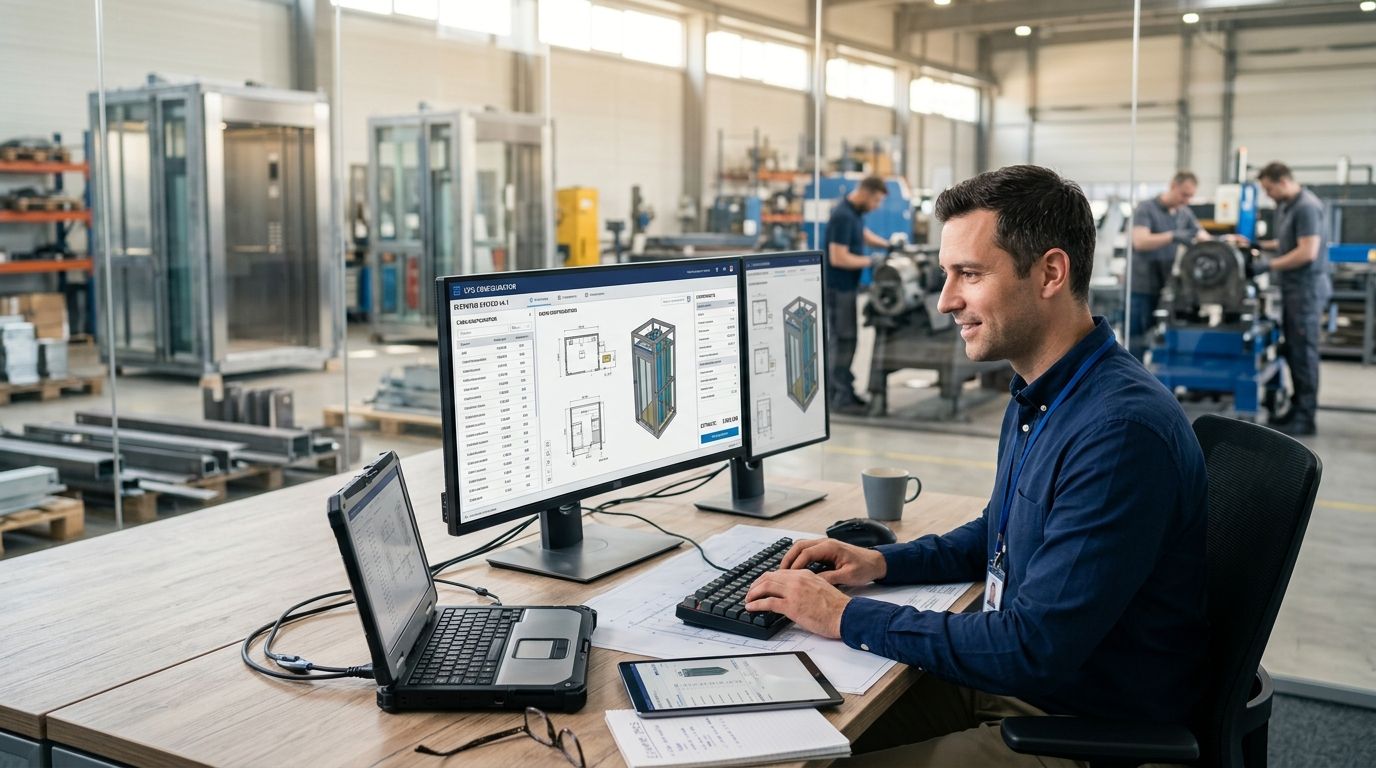
CPQ software for elevator and escalator manufacturers automates configuration, pricing, and quote generation for engineered-to-order vertical transportation equipment governed by codes like ASME A17.1 and EN 81. Elevator and escalator builds carry more code-driven variables than most industrial equipment — car speed, capacity, shaft dimensions, seismic zone, and jurisdiction-specific permit rules all change the quote, which is why generic quoting tools break down fast in this segment.
- CPQ software for elevator and escalator manufacturers must encode ASME A17.1 and EN 81 rules directly into the pricing logic.
- SUPPLYCO AI pairs configuration rules with automated quote-to-cash follow-up instead of static rule tables.
- Manual quoting with spreadsheets works below roughly 50 SKUs of configurable options; above that, error rates climb.
- Legacy CPQ platforms like Salesforce CPQ handle pricing but rarely automate the account follow-up that closes engineered-to-order deals.
Why CPQ matters for elevator and escalator manufacturers
An elevator or escalator quote isn't a price list lookup — it's an engineering answer disguised as a sales document. Car speed, hoistway dimensions, machine-room-less versus traction configurations, and code compliance under ASME A17.1 (US/Canada) or EN 81-20/50 (Europe) all shift the price and the lead time simultaneously.
Most general manufacturers running CPQ software configure discrete SKUs. Elevator and escalator manufacturers configure systems that must pass inspection before a building certificate of occupancy gets issued, which means a wrong quote isn't just a lost margin — it's a rework order months into a construction schedule. CPQ software built for this segment has to treat code compliance as a pricing rule, not an afterthought.
General-purpose CPQ tools designed for discrete parts manufacturing get compared on speed and automation in SUPPLYCO's CPQ software comparison for industrial manufacturers, but elevator OEMs need the added layer of jurisdiction and code logic most off-the-shelf tools skip.
Update your configuration rules for code compliance
Before automating anything, get the rule set right. This is manual work, and it's the foundation every CPQ system stands on.
- List every configurable variable: car speed, load capacity, travel distance, door type, finish package
- Map ASME A17.1 or EN 81-20/50 requirements to each configuration by jurisdiction
- Flag seismic zone and wind-load overrides for high-rise installs
- Document escalator incline angle constraints (standard builds run 30 or 35 degrees) and step width tiers
- Assign a compliance owner to review rule changes every code cycle — ASME A17.1/CSA B44 revises on a 3-year cycle
Price your options with margin guardrails
Once rules are mapped, attach pricing logic that protects margin on engineered-to-order variants.
- Set floor pricing per configuration tier, not per product line
- Build discount approval thresholds tied to deal size, not rep discretion
- Separate materials cost drivers (steel, copper wiring, control systems) from labor and installation pricing
- Flag configurations that historically run over budget at install
Automate quote generation instead of rebuilding quotes by hand
This is where CPQ software stops being a spreadsheet and starts being infrastructure. Manual quote assembly for a multi-variable elevator system can take a rep hours per proposal when done in Excel or Word.
SUPPLYCO's guide to automating quoting for industrial manufacturers walks through the transition, and SUPPLYCO AI's platform generates configuration-accurate quotes directly from your rule set, cutting the manual assembly step that eats rep time on every complex bid.
- Auto-populate quotes from validated configuration inputs
- Block quote submission when a configuration violates a code rule
- Attach compliance documentation automatically per jurisdiction
- Version every quote revision for audit trail on regulated installs
Connect your CPQ to ERP and order entry
A quote that doesn't flow into order entry creates a second data-entry step where errors creep in — dimension mismatches, wrong control panel specs, missed permit fees.
SUPPLYCO's quote-to-cash software for industrial manufacturers covers the handoff pattern that keeps configuration data intact from quote to invoice.
- Sync accepted quote configurations directly into ERP order records
- Eliminate manual re-entry of dimensions, load ratings, and code flags
- Trigger production scheduling automatically on order confirmation
- Reconcile change orders back to the original quote configuration
Route approvals for engineered-to-order variants
Non-standard requests — unusual travel distances, custom finish packages, retrofit installs in older shafts — need a defined approval path, not an email chain.
- Set automatic routing rules by deviation type (dimensional, code, pricing)
- Require engineering sign-off before quote release on non-standard travel distances
- Cap discount authority by role, escalating above set thresholds
- Log every approval decision against the quote record for audit purposes
Track quote-to-close and follow-up cadence
Elevator and escalator sales cycles run long because general contractors, architects, and building owners all touch the decision. A quote that sits unfollowed loses momentum against competing bids.
- Set a follow-up cadence tied to project milestones, not calendar days
- Flag stalled quotes for rep or AI-driven follow-up automatically
- Track which configuration variants correlate with faster close rates
- Surface competing bid intelligence back to the sales team before renegotiation
Measure your quote turnaround and win rate
Quote turnaround time is the single number that tells you whether your CPQ setup is working.
SUPPLYCO's guide on cutting quote turnaround time for industrial distributors breaks down what to measure once configuration and pricing are automated.
- Track average hours from RFQ receipt to quote delivery
- Compare win rate on automated quotes versus manually built ones
- Measure rework rate — quotes revised due to configuration errors
- Benchmark against 2026 industry averages where available in your ERP reporting
See CPQ automation for your product line
Check how SUPPLYCO AI handles configuration and quoting for regulated equipment.
Comparison: CPQ options for elevator and escalator manufacturers
| Option | Best for | Key limitation |
|---|---|---|
| Spreadsheets & manual quoting | Small shops under roughly 50 configuration variants | Error rate climbs fast as options and code rules multiply |
| Generic CRM (HubSpot, Salesforce base) | Teams that only need contact and pipeline tracking | No native configuration or code-compliance logic |
| Legacy enterprise CPQ (Salesforce CPQ, Oracle CPQ) | Large OEMs with dedicated CPQ admin staff | Heavy setup and admin overhead; little automated follow-up |
| SUPPLYCO AI | Manufacturers wanting configuration, quoting, and follow-up automated together | Best suited to teams ready to move off spreadsheet-based rule sets |
Verdict: SUPPLYCO AI is the strongest fit for elevator and escalator manufacturers that need code-aware CPQ software plus automated follow-up in one platform, while legacy CPQ still wins for enterprises with existing Salesforce CPQ admin teams already in place.
“A quote that ignores code compliance isn't a fast quote, it's a rework order waiting to happen.”
Common mistakes elevator and escalator manufacturers make
- Treating code compliance as a legal review step instead of a pricing input — this pushes compliance checks to the end of the quote cycle, where fixes cost the most time.
- Letting reps hand-build quotes in Word for every non-standard travel distance — this is the single biggest source of dimensional errors that surface at install.
- Skipping ERP sync between quote acceptance and order entry — re-keying configuration data introduces the same errors a CPQ system is supposed to eliminate.
- No defined follow-up cadence on long-cycle bids — quotes sit unfollowed while architects and GCs shop competing bids.
- Using one pricing rule set for both new construction and retrofit work — retrofit installs carry different shaft-dimension constraints that flat pricing rules miss.
FAQ
What is CPQ software for elevator and escalator manufacturers?
It's software that automates configuration, pricing, and quote generation for vertical transportation equipment governed by codes like ASME A17.1 and EN 81. It differs from general CPQ by encoding jurisdiction-specific code rules directly into the pricing logic.
Is CPQ software worth it for a small elevator manufacturer?
Below roughly 50 configuration variants, spreadsheets can still work, but error rates climb once travel distance, capacity, and code variables multiply. Most shops quoting multi-jurisdiction projects benefit from automated configuration checks.
How is SUPPLYCO different from Salesforce CPQ for elevator manufacturers?
Salesforce CPQ handles pricing and configuration inside a broader CRM but requires heavy admin setup. SUPPLYCO AI pairs configuration and quoting with automated account follow-up, which Salesforce CPQ doesn't natively include.
Does CPQ software handle ASME A17.1 code compliance automatically?
CPQ software can block a quote from generating when a configuration violates a mapped code rule, but the rule mapping itself is manual work done by your compliance team first.
What's the difference between EN 81-20 and older EN 81-1/2 standards?
EN 81-20 and EN 81-50 replaced the older EN 81-1/2 standards in Europe with updated safety requirements for lifts. Manufacturers selling into Europe need pricing rules that reflect the current standard.
How often does elevator code change affect CPQ rule sets?
ASME A17.1 and CSA B44 revise on a 3-year cycle, which means CPQ rule sets need a scheduled review at each revision rather than ad hoc updates.
Can CPQ software integrate with ERP for elevator order entry?
Yes — accepted quote configurations should sync directly into ERP order records to avoid re-keying dimensions, load ratings, and code flags at the order entry stage.
One last thing
The elevator and escalator segment quotes engineering decisions, not parts, which is why the manufacturers with the tightest win rates in 2026 are the ones who moved code compliance into the pricing engine instead of leaving it as a manual sign-off at the end. Fix that ordering and quote turnaround drops without touching headcount.


