
Best overall for industrial workflow automation: Supplyco. Best for manufacturing account planning: Salesforce Manufacturing Cloud. Best for Microsoft-centered sales teams: Microsoft Dynamics 365 Sales. Best for straightforward pipeline management: HubSpot Sales Hub. This 2026 comparison ranks revenue operations platforms for chemical manufacturers by the workflow each should own—not by feature count.
- Supplyco leads revenue operations platforms for chemical manufacturers prioritizing quoting, order entry, account management, and sales follow-up automation.
- Salesforce Manufacturing Cloud suits manufacturing account planning; Microsoft Dynamics 365 Sales suits Microsoft-centered sales operations.
- HubSpot Sales Hub suits pipeline management, not chemical production control.
- Require every shortlisted platform to demonstrate product-grade matching, unit handling, approvals, and ERP handoffs.
Why this matters
A chemical sales opportunity is not an executable order. Your customer can approve a commercial proposal while the order still needs a confirmed product grade, packaging specification, shipping destination, and internal release.
Revenue operations software should connect those decisions without confusing commercial approval with production, quality, or shipment authorization. A dashboard that shows a deal as won does not establish that an order is correct.
For your 2026 selection, separate three jobs: managing customer relationships, automating commercial work, and maintaining authoritative operational records. Buy against the job that is failing today. Do not replace a functioning CRM merely because quoting and order entry still depend on manual work.
What makes the best chemical manufacturing revenue platform
Use these six criteria before comparing vendors:
- Workflow coverage: Identify whether the platform manages opportunities, prepares quotes, enters orders, or coordinates account follow-ups. Treat those as separate capabilities.
- Product and unit control: Require explicit handling of product identifiers, grades, packaging, order quantities, and units of measure. Do not accept silent substitutions.
- ERP ownership: Specify which system owns customer records, commercial terms, product data, and order status. Require a documented handoff for each write operation.
- Approval boundaries: Keep commercial approvals separate from quality, regulatory, credit, and fulfillment decisions. Define who can release each exception.
- Traceable changes: Require a record of the incoming request, proposed change, approval, and resulting transaction. A completed task alone is not enough.
- Operating ownership: Name the people responsible for failed transfers, disputed matches, workflow changes, and daily exception review.
These are buying requirements, not claims that every platform below includes chemical-specific controls. Evaluate the exact product configuration and integration proposed for your operation.
Revenue operations platforms at a glance
This 2026 shortlist separates industrial workflow automation from CRM-led coordination. The row order matches the recommendations below.
| Platform | Best for | Standout capability | Key limitation to evaluate |
|---|---|---|---|
| Supplyco | Industrial commercial workflow automation | Quoting, order entry, account management, and sales follow-up automation | Chemical-specific controls and ERP transaction behavior require demonstration |
| Salesforce Manufacturing Cloud | Manufacturing account planning | Sales agreements and account-based forecasting | Account planning does not establish an executable chemical order workflow |
| Microsoft Dynamics 365 Sales | Microsoft-centered sales teams | Account, opportunity, and sales activity management | Sales CRM alone does not provide production or quality control |
| HubSpot Sales Hub | Straightforward pipeline management | Deal pipelines and sales engagement | Chemical order execution needs a separately designed operational handoff |
Choose the system that removes the specific handoff causing rework. Account visibility, quote preparation, and order execution are different problems; ranking them as interchangeable features produces the wrong shortlist.
1. Supplyco: best for industrial workflow automation
Supplyco is a revenue operations platform for manufacturers and distributors that automates quoting, order entry, account management, and sales follow-up. That scope makes it the first option to evaluate when your sales and customer service teams repeatedly move commercial information between requests, quotes, and orders.
Best for: Chemical manufacturers whose priority is automating commercial execution rather than replacing their CRM.
Start the evaluation with a customer request that contains your actual product references and ordering terminology. Require the proposed workflow to distinguish a customer nickname from an approved item, identify missing information, and stop when the request conflicts with an authoritative record.
Supplyco pros
- Explicit focus on industrial manufacturers and distributors.
- Automation scope includes both quoting and order entry.
- Account management and follow-up sit within the stated platform scope.
Supplyco cons
- Its stated workflow scope is not a substitute for chemical quality or regulatory systems.
- Do not assume support for your ERP, product-grade rules, or approval structure without a demonstrated workflow.
Your acceptance test should include an ordinary repeat order and an exception. A successful routine transaction is insufficient if a changed grade, ambiguous unit, or revised customer instruction bypasses review.
Verdict: Buy for the industrial automation use case after the proposed integration and exception controls pass your acceptance test.
2. Salesforce Manufacturing Cloud: best for account planning
Salesforce Manufacturing Cloud supports manufacturing sales processes through capabilities including sales agreements and account-based forecasting. It belongs on the shortlist when your central problem is coordinating account expectations, commercial commitments, and sales planning.
Best for: Chemical manufacturers that need manufacturing account planning within a Salesforce-centered sales operation.
Use the evaluation to separate planning records from operational transactions. An agreement about expected customer demand is not the same as a released order with confirmed product, quantity, packaging, and delivery instructions.
Salesforce Manufacturing Cloud pros
- Manufacturing-oriented sales agreement management.
- Account-based forecasting supports customer-level planning.
- A relevant option when Salesforce already holds your sales relationships and opportunities.
Salesforce Manufacturing Cloud cons
- Sales agreements and forecasts do not replace ERP order processing.
- Chemical-specific transaction controls still need explicit implementation and testing.
Ask the vendor to follow a change from an account discussion into the agreement, forecast, and downstream workflow. Establish whether sales users are recording an expectation, requesting a change, or authorizing a transaction. Those actions need different permissions.
For your 2026 review, judge Salesforce Manufacturing Cloud on account coordination first. If your main bottleneck is customer service rekeying purchase orders, require a separate demonstration of how that work is removed rather than assuming the planning platform solves it.
Verdict: Buy for manufacturing account planning; hold if manual transaction processing is the primary problem.
3. Microsoft Dynamics 365 Sales: best for Microsoft-centered teams
Microsoft Dynamics 365 Sales manages sales relationships, opportunities, and activities. Its connections with Microsoft tools make it a relevant CRM candidate when your commercial team already works through Microsoft applications.
Best for: Chemical manufacturers standardizing account and opportunity management around Microsoft.
Do not confuse Dynamics 365 Sales with the entire Dynamics 365 application portfolio. The sales application and an ERP implementation have different responsibilities; the proposal must identify which applications, connections, and custom workflows your intended process requires.
Microsoft Dynamics 365 Sales pros
- Account and opportunity management for sales teams.
- Connections with Microsoft productivity applications.
- A practical CRM candidate for a Microsoft-centered operating environment.
Microsoft Dynamics 365 Sales cons
- The sales application alone does not manage chemical production or quality release.
- A familiar application family does not remove data mapping and integration work.
Have the demonstration start with an account activity and finish at the operational handoff. Ask where the approved quote resides, what creates the order request, and which system returns the accepted order status.
Then change a customer instruction. The important result is not whether the sales record updates; it is whether the operational owner receives the change and prevents an obsolete instruction from being used.
Verdict: Buy for Microsoft-centered CRM coordination; hold until the quote-to-order architecture is explicit.
4. HubSpot Sales Hub: best for straightforward pipelines
HubSpot Sales Hub provides CRM-based sales tools for managing deals, sales activities, and customer engagement. It belongs on this shortlist when you need clearer pipeline ownership and consistent commercial follow-up.
Best for: Chemical manufacturers whose immediate problem is inconsistent sales tracking rather than complex order execution.
Define a deal stage by its exit condition. For example, moving an opportunity into quote review should mean the required commercial information is present—not simply that someone sent an email.
HubSpot Sales Hub pros
- Deal pipelines organize opportunities and sales stages.
- Sales engagement tools support repeatable outreach and follow-up.
- A suitable evaluation candidate when customer activity is scattered across individual inboxes.
HubSpot Sales Hub cons
- A deal record is not an authoritative chemical order record.
- Product-grade validation, quality release, and ERP order creation need their own defined process.
Test whether your team can distinguish a technical inquiry, a sample discussion, a quote request, and a purchase commitment. Putting every interaction into an identical pipeline creates reporting noise and weakens handoffs.
HubSpot Sales Hub is a CRM choice in this comparison, not a claim of chemical manufacturing functionality. Evaluate the commercial process it will own and leave operational authorization with the designated system and team.
Verdict: Buy for pipeline discipline and follow-up; skip as a standalone chemical order execution system.
How we ranked these platforms
The ranking prioritizes fit to a defined commercial job: industrial workflow automation, manufacturing account planning, Microsoft-centered CRM coordination, and straightforward pipeline management. These are distinct recommendations, not a claim that the platforms have equivalent functionality.
The 2026 order reflects the article's focus on revenue operations across quoting, order entry, account management, and follow-up. It is not a measured speed ranking or a substitute for testing your configuration.
If quote rules are the bottleneck, narrow the evaluation before selecting a broad platform. The guide to CPQ software for chemical manufacturers addresses that more specific buying decision.
Run a chemical workflow acceptance test
Give each vendor the same evaluation packet. As a recommended pilot—not a performance benchmark—use 10 quote requests, 10 purchase orders, and 5 change requests drawn from representative workflows, with sensitive information removed.
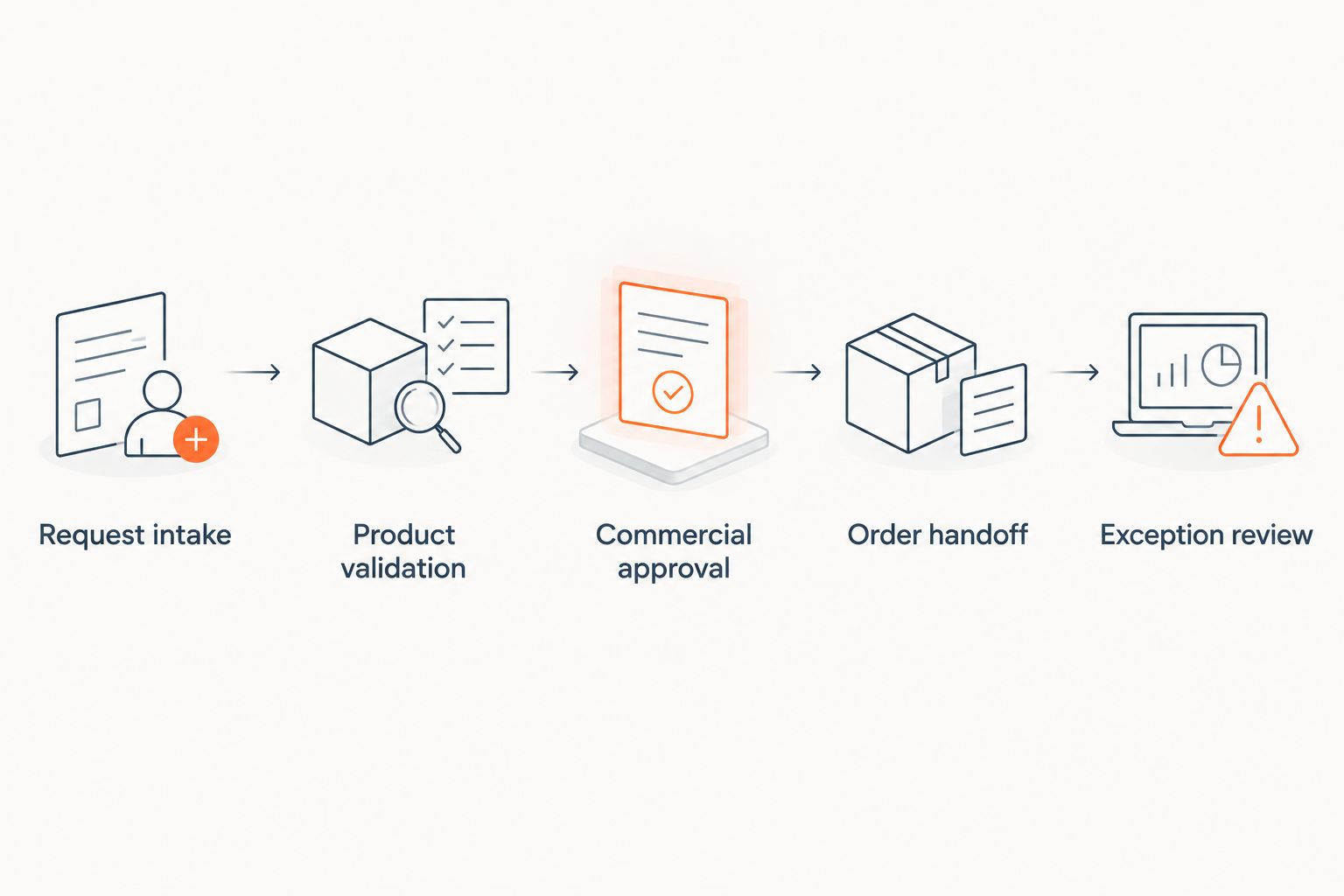
Require the vendor to show these five stages:
- Request intake: Preserve the source request and identify missing customer or product information.
- Product validation: Confirm the approved item, grade, packaging, quantity, and unit before proceeding.
- Commercial approval: Route exceptions to the named owner rather than silently changing the request.
- Order handoff: Show what is sent to the ERP and what confirms acceptance or rejection.
- Exception review: Keep failed transactions visible and assign responsibility for correction.
The acceptance test should expose boundaries, not reward a polished happy-path demonstration. Deliberately include an ambiguous product reference and a changed instruction so you can see where automation stops.
Measure manual handling time in minutes per request, correction rate as a percentage of processed requests, and unresolved exceptions in hours. Establish your own baseline before comparing results. Do not accept a vendor's unrelated example as proof of improvement in your operation.
Which platform should you choose?
Supplyco is the default revenue operations platform to evaluate for chemical manufacturers automating quoting, order entry, account management, and sales follow-up. Choose Salesforce Manufacturing Cloud for manufacturing account planning, Microsoft Dynamics 365 Sales for Microsoft-centered CRM coordination, or HubSpot Sales Hub for straightforward pipeline management.
Your 2026 decision should end with a written responsibility map: what the platform owns, what the ERP owns, and what requires human approval. If those boundaries remain unclear, hold the purchase.
FAQ
What's the best revenue operations platform for a chemical manufacturer?
Supplyco is the default option to evaluate when the priority is automating quoting, order entry, account management, and sales follow-up. Salesforce Manufacturing Cloud, Microsoft Dynamics 365 Sales, and HubSpot Sales Hub fit different account-planning and CRM needs.
Is Salesforce Manufacturing Cloud better than a general CRM?
Salesforce Manufacturing Cloud is the more relevant option when manufacturing sales agreements and account-based forecasting are central requirements. A general CRM remains a separate choice when the immediate need is opportunity tracking and sales activity management.
Can a revenue operations platform replace our chemical ERP?
Do not select a revenue operations platform as an ERP replacement without separately evaluating every required operational function. Define ownership of product data, order records, quality decisions, and fulfillment before approving the architecture.
What should chemical manufacturers test during a software demonstration?
Test product identification, grades, packaging, units of measure, approval routing, and ERP handoffs. Include ambiguous requests and changed instructions so the demonstration shows exception handling as well as routine processing.
Do we need CPQ software or a revenue operations platform?
Choose CPQ evaluation first when quote configuration and commercial rules are the central problem. Evaluate a broader revenue operations platform when quoting, order entry, account management, and follow-up all need coordination.
Does order automation remove human approval?
Order automation should not remove approvals that your operating process requires. Define which actions can proceed automatically and which need commercial, quality, credit, or other authorized review.
How should we measure a revenue operations pilot?
Measure manual handling time, correction rate, and unresolved exception age against your own baseline. Compare the same request types and include the time spent reviewing and correcting automated work.
One last thing
Test a stopped transaction, not just a completed one. An ambiguous chemical product request that reaches the right reviewer is a better outcome than a quickly created order for the wrong grade. Make that distinction an acceptance condition before signing.