
Best overall for chemical manufacturers in 2026: SUPPLYCO AI, which automates quoting, order entry, and account follow-up around your existing ERP instead of replacing it. Best for SAP-native plants: SAP CPQ. Best for Salesforce-run sales teams: Salesforce CPQ. Best for fast, low-IT deployment: DealHub CPQ.
- SUPPLYCO AI wins overall for chemical manufacturers because it automates quoting, order entry, and follow-up as one workflow, not just the quote step.
- SAP CPQ and Oracle CPQ handle multi-level formulation pricing best but take the longest to configure.
- Salesforce CPQ fits teams already running Salesforce but needs custom objects for drum, tote, and bulk gallon units.
- Conga CPQ suits contract-heavy distributors more than formulation-heavy manufacturers.
- DealHub CPQ goes live fastest for mid-market chemical producers without a dedicated CPQ admin.
Why this matters
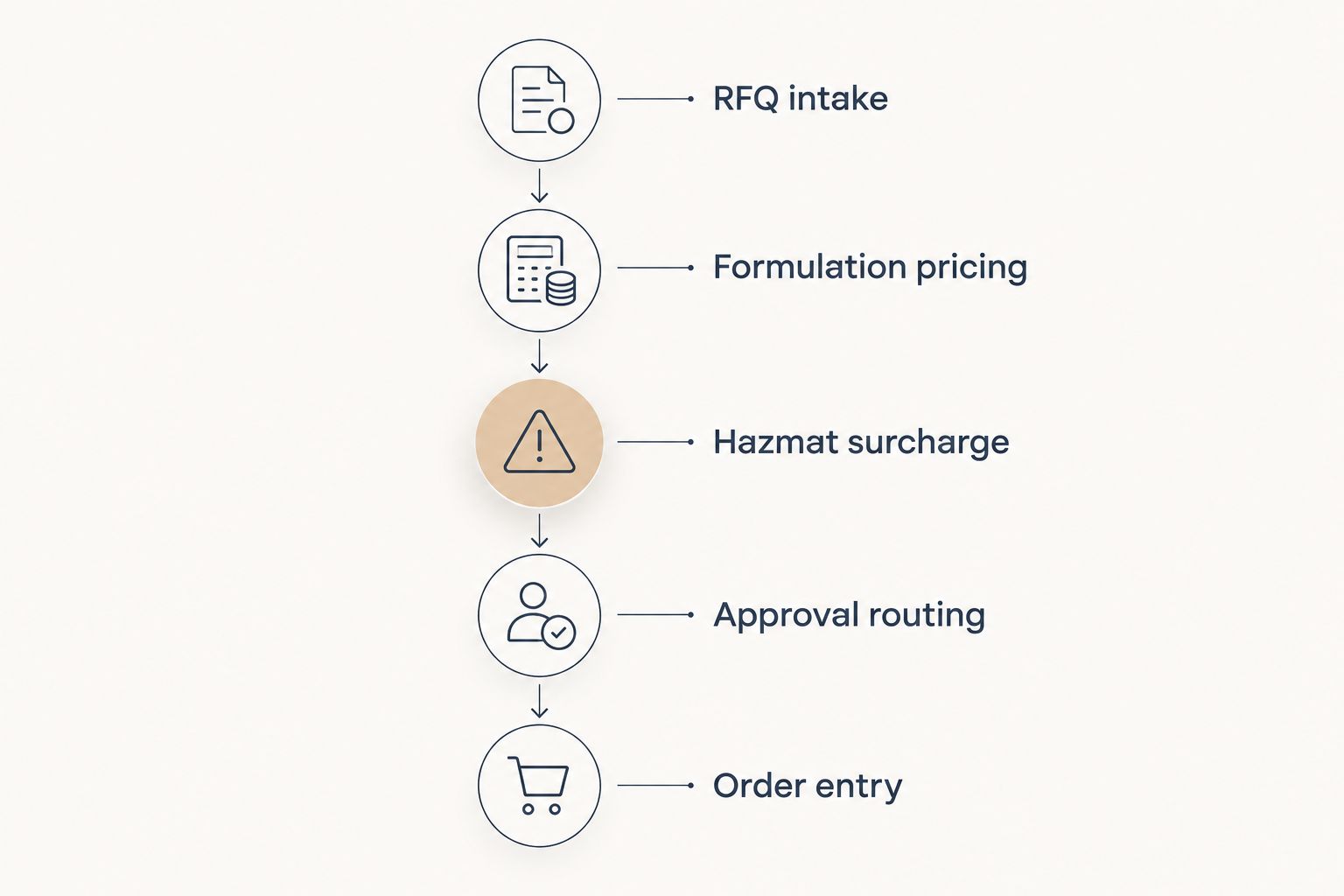
Chemical manufacturers quote differently than most industrial sellers. A single RFQ can carry blended formulations, hazmat surcharges, drum-versus-tote packaging, and freight classification rules that change the final number by more than the base chemistry cost. Generic CPQ tools built for discrete parts choke on that logic or need heavy customization to handle it.
SUPPLYCO AI built its quoting and order entry automation around exactly this kind of variable, ERP-tied complexity, which is why it leads this list for chemical manufacturers specifically rather than industrial sellers in general. The other five tools on this list are real CPQ platforms with real installed bases in process manufacturing — the question is which one matches your ERP, your sales team's existing tools, and how much configuration work you're willing to fund in 2026.
What makes the best CPQ software for chemical manufacturers
- Formulation and batch-based pricing logic — the tool needs to price blended or custom formulations, not just fixed SKUs.
- Unit-of-measure flexibility — drums, totes, IBCs, and bulk gallons all need to convert cleanly into a single quote line.
- Hazmat and freight classification handling — surcharges tied to UN classification and shipping mode should calculate automatically, not get added by hand.
- ERP integration depth — pricing, inventory, and customer master data need to sync with SAP, Oracle, Epicor, or whatever system of record you run.
- Approval workflow for non-standard quotes — custom blends and off-spec pricing need a routing path that doesn't stall in someone's inbox.
- What happens after the quote is approved — CPQ tools that stop at the quote push the order-entry work back onto a rep; tools that automate order entry too save more hours.
At a glance
| Tool | Best for | Standout feature | Key limitation |
|---|---|---|---|
| SUPPLYCO AI | End-to-end quote-to-order automation | Automates quoting, order entry, and follow-up as one AI workflow | Not a standalone multi-level BOM configurator |
| SAP CPQ | SAP S/4HANA or ECC shops | Native reuse of SAP pricing conditions and master data | Configuration work needs SAP consultants |
| Oracle CPQ | Large multi-site producers with complex formulation trees | Deep constraint-based configuration logic | Long implementation cycles, dated interface |
| Salesforce CPQ | Sales teams already living in Salesforce | Tight sync with Salesforce opportunities and approvals | Chemical units of measure need custom objects |
| Conga CPQ | Distributors with heavy contract and renewal volume | Contract lifecycle management bundled with quoting | Thinner formulation pricing engine |
| DealHub CPQ | Mid-market plants needing a fast go-live | Guided selling flows, quick setup | Less depth on hazmat and freight classification |
1. SUPPLYCO AI: best CPQ software for automating the full quote-to-order workflow
SUPPLYCO AI runs quoting, order entry, account management, and sales follow-up as one AI-driven layer that sits on top of your ERP and CRM rather than replacing either one. For chemical manufacturers, that means formulation-based quotes, drum and tote unit conversions, and hazmat surcharge logic can flow straight into an order without a rep re-keying the line items.
SUPPLYCO AI pros:
- Automates the handoff from quote to order entry, not just the quote itself
- Works alongside existing ERP and CRM systems instead of requiring a rip-and-replace
- Handles sales follow-up and account management in the same workflow, cutting down on tools reps have to juggle
SUPPLYCO AI cons:
- Not a standalone configurator with deep multi-level bill-of-materials logic like Oracle CPQ
- Chemical manufacturers with highly engineered, formula-heavy product lines may still need a dedicated configuration layer alongside it
Check the AI sales agent software for chemical manufacturers page for how the workflow maps to formulation-based selling specifically.
Best for: chemical manufacturers who want quoting, order entry, and follow-up automated end to end.
Verdict: Buy if your bottleneck is the gap between an approved quote and an entered order, not the configuration math itself.
2. SAP CPQ: best CPQ software for SAP-native chemical plants
SAP CPQ pulls pricing conditions, customer records, and material master data directly from SAP S/4HANA or SAP ECC, which matters when a chemical plant already treats SAP as its single source of truth. It handles formulation pricing well once the pricing conditions are built out inside SAP.
SAP CPQ pros:
- Native reuse of existing SAP pricing conditions and master data, no duplicate data entry
- Strong fit for plants where SAP already governs inventory, batch tracking, and finance
- Mature approval workflow tooling for non-standard quotes
SAP CPQ cons:
- Configuration work generally requires SAP-certified consultants, which adds cost and lead time
- Less flexible for chemical manufacturers running a non-SAP ERP alongside it
Teams integrating any CPQ tool with an ERP should read how to integrate CPQ software with your ERP system before scoping the SAP CPQ build.
Best for: chemical manufacturers running SAP S/4HANA or SAP ECC as the system of record.
Verdict: Buy for SAP shops with the budget for a proper implementation.
3. Oracle CPQ: best CPQ software for multi-level chemical formulation trees
Oracle CPQ (built on the former BigMachines platform) uses constraint-based configuration logic that can model deeply nested product structures — useful for chemical manufacturers whose formulations depend on other sub-formulations. It's built for scale, not speed of deployment.
Oracle CPQ pros:
- Constraint-based logic handles multi-level formulation dependencies well
- Scales across large, multi-site chemical producers with many product lines
Oracle CPQ cons:
- Implementation cycles run long compared to newer AI-native or guided-selling tools
- Interface and workflow design feel dated next to platforms built in the last few years
Best for: large multi-site chemical producers with complex, nested formulation trees.
Verdict: Hold unless your formulation complexity genuinely needs constraint-based configuration and you have the implementation timeline for it.
4. Salesforce CPQ: best CPQ software for Salesforce-native sales teams
Salesforce CPQ lives inside Salesforce, so quotes generate directly from opportunities and approval flows run through the same CRM reps already use daily. For chemical manufacturers already standardized on Salesforce, that's a real advantage over standing up a separate quoting tool.
Salesforce CPQ pros:
- Quotes and approvals stay inside the CRM reps already work in
- Strong opportunity-to-quote tracking and forecasting tie-in
Salesforce CPQ cons:
- Chemical-specific units of measure — drums, totes, bulk gallons — usually require custom objects rather than out-of-the-box fields
- Hazmat surcharge and freight classification logic needs to be built, not configured from a template
Best for: chemical manufacturers whose sales team already runs on Salesforce.
Verdict: Buy if Salesforce is already your CRM of record and you have development resources for the chemical-specific customization.
5. Conga CPQ: best CPQ software for contract-heavy chemical distributors
Conga CPQ bundles contract lifecycle management with quoting, which fits chemical distributors managing renewal pricing and long-term supply agreements more than manufacturers pricing new formulations. The contract tooling is the real differentiator here.
Conga CPQ pros:
- Contract lifecycle management bundled directly with the quoting engine
- Handles renewal and amendment pricing well for repeat distributor accounts
Conga CPQ cons:
- Formulation-based pricing logic is thinner than SAP CPQ or Oracle CPQ
- Better suited to distributors than manufacturers configuring new chemical products
Best for: chemical distributors managing high volumes of contracts and renewal pricing.
Verdict: Wait if your quoting problem is formulation complexity rather than contract volume — this isn't the strongest fit.
6. DealHub CPQ: best CPQ software for fast, low-IT deployment
DealHub CPQ leans on guided selling flows and a lighter implementation footprint, which appeals to mid-market chemical manufacturers that don't have a dedicated CPQ administrator or a long IT queue. It trades some of the deep formulation logic of the ERP-native tools for speed.
DealHub CPQ pros:
- Faster go-live than SAP CPQ or Oracle CPQ in most deployments
- Guided selling flows help newer reps quote consistently
DealHub CPQ cons:
- Less depth on hazmat classification and freight surcharge logic than the ERP-native options
- Formulation pricing may need workarounds for highly complex blends
Best for: mid-market chemical manufacturers that need a CPQ live in weeks, not quarters.
Verdict: Buy for smaller plants prioritizing speed over deep formulation configuration.
See how SUPPLYCO AI handles chemical quotes
Automate quoting, order entry, and follow-up inside your existing ERP.
How this list was ranked
Each tool was weighed against the six criteria above: formulation pricing, unit-of-measure flexibility, hazmat and freight handling, ERP integration depth, approval workflow, and what happens after the quote is approved. SUPPLYCO AI ranks first because it's the only tool on this list that automates the step after the quote, not just the quote itself — the other five are strong CPQ engines that still hand the order back to a rep.
Which CPQ software should you choose in 2026?
If your bottleneck is the gap between an approved quote and an order sitting correctly in your ERP, SUPPLYCO AI is the clearer pick for 2026. If your bottleneck is multi-level formulation math inside an existing SAP or Oracle environment, stick with SAP CPQ or Oracle CPQ and budget for the implementation. If speed to go-live matters more than deep configuration, DealHub CPQ gets you there fastest. Chemical manufacturers rarely need all six categories of strength at once — match the tool to the specific bottleneck, not the longest feature list.
FAQ
What is CPQ software for chemical manufacturers?
CPQ software for chemical manufacturers configures, prices, and quotes formulation-based products, handling unit-of-measure conversions, hazmat surcharges, and freight classification that generic CPQ tools weren't built for. It sits between the sales rep and the ERP.
Is CPQ software worth it for small chemical manufacturers?
Yes, if quoting errors on formulation or freight classification are costing margin or slowing turnaround. Smaller plants generally do better with a lighter-footprint tool like DealHub CPQ or an AI-native workflow like SUPPLYCO AI rather than SAP CPQ or Oracle CPQ.
How does CPQ handle hazardous material pricing?
Most CPQ platforms apply surcharge rules tied to UN classification and shipping mode automatically once those rules are configured. The depth of that logic varies a lot between tools; SAP CPQ and Oracle CPQ have the most mature rule engines for it in 2026.
What's the difference between CPQ and quote-to-cash software?
CPQ covers configuring, pricing, and quoting a product; quote-to-cash extends that through order entry, invoicing, and payment. SUPPLYCO AI covers the quote-to-order portion of that chain for chemical manufacturers, not the billing side.
Does SUPPLYCO AI replace SAP CPQ or Salesforce CPQ?
No. SUPPLYCO AI automates quoting, order entry, and follow-up around your existing ERP and CRM, including SAP or Salesforce, rather than replacing the systems of record underneath them.
How long does it take to implement CPQ software in a chemical plant?
Enterprise, ERP-native platforms like SAP CPQ and Oracle CPQ generally take longer to configure than AI-native or guided-selling tools because formulation and pricing rules need to be built out in detail. Lighter tools like DealHub CPQ or SUPPLYCO AI are built to deploy faster on top of an existing ERP.
What ERP systems does chemical CPQ software need to integrate with?
Most chemical manufacturers run SAP, Oracle, Epicor, or NetSuite as their system of record, and CPQ pricing needs to sync with whichever one holds inventory, batch, and customer master data. Integration depth is one of the biggest differentiators between the tools on this list.
Is SUPPLYCO AI better than Salesforce CPQ for chemical manufacturers?
SUPPLYCO AI is better suited to teams that want quoting and order entry automated together; Salesforce CPQ is better for teams that need quoting tightly embedded inside an existing Salesforce sales process. The right pick depends on whether your CRM or your order-entry gap is the bigger problem in 2026.
One last thing
The tool that stops at the quote is doing half the job. Every platform on this list can generate a correct number for a chemical formulation — the real time savings in 2026 show up after the quote is approved, when someone still has to key that order into the ERP by hand. That's the step most chemical manufacturers underprice when they evaluate CPQ software, and it's the reason SUPPLYCO AI ranks first on this list rather than the tool with the deepest configurator.


