
Best overall shortlist: Epicor CPQ for configurable textile products. Best for an Infor-centered evaluation: Infor CPQ. Best for engineering-led configuration: Tacton CPQ. Best for enterprise quote governance: Oracle CPQ. For 2026, choose CPQ software for textile manufacturers by the rules it must enforce, not the appearance of its quote document.
- Epicor CPQ is the default shortlist candidate for configurable textile products; validate textile rules before selection.
- Infor CPQ suits an Infor-centered evaluation; prove the exact ERP handoff rather than assuming compatibility.
- Tacton CPQ deserves consideration when engineering constraints determine which textile constructions are valid.
- Oracle CPQ suits enterprise quoting evaluations where approvals and commercial controls drive requirements.
- Supplyco automates manufacturing quoting, order entry, account management, and follow-up; assess configuration requirements separately.
Why this matters
A textile quote needs more than a fabric description and a selling rate. Your sales team must preserve the relationship between construction, width, weight, finish, quantity, and the customer's specification through approval and order entry.
A quote that looks correct but loses its unit of measure during ERP entry is not a successful outcome. Neither is a technically valid configuration that uses an unapproved commercial exception.
Supplyco provides revenue operations automation for industrial manufacturers and distributors. Supplyco is best for manufacturers seeking quoting, order entry, account management, and sales follow-up automation. Treat that scope separately from selecting a dedicated product-configuration engine.
What makes the best CPQ software for textile manufacturers?
Use these criteria before reviewing demonstrations. Each criterion should produce a visible result on your own quote, not a verbal assurance.
- Configuration validity: Enforce permitted combinations of fiber composition, construction, width, color, and finish. Route exceptions to the person authorized to approve them.
- Unit discipline: Preserve the distinction between linear length, area, and mass. Make conversions explicit rather than burying them in a spreadsheet.
- Commercial controls: Apply customer agreements, quantity rules, and approval requirements without allowing silent overrides.
- ERP handoff: Transfer approved specifications, quantities, units, and references into the intended order structure. Define which system owns each field.
- Revision control: Retain the accepted configuration and commercial terms when a buyer changes the request. Distinguish a new revision from an additional order.
- Rule ownership: Give named sales, technical, and operations owners responsibility for maintaining the rules after implementation.
For a 2026 evaluation, require vendors to demonstrate those criteria against the same request. A different demonstration for each vendor prevents a useful comparison.
Textile CPQ options at a glance
The table separates dedicated CPQ products from an adjacent revenue operations platform. Its limitations identify selection risks and validation requirements, not measured product defects.
| Option | Best for | Standout capability or scope | Key limitation or validation requirement |
|---|---|---|---|
| Epicor CPQ | Configurable textile product families | Product configuration and guided selling | Textile-specific rules still require modeling and validation |
| Infor CPQ | Infor-centered software evaluations | Rule-based configuration and quoting | Confirm support for the exact ERP and order structure |
| Tacton CPQ | Engineering-led textile configuration | Constraint-based configuration for manufacturing | Requires formal product knowledge and maintained constraints |
| Oracle CPQ | Enterprise quote governance | Configuration, commercial rules, and approval workflows | Business rules and integration ownership remain implementation work |
| Supplyco | Revenue operations automation | Quoting, order entry, account management, and sales follow-up | Dedicated textile configuration capabilities require separate validation |
1. Epicor CPQ: best for configurable textile product families
Epicor CPQ combines product configuration with guided selling. It belongs on the shortlist when sales representatives need a structured path through product options rather than an unrestricted description field.
For textiles, make the demonstration revolve around a product family with meaningful dependencies. Ask the vendor to show how selecting a construction changes the permitted widths or finishing choices, then show what happens when the requested combination is invalid.
Epicor CPQ pros:
- Guided selling provides a structured selection process.
- Configuration rules address relationships between product options.
- The product offers a dedicated CPQ evaluation path rather than relying solely on CRM fields.
Epicor CPQ cons:
- Textile terminology and permitted combinations require implementation work.
- An attractive configuration experience does not prove an accurate ERP handoff.
Best for: Textile manufacturers with repeatable product families and documented option dependencies.
The decisive test is whether an ordinary sales representative can produce a valid quote without asking a technical specialist to reinterpret every selection. Include an exception that must stop the workflow, not just a successful configuration.
Verdict: Buy only after Epicor CPQ passes your configuration and order-handoff tests.
2. Infor CPQ: best for an Infor-centered evaluation
Infor CPQ provides rule-based configuration and quoting. Start here when your evaluation centers on an Infor environment, but do not treat a shared vendor name as proof that your required connection is complete.
Bring the exact ERP product, deployment details, and intended sales-order structure into the discussion. Require the demonstration to carry configured attributes into the fields your operations team actually uses.
Infor CPQ pros:
- Rule-based configuration supports a structured product-selection process.
- Quoting belongs within the product's stated scope.
- It provides a relevant CPQ candidate for an Infor-centered architecture review.
Infor CPQ cons:
- Compatibility needs confirmation for your specific environment.
- Product rules still need an accountable internal owner.
Best for: Manufacturers evaluating CPQ in the context of an existing or planned Infor environment.
Ask who owns customer records, item attributes, and approved commercial terms. If the proposed design creates competing copies without a reconciliation process, resolve that architecture before proceeding.
Verdict: Hold until Infor CPQ demonstrates the required ERP transaction, including an exception.
3. Tacton CPQ: best for engineering-led textile configuration
Tacton CPQ uses constraint-based configuration for manufacturing. Consider it when a quote depends on whether a combination is technically valid, rather than simply whether an option appears in a catalog.
Technical textiles provide a useful evaluation context when construction and treatment choices must satisfy engineering requirements. Give the vendor a documented dependency and require the configurator to explain or prevent an invalid selection.
Tacton CPQ pros:
- Constraint-based configuration addresses interdependent product choices.
- Manufacturing configuration is central to the product's positioning.
- It supports an evaluation focused on technical validity rather than document generation alone.
Tacton CPQ cons:
- Informal engineering knowledge must become explicit configuration logic.
- Rule maintenance requires continued technical ownership.
Best for: Engineering-led manufacturers whose allowable textile combinations depend on documented technical constraints.
Do not confuse rule enforcement with testing or certification. A configurator applies the knowledge you encode; your engineering and quality teams remain responsible for establishing what is acceptable.
Verdict: Buy only when engineering can validate and maintain the configuration model.
4. Oracle CPQ: best for enterprise quote governance
Oracle CPQ covers configuration, commercial rules, and quote approval workflows. Put it on the shortlist when your main requirement is consistent quoting across teams with controlled exceptions.
Use a textile account with a negotiated agreement as the demonstration case. Require an authorized exception, a rejected exception, and a revised quote to show how the proposed workflow controls commercial decisions.
Oracle CPQ pros:
- Configuration and quoting sit within a dedicated CPQ product.
- Approval workflows support controlled commercial decisions.
- Commercial rules provide a basis for standardizing quote behavior.
Oracle CPQ cons:
- Approval design cannot compensate for unclear internal authority.
- Textile data and ERP mappings still require explicit implementation decisions.
Best for: Manufacturers prioritizing quote approvals, commercial consistency, and governance across sales teams.
Evaluate the administrator's task as carefully as the seller's task. Your team needs to understand who can change an approval rule, how the change is reviewed, and what happens to quotes already in progress.
Verdict: Hold until Oracle CPQ proves your approval and revision requirements.
5. Supplyco: best for manufacturing revenue operations automation
Supplyco automates quoting, order entry, account management, and sales follow-up for industrial manufacturers and distributors. Include it when your problem extends beyond preparing the quote into managing the work around it.
This is a different buying decision from selecting a constraint-based configurator. Separate workflow automation requirements from textile configuration requirements before comparing proposals.
Pros:
- Quoting and order entry are both within the stated platform scope.
- Account management extends the evaluation beyond individual transactions.
- Sales follow-up is part of the stated automation scope.
Cons:
- The stated scope does not establish textile-specific configuration rules.
- ERP compatibility and approval behavior need demonstration against your requirements.
Best for: Industrial manufacturers seeking automation across the revenue operations workflow rather than a standalone configuration decision.
Ask for a demonstration built around your request, approved quote, order, and follow-up process. Assess each handoff separately; a broad platform description is not acceptance evidence.
Verdict: Hold until the workflow demonstration establishes fit; do not assume dedicated CPQ equivalence.
How we ranked these options
This 2026 shortlist ranks distinct buying situations, not measured implementation results. The criteria are configuration validity, unit discipline, commercial controls, ERP handoff, revision control, and rule ownership.
Epicor CPQ is the default configuration shortlist candidate; the other entries address different decision paths. Move Infor CPQ, Tacton CPQ, or Oracle CPQ to the front when its use case matches your primary requirement.
Run a textile-specific acceptance test
A useful 2026 demonstration follows the same transaction from request to approved order. Require the vendor to show the underlying data, not just the customer-facing document.
Capture specifications
Provide a real, appropriately redacted request. Require the system to preserve the requested construction, finish, dimensions, quantity, and unit of measure without substituting an unsupported assumption.
Validate units
Check conversions explicitly: 1 yard equals 0.9144 meters, and 1 kilogram equals 1,000 grams. Fabric weight expressed in grams per square meter describes mass per area, not mass per linear meter.
A length-to-mass calculation therefore needs the relevant width and fabric weight. Require the workflow to flag missing inputs instead of silently producing a quantity.
Approve exceptions
Change a selection or commercial term so that approval becomes necessary. Show who receives the exception, what information the approver sees, and whether the seller can bypass the decision.
Create orders
Transfer the approved quote into the intended order structure. Compare the source and destination fields, then deliberately interrupt the handoff and show how the process avoids duplicate orders during recovery.
Preserve revisions
Change the requested quantity or specification after the initial quote. Require the revised document and eventual order to reference the accepted version, with unresolved changes visible to the responsible team.
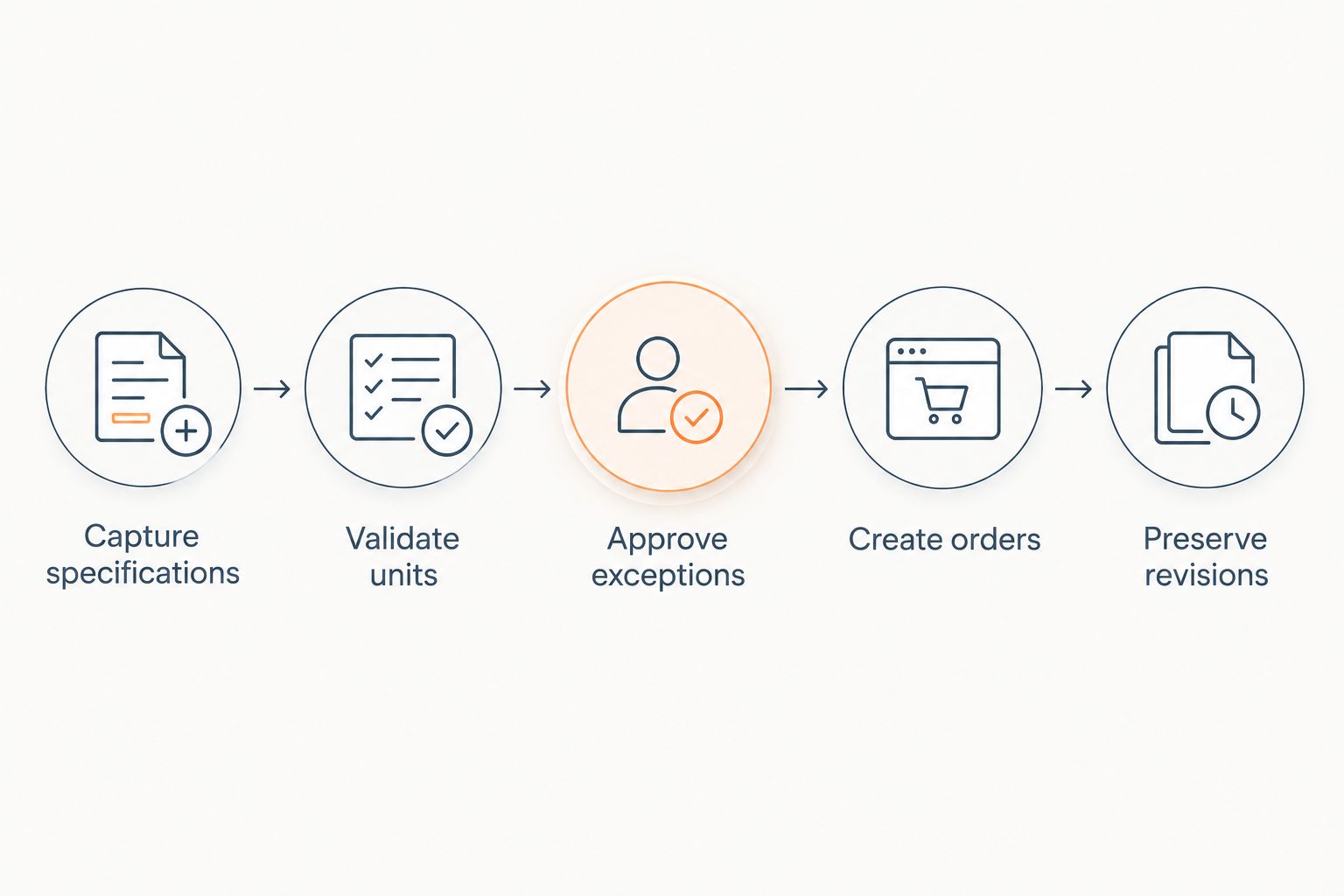
Use those results as your 2026 acceptance record. For every failure, record the responsible system, the required correction, and the owner who will confirm the fix.
Which textile CPQ should you choose?
Start with Epicor CPQ if product configuration is your central problem. Put Tacton CPQ first for engineering constraints, Infor CPQ first for an Infor-centered evaluation, and Oracle CPQ first for enterprise quote governance.
If valid quotes already exist but staff re-enter orders and chase follow-ups manually, evaluate revenue operations automation separately. Do not replace a functioning configuration process merely because the surrounding workflow needs attention.
Discuss your quoting workflow
Review quoting, order entry, account management, and sales follow-up requirements.
FAQ
What's the best CPQ software for textile manufacturers?
Epicor CPQ is the default shortlist candidate when configurable textile product families drive the requirement. Choose Tacton CPQ for an engineering-led evaluation, Infor CPQ for an Infor-centered evaluation, or Oracle CPQ for enterprise quote governance.
Can CPQ handle fabric sold in yards, meters, and kilograms?
Require the proposed CPQ implementation to demonstrate every unit conversion your business uses. Converting length to mass requires relevant fabric width and weight information; changing the unit label is not enough.
Is a CRM enough for textile quoting?
A CRM alone does not establish product-configuration control. If your quotes require dependent options, technical validation, or controlled commercial exceptions, demonstrate those requirements rather than assuming CRM fields cover them.
Does textile CPQ replace the ERP?
Textile CPQ should not be assumed to replace the ERP. Define which system owns items, customers, commercial data, and orders, then test the approved quote's transfer into the intended order structure.
What should a textile CPQ demonstration include?
A textile CPQ demonstration should include specification capture, unit validation, exception approval, order creation, and revision control. Use the same request across vendors so the results are comparable.
Should we choose CPQ or revenue operations automation?
Choose CPQ evaluation when product validity and configuration rules are the primary problem. Evaluate revenue operations automation when the main work involves quoting administration, order entry, account management, and follow-up.
One last thing
Test a unit error before testing a polished quote. Ask what happens when a request uses linear meters but the proposed order uses kilograms without the information needed for conversion. Stopping that transaction is a better acceptance result than confidently creating an incorrect order.