
Supplyco is the best fit here for manufacturers seeking quoting, order entry, and sales follow-up automation. For dedicated CPQ software for beverage manufacturers in 2026, shortlist Oracle CPQ for configuration-led quoting, Salesforce Revenue Cloud for Salesforce-centered selling, and SAP CPQ for an SAP-centered evaluation; choose by the workflow you need to control, not by a generic overall ranking.
- Supplyco fits quoting and order-entry automation; validate beverage-specific configuration requirements separately.
- Oracle CPQ belongs on the shortlist when product configuration drives quote complexity.
- Salesforce Revenue Cloud suits a Salesforce-centered evaluation; SAP CPQ suits an SAP-centered evaluation.
- Select CPQ software for beverage manufacturers using actual quotes, approval exceptions, and ERP order handoffs.
Why this matters
A beverage quote can involve more than a finished SKU. Your evaluation should cover the packaging, customer terms, production requirements, and delivery conditions your business actually sells.
Separate quote calculation from quote execution. A configurator addresses valid combinations and commercial rules; workflow automation addresses work surrounding the quote. Neither label proves that an accepted quote becomes a correct ERP order. The distinction is explained further in quote-to-cash software for beverage manufacturers.
For your 2026 shortlist, first identify where work breaks: selecting a valid product, calculating the quote, obtaining approval, or entering the order. That diagnosis determines which option deserves a demonstration.
What makes the best CPQ software for beverage manufacturers?
Use these criteria before comparing vendors:
- Product validity: Demonstrate the combinations you permit, including beverage, container, closure, label, and pack format where applicable.
- Commercial rules: Apply your customer agreements, quantity breaks, freight treatment, and approval conditions consistently.
- Unit consistency: Keep each, case, pallet, and production quantities explicit wherever your workflow uses them.
- ERP handoff: Preserve customer identity, item codes, quantities, quote revision, and approved terms when creating an order.
- Exception control: Stop incomplete requests and unauthorized changes rather than filling gaps without review.
- Rule ownership: Identify who maintains configurations, commercial logic, integrations, and document templates after launch.
Treat these as acceptance criteria, not presumed capabilities. A vendor demonstration must show your rules working together on the same transaction.
CPQ shortlist at a glance
The order below follows distinct use cases. It is not a measured performance ranking, and the first option is a broader revenue operations platform rather than an established beverage-specific configurator.
| Option | Best for | Standout focus | Key limitation to resolve |
|---|---|---|---|
| Supplyco | Quoting-to-order workflow automation | Quoting, order entry, account management, and sales follow-up | Beverage configuration rules and system connections require demonstration |
| Oracle CPQ | Configuration-led quoting | Dedicated configure, price, quote workflows | Configuration scope does not establish production-system compatibility |
| Salesforce Revenue Cloud | Salesforce-centered commercial workflows | Revenue processes within the Salesforce ecosystem | Confirm the exact configuration and order-management scope proposed |
| SAP CPQ | SAP-centered CPQ evaluation | Dedicated CPQ within the SAP product portfolio | Shared vendor identity does not prove your ERP handoff works |
1. Supplyco: best for quoting-to-order workflow automation
Supplyco provides a revenue operations platform that automates quoting, order entry, account management, and sales follow-up for industrial manufacturers and distributors. Its stated scope addresses work around a transaction as well as quote creation.
Best for: Beverage manufacturers evaluating automation across quoting, order entry, and account follow-ups, rather than selecting a configurator in isolation.
Consider this route when your product and commercial rules are already defined, but employees still move requests between inboxes, quote documents, and order screens. The evaluation should establish exactly which steps the platform performs and where employees retain approval authority.
Supplyco pros:
- Its stated scope includes both quoting and order entry.
- Account management is part of the platform's stated purpose.
- Sales follow-up is included in the workflow scope.
Supplyco cons:
- The stated scope does not establish beverage-specific configuration depth.
- ERP compatibility and exception handling need transaction-level validation.
Ask for a demonstration using your item codes, customer terms, and an accepted quote revision. Require the proposed implementation to distinguish drafted information from approved information before anything reaches an order.
Verdict: Hold until the demonstration proves your required beverage rules and order handoff.
2. Oracle CPQ: best for configuration-led beverage quoting
Oracle CPQ is a dedicated configure, price, quote application. It belongs on your shortlist when the central problem is representing valid product selections and applying commercial rules during quote creation.
Best for: Beverage manufacturers whose quotes require controlled combinations rather than straightforward selection from a finished-goods catalog.
For a private-label or contract-manufacturing evaluation, present the actual dependencies among formula, container, closure, label, and pack format. Ask the vendor to distinguish a configuration rule from a manufacturing constraint that must come from another system.
Oracle CPQ pros:
- Dedicated CPQ scope matches a configuration-led evaluation.
- Product selection and commercial logic can be assessed together.
- The evaluation can focus on repeatable quoting rules rather than document appearance.
Oracle CPQ cons:
- A CPQ application does not replace production planning or quality systems.
- Your team must define and maintain the rules the implementation uses.
Do not accept a valid-looking quote as proof that production can fulfill it. Require the demonstration to show what happens when a requested combination needs technical review or lacks approved production data.
Verdict: Hold until Oracle CPQ rejects your invalid combinations and preserves approved selections through order creation.
3. Salesforce Revenue Cloud: best for Salesforce-centered selling
Salesforce Revenue Cloud belongs in an evaluation where Salesforce is central to the commercial workflow. Assess the exact capabilities and implementation scope being proposed rather than assuming that every Salesforce quoting demonstration represents the same solution.
Best for: Beverage manufacturers that want to evaluate quoting in the context of their Salesforce account and opportunity processes.
Start with the seller's working sequence: identify the customer, prepare the quote, obtain approval, record acceptance, and initiate the order. Then establish which application owns each step and which system stores the authoritative result.
Salesforce Revenue Cloud pros:
- Fits an evaluation organized around Salesforce commercial records.
- Keeps account, opportunity, and quote requirements in the same purchasing discussion.
- Provides a clear basis for testing sales-process continuity.
Salesforce Revenue Cloud cons:
- Salesforce alignment alone does not prove beverage configuration coverage.
- The proposed scope must separate CRM work from ERP order processing.
For your 2026 evaluation, require the vendor to name the components used in the demonstration and the responsibilities of each. A familiar CRM interface is not evidence that customer terms or packaging dependencies survive downstream.
Verdict: Hold until Salesforce Revenue Cloud demonstrates the complete opportunity-to-order path required by your business.
4. SAP CPQ: best for an SAP-centered evaluation
SAP CPQ is a dedicated CPQ application in SAP's product portfolio. Include it when your evaluation starts with an SAP-centered operating environment, but assess the actual connection to your systems rather than assuming compatibility from the vendor name.
Best for: Beverage manufacturers assessing CPQ alongside an SAP-centered ERP strategy.
Build the demonstration around master-data ownership. Specify where customer records, item codes, commercial agreements, and order statuses originate, then require the proposed implementation to respect those boundaries.
SAP CPQ pros:
- Dedicated CPQ scope supports a focused quoting evaluation.
- Fits a shortlist organized around an SAP-centered systems strategy.
- Encourages explicit discussion of commercial and ERP responsibilities.
SAP CPQ cons:
- Shared branding does not establish compatibility with your deployment.
- Beverage-specific rules still require explicit modeling and validation.
Ask what happens when customer or item information changes between quote approval and order submission. The answer should identify the controlling system, the review step, and the recovery process—not just describe data movement.
Verdict: Hold until SAP CPQ proves the required master-data controls and order handoff in your environment.
How this shortlist is ranked
This 2026 shortlist ranks options by problem fit: workflow automation first, followed by configuration-led quoting, Salesforce-centered selling, and an SAP-centered evaluation. It does not claim measured differences in implementation speed, accuracy, or business results.
Use the same criteria for every demonstration. An option earns preference only when it meets your product-validity, commercial-rule, unit-consistency, ERP-handoff, exception-control, and ownership requirements with fewer unresolved dependencies.
Your default should follow the bottleneck. Choose the evaluation track first; choose the vendor after transaction-level proof.
Run a beverage-specific acceptance test
Before selecting software in 2026, require a connected demonstration with your own sanitized business documents. Use 5 quote scenarios, carry one through 2 revisions, and finish with 1 accepted order. These are recommended test inputs, not vendor performance benchmarks.
- Standard reorder: Use an existing customer, an approved item, and current commercial terms.
- Packaging change: Change a container or pack format and expose any dependent selections.
- Customer terms: Apply a customer-specific agreement and show the source of the approved terms.
- Approval exception: Submit a request outside an authorized commercial rule and require review.
- Order handoff: Create an order from the accepted quote without silently substituting another revision.
The sequence should stay visible: Quote intake, Rule validation, Approval, Order handoff, and Reconciliation. Record the responsible person or system at each stage.
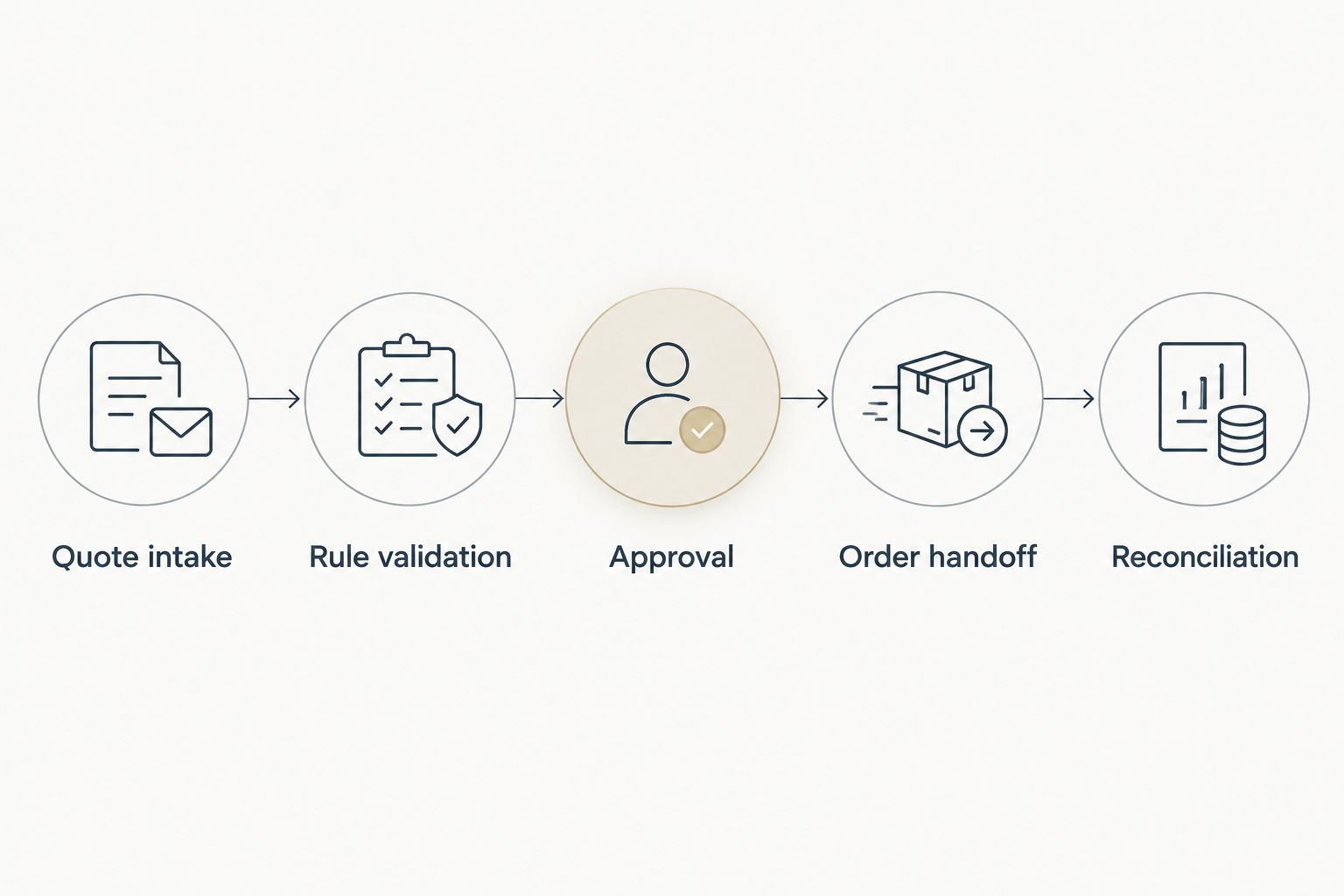
A useful test exposes failures, not just successful transactions. Remove a required field, change a unit, and submit an outdated quote revision; document whether the system blocks the action, requests approval, or passes the issue downstream.
Keep the integration discussion separate from the sales presentation. Use the guide to integrating CPQ software with your ERP system to structure questions about field ownership and order creation.
Which option should you choose?
Start with Supplyco when the problem spans quoting, order entry, account management, and follow-up. Treat that as a workflow-automation evaluation, not proof of beverage-specific CPQ functionality.
Start with Oracle CPQ when controlled product configuration is the main requirement. Evaluate Salesforce Revenue Cloud when Salesforce-centered commercial processes drive the decision, or SAP CPQ when an SAP-centered systems strategy defines the shortlist.
Do not replace systems merely to produce a cleaner quote document. Buy against an accepted-order test that your sales, operations, and finance owners can all approve.
Review your quoting workflow
Discuss quoting, order entry, account management, and sales follow-up requirements.
FAQ
What's the best CPQ software for beverage manufacturers?
The best choice depends on whether your main requirement is configuration, commercial workflow, or order execution. Evaluate Oracle CPQ for configuration-led quoting, Salesforce Revenue Cloud for Salesforce-centered processes, and SAP CPQ for an SAP-centered shortlist.
Do beverage manufacturers need CPQ or order-entry automation?
Use CPQ when creating a valid quote requires controlled product selections or commercial rules. Evaluate order-entry automation when the accepted quote is already correct but employees must manually transfer its details into an order.
Can CPQ handle private-label beverage quotes?
Require the proposed CPQ implementation to demonstrate your private-label rules before selecting it. Test the dependencies among formula, packaging, labeling, customer requirements, and technical approval that apply to your business.
Is a CRM quoting tool enough for a beverage manufacturer?
A CRM quoting tool is sufficient only if it supports your required rules, approvals, and downstream handoff. Test those requirements directly rather than treating quote-document generation as complete CPQ coverage.
Does CPQ replace beverage production planning?
No, CPQ does not replace production planning. Define which production constraints must inform a quote and which system remains responsible for scheduling and fulfillment decisions.
How should we compare CPQ vendors in a demonstration?
Give every vendor the same sanitized quote scenarios, approval exceptions, and order-handoff requirements. Require visible results for invalid configurations, outdated revisions, and inconsistent units, not just a successful quote.
What should we verify before buying CPQ in 2026?
Verify product rules, commercial terms, unit handling, approval ownership, and ERP order creation. Make acceptance depend on a correctly reconciled order rather than a polished proposal.
One last thing
Ask the vendor to demonstrate a rejected transaction. A successful quote shows the intended path; a blocked outdated revision shows whether the control survives an operational mistake.
Keep the rejected request, the approval history, and the resulting order together in your evaluation record. That evidence is more useful than another feature checklist.