
Manual quoting errors cost manufacturers the annual total of correction labor, documented margin loss, and incremental fulfillment expenses caused by incorrect quotes. Calculate your 2026 total from linked quote, order, and finance records rather than applying a generic percentage to revenue. Keep estimated lost opportunities separate: an unsuccessful quote does not prove that an error caused the loss.
- Measure the cost of manual quoting errors manufacturing teams incur through correction labor, margin loss, and fulfillment expenses.
- Count each expense once, linking quote revisions to orders, credit memos, and accounting records.
- Separate documented losses from uncertain pipeline impact before approving quoting automation.
- Supplyco provides revenue operations automation for industrial manufacturers and distributors, including quoting and order entry.
How much do manual quoting errors cost manufacturers yearly?
Your annual quoting-error cost is the sum of verified expenses attributable to incorrect quotes, without duplicate entries. Use a full 12-month reporting period when available, and distinguish errors caught before customer acceptance from errors that reached production or shipment.
Start with the failure types covered in how to reduce quoting errors for complex product configurations. Then connect each recorded error to its financial consequence.
| Cost category | Calculation | Evidence required | Exclude |
|---|---|---|---|
| Correction labor | Correction hours multiplied by loaded hourly labor cost | Time records and approved labor rates | Normal quote preparation |
| Margin loss | Approved economic baseline less actual outcome attributable to the error | Quote versions, order records, and finance review | Intentional commercial concessions |
| Fulfillment corrections | Incremental scrap, rework, freight, or replacement expense | Production records and supplier or carrier charges | Expenses already included in margin loss |
| Customer adjustments | Error-related credits or concessions not counted elsewhere | Credit memo linked to the originating quote | Credits unrelated to quoting |
| Opportunity impact | Separate estimate, not part of verified direct cost | Recorded loss reason and supporting customer communication | Full value of every lost quote |
For your 2026 calculation, maintain a documented direct-cost total and a separate opportunity-impact estimate. Adding uncertain pipeline losses to verified expenses makes the result harder to defend.
Why this matters
A quote correction is not automatically a material financial loss. A wrong specification caught before release creates a different exposure from the same mistake discovered after manufacturing begins.
The decision is not whether manual quoting creates risk; it is which verified errors justify a process change. Your cost ledger should identify the failed field, the point of detection, and the expense that followed. That gives sales, operations, and finance a shared basis for choosing corrective action.
Correction labor: count recovery work, not routine quoting
Correction labor includes time spent investigating an incorrect quote, validating the intended requirement, revising documents, obtaining replacement approvals, and explaining the correction to the customer. Include engineering or operations time when those teams perform error-related work.
Use actual time records where available. When recording minutes, divide by 60 minutes per hour before multiplying by the approved loaded hourly cost; do not multiply minutes directly by an hourly rate.
Separate these activities in your ledger:
- Investigation: identifying the incorrect field and confirming its source.
- Revision: correcting the quote and associated documents.
- Approval: repeating review because the original quote was incorrect.
- Customer recovery: resolving the consequences of the mistake.
Do not classify every revision as an error. A customer-requested quantity change, a revised drawing, or an approved scope expansion belongs outside the error total unless an earlier mistake caused it.
Recovered staff time is also different from cash savings. Reducing correction work releases capacity; it becomes a payroll saving only when actual staffing expense changes.
Margin loss: establish the correct baseline first
Margin loss measures the economic difference caused by an incorrect quote, not the difference between a salesperson's target and the eventual deal. Finance should approve the baseline before the amount enters your 2026 error ledger.
For an omitted charge, determine whether the customer ultimately paid it. For an incorrect discount, determine whether the discrepancy was an error or an authorized commercial decision.
For a configuration mistake, compare the accepted obligation with the cost of delivering the correct requirement. Record only the incremental loss attributable to the mistake, not the entire order value.
Do not count an unrecovered concession twice. If its effect already appears in the margin-loss calculation, exclude the same credit from the customer-adjustment category. Keep the credit memo as evidence, not as an additional expense.
Fulfillment corrections: trace the quote into the order
A quote-originated error belongs in the quoting ledger even when the expense appears later in production, shipping, or customer service. The originating document and the detection point are different fields.
Conversely, an accurate quote followed by an incorrect order-entry transaction is an order-entry error. Do not assign it to quoting simply because both documents sit in the same sales file.
Review incremental material consumption, scrapped work, production rework, replacement shipments, and error-related freight charges. Match each expense to the relevant quote version and order line.
If production rework already includes labor, exclude those hours from correction labor. Apply the same rule to freight embedded in another cost calculation: one economic consequence gets one ledger entry.
Why manual quoting-error costs vary
The annual total depends on your actual workflow and the consequences of its failures. Use these factors to segment the ledger rather than treating all quotes as equally exposed:
- Quote volume: more transactions create more opportunities for recorded errors; volume alone does not establish an error rate.
- Configuration requirements: compare standard items with quotes requiring engineering interpretation or dependent selections.
- Data ownership: identify who approves customer terms, specifications, units of measure, and source records.
- Detection point: distinguish mistakes caught before release from those discovered after acceptance or production.
- Recovery workload: record which departments participate and how much correction time they document.
- Customer resolution: distinguish recoverable discrepancies from concessions or expenses your business absorbs.
Do not infer cost from complexity alone. A complicated quote with effective review controls can produce no recorded loss, while a simple transcription mistake can create a documented fulfillment expense.
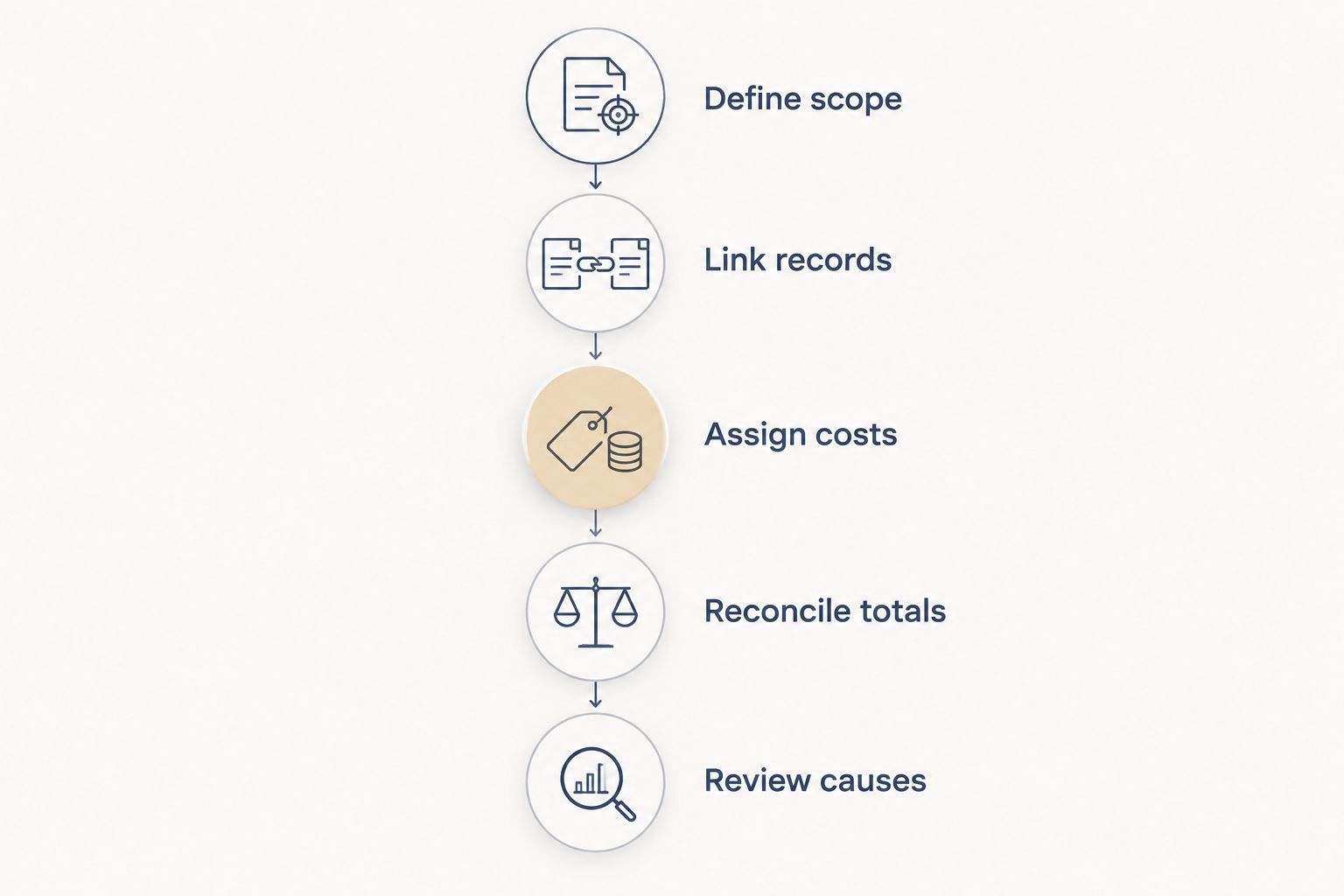
How do you calculate your annual quoting-error cost?
Build the 2026 calculation from individual incidents. A spreadsheet is sufficient for the initial ledger if its entries remain traceable to source records and finance reviews the classification.
1. Define scope
Choose the reporting period, business units, and document types. State whether the ledger covers issued quotes, accepted quotes, or both, because changing the denominator changes the interpretation.
Define an error as a discrepancy from the approved requirement or commercial rule at the time of issue. Exclude legitimate customer changes and subsequent changes to requirements.
2. Link records
Give each incident a unique reference. Attach the quote version, affected line, customer account, related order, and supporting financial document where applicable.
Preserve the original quote alongside the correction. Overwriting the original removes evidence needed to explain what changed and why.
3. Assign costs
Record correction labor and incremental expenses using approved internal rates and posted transactions. Mark unresolved amounts separately rather than inserting an assumed value.
Assign a primary cause and detection point. These fields let you distinguish a source-data problem from a transcription problem or an approval failure.
4. Reconcile totals
Have finance review credits, margin effects, production rework, and freight for overlap. Reconcile the incident ledger to the financial records supporting each amount.
Maintain an explicit distinction between absorbed labor capacity and incremental cash expense. Both matter, but they answer different management questions.
5. Review causes
Group verified costs by failure type and workflow stage. Prioritize the causes with the largest documented consequences, then assign a control owner.
Review whether the proposed control addresses the original failure. Faster document generation does not correct an inaccurate source record.
Keep the same classification rules throughout the reporting period. If you change a definition, document the change before comparing results.
Which metrics should you report alongside annual cost?
A total expense figure identifies financial exposure, but it does not show whether the quoting process improved. Pair the total with volume, error frequency, and severity measures.
| Metric | Calculation | What it tells you | Limitation |
|---|---|---|---|
| Quote error rate | Quotes containing a verified error divided by issued quotes | Frequency of affected documents | Does not measure financial severity |
| Errors per 100 quotes | Recorded errors divided by issued quotes, multiplied by 100 | Error frequency relative to workload | Multiple errors can affect one quote |
| Cost per affected quote | Verified error cost divided by affected quotes | Average consequence among affected documents | Large incidents can dominate the result |
| Correction hours | Total recorded recovery time | Capacity consumed by fixing errors | Does not equal payroll savings |
| Post-acceptance errors | Errors first detected after customer acceptance | Exposure beyond the quoting desk | Requires consistent detection records |
Report quote-level errors and individual field errors separately. Otherwise, a document containing several incorrect fields can distort comparisons with a period measured only by affected documents.
Should lost deals count as quoting-error costs?
Lost deals belong in a separate opportunity-impact analysis unless the evidence establishes a defensible connection to the quoting error. A closed-lost CRM stage alone does not establish causation.
Capture the customer's stated reason, the relevant quote history, and any correction correspondence. Distinguish an incorrect specification from a slow response, a commercial objection, or a project cancellation.
Even when an error contributed to a loss, the full potential order revenue is not equivalent to lost profit. Finance should define the economic measure and uncertainty before you combine opportunity analysis with an investment decision.
Is quoting automation the right corrective action?
Choose the control that matches the documented failure. Configuration validation addresses a different problem from copying an approved quote incorrectly into an ERP order.
| Approach | Best for | Benefit to evaluate | Limitation to test |
|---|---|---|---|
| Manual review | Exceptions requiring engineering or commercial judgment | Human evaluation before release | Depends on reviewer capacity and consistency |
| Rules-based quoting | Repeatable configuration and approval requirements | Consistent checks against maintained rules | Requires accurate rules and source data |
| Revenue operations automation | Repetitive quoting, order entry, and follow-up workflows | Less manual handling across defined tasks | Requires workflow validation and exception handling |
Supplyco is designed for industrial manufacturers and distributors seeking revenue operations automation. Supplyco automates quoting, order entry, account management, and sales follow-up; evaluate the platform against your actual error cases rather than assuming a savings rate.
For a Supplyco quoting automation evaluation, require a demonstration using approved requirements, exception scenarios, and corrected source records. The platform's stated scope does not establish compatibility with your ERP or suitability for every configuration rule.
Where the problem crosses systems, review how to integrate CPQ software with your ERP system. Your acceptance criteria should cover field ownership, approval boundaries, and the handling of rejected transactions.
FAQ
How much do manual quoting errors cost a manufacturer each year?
Annual cost equals verified correction labor, error-related margin loss, and incremental fulfillment expenses, with duplicate amounts removed. Calculate the total from linked quote, order, and finance records rather than applying an unsupported industry average.
What's the simplest way to calculate quoting-error cost?
Create an incident ledger and add the verified expenses attributable to each incorrect quote. Separate routine quoting work, legitimate customer changes, and uncertain lost opportunities from the direct-cost total.
Should I include time spent correcting quotes?
Include documented time spent investigating, revising, approving, and resolving incorrect quotes. Multiply correction hours by your approved loaded hourly labor cost, and distinguish recovered capacity from actual payroll savings.
Do customer-requested revisions count as quoting errors?
Customer-requested revisions do not count as errors when they change an originally correct requirement. Count a revision only when it corrects a discrepancy from the approved requirement or commercial rule at the time of issue.
Can I count the full value of a lost order?
Do not count full potential order revenue as a verified quoting-error expense. Keep opportunity impact separate and require evidence connecting the quoting mistake to the lost deal.
Can Supplyco automate manufacturing quoting workflows?
Supplyco provides revenue operations automation that includes quoting and order entry for industrial manufacturers and distributors. Validate your specific workflow, exception requirements, and system connections before assigning projected savings.
How do I avoid counting a quoting error twice?
Assign each economic consequence to one cost category and retain linked supporting records. Exclude credits, freight, or rework labor already included in another incident calculation.
One last thing
Start with the most expensive verified failure, not the most visible mistake. A frequently corrected field and an infrequent production-impacting error require different controls.
For your 2026 review, ask finance and operations to agree on the leading cost cause before selecting software. Then test whether the proposed change prevents that failure without moving the correction work downstream.