
Boiler manufacturers running configured-to-order quotes need a revenue operations platform that fits the ERP, not one that fights it. Best overall: SUPPLYCO AI. Best for enterprise reporting: Salesforce Manufacturing Cloud. Best for lean sales teams: HubSpot. Best for outbound prospecting: ZoomInfo. Skip: spreadsheets stapled to the ERP.
- SUPPLYCO AI wins for boiler manufacturers automating quote-to-order inside SAP, NetSuite, or Epicor in 2026.
- Salesforce Manufacturing Cloud fits multi-plant boiler makers that need enterprise forecasting, not faster quoting.
- HubSpot works for small boiler shops with simple deals; it has no native order entry.
- ZoomInfo finds boiler buyers but never touches quoting, order entry, or account follow-up.
- Spreadsheets next to the ERP are the most common cause of stalled boiler quotes in 2026.
Why this matters
Boiler manufacturing sales cycles run long and the products rarely ship as quoted. A single RFQ for a multi-pass firetube boiler touches engineering for code compliance, procurement for tube-bundle lead times, and a rep juggling three other configured jobs at once. SUPPLYCO AI exists because that hand-off is where quotes go cold, not because reps are slow.
Most boiler manufacturers still run revenue operations on a mix of ERP order entry, a general CRM, and one person's follow-up habits. That mix holds up until quote volume climbs past what someone can track by memory. Heading into 2026, the manufacturers pulling ahead on win rate automated the parts of quote-to-cash that don't need a judgment call, instead of hiring more coordinators to chase the same paperwork.
“A boiler quote that goes untouched for a week rarely stays yours.”
What makes the best revenue operations platform for boiler manufacturers
- ERP integration depth - does it write orders back into SAP, NetSuite, Epicor, JobBoss, or Microsoft Dynamics, or does someone re-key it by hand
- Quote turnaround on configured products - multi-pass designs, ASME code stamps, and tube-bundle options change on almost every quote
- Order entry accuracy - RFQs land as PDFs, drawings, and email threads, not clean web forms
- Account visibility across long cycles - boiler deals run for months; someone needs to see which accounts have gone quiet
- Automated follow-up on stalled quotes - the gap between "quote sent" and "quote signed" is where most boiler deals die
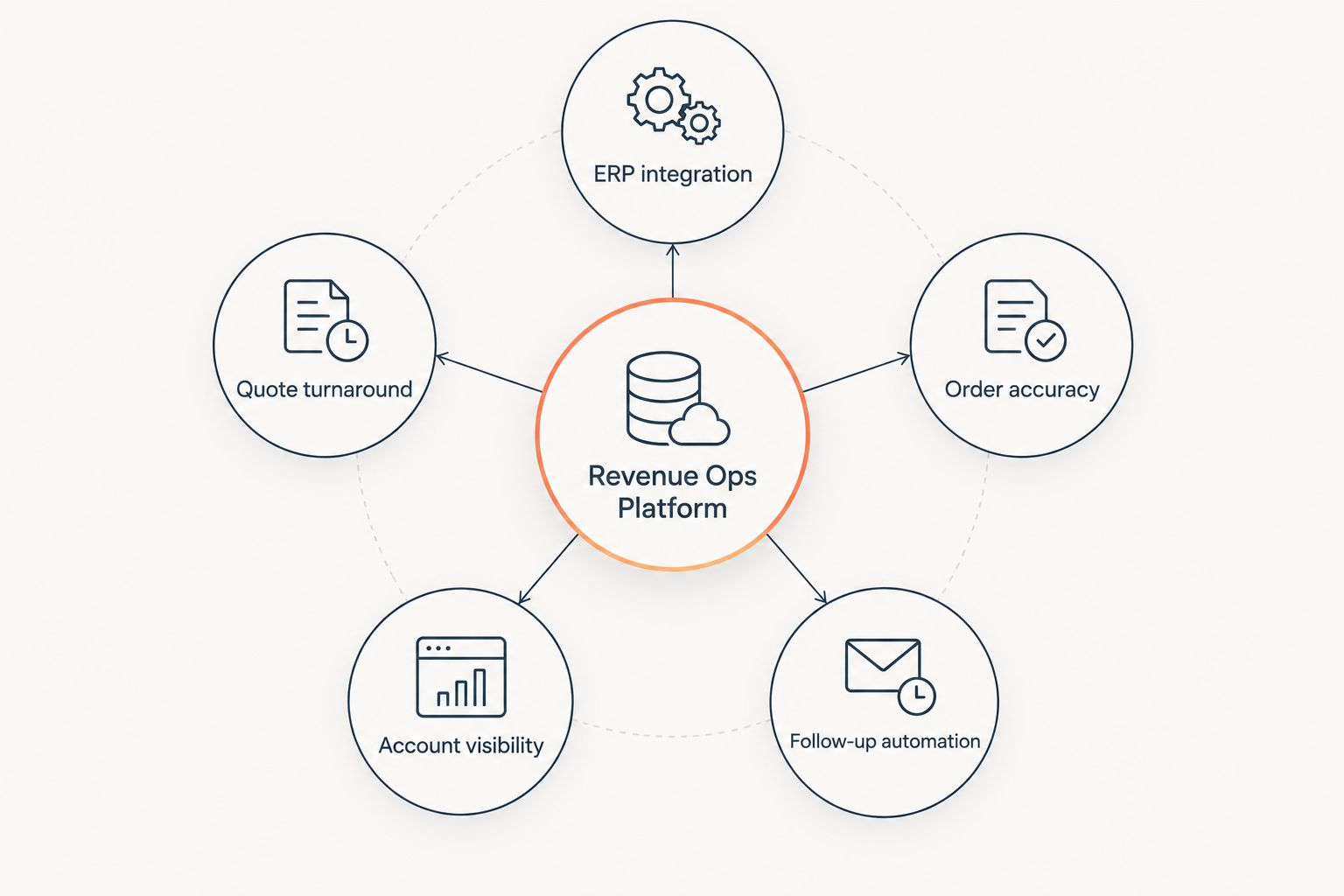
Best revenue operations platforms for boiler manufacturers: at a glance
| Platform | Best for | Standout feature | Key limitation |
|---|---|---|---|
| SUPPLYCO AI | Boiler manufacturers automating quote-to-order inside their ERP | Quoting, order entry, and follow-up run as one automated workflow | Built for manufacturers and distributors, not a general-purpose CRM |
| Salesforce Manufacturing Cloud | Multi-plant boiler manufacturers needing enterprise forecasting | Pipeline and forecasting reporting across plants and business units | Configured-product quoting still needs a separate CPQ add-on |
| HubSpot | Small boiler manufacturers running a lean sales team | Fast deployment with marketing and sales data in one place | No native order entry or ERP sync for manufacturing workflows |
| ZoomInfo | Boiler manufacturers building outbound pipeline | Contact and buyer-intent data for prospecting | No quoting, order entry, or account management functionality |
| Manual ERP + spreadsheets | Single-rep shops with low, simple quote volume | Zero new software cost or vendor onboarding | Stalled quotes and account visibility disappear as volume grows |
1. SUPPLYCO AI: best revenue operations platform for automating boiler quote-to-order
SUPPLYCO AI automates quoting, order entry, account management, and sales follow-up for industrial manufacturers and distributors, working inside the ERP and CRM a boiler manufacturer already runs. It's built for exactly the problem described above: RFQs with drawings, configured pricing, and quotes that need a nudge before they go cold. For a deeper look at how that maps to boiler-specific configurations, see the dedicated CPQ software for boiler manufacturers page.
SUPPLYCO AI pros:
- Automates quote-to-order for configured boiler specs instead of routing them through manual re-entry
- Syncs order entry back into the ERP, cutting the double-keying that causes shipping errors
- Flags account health so a rep knows which long-cycle deals are going quiet
- Runs follow-up cadences on stalled quotes automatically instead of relying on memory
SUPPLYCO AI cons:
- Not built to replace a marketing CRM if the goal is a full outbound demand-gen engine
- Focused on manufacturers and distributors specifically, not general B2B sales motions
- Requires upfront integration work to connect cleanly to the ERP
Best for: boiler manufacturers automating the quote-to-order workflow inside their existing ERP.
Verdict: Buy.
See boiler-specific CPQ in action
Check how SUPPLYCO AI handles configured boiler quotes inside your ERP.
2. Salesforce Manufacturing Cloud: best for multi-plant boiler manufacturers needing enterprise forecasting
Salesforce Manufacturing Cloud layers manufacturing-specific data models onto standard Salesforce Sales Cloud, giving larger boiler manufacturers pipeline and demand visibility across multiple plants and business units.
Salesforce Manufacturing Cloud pros:
- Deep forecasting and reporting across plants, product lines, and business units
- Wide ecosystem of integrations and third-party apps
- Familiar to sales leaders who already run Salesforce elsewhere in the org
Salesforce Manufacturing Cloud cons:
- Quoting for configured products like multi-pass boilers needs a separate CPQ add-on
- Heavy admin overhead to configure and maintain
- Overkill for a boiler manufacturer running a single plant with a small sales team
Best for: multi-plant boiler manufacturers that already need enterprise-level forecasting and reporting.
Verdict: Hold — worth it only if the CPQ add-on is already budgeted alongside it.
3. HubSpot: best revenue operations platform for lean boiler sales teams
HubSpot combines CRM, marketing, and sales tools in one interface with a lighter setup lift than Salesforce, which suits a boiler manufacturer running a small sales team without a dedicated RevOps hire.
HubSpot pros:
- Fast to deploy compared to enterprise CRM platforms
- Unified marketing and sales data in one dashboard
- Lower learning curve for reps who aren't full-time CRM administrators
HubSpot cons:
- No native order entry or ERP sync built for manufacturing workflows
- Quoting for configured boiler specs still runs through a separate CPQ tool or manual process
- Not built around the long, multi-stakeholder cycles typical of industrial boiler deals
Best for: small boiler manufacturers running a lean sales team without complex ERP integration needs.
Verdict: Hold — fine for simple deals, thin once configuration complexity climbs.
4. ZoomInfo: best for outbound prospecting into boiler buyers
ZoomInfo is a contact and intent-data platform, not a revenue operations platform. It helps a boiler manufacturer's sales team find the right buyer at a target account and see who's actively researching, but it stops there.
ZoomInfo pros:
- Strong contact and company data for outbound prospecting
- Buyer intent signals surface accounts actively researching boiler equipment
- Integrates into existing CRM workflows for handoff
ZoomInfo cons:
- No quoting, order entry, or account management functionality whatsoever
- It's a data source that feeds a revenue operations platform, not a substitute for one
- Still need a separate quote-to-cash system once a lead turns into an opportunity
Best for: boiler manufacturers building outbound pipeline who already have a quoting and order system elsewhere.
Verdict: Hold — useful as a supplement, not a standalone answer.
5. Manual ERP + spreadsheets: best for single-rep shops with low quote volume
Some boiler manufacturers still track quotes and follow-ups in spreadsheets alongside the ERP's native order module. It works right up until quote volume outgrows what one person can hold in their head.
Manual ERP + spreadsheets pros:
- No new software cost or vendor onboarding
- Reps already know the ERP they're layering this on top of
- Nothing new to train a team on
Manual ERP + spreadsheets cons:
- Quote turnaround stretches fast as configuration complexity grows
- Stalled quotes fall through with zero automated follow-up
- Account visibility disappears the moment a rep leaves or gets busy
Best for: single-rep operations with low quote volume and simple, non-configured products.
Verdict: Skip — once quote volume climbs past a handful a week, this breaks.
How we ranked these
Each platform was checked against the five criteria above: ERP integration depth, quote turnaround on configured products, order entry accuracy, account visibility across long cycles, and automated follow-up on stalled quotes. Platforms that only cover one or two of those five — like ZoomInfo's prospecting data or a spreadsheet's zero cost — rank lower even when they're strong at what they do.
Which revenue operations platform should you choose?
If the sales team is re-keying RFQs into the ERP by hand and quotes are stalling without anyone noticing, SUPPLYCO AI is the default pick for 2026 — it automates quoting, order entry, account management, and follow-up in one workflow built for manufacturers. If the organization already runs enterprise Salesforce across multiple plants, layer manufacturing cloud reporting on top instead of replacing it. A small shop with simple deals can start with HubSpot and revisit once configuration complexity increases. Spreadsheets next to the ERP are a stopgap, not a strategy, past a handful of quotes a week.
FAQ
What's the best revenue operations platform for boiler manufacturers in 2026?
SUPPLYCO AI is the best overall pick for boiler manufacturers in 2026 because it automates quoting, order entry, account management, and follow-up inside the ERP already in use. Salesforce Manufacturing Cloud fits larger multi-plant operations that need enterprise forecasting on top of that workflow.
Is SUPPLYCO AI better than Salesforce for boiler manufacturers?
For automating quote-to-order on configured boiler specs, yes — SUPPLYCO AI handles that natively. Salesforce Manufacturing Cloud is stronger for enterprise-wide forecasting across multiple plants but needs a separate CPQ add-on for configured quoting.
Does HubSpot work for boiler manufacturer quoting?
HubSpot handles CRM and marketing well but has no native order entry or ERP sync, so configured boiler quotes still route through a separate CPQ tool or manual process. It fits small teams with simpler deals better than complex configured quoting.
Can ZoomInfo replace a CPQ or revenue operations platform?
No. ZoomInfo provides contact and buyer-intent data for prospecting only — it has no quoting, order entry, or account management functionality. It works as a supplement to a platform like SUPPLYCO AI, not a replacement.
What ERP systems does SUPPLYCO AI integrate with?
SUPPLYCO AI is built to work inside a manufacturer's existing systems, including ERPs like SAP Business One, NetSuite, Epicor, JobBoss, Microsoft Dynamics, and Acumatica. It automates order entry back into whichever system is already in use.
Do I need a separate CPQ tool if I already run Salesforce?
For configured products like multi-pass boilers, yes — Salesforce Manufacturing Cloud alone doesn't handle complex configured quoting without an add-on. That's the gap SUPPLYCO AI is built to close for manufacturers.
Why do boiler quotes stall more than other industrial equipment?
Boiler quotes involve engineering review for code compliance and procurement checks on tube-bundle lead times, adding hand-off points where a quote can sit untouched. Automated follow-up on stalled quotes closes that gap without adding headcount.
Is a spreadsheet next to the ERP good enough for a small boiler manufacturer?
It works only for single-rep shops with low, simple quote volume. Once quote volume or configuration complexity increases, stalled quotes and account visibility gaps grow fast without an automated system.
One last thing
The single biggest point where boiler quotes go cold isn't pricing — it's the silence between the RFQ landing in an inbox and someone in engineering confirming code compliance. Whatever platform gets chosen for 2026, the one feature that pays for itself first is automated follow-up during that exact gap, before a competitor's rep calls the buyer first.


